
How to train for a Swiss Alps hiking week from the flatlands
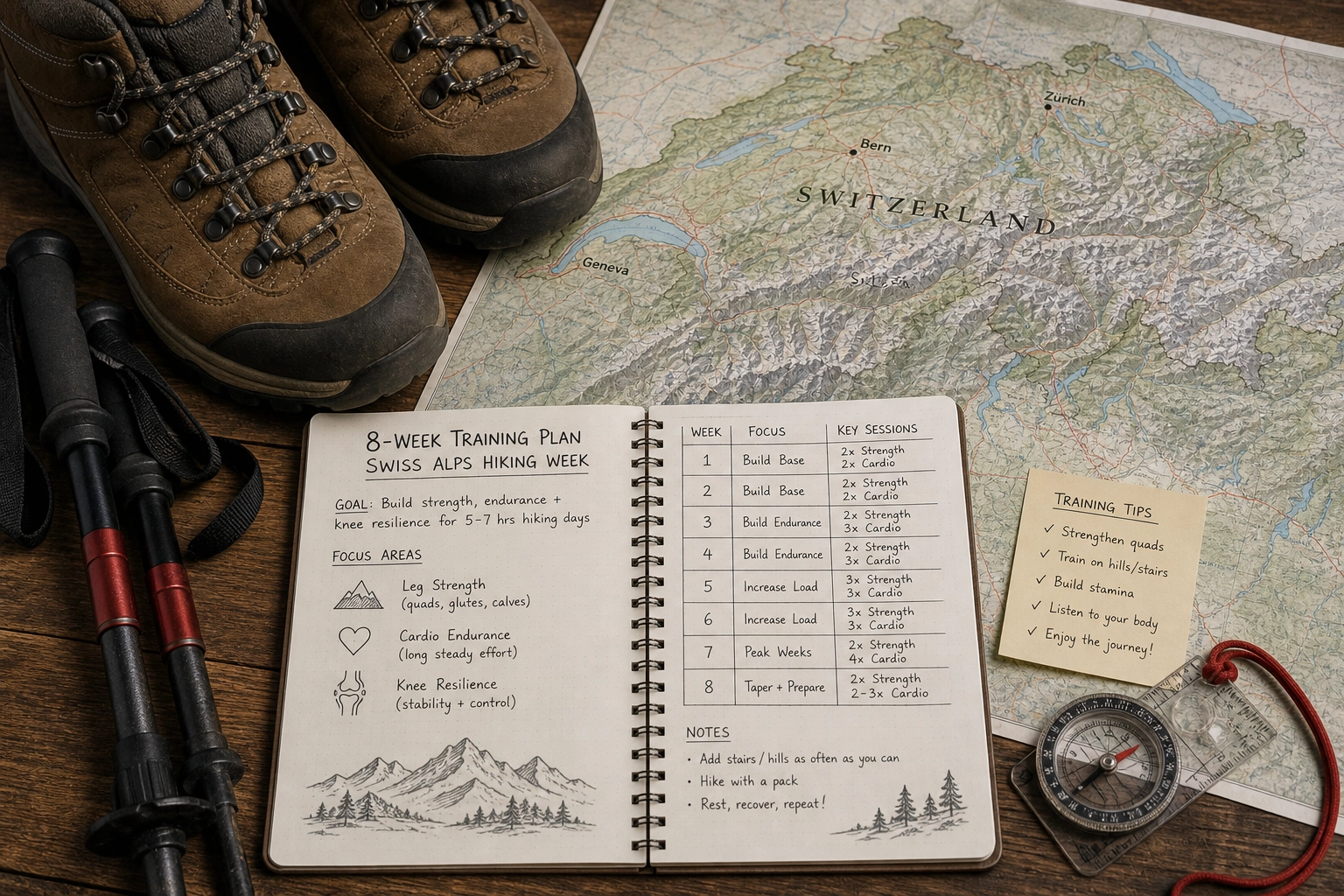
Preparing for a week of alpine trekking when your daily commute is completely flat presents a distinct physical challenge. Walking 15,000 steps across asphalt in London, Amsterdam, Chicago, or Berlin builds basic cardiovascular stamina, but it leaves your quads, knees, and stabilizer muscles utterly unprepared for a 1,000-meter vertical descent over loose alpine granite.
When travelers ask how fit they need to be for a guided hiking week in Switzerland, they often focus on cardiovascular lung capacity. While cardio matters, the primary physical filter on Swiss trails is eccentric muscle strength and back-to-back day endurance. You do not need to be an elite trail runner or high-altitude mountaineer to enjoy a guided week in the Valais or Bernese Oberland. You do, however, need targeted physical preparation that specifically mimics mountain incline and braking force when you have zero real hills nearby.
This guide breaks down the precise physical demands of a summer hiking week in Switzerland and details a practical, 8-week flatland training protocol designed to get you alpine-ready.
Real-World Benchmark: What a Guided Swiss Hiking Week Demands
Most guided group trips in Switzerland—such as those centered around basecamp lodges in Liddes or St. Stephan—are structured around daily loop or point-to-point day hikes. Because your heavy luggage remains at the hostel or lodge, you only carry a daypack containing extra layers, water, snacks, and waterproof gear.
Despite carrying a light load, mountain terrain places unique demands on the body that flat ground cannot replicate. Here is what a typical day looks like on moderate-to-challenging Swiss trails:
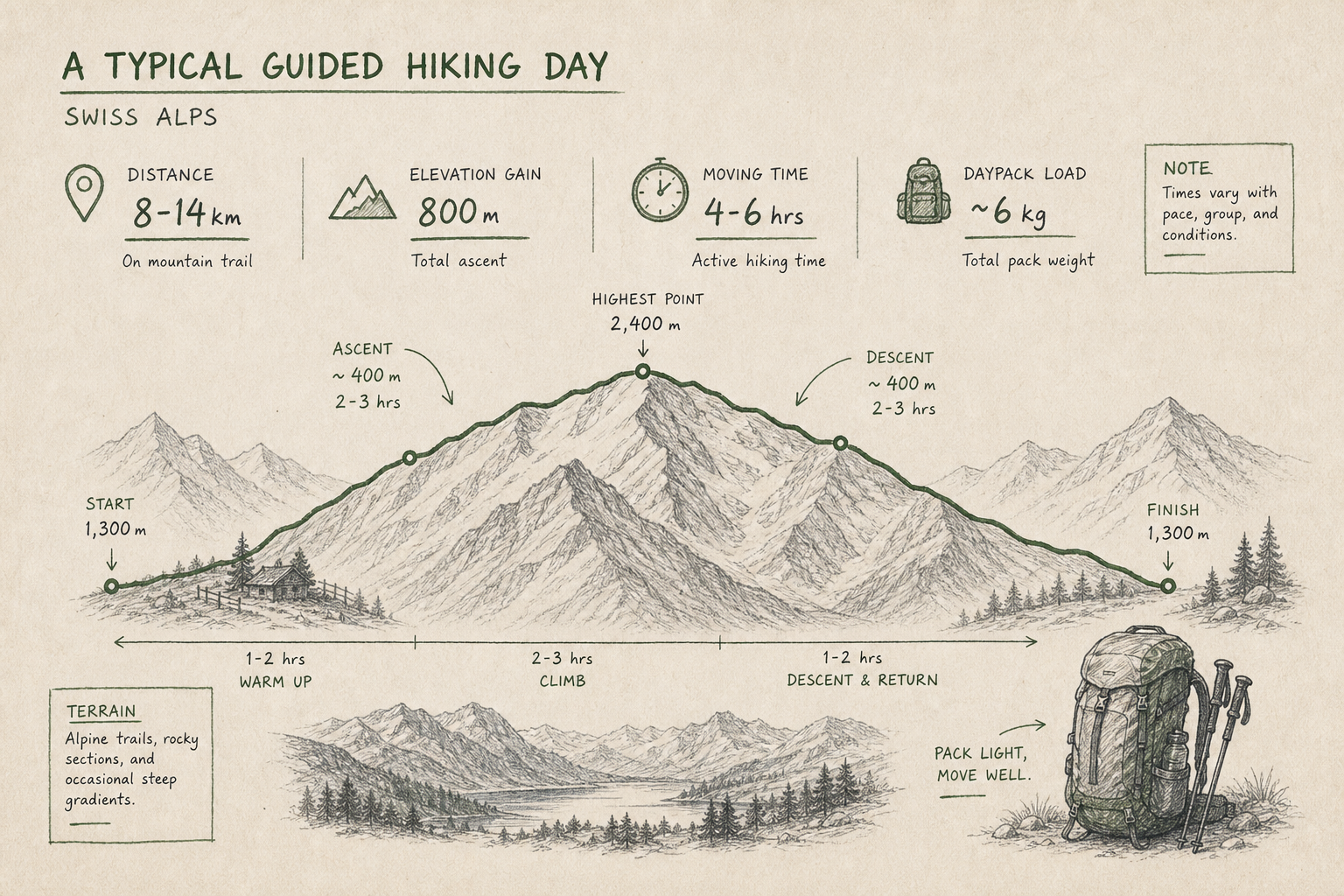
- Daily Distance: 8 to 14 kilometers (5 to 9 miles) per day.
- Elevation Gain & Loss: 600 to 1,000 meters (2,000 to 3,300 feet) of ascent AND descent daily.
- Active Moving Time: 4 to 6 hours of continuous trail time, moving at a steady, conversational pace.
- Pack Weight: 5 to 7 kilograms (11 to 15 lbs) daypack.
- Terrain: Rocky singletrack, exposed switchbacks, timber staircases, scree, and occasional snow patches.
- Elevation Range: Trailheads typically sit between 1,000m and 1,400m, with passes and ridges reaching between 2,000m and 2,800m.
At these elevations, acute mountain sickness is rare because you descend to valley accommodation every night. However, the thinner air at 2,500 meters increases your heart rate by roughly 10% to 15% for the same physical output compared to sea level. According to discussions among alpine guides and park experts, high-elevation hiking in the Swiss Alps rarely poses serious altitude danger for standard trail routes, but it definitely intensifies perceived exertion during steep climbs (Tips for high elevation hiking in the Swiss Alps).
If you want to understand how group dynamics function on these routes, explore our breakdown of guided hiking in switzerland to see how daily itineraries are paced.
| Hiking Fitness Metric | Moderate Guided Week | Challenging Guided Week | Flatland City Benchmark |
|---|---|---|---|
| Daily Elevation Gain | 500m – 800m | 900m – 1,300m | 10–15 flights of stairs |
| Daily Distance | 8 km – 11 km | 12 km – 18 km | 10,000 – 12,000 flat steps |
| Steep Descent Impact | Moderate quad fatigue | Severe knee & quad strain | Zero equivalent in city walking |
| Moving Time | 3.5 – 5 hours | 5.5 – 7.5 hours | 1.5 hours casual walking |
| Required Base | Zone 2 cardio + basic legs | Strong eccentric quads + core | Basic cardiovascular fitness |
The Flatland Dilemma: Concentric vs. Eccentric Fatigue
The biggest mistake flatland hikers make is relying solely on running, cycling, or flat urban walking for training. These activities build cardiovascular fitness and concentric leg power (concentric contractions occur when muscles shorten under tension, such as pushing down on a bicycle pedal or pushing off the ground during a run).
When climbing an alpine trail, your quadriceps and glutes work concentrically to lift your body weight against gravity. This taxes your heart and lungs. When you turn around and walk down 1,000 meters of steep, rocky switchbacks, your muscles switch to eccentric contractions. Eccentric contractions occur when muscles lengthen under load as they act as brakes to stop you from accelerating downhill.
Eccentric loading causes microscopic tears in muscle fibers at a far higher rate than concentric exercise. This is why flatlanders who feel energetic during a morning climb often find their legs trembling uncontrollably during an afternoon descent. By day three of a hiking holiday, unconditioned quadriceps become severely inflamed, leading to DOMS (delayed onset muscle soreness) and patellofemoral knee pain.
To prepare effectively in flat terrain, training must prioritize eccentric muscle loading alongside cardiorespiratory building blocks, as highlighted in endurance frameworks from outdoor conditioning specialists (Training for the Alps in the Flatlands).
The 8-Week Flatland-to-Alps Training Framework
If you have two months before your trip, this structured 8-week plan systematically builds the strength, joint stability, and aerobic stamina required for mountain trails.
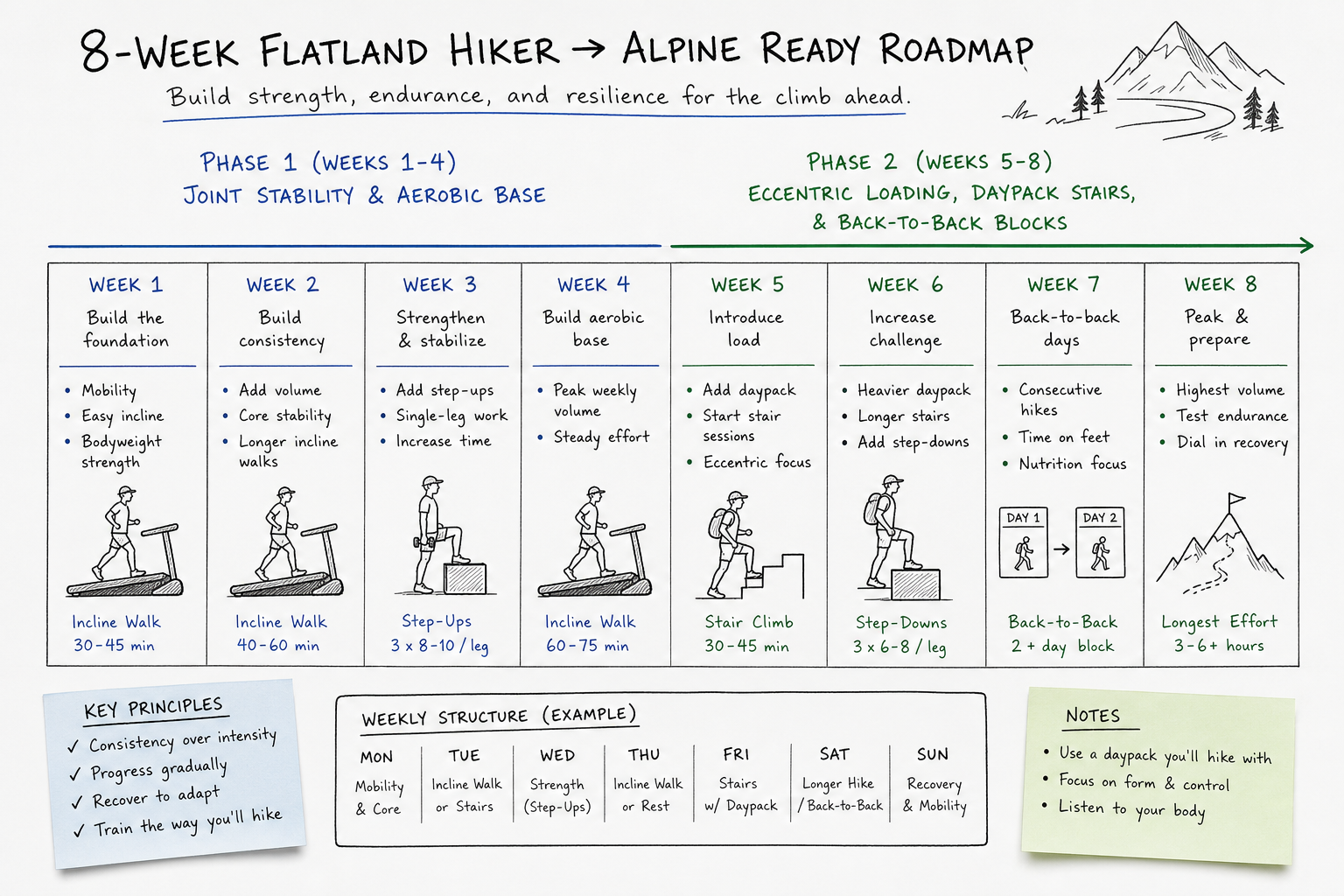
Phase 1: Weeks 1 to 4 — Foundation and Joint Resilience
The goal of Phase 1 is building structural resilience in your ankles, knees, and hips, while establishing a baseline aerobic engine.
- Target: 3 gym/strength sessions and 2 cardio sessions per week.
- Cardio Focus: 45-minute Zone 2 sessions (low intensity where you can hold a full sentence without gasping). Use an incline treadmill set to 10–12% at a slow walking speed (3.5–4.5 km/h), or use an elliptical machine.
- Strength Focus: Low weights, high control. Focus on knee stability, calf strength, and core stability.
Phase 2: Weeks 5 to 8 — Specificity, Eccentric Loading, and Cumulative Volume
In Phase 2, load is added to simulate daypack weight, and movement patterns transition toward high-step repetitions and simulated descents.
- Target: 2 gym sessions, 1 stairwell/stairmaster session, and 1 weekend back-to-back long hike.
- Cardio Focus: Stairclimber or real staircases carrying a 6 kg (13 lb) pack.
- Strength Focus: Slow eccentric tempos (3-4 seconds per lowering phase) on lunges and step-downs.
- Weekend Effort: Back-to-back outdoor walks on consecutive days (e.g., 12 km on Saturday, 12 km on Sunday) to train your legs to perform under pre-existing fatigue.
Pillar 1: Simulating Elevation Gain Without Hills
When natural hills are absent, you must create vertical resistance using artificial equipment or urban architecture.
Incline Treadmill vs. Stairmaster vs. Real Stairs
Not all incline substitutes work your muscles equally:
- Incline Treadmill (12% to 15% Incline): Excellent for sustained uphill cardio without impact. Walking at 4 km/h at a 15% grade closely matches the energy expenditure of an alpine trail ascent. Keep your hands off the handlebars; leaning on the handles reduces the effective incline by half and ruins posture.
- Stairclimber (StairMaster): The best gym machine for building step-up strength. Because the steps drop away, it forces continuous hip and knee flexion. Aim for 30 to 45 minutes at a steady pace of 45–60 steps per minute while wearing a light backpack.
- Urban Stairwells and Parking Garages: Multi-story stairwells in office buildings, sports stadiums, or parking garages offer the truest physical match. Unlike gym machines, climbing real stairs allows you to walk back down, giving you crucial eccentric quad training.
When structuring your indoor workouts, structured progression guides emphasize keeping cardiovascular intensity steady rather than sprinting in bursts (Creating your own training plan for hiking in the Alps).
Weighted Box Step-Ups: The Ultimate Flatland Drill
If you only have time for one exercise in your living room or gym, make it the weighted box step-up.
- Box Height: 30 cm to 40 cm (12 to 16 inches). Avoid excessively high boxes that force your lower back to round.
- Execution: Step up cleanly using the front leg only. Do not bounce off the trailing foot. Drive through the heel, stand fully upright at the top, and lower yourself slowly under control over a full 2-second count.
- Progression: Start with bodyweight (3 sets of 20 steps per leg). Over 4 weeks, add a daypack loaded with 5 kg to 10 kg and increase volume to 500 total steps per session.
Pillar 2: Bulletproofing Your Knees for Alpine Descents
Ascending 800 meters tests your lungs; descending 800 meters tests your connective tissues. Knee pain during descents usually stems from weak quadriceps, tight hips, or weak gluteus medius muscles that fail to stabilize the knee cap over the toes.
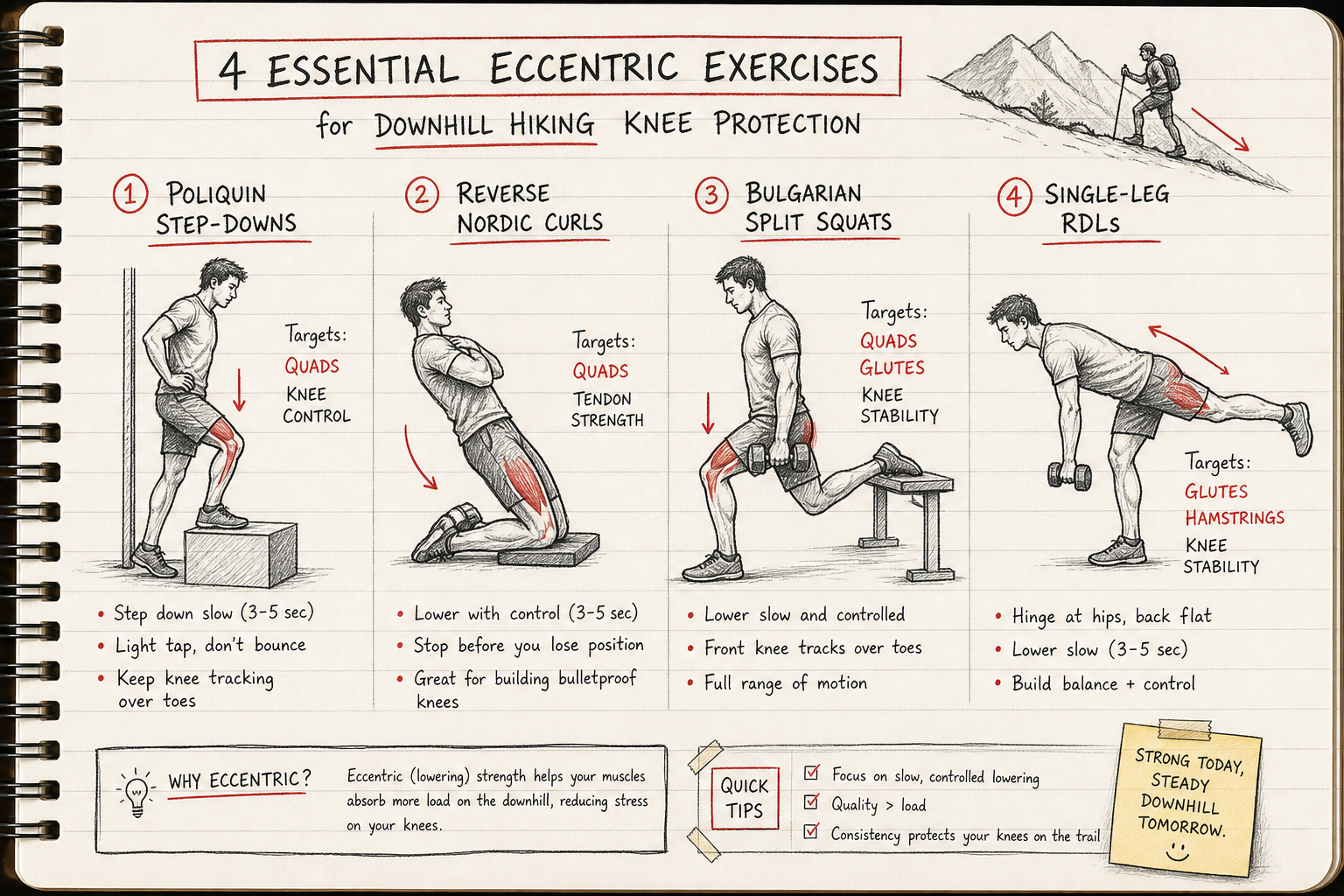
4 Essential Exercises for Downhill Conditioning
Include these four movements in your workout routine twice a week:
- Poliquin Step-Downs (Slow Eccentrics): Stand on an elevated block or step (10–15 cm high). Elevate your heel on a small wedge. Slowly lower your opposite heel toward the floor by bending the supporting knee, taking 3 full seconds to touch the ground lightly before driving back up. Perform 3 sets of 12 to 15 repetitions per leg.
- Reverse Nordic Curls: Kneel upright on a soft pad with feet flat behind you. Keeping your torso, hips, and thighs aligned in a straight line, lean backward from the knees by 20 to 45 degrees. Hold for one second, then engage your quadriceps to pull your torso forward to the start position. This exercise lengthens and strengthens the quadriceps rectus femoris under high load.
- Bulgarian Split Squats: Place your back foot on a bench behind you. Lower your back knee toward the ground slowly over 3 seconds, keeping your front knee tracking over your middle toes. Drive up through the front heel. Add dumbbells as strength improves.
- Single-Leg Romanian Deadlifts: Stand on one leg with a slight bend in the knee. Hinge at the hips, reaching your rear leg straight back until your torso is parallel to the ground. Return to standing by squeezing the glute. This strengthens the hamstrings and ankle stabilizers, preventing fatigue-induced rolls on loose rocks.
The Role of Trekking Poles
Trekking poles are non-negotiable equipment on Swiss mountain trails. Biomechanical studies demonstrate that using two poles during steep downhill walking reduces compressive load on the knee joints by up to 25% and shifts significant strain to the upper body and core.
Ensure your poles are adjusted correctly: when walking on flat ground, your elbows should form a 90-degree angle. Lengthen your poles by 5 to 10 cm when descending, and shorten them by 5 to 10 cm when ascending steep slopes.
Pillar 3: Cardiorespiratory Base and Back-to-Back Endurance
Unprepared hikers often handle Day 1 with enthusiasm, only to hit a wall of exhaustion on Day 3. Multi-day trips require an established aerobic base built on Zone 2 training.
Why Zone 2 Cardio Trumps HIIT for Hikes
High-intensity interval training (HIIT) boosts short bursts of power, but alpine hiking is an ultra-endurance activity where you burn fat and glycogen at a steady aerobic rate over 6 hours. Zone 2 training increases mitochondrial density in your muscle fibers, allowing your body to generate energy efficiently without accumulating excessive lactate.
Keep your heart rate between 60% and 70% of your maximum heart rate during training walks and cardio sessions. You should be able to hold a full conversation without gasping for breath. If you are breathing heavily through your mouth, slow down.
Weekend Block Sessions
To simulate a multi-day itinerary, schedule