
Training guide to prepare for a week of hiking in the Swiss Alps
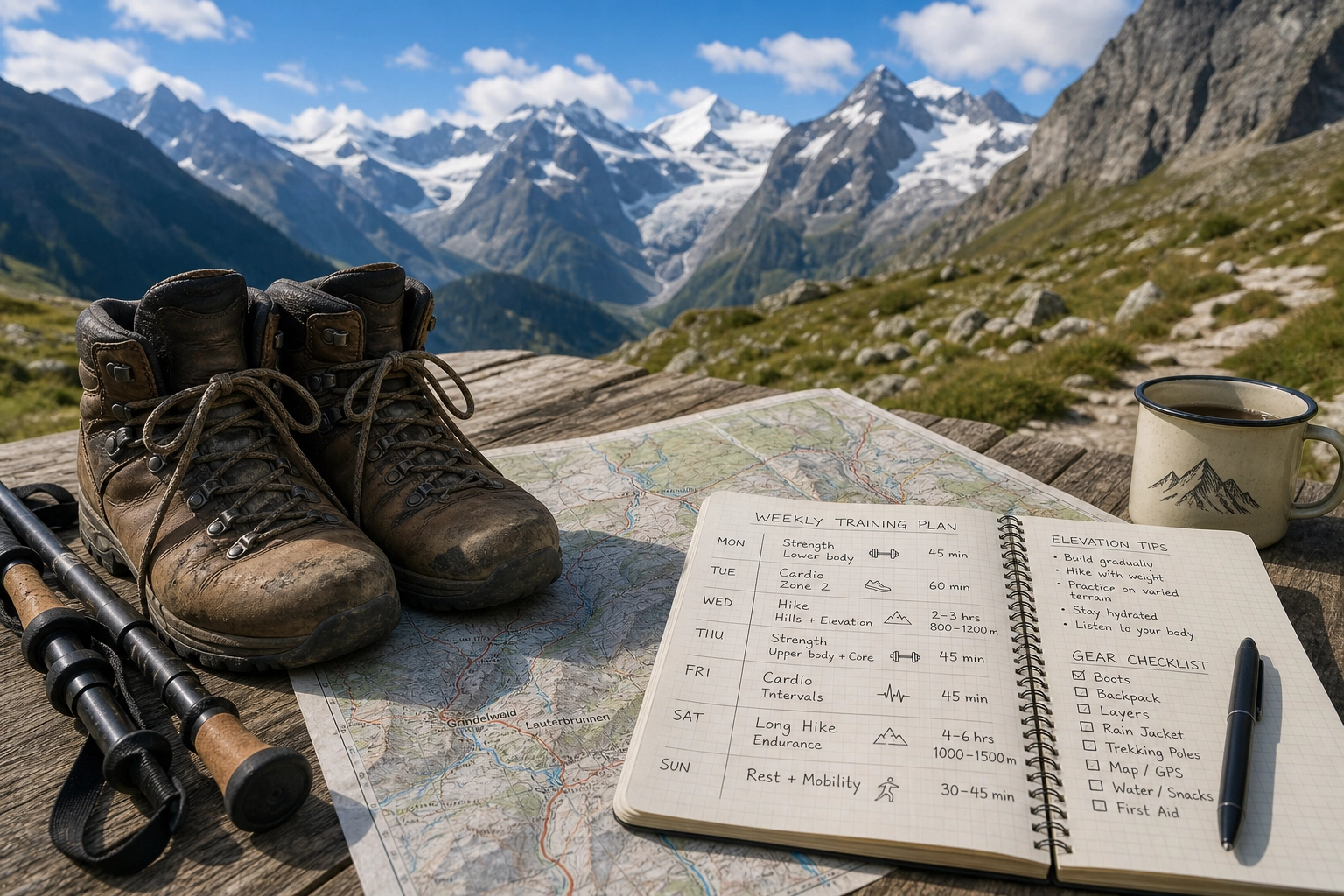
Most people who struggle on a week-long hiking holiday in Switzerland do not fail because they lack heart, stamina, or enthusiasm. They fail because they train for distance instead of elevation, or because they underestimate what six consecutive days of 1,000-meter descents do to their knees.
Walking 15 kilometers on a weekend flat path in your hometown is a great starting point, but it does not prepare your musculoskeletal system for stepping down 3,000 wooden and stone trail stairs with a 6-kilogram daypack on your back. In the Swiss Alps, elevation profile is everything.
If you are planning a guided hiking trip—whether you are staying at a central lodge near Valais or taking day trips out of St. Stephan—knowing your fitness baseline and training specifically for alpine demands will transform your holiday from a battle against sore quads into an enjoyable trek across high mountain passes.
Here is what you actually need to know about fitness requirements, how to test your current stamina, and a complete training blueprint designed for flatland hikers and mountain newcomers alike.
Understanding the Physical Demand: What an Alpine Hiking Week Expects
When booking a guided hiking week in Switzerland, tour descriptions often classify routes as moderate or intermediate. However, intermediate in the Swiss Alps usually means something vastly different from intermediate in non-mountainous regions.
A typical day on a guided summer trekking itinerary involves 4 to 6 hours of moving time, covering 10 to 18 kilometers, with daily vertical changes ranging between 600 meters and 1,200 meters.
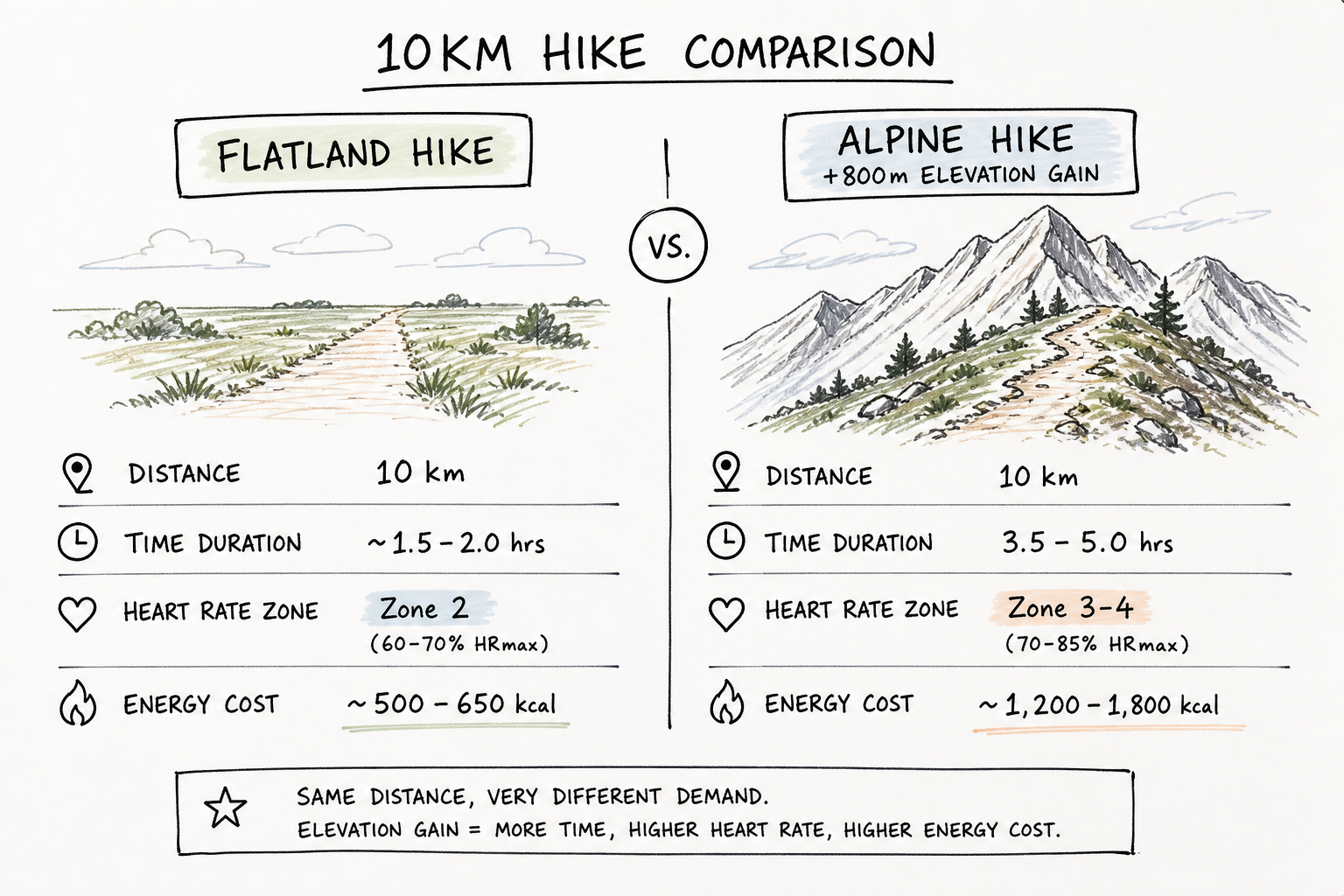
To put that in perspective, climbing 800 meters of elevation in a single morning is roughly equivalent to walking up the stairs of a 240-story skyscraper. And once you reach the summit pass, you have to walk all the way back down.
The Daily Alpine Rhythm
Unlike self-guided wilderness expeditions where you carry heavy camping gear, a guided day-hiking trip allows you to carry a lightweight daypack containing water, extra layers, a trail lunch, and personal items. While a lighter pack makes ascent easier, the cumulative effect of daily exertion remains the primary obstacle.
| Hiking Metric | Average Daily Requirement | Tougher Day / High Pass | What It Feels Like |
|---|---|---|---|
| Moving Time | 4.5 – 6 hours | 6.5 – 8 hours | Continuous exertion with 10-minute hourly breaks |
| Distance | 10 – 14 km (6–8.5 miles) | 15 – 20 km (9.5–12.5 miles) | Moderate distance, heavy terrain load |
| Elevation Gain | +600 m to +900 m | +1,000 m to +1,400 m | Sustained climb lasting 2 to 3.5 hours |
| Elevation Loss | -600 m to -900 m | -1,000 m to -1,400 m | Sustained braking action on knees and calves |
| Pack Weight | 4 – 6 kg (9–13 lbs) | 6 – 8 kg (13–17 lbs) | Light, but noticeable over 6 hours |
As noted in discussions on how to physically prep for a Swiss Alps hiking trip, distance alone is a misleading metric for mountain readiness. A 10-kilometer flat walk takes around two hours, while a 10-kilometer trail with 900 meters of ascent easily takes four to five hours depending on terrain density and foot placement.
The Three Fitness Pillars of Alpine Readiness
Preparing for the Alps requires building three primary physical attributes: eccentric muscle strength, sustainable aerobic base, and foot and joint resilience.
1. Eccentric Strength (The Downhill Factor)
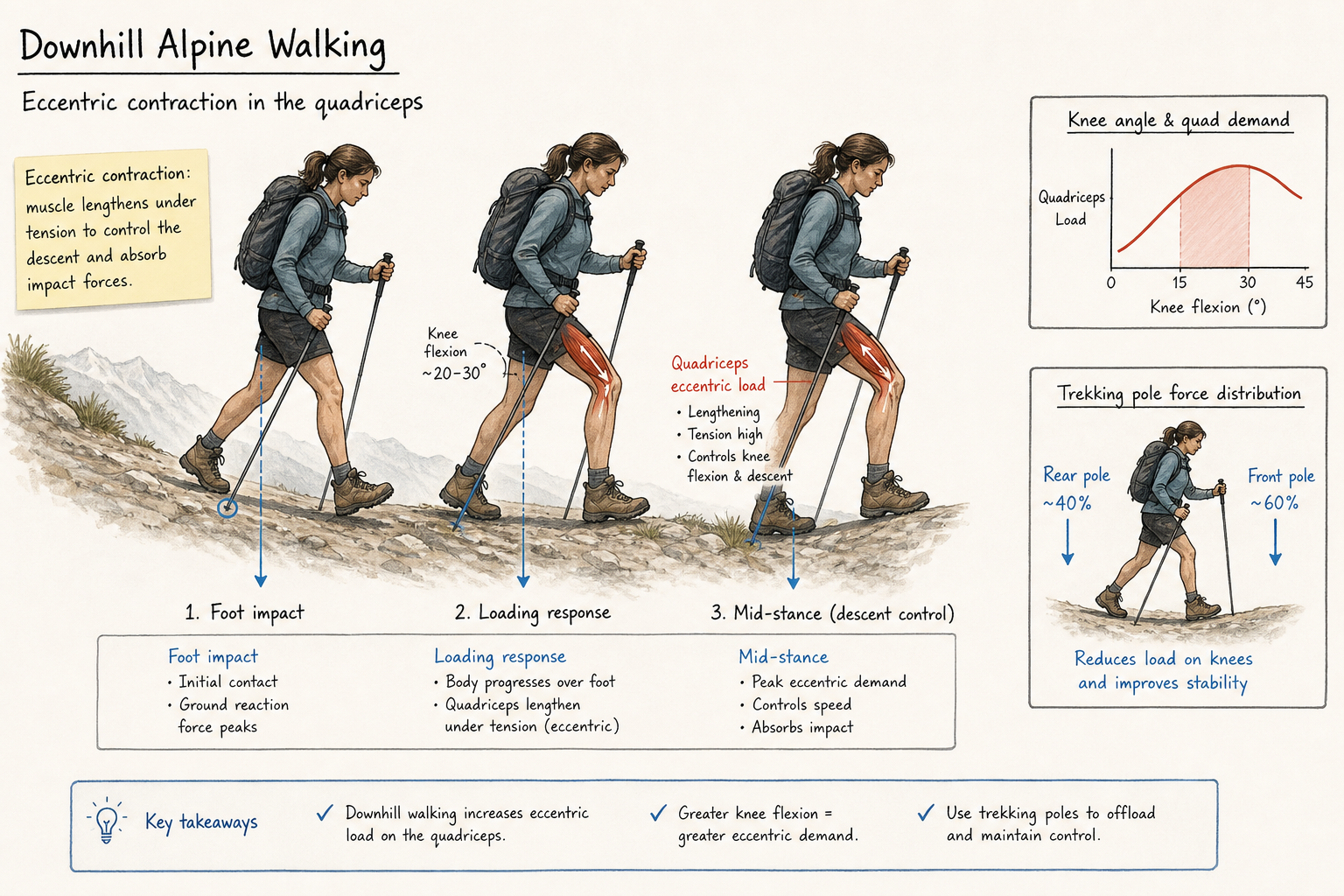
Most beginners assume that hiking uphill is the hardest part of mountain travel. Uphill hiking demands significant cardiorespiratory output and concentric leg strength (pushing your body upward against gravity). It makes you sweat and breathes heavy, but your cardiovascular system recovers relatively fast once you reach the top.
Downhill hiking works through eccentric muscle contractions, where your muscles lengthen under load as they act as brakes to cushion every step down. Downhill movement inflicts micro-tears on quadriceps and calf fibers. Without proper conditioning, this causes delayed onset muscle soreness (DOMS) so severe that by Day 3, bending your knees to sit on a chair becomes painful.
Building eccentric quad strength before arriving in Switzerland is the single best step you can take to enjoy your trip.
2. Low-Intensity Aerobic Base (Zone 2 Endurance)
Guided groups move at a steady, rhythmic pace. You do not need explosive speed or high-intensity interval training (HIIT) sprint capacity. What you need is an aerobic engine capable of sustaining Zone 2 heart rate exertion for hours without draining your glycogen stores.
Zone 2 training refers to exercise performed at a pace where you can comfortably hold a full conversation without gasping for breath. Training in this zone improves mitochondrial efficiency, teaches your body to burn fat for sustained fuel, and lowers your baseline fatigue over consecutive days.
3. Ankle, Foot, and Joint Resilience
Alpine trails vary widely, from smooth alpine pasture paths to loose scree, wet granite, and tree root networks. Negotiating uneven ground for six hours forces thousands of micro-adjustments in your ankles, feet, and core stabilizers. Strong ankles and stabilized hip flexors prevent rolled joints and foot fatigue.
If you want to know how guided trips handle social dynamics and pace matching on these paths, check out our guide on finding your social group during guided hiking in Switzerland.
Flatland Training Strategy: How to Prep Without Mountains
Living in a city or a flat region is no excuse for arriving unprepared. Thousands of hikers from flat regions complete high-elevation trips successfully every summer by using smart substitute exercises.
As outlined in Alpine Hikers’ flatland training recommendations, preparing for mountain climbs from flat terrain requires focusing on three specific elements: vertical simulation, targeted gym resistance, and weighted walking.
Flatland Exercise Substitutes
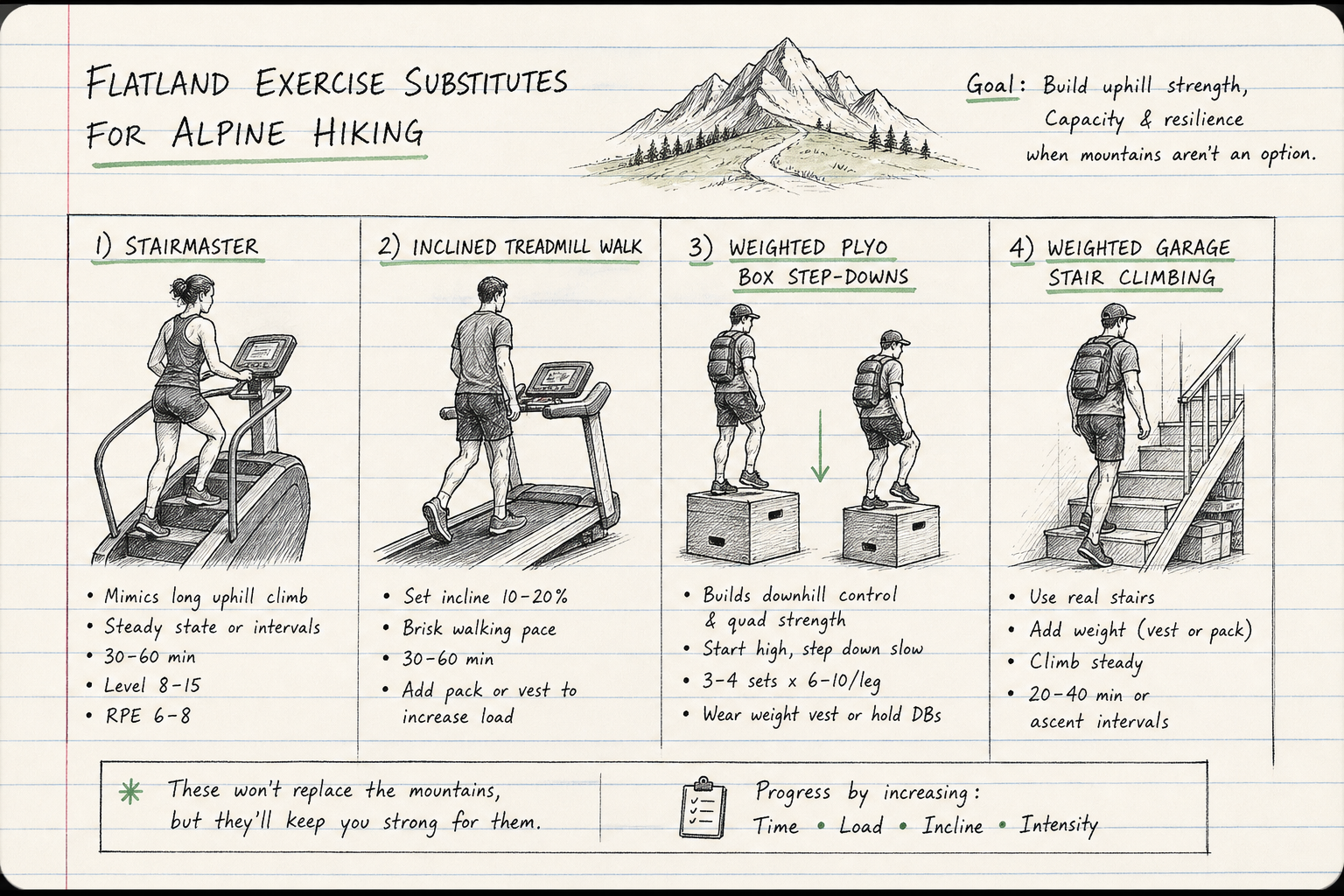
- The Stairmaster or Bleachers: The Stairmaster is the most efficient indoor simulator for mountain climbing. Focus on long, continuous sessions (30 to 60 minutes) at a moderate, steady speed rather than fast intervals. Avoid holding heavily onto the handrails, as leaning forward on handrails eliminates core engagement and removes lower leg loading.
- Inclined Treadmill Walking: Set a gym treadmill to its maximum incline (usually 12% to 15%) and walk at a pace between 3.5 km/h and 4.5 km/h. Do not run. Focus on pressing through your heels and driving up with your glutes.
- Weighted Box Step-Downs: To train your legs for steep descents without a mountain, stand on a 15 to 20 cm wooden plyo box or gym step. Slowly lower one foot to touch the floor without transferring weight, then drive back up through the standing leg. The slow, controlled lowering phase mimics the exact braking load of downhill mountain walking.
- Parking Garage or Stadium Stairs: Finding a multi-story building or stadium allows you to practice both ascending and descending stairs. Walking down 10 to 20 flights of stairs repeatedly builds eccentric leg strength that treadmills cannot replicate.
The 12-Week Swiss Alpine Training Plan
This progressive 12-week schedule is designed for hikers starting with average recreational fitness. If you already exercise regularly, you can condense this program into an 8-week cycle.
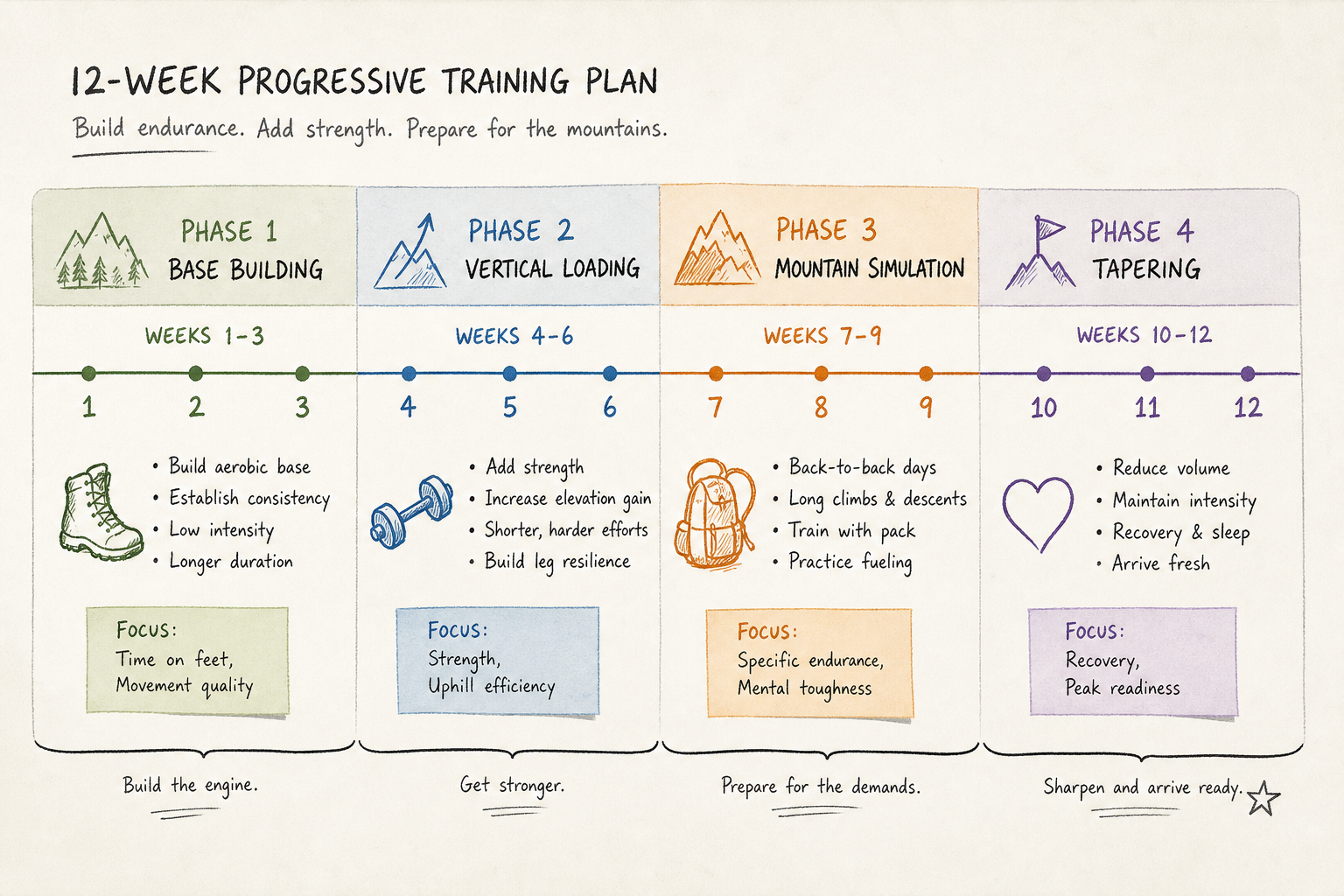
Phase 1: Base Building (Weeks 1 to 4)
Goal: Establish baseline aerobic stamina, condition feet, and build foundational leg strength.
- Monday: Rest or gentle mobility/stretching.
- Tuesday: 45 minutes Zone 2 cardio (brisk flat walking, cycling, or light jogging).
- Wednesday: Strength Session A (Legs & Core).
- Goblet Squats: 3 sets of 12 reps
- Reverse Lunges: 3 sets of 10 reps per leg
- Romanian Deadlifts: 3 sets of 12 reps
- Calf Raises: 3 sets of 15 reps
- Planks: 3 sets of 45 seconds
- Thursday: 45 minutes Inclined Treadmill (10–12% incline, steady pace) or Stairmaster.
- Friday: Rest.
- Saturday: Long Outdoor Walk (2.5 to 3.5 hours) on undulating terrain with a light daypack (3–4 kg).
- Sunday: Active Recovery (30–45 minute easy walk or swim).
Phase 2: Vertical Loading & Strength Progression (Weeks 5 to 8)
Goal: Increase vertical volume, introduce slow eccentric strength work, and build pack weight.
- Monday: Rest.
- Tuesday: 60 minutes Zone 2 cardio or Stairmaster session (30 mins Stairmaster + 30 mins incline treadmill).
- Wednesday: Strength Session B (Eccentric Focus).
- Weighted Step-Downs (Slow 3-second lowering): 3 sets of 10 reps per leg
- Bulgarian Split Squats: 3 sets of 8 reps per leg
- Single-Leg Romanian Deadlifts: 3 sets of 10 reps per leg
- Standing & Seated Calf Raises: 4 sets of 15 reps
- Side Planks & Hanging Knee Raises: 3 sets
- Thursday: 60 minutes brisk cardio (Cycling or Stairmaster).
- Friday: Rest.
- Saturday: Long Hike (4 to 5 hours) seeking local hills, stairs, or rough paths. Carry a 5–6 kg pack.
- Sunday: 60-minute recovery walk or light road cycling.
Phase 3: Mountain Simulation & Back-to-Back Volume (Weeks 9 to 10)
Goal: Simulate multi-day fatigue by scheduling weekend back-to-back training days.
- Monday: Rest.
- Tuesday: 60 minutes Stairmaster or stair-well climbing with a 5 kg backpack.
- Wednesday: Strength Session B (Maintain current weights, focus on control).
- Thursday: 45 minutes Zone 2 cardio.
- Friday: Rest.
- Saturday: Long Hike / Stair Session (5 hours) with full trip daypack weight (6 kg).
- Sunday: Back-to-Back Hike (3 to 4 hours) on tired legs to simulate Day 2 and Day 3 of your Alpine week.
Phase 4: Tapering & Readiness (Weeks 11 to 12)
Goal: Allow muscle tissue to recover, store glycogen, and shed fatigue before departure.
- Week 11: Cut overall training volume by 30%. Keep workouts light and easy. Do one weekend walk of 3 hours.
- Week 12 (Departure Week): No heavy lifting or long strenuous hikes. Do two 30-minute easy flat walks to stay loose. Rest, stretch, hydrate, and prepare your gear.
Altitude and Elevation: Managing the Swiss Alpine Environment
Most classic summer day hikes in Switzerland operate between 1,200 meters and 2,800 meters above sea level. For example, high-elevation routes around Valais or day trips near Glacier 3000 sit high enough that atmospheric pressure drops slightly.
As explained in traveler discussions on elevation in the Swiss Alps, typical hiking routes in Switzerland rarely cause acute mountain sickness (AMS) like high Himalayan treks do, because you sleep down in valleys (such as Liddes or St. Stephan) and ascend during the day. However, you will notice subtle physical effects above 2,000 meters:
- Higher Breathing Frequency: Your body works slightly harder to take in oxygen during uphill sections. Breathe in a controlled, rhythmic pattern synced with your steps.
- Increased Dehydration: High mountain air is colder and drier, causing rapid moisture loss through respiration. Drink water consistently throughout the hike rather than chugging at lunch stops.
- Sun Intensity: Ultraviolet radiation increases roughly 10% to 12% for every 1,000 meters of elevation gained. Sunscreen, sunglasses, and a wide-brim hat prevent sun fatigue.
When preparing your wardrobe for variable mountain conditions across these elevations, review our complete guide on what to pack for a summer hiking trip in the Swiss Alps.
Trail Logistics & Gear Readiness
Physical fitness is only half the equation. Having your gear dialled in prevents blisters, cold spots, and unnecessary energy burn.
Footwear: Broken-In Boots vs. Trail Runners
Do not start a week-long hiking holiday with brand-new footwear. Shoes or boots must have at least 40 to 50 kilometers of wear before arriving in Switzerland.
- Trail Running Shoes: Excellent for well-maintained Swiss paths (Wanderwege). They are light, breathable, and cut down on leg fatigue. However, they provide less ankle support on loose rock.
- Mid-Cut Hiking Boots: Ideal if you carry ankle vulnerability or prefer extra stability on steep, rocky alpine trails (Bergwanderwege). Make sure they are waterproof with deep Vibram-style lugs.
The Value of Trekking Poles
Trekking poles are not optional accessories in the Alps; they are functional movement tools. Research shows that using two trekking poles reduces joint stress on your knees and hips by up to 20% to 25% during steep descents. They also engage your upper body muscles, redistributing workload away from your quadriceps during multi-hour climbs.
To see how proper gear choices and smart route selection help stretch your trip budget, read our advice on hiking in Switzerland without high costs.
Self-Assessment Checklist: Are You Ready for Day 1?
Before flying out to join your group trip, use this practical benchmark checklist to evaluate whether your physical foundation is ready.
[ ] THE 3-HOUR TEST
Can you walk continuously for 3 hours on uneven ground or inclined treadmill without stopping for more than 5 minutes?

[ ] THE PACK TEST
Can you carry a 6 kg daypack for 4 hours without experiencing shoulder, lower back, or neck strain?

[ ] THE DESCENT TEST
Can you perform 30 controlled step-downs per leg from a standard stair step without knee pain or wobbling?

[ ] THE RECOVERY TEST
After a weekend long hike, can you wake up the next morning and walk comfortably for another 2 hours?

[ ] FOOTWEAR CHECK
Have your chosen hiking shoes been tested on at least three 10+ km walks with zero severe hot spots or blisters?
If you answered