What to Pack for Hut Hiking in Switzerland (5 Essentials)
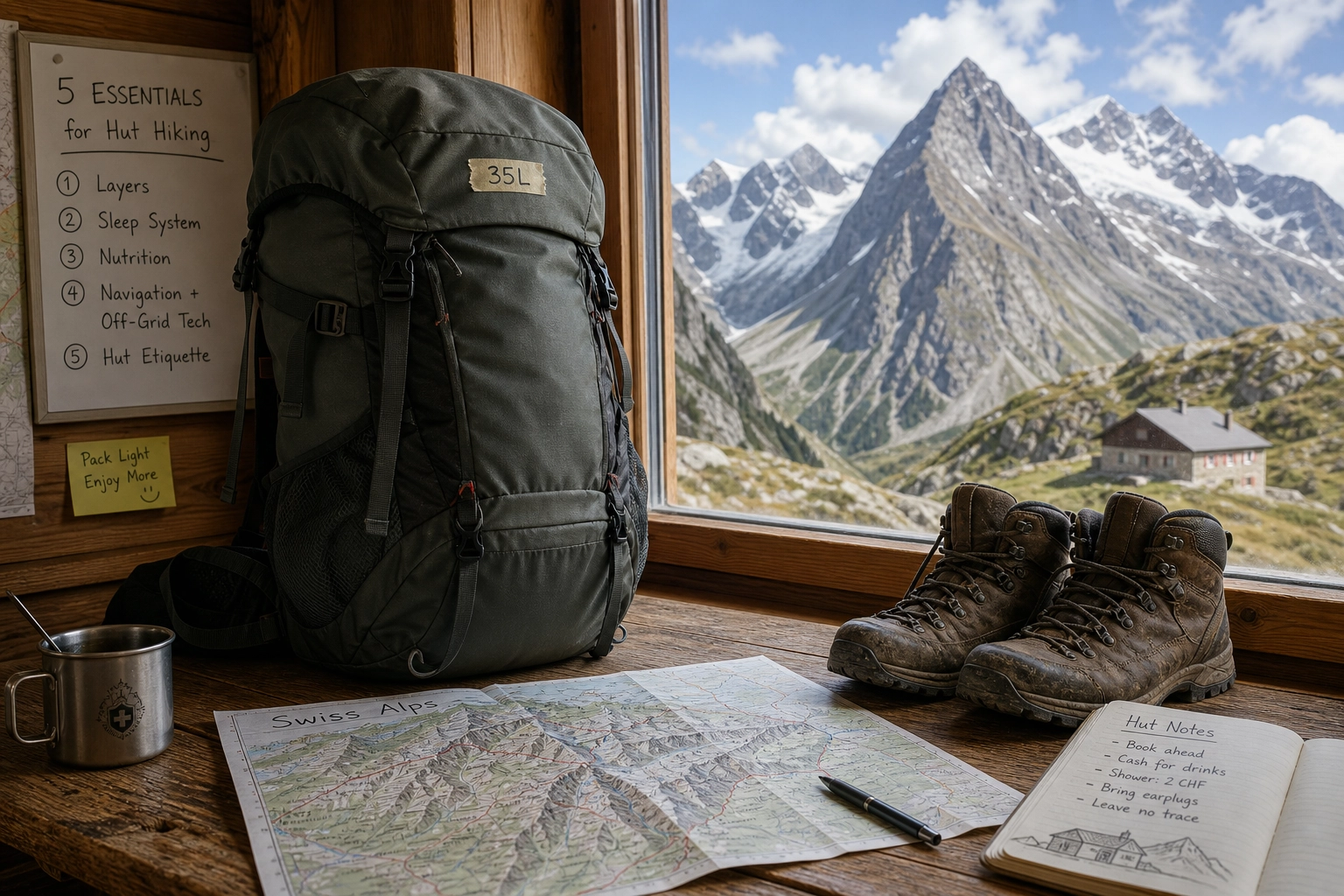
Picture this: It’s 4:30 PM. You have just finished a grueling 1,200-meter ascent to the Cabane de Moiry. The high-altitude wind has picked up, and a cold drizzle is starting to freeze on your jacket. You step into the warmth of the mudroom, swap your mud-caked boots for dry slippers, and head to the dining room for a warm slice of apricot tart. But when you pull out your smartphone to pay with Apple Pay, the hut warden shakes their head.
“Kein Internet. Nur Bargeld.”
(No internet. Cash only.)
You scramble through your pack, realizing you only have a 5-Franc coin and a credit card that is entirely useless at 2,500 meters.
Don’t be that hiker.
Preparing for hut to hut hiking in Switzerland is an exercise in extreme minimalism. If you are used to backpacking in North America or wild camping in Scandinavia, your instinct will be to pack a tent, a bulky sleeping bag, a stove, gas canisters, and three days of dehydrated meals. In the Swiss Alps, doing this will only weigh you down with 15 kilos of unnecessary gear, turning a beautiful T3 alpine traverse into a miserable sufferfest.
The Swiss Alpine Club (SAC) hut system provides the infrastructure; you just need to bring the right personal kit. In this guide, we break down the exact five essentials you need to pack for a successful Swiss mountain trek, how to manage your weight, and the unwritten etiquette of “Hut Life.”
Understanding the Swiss Alpine Club (SAC) Hut Ecosystem
Before you pack a single item into your backpack, you need to understand the environment you are packing for. The SAC operates over 150 mountain huts across the country. These range from modern architectural marvels like the Monte Rosa Hut to rustic, stone-walled shelters built in the 19th century.
The “Half-Board” Reality
When you book a stay at a Swiss hut, you are typically booking Halbpension (half-board). This includes:
- A bunk bed: Usually in a communal dormitory (Matratzenlager), complete with a mattress, a pillow, and thick duvets or wool blankets.
- Dinner: A hearty, high-calorie 3-course meal served communally at a set time (usually 6:30 PM). Think soup, a main course like Rösti or pasta, and a simple dessert.
- Breakfast: A simple alpine start of bread, butter, jam, cheese, and coffee or tea.
Because the hut provides your bedding and two of your three daily meals, your packing strategy radically shifts. You are not a self-supported wilderness explorer; you are a patron of a high-altitude hostel.
The Weight Limit Rule
The golden rule of the Swiss Alps is simple: Your fully loaded backpack should not exceed 10% to 15% of your body weight. For most hikers, this means aiming for a total pack weight of 7 to 9 kilograms (15 to 20 lbs) inside a 30 to 35-liter backpack. Anything larger, like a 65-liter expedition pack, is a clear sign of an amateur who is about to have a very bad time on steep, cable-assisted switchbacks.
Essential 1: The Sanitary Sleep System
While the hut provides the mattress and the heavy blankets, you cannot sleep directly in them. Thousands of sweaty hikers pass through these bunks every season, and hauling heavy blankets down to the valley for washing is economically and environmentally impossible for off-grid huts.
The Mandatory Sleeping Bag Liner
You are strictly required to bring a Hüttenschlafsack (hut sleeping bag liner). If you show up without one, you will be forced to buy a cheap, scratchy cotton one from the warden at a massive markup, assuming they have inventory.
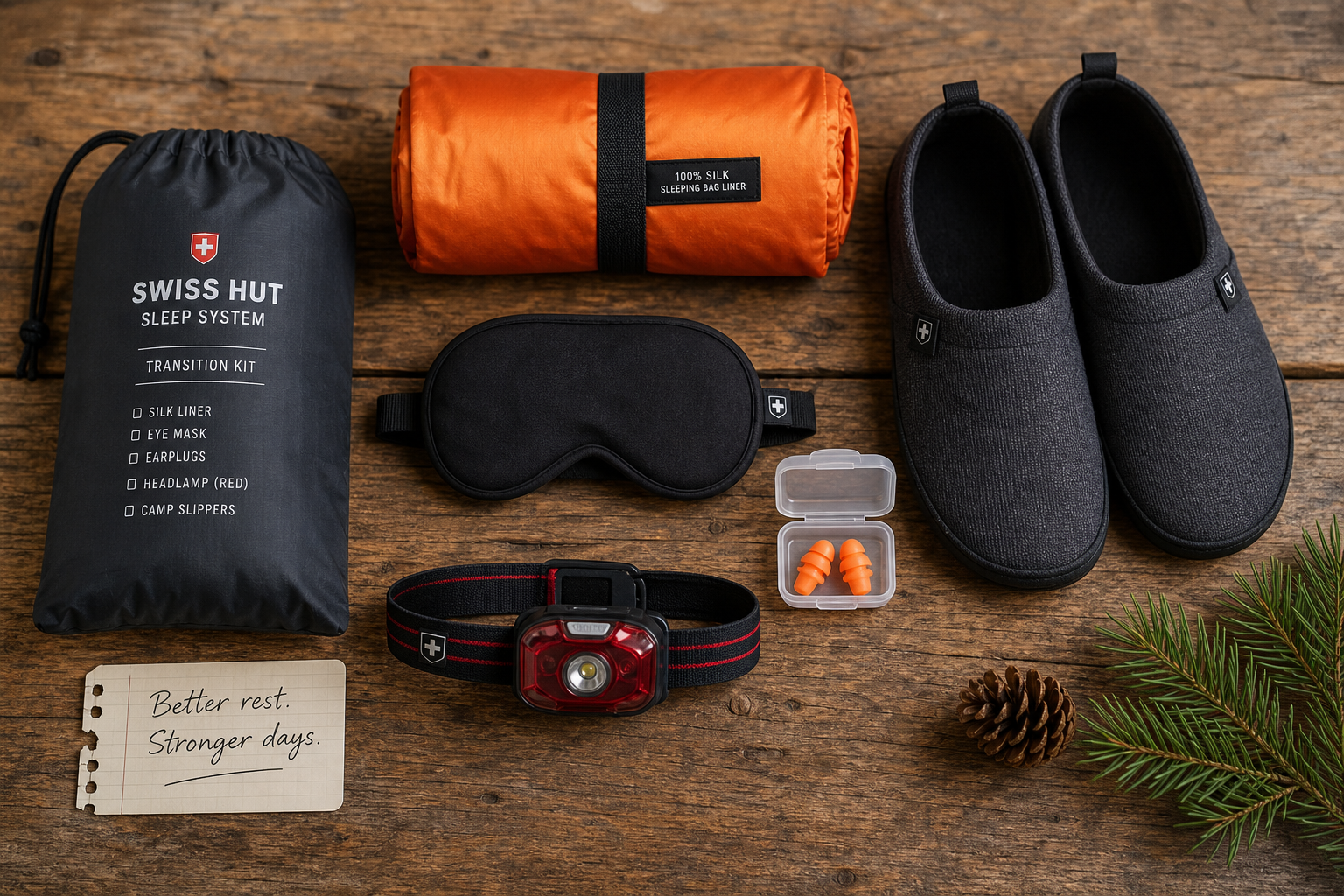
- Silk Liners (Best Choice): Weighing just 100-130 grams, silk is the ultimate material for hut hiking. It packs down to the size of an apple, regulates your body temperature perfectly, and feels luxurious after a hard day on the trail.
- Cotton Liners (Budget Choice): Heavier (around 300-400 grams) and bulkier, but acceptable if you are on a strict budget.
- Fleece Liners (Avoid): These are too warm. Dormitories pack 10 to 20 human bodies into a small room with closed windows. The ambient body heat will make a fleece liner feel like a sauna.
The Sensory Deprivation Kit
Communal sleeping means communal noises. When 20 hikers are in a room, someone is guaranteed to snore. Furthermore, alpine climbers often wake up at 3:30 AM for glacier crossings, meaning headlamps and rustling plastic bags will inevitably disturb your sleep.
- Silicone Earplugs: Foam earplugs often fall out during the night. Moldable silicone earplugs create a waterproof, soundproof seal that can block out even the loudest “chainsaw” snorer in the bunk next to you.
- Eye Mask: Essential for blocking out early sunrise light and the glare of other hikers’ headlamps.
- Red-Light Headlamp: When you need to use the bathroom at 2:00 AM, using a bright white headlamp in a dorm is a major breach of etiquette. Bring a headlamp with a dedicated red-light mode to preserve everyone’s night vision.
Essential 2: The “Hut Transition” Kit (Footwear & Clothing)
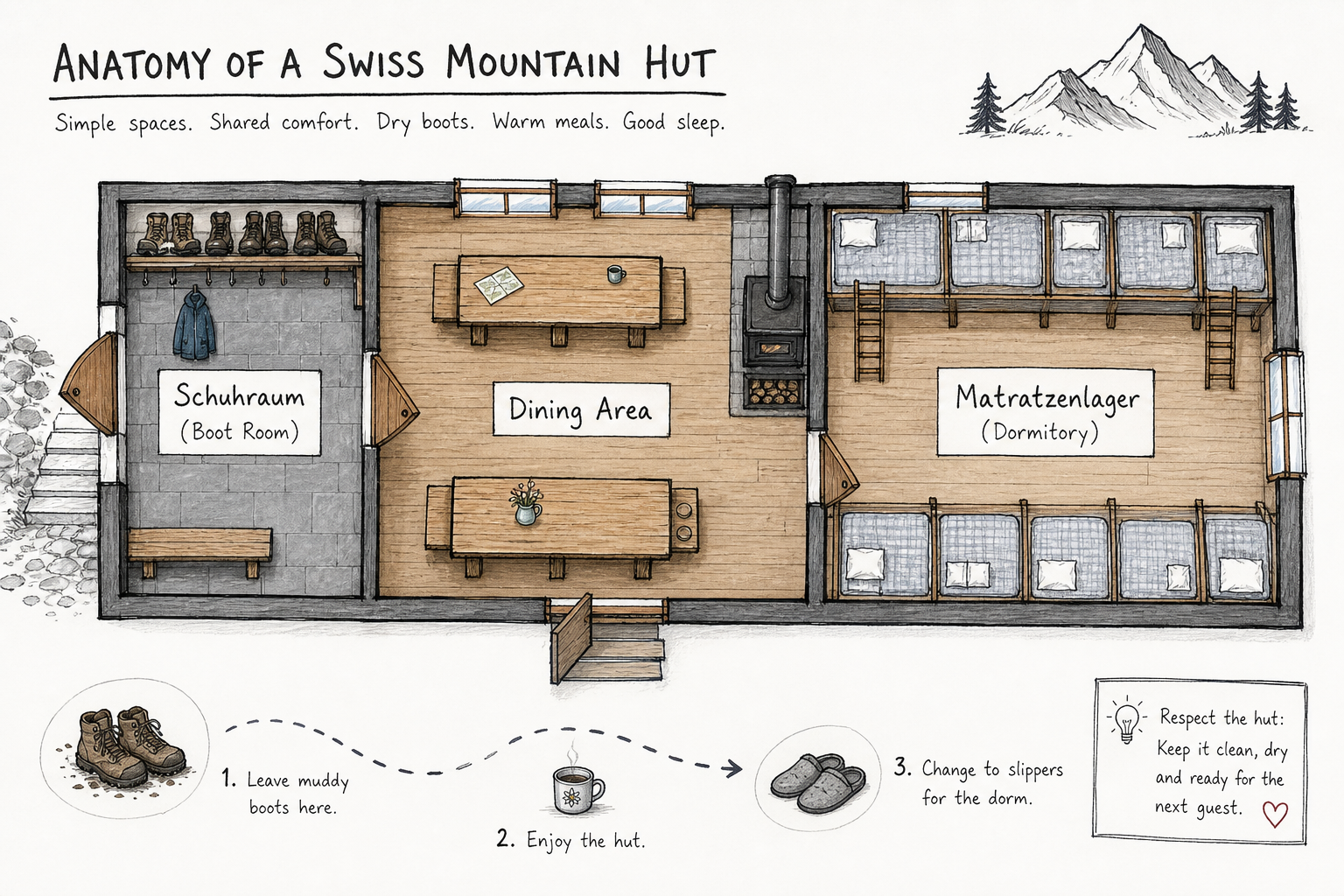
The most sacred rule of Swiss mountain huts is the mudroom protocol. You are absolutely forbidden from wearing your hiking boots past the Schuhraum (boot room). This prevents the alpine mud, sheep manure, and snow from being tracked into the dining and sleeping areas.
The Hut Shoe
Most huts have a communal basket of Hüttenfinken (crocs, rubber clogs, or felt slippers) for guests to use. However, these are often worn out, mismatched in size, and have been worn by hundreds of unwashed feet.
Bringing your own lightweight camp shoes is highly recommended.
- Foam Slides / Crocs: The standard choice. They are lightweight, can be clipped to the outside of your pack with a carabiner, and allow you to wear thick wool socks with them.
- Down Booties: If you are hiking late in the season (September), huts can be drafty. Down booties with a durable rubber sole offer incredible comfort.
The “Dry Change” of Clothes
Once your boots are off, you want to strip off your sweaty hiking layers immediately. You need a dedicated set of “hut clothes” that never see the trail. These stay clean, dry, and warm inside your pack.
- 1 Pair of Lightweight Camp Pants: Softshell or fleece-lined sweatpants.
- 1 Clean Merino Wool T-Shirt: Merino naturally resists odor, ensuring you don’t smell like a locker room at the communal dinner table.
- 1 Pair of Fresh Wool Socks: Strictly for wearing inside the hut.
The Minimalist Wash Kit
Do not pack full-sized shampoo bottles. Most high-altitude huts do not have showers. If they do, they operate on a coin-timer (e.g., 5 CHF for 2 minutes of lukewarm water) and water pressure is minimal.
Your hygiene kit should consist of:
- A travel-sized toothbrush and toothpaste.
- A small pack of biodegradable wet wipes (for a “trail shower” when real showers aren’t available).
- A palm-sized microfiber towel.
- A small stick of deodorant.
Essential 3: Off-Grid Tech, Navigation & Currency
Digital preparedness is where most international hikers fail. While the valleys of Switzerland are ultra-modern, the high alpine environment operates on analog rules.
Cash is King (Swiss Francs)
While the hotels in Swiss mountains down in the resort villages take all major credit cards, remote SAC huts frequently lose their internet connection. If the cloud cover is thick, the card terminal won’t work.
You must carry physical Swiss Francs (CHF). Bring enough to cover your half-board stay (around 80-100 CHF per night for non-SAC members), plus extra for:
- Beer or Wine: A celebratory post-hike Erdinger on the terrace costs around 6-8 CHF.
- Cake: Slices of fruit tart are a staple and cost around 5-7 CHF.
- Showers: If available, coin-operated showers take 1-CHF or 5-CHF coins.
- Emergency Purchases: Buying a spare map or trail snacks from the warden.
Power Management
Wall outlets are the most fought-over commodity in a mountain hut. There might be two sockets in the entire dining room, surrounded by a tangle of chargers from 40 different hikers.
Do not rely on the hut to charge your phone. Bring a reliable 10,000mAh to 20,000mAh power bank. This is enough to charge your phone and your smartwatch for 2 to 3 days. Additionally, if you do manage to find an outlet, remember that Switzerland uses the Type J plug. Standard European Type C plugs will sometimes fit into the two-prong holes, but grounded Type E/F plugs will not. Bring a specific Swiss adapter.
Navigation and Safety Apps
Before you lose cell service, ensure you have the following downloaded:
- SwissTopo / SwitzerlandMobility: The gold standard for Swiss maps. Download the maps for offline use. This is crucial for navigating any guided hiking in Switzerland or solo alpine traverse.
- MeteoSwiss: The weather in the Alps changes violently. A sunny morning can turn into a dangerous afternoon thunderstorm. MeteoSwiss provides hyper-local, highly accurate radar predictions.
- Rega App: The Swiss air rescue service. In a severe emergency, triggering the app sends your exact GPS coordinates to the helicopter dispatch.
Essential 4: Strategic Alpine Layering & Trail Gear
The Swiss summer hiking season runs from late June to mid-September. Even during a Swiss Alps summer, you can experience 25°C (77°F) in the valley and a snowstorm at the 2,800-meter pass on the exact same day.
The 3-Layer System
Avoid heavy cotton sweatshirts or thick winter coats. You need a modular system:
- Base Layer: Moisture-wicking synthetic or merino wool t-shirt. Avoid cotton entirely; once it gets wet from sweat, it stays cold.
- Mid Layer: A lightweight fleece pullover.
- Insulation Layer: A highly compressible down or synthetic puffy jacket. This is essential for sitting on the hut terrace in the evening as the temperature drops near freezing.
- Shell: A Gore-Tex or similar waterproof/windproof hard shell jacket and lightweight waterproof rain pants.
Footwear Dictated by the T-Scale
Switzerland categorizes trails from T1 (easiest) to T6 (difficult alpine).
- For T1 and T2 trails (wide, well-maintained paths), modern trail running shoes are often sufficient and save significant weight.
- For T3 and T4 trails (exposed sections, scree fields, chains, and ladders), you need stiff-soled approach shoes or mid-cut hiking boots with a sticky Vibram sole.
Trekking Poles
Poles are not just for older hikers; they are an absolute necessity in the Alps. A typical Swiss hike might involve a punishing 1,500-meter descent in a single afternoon. Trekking poles save your knees from taking thousands of kilos of cumulative impact and provide crucial stability when crossing lingering snowfields in early July.
Essential 5: Hydration, Snacks, & Waste Management
Food and water logistics at altitude require careful planning. Water does not magically flow to 3,000 meters; huts have to capture rainwater or melt snow, meaning it is treated as a precious resource.
The Water Economics
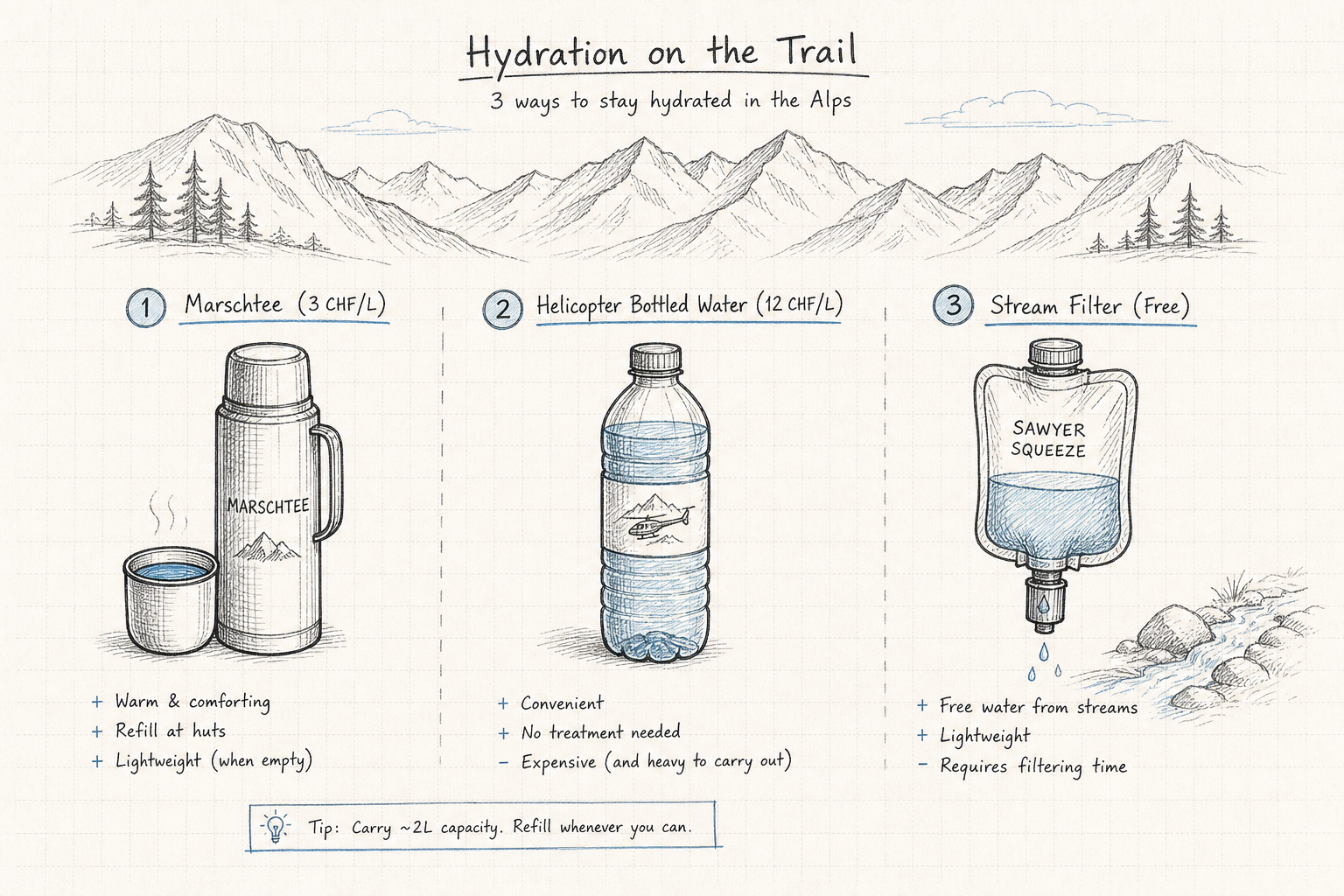
Never assume the tap water in the hut washroom is safe to drink (Trinkwasser). It is often marked “Kein Trinkwasser” (Not drinking water). You have three options for hydration on the trail:
- Marschtee (Marching Tea): This is the local secret to hiking in Switzerland without the high cost. Every morning, the hut brews massive vats of sweet fruit or black tea. For around 3-4 CHF per liter, they will fill your Nalgene or thermos. It provides warmth in the morning and sweet calories throughout the day.
- Bottled Water: Huts sell 1.5L bottles of water, but they are flown in by helicopter. Expect to pay 10 to 14 CHF per bottle.
- Water Filtration: Bring a lightweight squeeze filter (like a Sawyer Squeeze or Katadyn BeFree). You can fill up at alpine streams, but always filter. High alpine pastures are grazed by cows and sheep, meaning untreated water carries a high risk of bacterial contamination.
Summit Snacks
Because your breakfast and dinner are covered by the hut, you only need to pack calories for the hours you are walking.
Pack dense, high-calorie foods that don’t melt or crush easily:
- Nuts, dried mango, and trail mix.
- Hard Swiss cheese (Gruyère or Appenzeller) and cured sausage (Landjäger).
- Electrolyte tablets to add to your water for salt replacement.
Leave No Trace
Huts do not have garbage trucks. Any trash you generate must be packed out by you. Bring a dedicated ziplock bag to act as your personal trash bin for snack wrappers, used wet wipes, and fruit peels. Yes, even banana peels must be packed out—they take years to decompose in the freezing alpine environment.
The Basecamp Strategy: What to Do With Bulky Luggage
For international backpackers and digital nomads, the hardest logistical challenge isn’t the elevation gain—it’s luggage management. You cannot drag a 70-liter wheeled suitcase, a 16-inch laptop, and three weeks of European travel clothes up a T3 alpine trail.
This is where the “Basecamp Strategy” comes in. Instead of paying expensive luggage transfer services or abandoning your gear in sketchy train station lockers, you use a community adventure lodge as your staging ground.
If you are hiking the Val de Bagnes region or exploring trails near Mont Blanc, checking into a lodge like Ski Hostel in Liddes or St. Stephan solves this problem immediately. You can spend Friday utilizing their high-speed Wi-Fi to finish your remote work, enjoy a home-cooked, Brazilian-influenced communal dinner with other travelers, and then securely store your heavy luggage in their facilities.
With only your 35-liter pack, you can tackle a 3-day hut-to-hut traverse unburdened. When you return, exhausted and muddy, your basecamp is waiting with hot showers, a BBQ, and an international community eager to hear your trail stories. It is a logistical lifesaver for anyone planning a long-term trip.
The Complete 35-Liter Packing Checklist
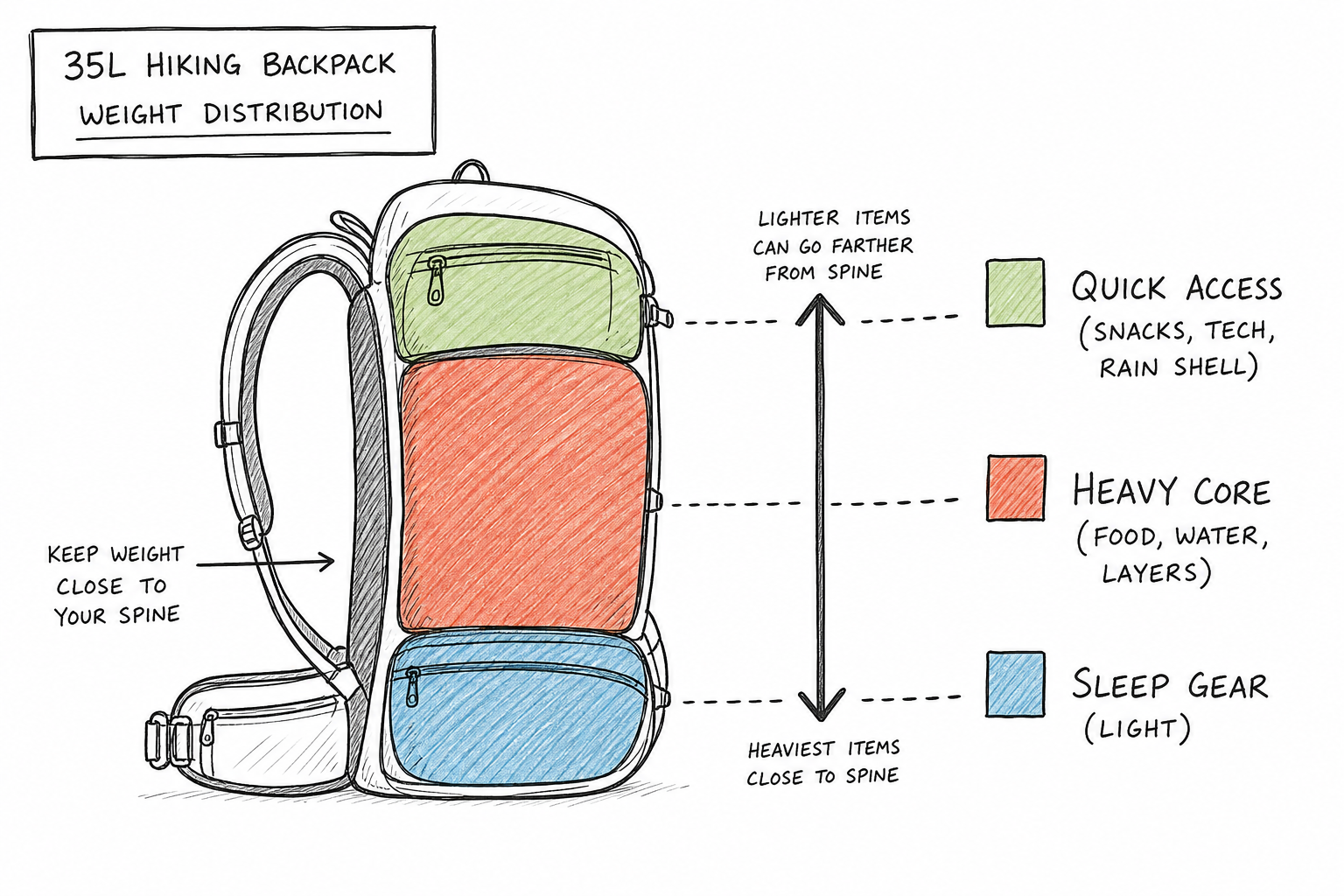
To ensure you don’t forget anything, use this structured packing matrix when loading your bag. Pack the heaviest items close to your spine, the sleep gear at the bottom, and the trail-essentials at the very top.
| Category | Items to Pack | Weight Priority |
|---|---|---|
| Sleep System | Silk liner, silicone earplugs, eye mask. | Bottom of pack (Lightweight) |
| Hut Transition | Lightweight camp pants, clean merino tee, fresh wool socks, minimalist wash kit, hut shoes. | Middle of pack (Moderate) |
| Clothing & Weather | Gore-Tex shell, rain pants, down puffer jacket, fleece mid-layer, sun hat, sunglasses. | Middle/Top (Heavy/Moderate) |
| Tech & Admin | 10,000mAh power bank, Swiss Type J adapter, charging cables, SAC membership card, physical Swiss Francs. | Brain of pack (Lightweight) |
| Trail Gear | Trekking poles, 2L water capacity (bottles/bladder), water filter, personal first aid/blister kit, sunscreen. | External/Accessible (Heavy) |
Frequently Asked Questions (FAQ)
Do I need to pack a sleeping pad or a tent for a hut hike?
No. Wild camping is strictly regulated and often illegal above the tree line in many Swiss cantons. The SAC huts provide a mattress and blankets. If you bring a tent, you are carrying “dead weight” that you likely will not be legally allowed to use.
Can I cook my own food at the hut?
Generally, no. Huts do not allow guests to use their commercial kitchens, and firing up a personal gas stove on the wooden terrace or inside the dormitory is forbidden due to fire hazards. Embrace the half-board option; the food is excellent and saves you from carrying pots, pans, and fuel.
What happens if I get stuck in a storm and can’t make it to the next hut?
This is why you pack the Gore-Tex shell and download the MeteoSwiss app. If the weather turns violently, do not push forward over exposed passes. Retreat to the valley or stay put at your current hut. Hut wardens communicate with each other; if you are delayed due to safety, let your current warden know, and they will often radio the next hut to adjust your reservation.
Is there Wi-Fi in the huts?
Rarely. Some lower-elevation huts might offer paid Wi-Fi vouchers, but anything above 2,500 meters is likely a dead zone. Inform your family of your itinerary beforehand, put your phone on airplane mode to save battery, and enjoy the rare opportunity to disconnect entirely.