
How to Plan Hut to Hut Hiking in Switzerland (7 Tips)
Your boots are still slightly damp from yesterday’s glacier crossing, but you’re sitting at a heavy wooden table at 2,500 meters, a steaming mug of filter coffee in hand. Through the dining room window, the morning alpenglow is painting the jagged peaks of the Valais Alps a brilliant, fiery orange. You haven’t carried a tent, you slept in a warm bed, and last night, you shared a three-course meal with hikers from five different continents.
This is the reality of hut to hut hiking in Switzerland.
While North American backpacking often requires hauling 40 pounds of survival gear into the wilderness, the European Alps offer a completely different model: high-altitude hospitality. The Swiss hut network allows you to traverse some of the most formidable and breathtaking mountain ranges on earth with little more than a 35-liter daypack, a sleeping liner, and a healthy appreciation for communal living.
But navigating the logistics of a Swiss alpine trek—from decoding the Swiss Alpine Club (SAC) booking portal to understanding the strict unwritten rules of the “boot room”—can overwhelm even experienced hikers. Planning a route that connects safely, securing beds during the competitive summer season, and keeping the budget under control require strategic foresight.
Whether you are using our basecamps at Ski Hostel in Liddes or St. Stephan to acclimatize before tackling the Tour des Combins, or you are arriving as a solo traveler looking to piece together your first multi-day trek, this guide breaks down exactly how to plan a hut-to-hut adventure in Switzerland.
The Anatomy of the Swiss Hut Network
Before diving into the planning tips, it helps to understand what a “Swiss mountain hut” actually is. These are not emergency bivouacs or primitive lean-tos.
Switzerland boasts over 150 official Swiss Alpine Club (SAC) huts, plus dozens of privately owned cabanes and rifugios. Originally built in the late 19th and early 20th centuries to shelter mountaineers attempting first ascents, they have evolved into high-altitude lodges.
Modern huts range from historic stone cabins perched precariously on rocky outcrops (accessible only via ladders and fixed ropes) to modern, energy-efficient architectural marvels boasting indoor plumbing and panoramic dining rooms. Regardless of their aesthetic, almost all operate on a similar model: they offer dormitory-style sleeping arrangements, a mandatory “half-board” food option (dinner and breakfast), and are managed by a dedicated warden (the Hüttenwart), who oversees everything from helicopter food deliveries to avalanche safety.
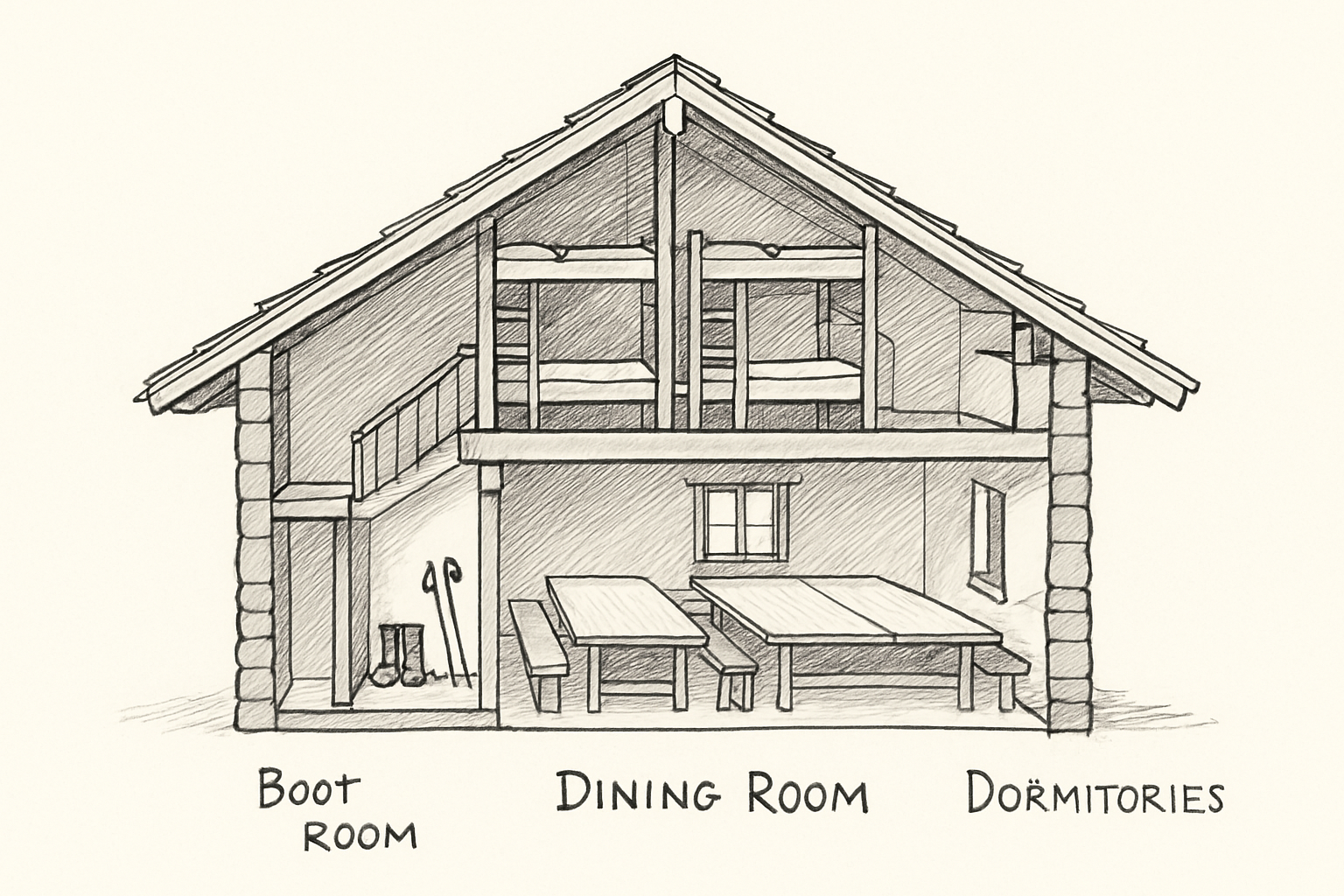
Understanding this system is the foundation of your trip. You are not just booking a bed; you are booking into a highly synchronized, high-altitude logistics operation.
Tip 1: Choose the Right Route for Your Experience Level
The quickest way to ruin a hut-to-hut trip is to overestimate your hiking pace and underestimate the Swiss terrain. A distance of 12 kilometers might take three hours in a valley, but it can take seven hours when you are gaining 1,200 meters of elevation over loose scree.
When evaluating routes, pay close attention to the Swiss Trail Grading System (the T-Scale). Yellow signs indicate standard hiking paths (T1), while red-and-white markers indicate mountain trails (T2-T3) requiring sturdy boots and surefootedness. Blue-and-white markers (T4-T6) are alpine routes that may involve scrambling, glacier crossings, and significant exposure.
The “Basecamp” approach for Beginners
If you are new to multi-day alpine hiking, leaping straight into a 10-day traverse is risky. Instead, establish a base at a social lodge in the valley. Ski Hostel, located in the heart of the Val de Bagnes region (Liddes) and the Bernese Oberland (St. Stephan), serves as an ideal launchpad. You can leave your heavy luggage secured, spend a few days doing day hikes to acclimate, and then embark on a 2-to-3-day introductory hut circuit.
For beginners, sticking to well-trodden paths where navigation is obvious and the elevation gain is manageable is key. If you are looking for specific trail recommendations, check out our guide on the 5 Best Hiking Trails in Switzerland Near Mont Blanc.
Intermediate: The Classic Traverses
Once you are comfortable with consecutive days of elevation gain, Switzerland opens up. The Via Alpina (specifically the Bear Trek section in the Bernese Oberland) and the Tour des Combins are spectacular choices. These routes offer dramatic glacier views, well-marked paths, and comfortable, highly social huts along the way.
Many hikers planning intermediate routes look for communal support. As discussed in Guided Hiking in Switzerland: Finding Your Social Group, joining forces with other travelers can make navigating these classic traverses safer and more enjoyable.
Advanced: High Alpine and Border Crossings
The legendary Walker’s Haute Route (Chamonix to Zermatt) is the gold standard for advanced hikers, requiring stamina, minor scrambling, and the ability to handle consecutive 1,500-meter ascent days. Other options include border-crossing excursions. From our Liddes basecamp, experienced hikers often string together routes crossing into Aosta in Italy or venturing toward the French border, utilizing both Swiss SAC huts and Italian Rifugios. For high-mileage athletes, run.outsideonline.com highlights how trail runners even fastpack these extensive routes.
Tip 2: Master the SAC Booking System (And Book Early)
Spontaneity is the enemy of the Swiss hut hiker in July and August. The most popular huts book out months in advance.
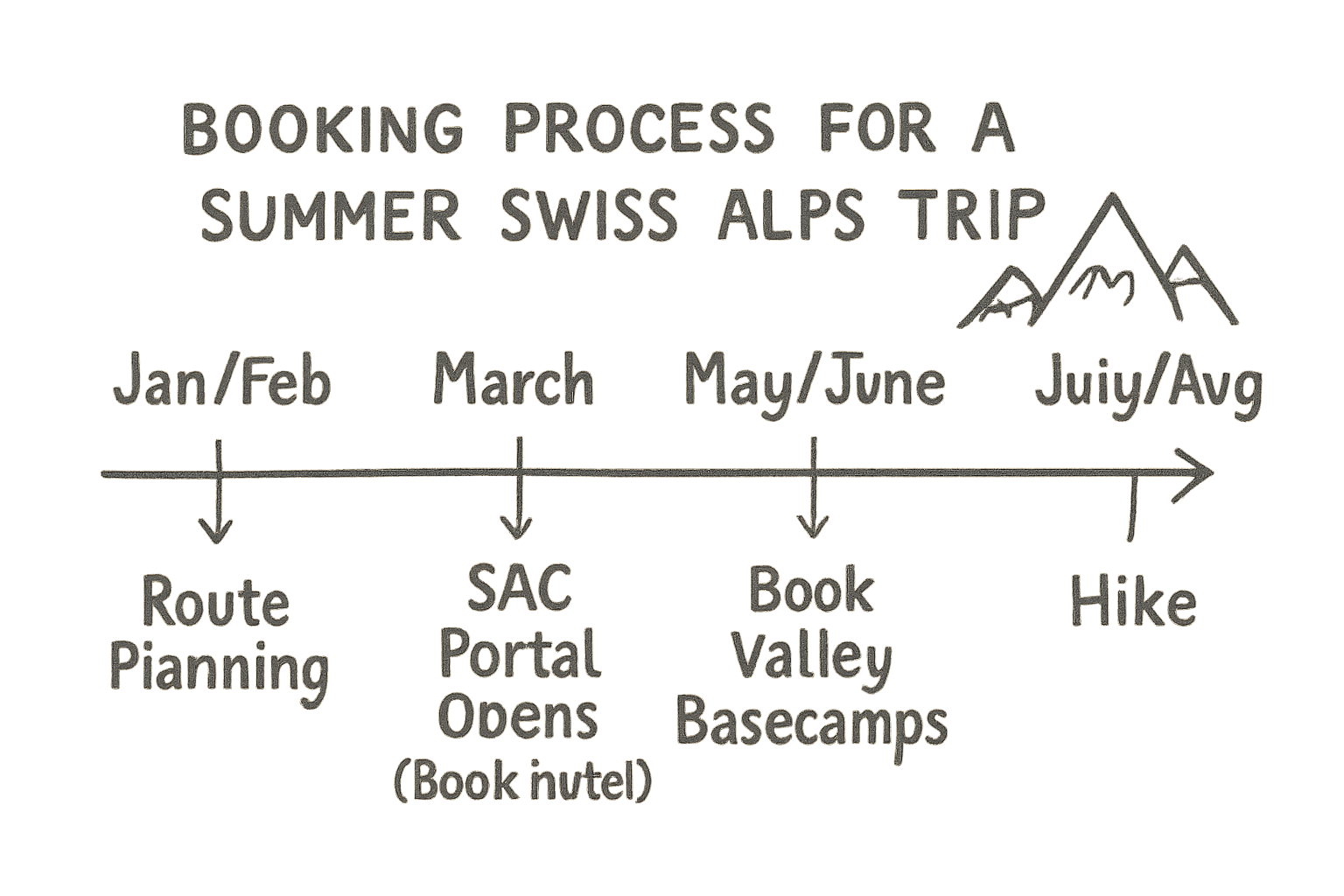
The Booking Timeline
- January/February: Route planning phase. This is when you should be mapping your itinerary and determining which huts connect your days.
- March: The SAC online booking portal opens for the summer season for most huts. If you are hiking the Haute Route or staying in famous spots like the Cabane de Louvie or Cabane de Moiry, you need to book the week the portal opens.
- May/June: Finalize your valley accommodation. Book your pre- and post-hike stays at hostels or lodges to ensure you have a place to recover and celebrate.
How to Use the Portal
Almost all SAC huts use the centralized reservation system at alpenclub.ch. You will create an account, search for the hut, and view a calendar of availability.
When booking, you will usually be required to secure your spot with a credit card. Most huts do not charge the full amount upfront; instead, they place a hold or charge a small deposit, and you pay the remainder (plus drinks and snacks) directly at the hut.
What if a Hut is Full?
If your dream route is blocked by one fully booked hut, don’t panic. Cancellations happen frequently due to weather. Call the hut warden directly (don’t just rely on the website). Wardens often keep a few emergency beds in reserve, or they can advise you on a safe alternate route to a neighboring, less crowded cabane. As noted in planning discussions on reddit.com/r/hiking, flexibility and a willingness to call the wardens can often save a disrupted itinerary.
Tip 3: Pack Ruthlessly Light (The 35L Rule)
The most common mistake first-time hut hikers make is bringing a 65-liter backpack filled with camp stoves, multiple changes of clothes, and heavy toiletries. In the Alps, ounces equal pounds, and pounds equal misery on a 20% gradient climb.
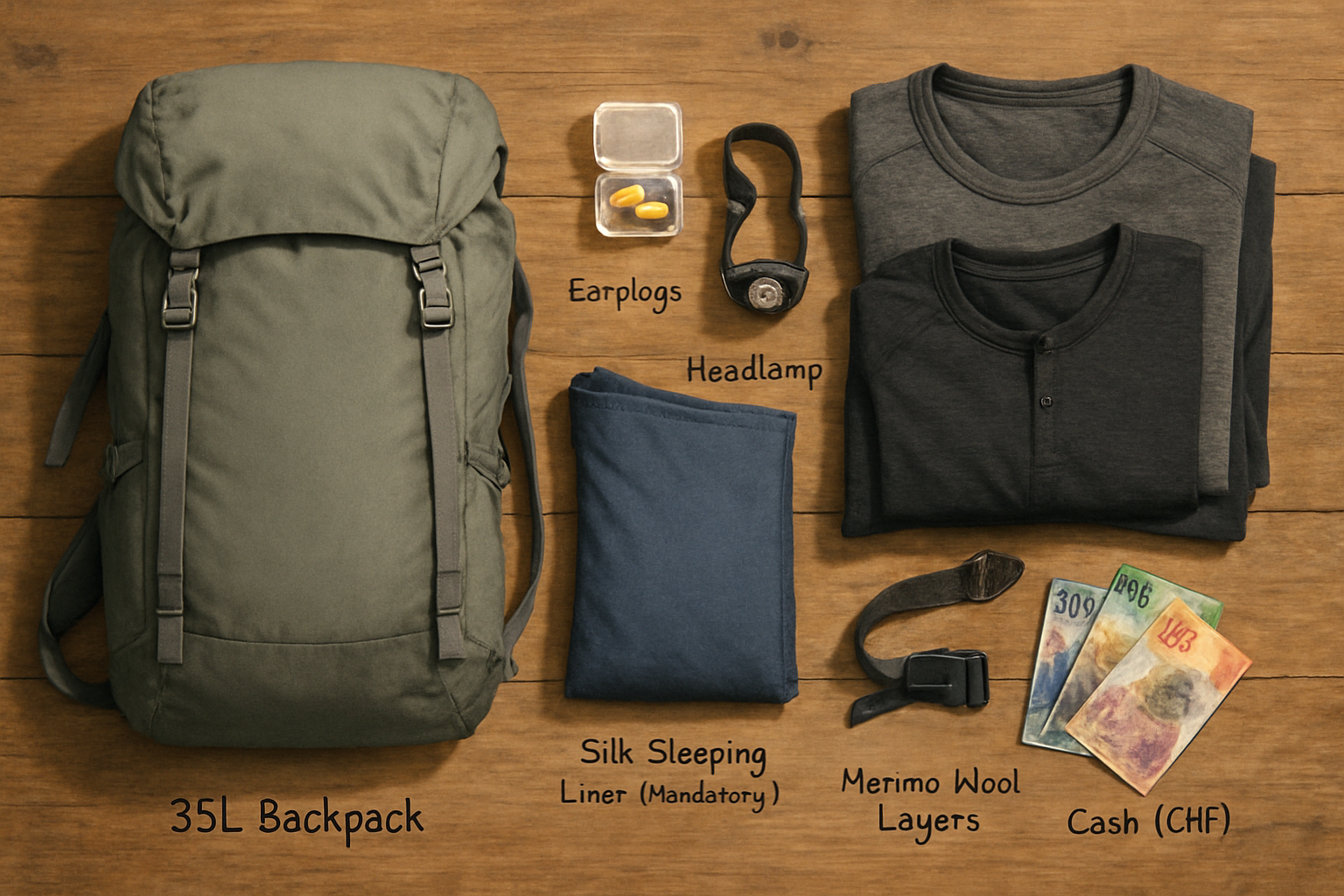
Because the hut provides your bed, your dinner, and your breakfast, you only need to carry your daytime layers, safety gear, and minimal hygiene items. A 30 to 35-liter pack is more than enough.
The Non-Negotiables
- A Silk or Cotton Sleeping Liner: This is absolutely mandatory in every Swiss hut. They provide the mattress, the pillow, and the thick wool blankets or duvets, but for hygiene reasons, you must sleep inside your own liner.
- Earplugs: You will be sleeping in a dormitory with 8 to 20 other people. Someone will snore. Someone will wake up at 4:30 AM to climb a peak. Earplugs are your best defense.
- Cash (Swiss Francs): While many modern huts now accept cards or TWINT (the Swiss mobile payment app), high-altitude Wi-Fi connections frequently drop. Always carry enough cash to cover your half-board and any emergency expenses.
- Headlamp: Essential for navigating to the outdoor washrooms at night or packing your bag before dawn.
The Clothing Strategy
You do not need a fresh outfit for every day. Adopt the “hike wet, sleep dry” mentality.
Bring one set of hiking clothes (merino wool is ideal for odor control) that you wear during the day, and one set of clean, comfortable “hut clothes” (like lightweight sweatpants and a clean t-shirt) that you change into immediately after taking off your boots.
For a comprehensive breakdown of exactly what to put in your bag, reference our Swiss Alps Summer: A Simple 5-Step Packing Guide.
Tip 4: Understand Hut Etiquette and Routines
Swiss mountain huts operate with military precision. Adhering to the unspoken rules ensures you fit seamlessly into the alpine community and don’t draw the ire of the warden.
The Boot Room (Schuhraum)
Upon entering a hut, you will immediately encounter the boot room. This is where your hiking boots, wet rain gear, trekking poles, and ice axes must remain. Never walk into the living quarters or dormitories with your hiking boots on.
Huts provide Hüttenfinkli (hut slippers)—usually a massive bin of mismatched Crocs or felt clogs—for you to wear indoors.
The Dormitory (Massenlager)
When you check in with the warden, you will be assigned a specific bed number in a dormitory. Claim your spot by laying out your sleeping liner. Keep your gear contained to your designated area. Backpacks should be tucked neatly under the bed or on designated shelves, not sprawling across the communal floor space.
Communal Dining
Dinner is the highlight of the hut experience. It is served precisely at a scheduled time, usually 18:30 (6:30 PM). If you are late, you miss the soup course.
Seating is communal. You will be placed at long wooden tables with other hikers. This is where the magic of the alpine social experience happens. You might find yourself passing bread to a Parisian mountaineer, pouring water for a German family, and sharing route tips with an American solo traveler. The food is incredibly hearty—expect thick vegetable soups, rosti with bratwurst, creamy polenta, or rich pasta dishes, designed to replenish thousands of burned calories.
Quiet Hours (Hüttenruhe)
Lights out is strictly enforced, typically at 22:00 (10:00 PM). If you need to pack your bag for an early alpine start, do it the night before. Rustling plastic bags at 5:00 AM is considered a cardinal sin in the Alps.
Tip 5: Budgeting for the Alps (Without Going Broke)
Switzerland is notoriously expensive, but hut-to-hut hiking is actually one of the most cost-effective ways to see the country, provided you plan correctly.
Breakdown of Hut Costs
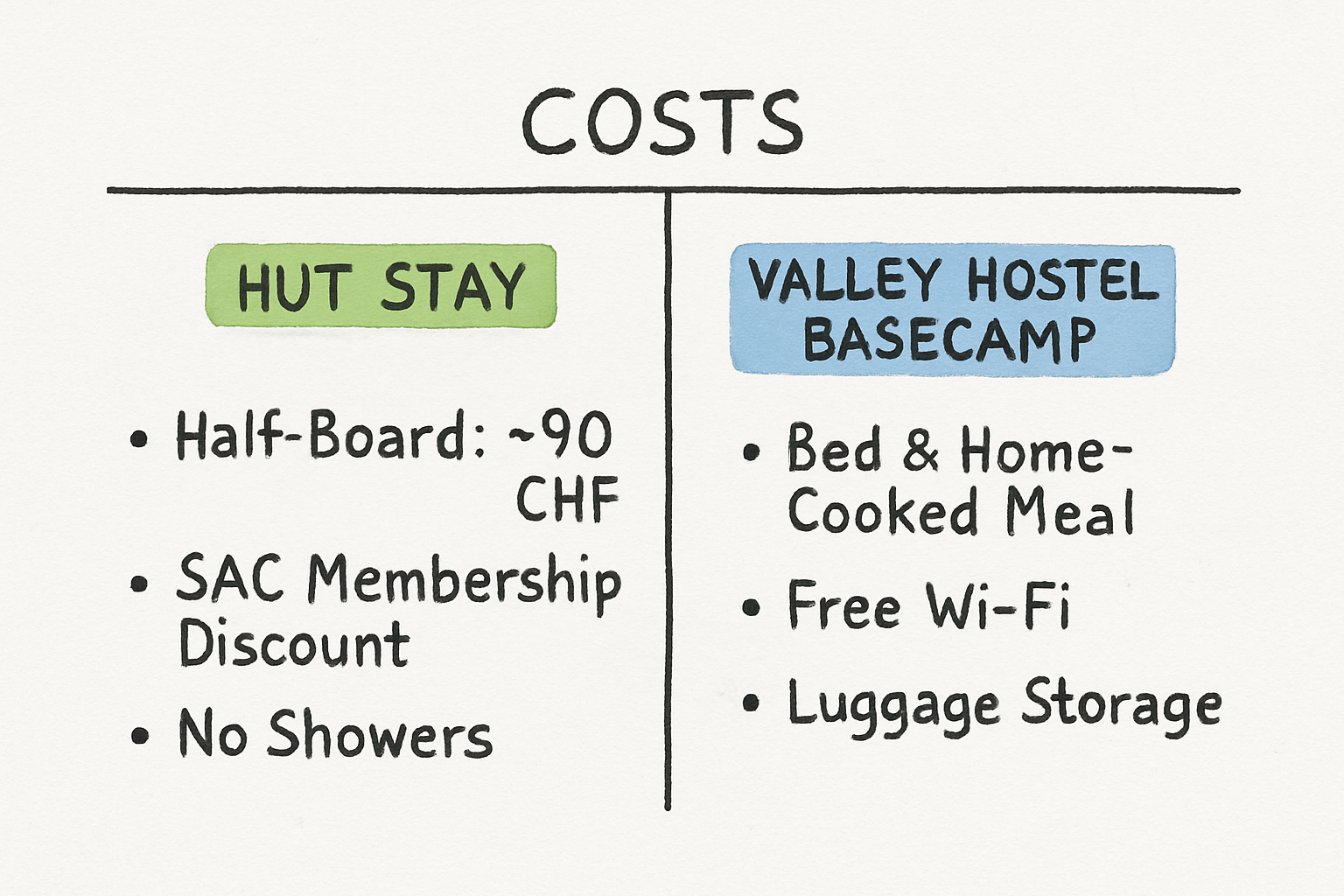
A typical overnight stay with half-board (dinner, bed, and breakfast) costs between 80 and 110 CHF per night for an adult.
What is not included is your drinking water, daytime snacks, and alcohol. Because everything must be flown in by helicopter or carried up by mules, a 1.5-liter bottle of water might cost 8 CHF, and a celebratory pint of beer can cost 7 CHF. (Note: Only buy bottled water if the hut specifies their tap water is non-potable; most huts provide safe, free drinking water from alpine springs, but always ask the warden first).
The SAC Membership Hack
If you plan to stay in SAC-owned huts for more than six nights, it is mathematically worth purchasing an annual SAC membership (approx. 85 CHF). Members receive a significant discount (usually 10-15 CHF) on their nightly stays, priority booking in some cases, and reciprocal rights in Austrian, French, and Italian alpine clubs.
Strategic Valley Stays
To balance your budget, avoid expensive luxury hotels in the valleys between your treks. As outlined in Hotels in Swiss Mountains? Why Social Lodges Beat Luxury, community-driven lodges like Ski Hostel provide the exact same access to the trails at a fraction of the cost. We include home-cooked communal dinners in our packages, allowing you to maintain the social atmosphere of the huts without the resort town price tag.
For more cost-saving strategies, read 7 Tips for Hiking in Switzerland (Without the High Cost).
Tip 6: Weather and Navigation Readiness
The Alps create their own weather systems. A morning that starts with cloudless blue skies can easily devolve into a violent, lightning-filled thunderstorm by 3:00 PM.
The Early Start
Alpine hikers operate on the “early to rise” principle for a reason. Thunderstorms in the Alps generally build up in the mid-to-late afternoon due to thermal convection. By starting your hike at 7:00 AM, you aim to be over the highest pass and safely descending toward your next hut by 2:00 PM.
Digital Navigation (SwissTopo)
Do not rely on Google Maps for alpine trails. Download the SwitzerlandMobility app or the SwissTopo app. These are the gold standards for Swiss hiking, offering incredibly detailed, offline-capable topographic maps. They show the exact color-grading of the trails, public transport connections, and live location tracking.
Even with digital maps, always carry a physical topographic map of the region and a compass. Phone batteries drain incredibly fast in cold mountain air, and as huttohuthikingswitzerland.com points out in their tour planning materials, redundancy is key to safety in the high alpine.
Tip 7: Plan Your Acclimatization and Basecamp Logistics
Hiking from hut to hut means you are constantly on the move, carrying only the essentials. But what do you do with your laptop, your clean travel clothes, and your massive suitcase while you spend a week in the mountains?
This is where a dedicated “basecamp” strategy becomes invaluable.
The Ski Hostel Basecamp Advantage
At Ski Hostel, our locations in Liddes and St. Stephan are designed specifically for this logistical challenge. When you book a stay with us before and after your trek, you solve several massive headaches:
- Acclimatization: Going from sea level straight to a 2,800m hut is a recipe for altitude sickness. Spending two days at our lodge, engaging in moderate day hikes and enjoying home-cooked Brazilian-influenced dinners, lets your body adjust to the elevation.
- Luggage Storage: Leave your heavy suitcase safely with us. You don’t need to rent expensive lockers at train stations.
- Community Intel: Our hosts, volunteers, and fellow guests act as a live information hub. You can get up-to-the-minute trail conditions, borrow a forgotten piece of gear, or even find a hiking partner over a BBQ gathering.
- Recovery: After a week of sleeping in dormitories and eating dehydrated lunches, returning to high-speed Wi-Fi, a hot shower, and a spa night at the hostel is the ultimate reward.
This basecamp model isn’t just for summer; we apply the same logic to winter sports. If you’re curious how this translates to the colder months, read Which Swiss Ski Resort Fits a Backpacker’s Budget?.
Comparing Hut vs. Valley Hiking Options
Not sure if multi-day hut hiking is exactly what you want, or if you’d prefer doing day trips from a central location? Here is a breakdown to help you decide:
| Feature | Hut-to-Hut Traverse | Basecamp Day Hiking (Ski Hostel) |
|---|---|---|
| Accommodation | Shared dormitories (8-20 beds). | Private rooms or smaller shared rooms. |
| Logistics | Must carry everything you need for the week. | Carry only a light daypack; leave heavy gear in your room. |
| Views | Wake up deep in the high alpine, above the clouds. | Beautiful valley views; requires morning transit to reach peaks. |
| Flexibility | Rigid. Must reach the next booked hut regardless of weather. | Highly flexible. Can choose a rest day, a valley walk, or an epic peak depending on the weather. |
| Cost | ~80-110 CHF/night (Half-board) + SAC membership. | Highly affordable, all-inclusive packages available. |
| Vibe | Raw, adventurous, and strictly structured. | Relaxed, highly social, "home away from home" atmosphere. |
If you want the best of both worlds, stringing together 3 days of day-hiking from our lodge followed by a 3-day hut mini-traverse is the ideal Swiss itinerary.
Frequently Asked Questions
Do I need to speak German or French?
While Switzerland has four national languages (German, French, Italian, and Romansh), English is widely spoken by hut wardens, especially on popular routes like the Haute Route or Via Alpina. However, learning a simple Grüezi (Swiss German hello) or Bonjour goes a very long way in building goodwill with the staff.
Can I hike hut-to-hut if I have dietary restrictions?
Yes, but you must communicate them in advance. When booking your bed on the SAC portal, there is usually a section for dietary needs. Huts can almost always accommodate vegetarian diets. Vegan, gluten-free, or severe allergy requirements are harder to manage due to the remote nature of the kitchens, so it is highly recommended to email or call the hut warden directly weeks in advance to confirm.
Is it safe to hike alone?
Hiking alone is common in the Swiss Alps, provided you stick to well-marked trails (T1-T3) and have the necessary experience. Because the huts are so social, solo hikers rarely feel truly alone. You will often end up hiking parallel to the same groups of people day after day. For more on finding a crew on the trail, see Mountain Mont Blanc: 7 Ways to Visit Without the Crowd.
Do I need specialized climbing gear?
For standard hut-to-hut hiking on red-and-white marked trails, no. Good hiking boots, trekking poles, and proper clothing are sufficient. If your route includes blue-and-white alpine trails or glacier traverses, you will need crampons, an ice axe, a harness, and the knowledge of how to use them (or a hired mountain guide).
The Final Ascent
Hut to hut hiking in Switzerland is more than just a physical challenge; it is an immersion into a unique alpine culture. It strips away the excess of modern travel, forcing you to focus on the rhythm of your feet, the changing of the weather, and the shared humanity of a communal dinner table at 2,500 meters.
By choosing the right route, mastering the logistics of the SAC portal, packing strictly to the 35L rule, and utilizing a strategic basecamp like Ski Hostel to anchor your trip, you eliminate the stress of planning and leave room for the awe of the mountains.
So lace up your boots, secure your sleeping liner, and get ready for the alpine start. The peaks are waiting.