Mont Blanc Mountain Cable Car: Prices & Top Photo Spots
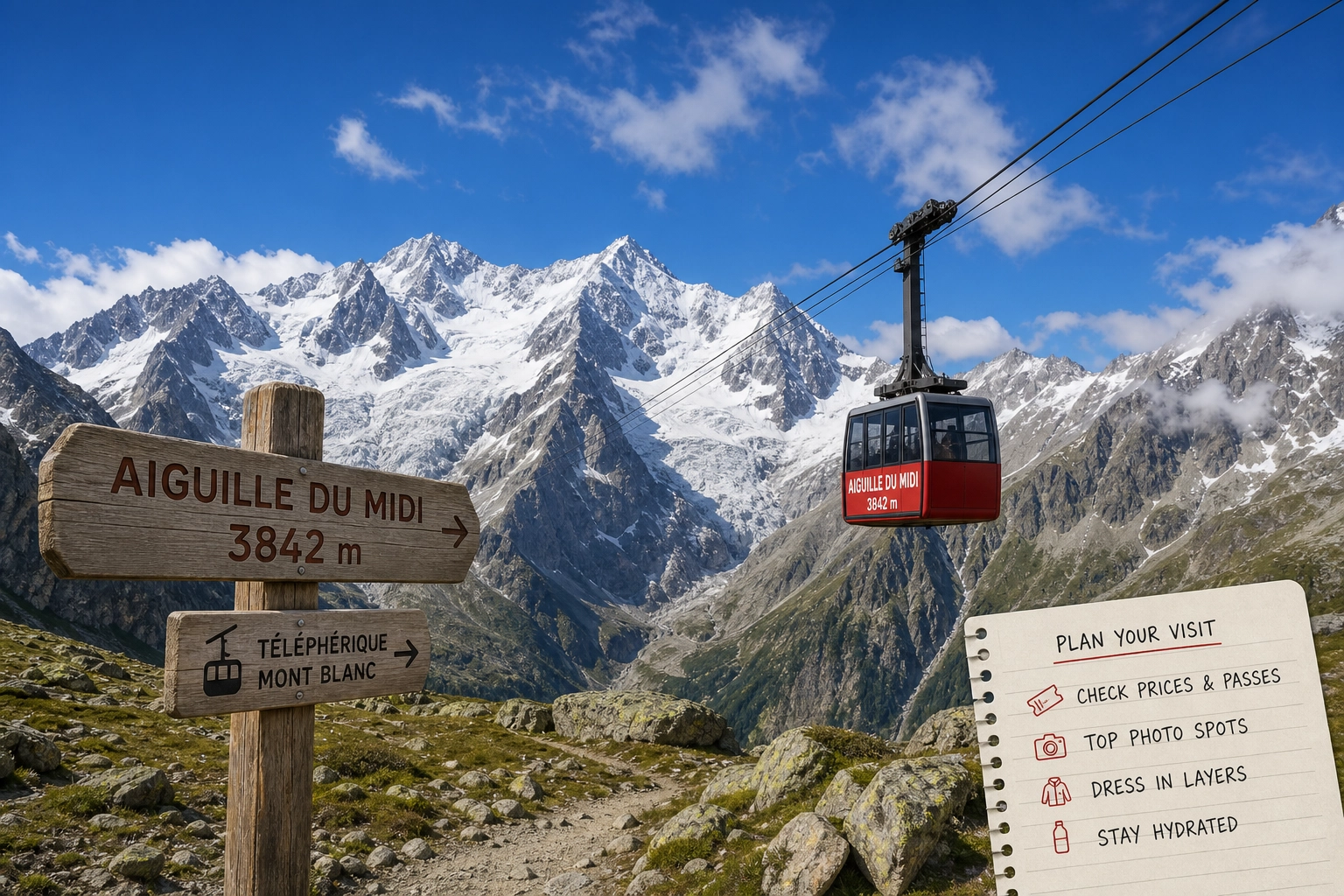
Stepping out of the Aiguille du Midi cable car at 3,842 meters hits you with three things instantly: the biting cold, the blinding glare off the glacier, and the sudden realization that the air is noticeably thinner.
Visiting the Mont Blanc massif via cable car is a bucket-list experience for international backpackers and seasoned alpinists alike. However, planning this excursion is notoriously confusing. You are dealing with multiple cable car systems, variable high-altitude weather, moving international borders, and premium ticket prices. If you just show up at the ticket counter in Chamonix without a plan, you risk spending hundreds of euros to stand in a cloud.
This guide breaks down exactly how to navigate the Mont Blanc mountain cable car system, where to find the most spectacular photo spots away from the tour groups, and how to structure your itinerary to maximize your budget.
Demystifying the Mont Blanc Cable Car Systems
Many travelers assume there is a single “Mont Blanc cable car” that takes you to the summit of the famous peak. This is a misconception. There are no cable cars to the actual summit of Mont Blanc (4,805 meters).
Instead, there are two distinct but connected cable car systems that take you high into the massif, offering unparalleled views of the peak. Understanding the difference is your first step to planning the trip.
1. The Aiguille du Midi Cable Car
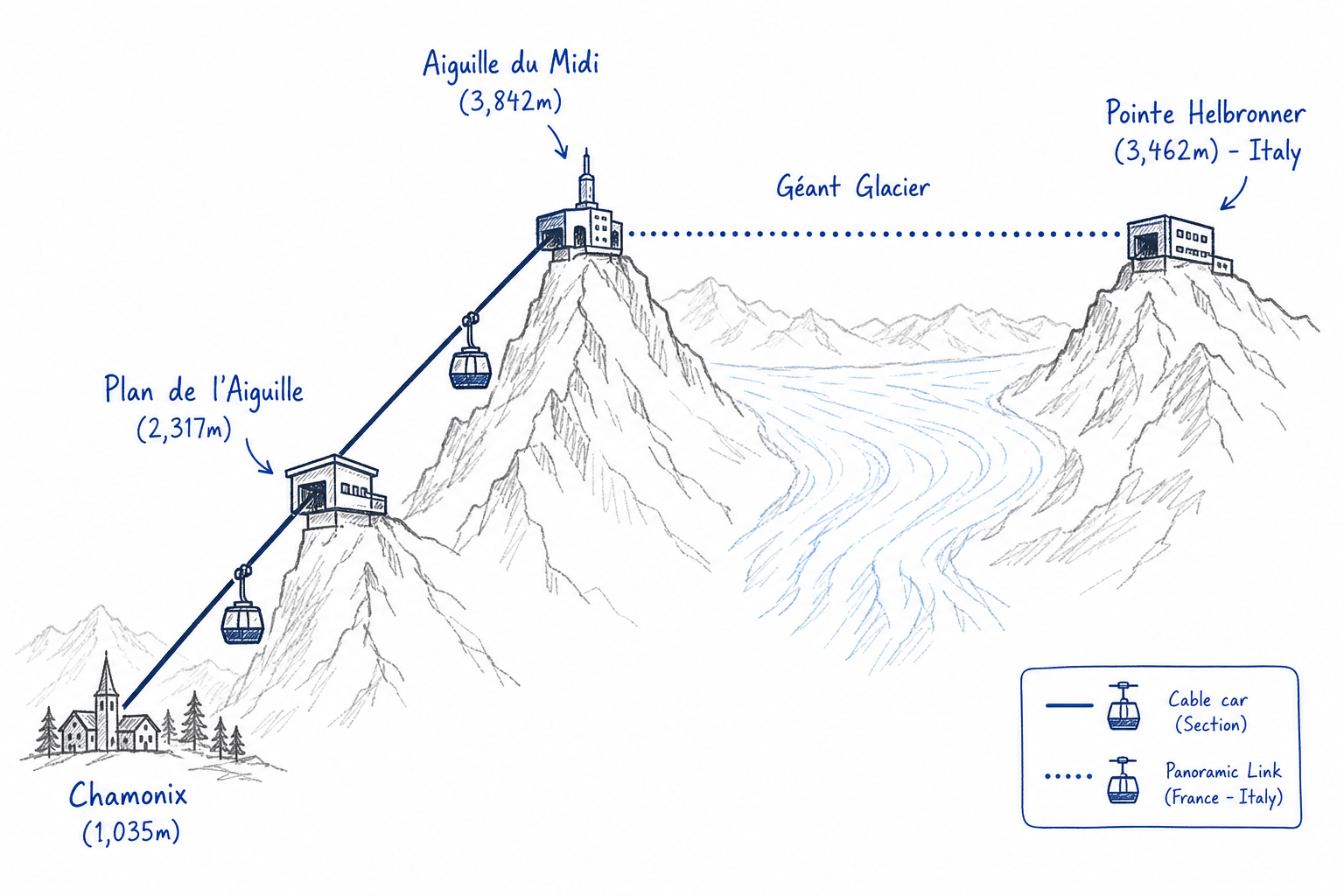
This is the main vertical ascent from the French side. Operated year-round (except for an annual maintenance period), this lift departs from the center of Chamonix and travels up to the Aiguille du Midi peak at 3,842 meters. It is a two-stage journey. You cannot ride the Panoramic Mont-Blanc without first taking the Aiguille du Midi or its Italian counterpart, the Skyway Monte Bianco.
2. The Panoramic Mont-Blanc Gondola
This is a separate, seasonal ride. Operating only from late spring to early autumn, this gondola stretches horizontally across the Géant Glacier. It connects the summit of the Aiguille du Midi in France to Pointe Helbronner in Italy. According to Wikipedia’s entry on the Vallée Blanche Cable Car, this marvel of alpine engineering travels over 5 kilometers without a single support pillar between the Gros Rognon and Pointe Helbronner.
Current Ticket Prices and Pass Options
Because you are accessing high-alpine infrastructure, tickets are a significant investment. Prices fluctuate slightly by season, but here is what budget-conscious travelers need to know to optimize their spend.
Standard Return Tickets vs. The MultiPass
If you only want to ride up to the Aiguille du Midi, take your photos, and come down, a standard return ticket is your baseline option. However, if you plan to do any other activities in the valley—such as taking the Montenvers train to the Mer de Glace or using other valley lifts—the Mont Blanc MultiPass usually pays for itself within two rides.
| Ticket Type | Best For | Typical 2026 Price Range | Inclusions |
|---|---|---|---|
| Aiguille du Midi Return | Short, focused summit visits. | €75 - €80 | Round trip from Chamonix to 3,842m. |
| Panoramic Mont-Blanc Supplement | Glacier crossing to Italy. | €35 - €40 (Paid on top of main ticket) | Round trip across the glacier to Pointe Helbronner. |
| Mont Blanc MultiPass (1-Day) | Active hikers and sightseers. | €80 - €85 | Unlimited access to Aiguille du Midi, Montenvers, and valley lifts. |
Note: Prices are approximate. You can check real-time rates and book passes via the Aiguille du Midi official booking site.
Budget Tip: If you are staying at a community lodge like Ski Hostel in the Swiss Alps, utilizing their organized border-crossing day trips to Chamonix cuts down drastically on logistics and accommodation costs, allowing you to allocate more of your budget to the MultiPass.
The Journey to 3,842 Meters: A Step-by-Step Breakdown
The ascent requires active participation. You don’t just sit in a gondola for thirty minutes. The journey is broken into distinct stages, each offering different activities and climatic changes.
Stage 1: Chamonix to Plan de l’Aiguille (2,317m)
The lower section of the cable car leaves the valley floor and climbs steeply through the pine forests. The car holds up to 70 people and ascends incredibly fast.
When you exit at the midpoint, Plan de l’Aiguille, you are in the high alpine tundra. Many visitors rush straight to the second cable car. The smarter move is to step outside for 15 minutes. This gives your lungs a slight head start on acclimatizing and offers excellent views of the Chamonix valley below. This is also the starting point for several excellent hikes, which we will cover below.
Stage 2: Plan de l’Aiguille to the Summit (3,842m)
This second leg is an engineering marvel. It is a single span of cable with no support pillars, rising straight up the sheer rock face of the Aiguille du Midi. The ascent is dramatic. As you approach the top station, the cable car swings slightly as it docks into a tunnel carved directly into the granite.
Exploring the Summit Complex
Once at the top, you are navigating a multi-level complex of terraces, tunnels, and elevators.
- The Pipe: A steel tube walkway suspended over the mountain face, allowing you to walk a full circuit around the central pinnacle.
- Le 3842 Restaurant: One of the highest restaurants in Europe. While arguably out of a typical backpacker’s daily food budget, grabbing a coffee here is a highly memorable experience.
- The Ice Tunnel: The exit point for mountaineers heading out onto the Vallée Blanche. Watching heavily geared climbers rope up and descend the narrow snow ridge is fascinating, even if you are staying safely behind the guardrails.
Top 5 Photo Spots You Can’t Miss (And How to Avoid Crowds)
Getting a clean, crowd-free shot at one of the most popular attractions in the French Alps requires strategy. The golden rule is to book the earliest possible cable car departure (usually between 6:30 AM and 8:00 AM, depending on the summer month).
1. Step into the Void (Le Pas dans le Vide)
This is a 2.5-meter glass box suspended over a 1,000-meter precipice.
- The Shot: A top-down perspective showing nothing but glass and the jagged glacier far below your feet.
- The Strategy: There is always a queue. Head straight for the summit elevator the moment you arrive at the top station to beat the mid-morning rush.
2. The Panoramic Mont-Blanc Gondola Cars
If you purchase the supplement to ride across to Italy, the gondola cars themselves provide the best photography platform.
- The Shot: Looking back at the Aiguille du Midi peak rising like a needle out of the clouds, or shooting down into the crevasses of the Géant Glacier.
- The Strategy: The gondolas operate in groups of three. Try to board the first or last car in the trio so your view isn’t obstructed by the other cars.
3. The 360° Summit Terrace
The absolute highest point you can access without crampons and an ice axe.
- The Shot: A sweeping panorama featuring Mont Blanc, Mont Maudit, and Mont Blanc du Tacul.
- The Strategy: Use a polarizing filter if you have one. The glare off the high-altitude snow can easily blow out the highlights in your photos.
4. Lac Bleu from Plan de l’Aiguille
Often overlooked by those rushing to the summit, this small alpine lake is a 15-minute walk from the mid-station.
- The Shot: The jagged peaks of the Aiguilles de Chamonix reflected perfectly in the crystal-clear water of Lac Bleu.
- The Strategy: Visit this spot on your descent. The light in the late morning or early afternoon hits the water beautifully, and it’s a great place to eat a packed lunch.
5. The Mountaineer’s Ridge
From the viewing platforms near the ice tunnel exit, you can photograph climbers beginning their ascents.
- The Shot: Tiny, colorful silhouettes roped together against the massive white expanse of the Vallée Blanche.
- The Strategy: A telephoto lens (70-200mm) is ideal here to compress the distance and show the immense scale of the landscape compared to the human figures.
Planning Your Day: Logistics, Parking, and Timetables
Logistics can make or break an alpine excursion. The Chamonix Tourist Office guide on the Aiguille du Midi strongly recommends booking your time slot days or weeks in advance during the July and August peak seasons.
Boarding Time Slots
When you buy a ticket, you are assigned a specific boarding time for the ascent. You must be in the loading zone 15 minutes prior. During busy periods, you will also be given a boarding pass with a designated return time from the summit. You generally get about 1.5 to 2 hours at the top, which is plenty of time to see the terraces and Step into the Void.
Parking in Chamonix
Chamonix traffic is notoriously congested.
- Parking du Grépon: This is the closest major lot to the Aiguille du Midi base station. It fills up rapidly by 8:30 AM.
- Courmayeur Parking: If you are visiting from the Italian side via the Skyway Monte Bianco (to connect to the Panoramic gondola), use the lots at the Skyway base in Entrèves.
The Hostel Basecamp Advantage
If you are staying at an adventure lodge like Ski Hostel in the Val de Bagnes region, navigating this is much easier. Instead of paying premium Chamonix hotel rates or fighting for parking, you can join a guided group transport. By basing yourself in a more affordable Swiss location, you can easily access mountain Mont Blanc as a day excursion while returning to a communal dinner and a more relaxed atmosphere in the evening.
Hiking Extensions: Making It an Adventure
Riding a cable car isn’t exactly a physical workout. For those wanting to stretch their legs, the mid-station (Plan de l’Aiguille) acts as a gateway to some of the most scenic trails in the valley.
The Grand Balcon Nord Route
Rather than riding the cable car back down to Chamonix, many hikers choose to disembark at the mid-station and hike the Grand Balcon Nord to the Montenvers Mer de Glace train station.
- Difficulty: Moderate
- Duration: 2.5 to 3 hours
- Why do it: This high-altitude traverse offers continuous, unobstructed views of the Chamonix valley. At the end of the trail, you can take the historic red cogwheel train down to the valley floor (covered by the Mont Blanc MultiPass).
If you want to read more about planning trail routes, check out our guide on the best hiking trails in Switzerland and nearby border regions.
The “Altitude Sickness” Myth (And Reality)
There is a persistent myth that because you are riding a cable car instead of climbing, you won’t suffer from altitude sickness.
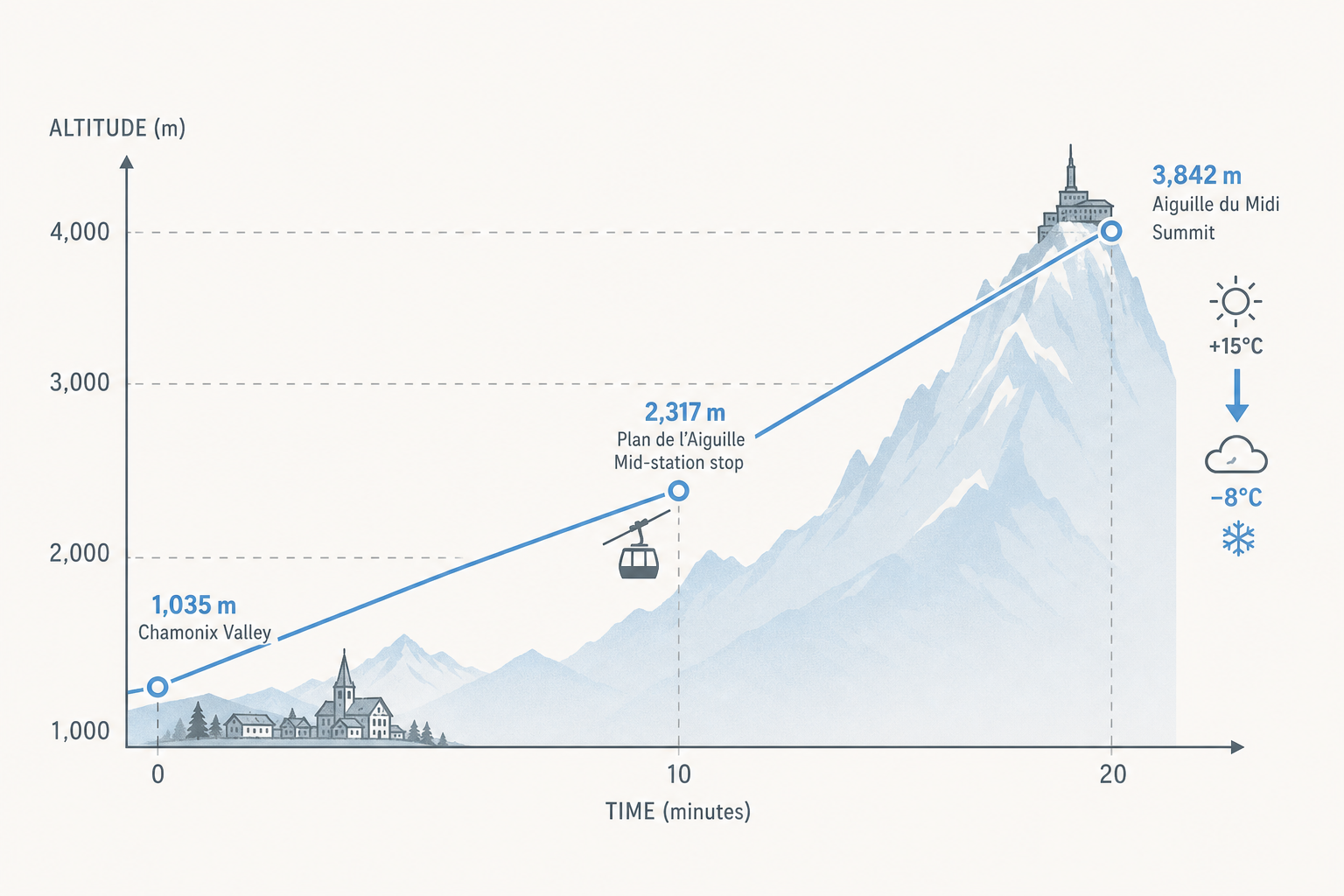
This is entirely false. In fact, rapid mechanical ascent is exactly what triggers Acute Mountain Sickness (AMS). You are traveling from 1,035 meters to 3,842 meters in roughly 20 minutes. Your body does not have time to acclimatize to the drop in oxygen pressure.
What to expect at the summit:
- Your heart rate will elevate noticeably even when standing still.
- Walking up a flight of stairs will feel like you’ve just jogged a mile.
- Slight lightheadedness or a mild headache is common after an hour.
How to mitigate it:
Drink plenty of water before you board the first cable car. Move slowly at the summit—do not run between photo spots. If you begin to feel genuinely dizzy or nauseous, the cure is immediate descent. Taking the cable car back to the mid-station will resolve mild AMS symptoms almost instantly.
What to Pack for the Ascent (Summer vs. Winter)
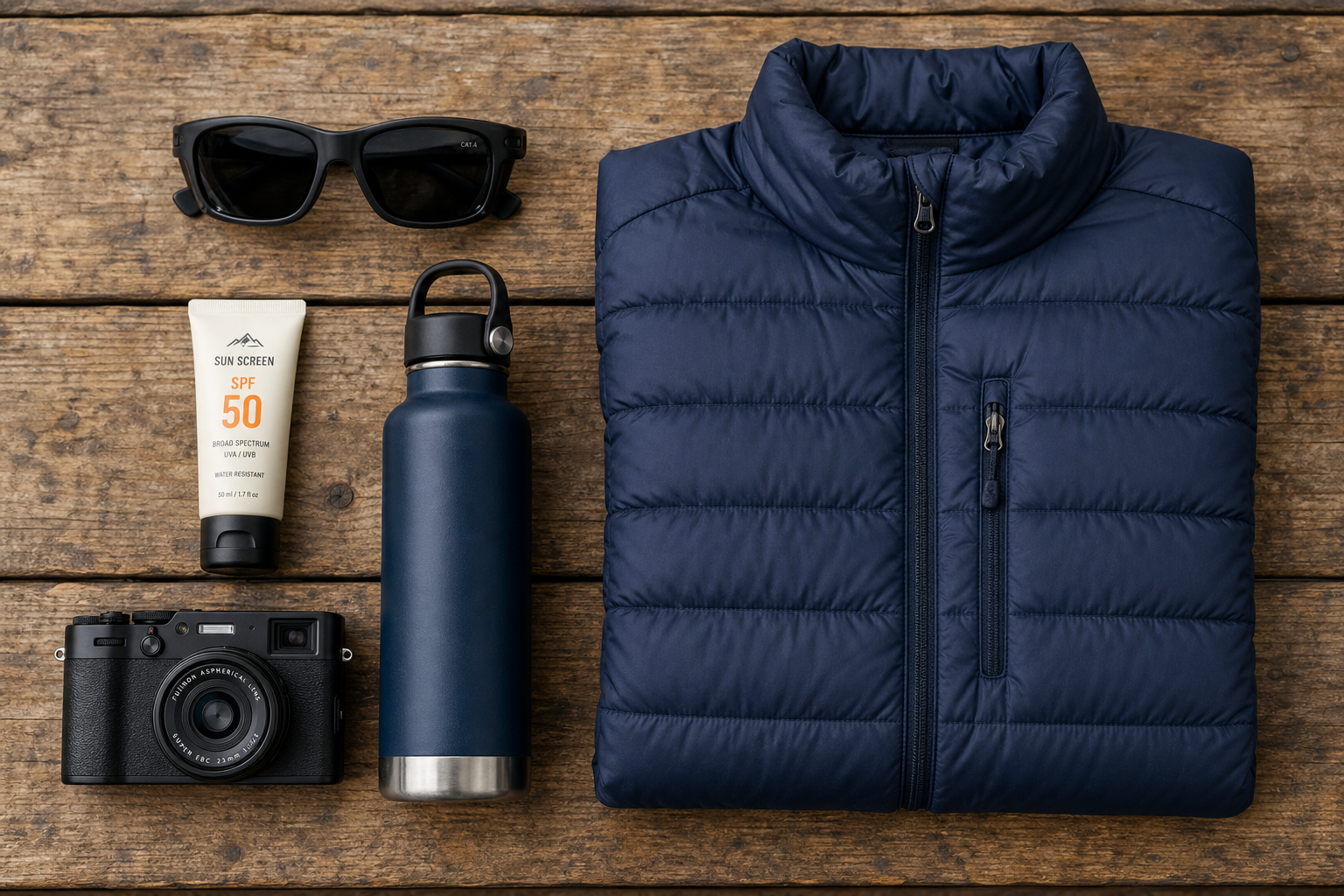
Packing for the Aiguille du Midi requires acknowledging a severe microclimate. Even in the middle of a July heatwave in the valley, the summit temperature regularly sits below freezing.
For a deeper dive on seasonal gear, refer to our Swiss Alps Summer packing guide, but here is what you absolutely must bring on the cable car:
| Item | Why It’s Mandatory | Summer | Winter |
|---|---|---|---|
| Category 4 Sunglasses | The UV radiation at nearly 4,000m reflecting off a glacier can cause snow blindness in minutes. | Required | Required |
| Insulated Jacket/Puffer | Temperatures at the summit can be 20°C (36°F) colder than in Chamonix. | Required | Required (Heavy duty) |
| Sunscreen (SPF 50+) | Thin atmosphere provides very little protection against UV rays. | Required | Required (Face/Lips) |
| Sturdy Closed-Toe Shoes | The viewing platforms are grated steel; flip-flops are a major hazard. | Required | Winter Boots |
| Water Bottle | Essential for hydration to stave off mild altitude symptoms. | Required | Thermos with hot tea |
Border Crossing: Combining Switzerland, Italy, and France
One of the most unique ways to experience the Mont Blanc cable cars is as part of a multi-country itinerary. Because the massif borders France, Italy, and Switzerland, you can easily base yourself in a quieter region and strike out for day trips.
For instance, if you want to experience the Italian side of the mountain culture, you can drive through the Mont Blanc tunnel to Courmayeur. From there, you can ride the Skyway Monte Bianco up to Pointe Helbronner and take the Panoramic Mont Blanc cable car across to France.
We regularly organize these types of logistical maneuvers for guests at Ski Hostel. Whether you want to try skiing in the Italian Alps or need guided hiking in Switzerland, treating the Tri-ent valley and Val de Bagnes as your hub provides maximum flexibility without the premium resort price tags.
Frequently Asked Questions
Do I need to book the Aiguille du Midi in advance?
Yes. During summer (June through September) and peak winter holidays, booking your boarding time online at least 3 to 5 days in advance is highly recommended. Walk-ups often face hours of waiting or find tickets sold out entirely.
Are dogs allowed on the cable car?
No. Due to the extreme altitude, tight spaces, and steep grated metal stairways, pets are strictly forbidden on the Aiguille du Midi and Panoramic Mont-Blanc lifts.
What happens if the weather is bad?
The cable cars are highly susceptible to high winds and low visibility. The operating company closely monitors conditions and will delay or cancel trips for safety. Always check the live webcam and lift status on the Mont Blanc Natural Resort app before leaving your accommodation. If the lift is closed due to weather, tickets are generally refunded or rescheduled.
Is the Panoramic Mont-Blanc gondola scary?
If you have a severe fear of heights, the Panoramic gondola might be challenging. It travels incredibly high over the glacier, and the cars do occasionally pause mid-journey to load and unload passengers at the end stations. However, the movement is generally very smooth, and the breathtaking scenery usually distracts from the sheer drop below.
Riding the Mont Blanc mountain cable car systems is an unmatched way to interact with the high alpine environment. By understanding the ticket structures, preparing for the altitude, and timing your visit to secure the best photo spots, you can transform what is often a stressful tourist trap into a highlight of your European mountain adventure. Ensure you book ahead, pack your layers, and most importantly, remember to stop and actually look at the mountains through your own eyes, not just your camera lens.