Skiing in the Italian Alps? Try This Aosta Day Trip
There is a specific moment during a cross-border ski trip when you realize you have hacked the system. You wake up in a cozy, timber-framed Swiss adventure lodge, strap your skis to the roof rack, and drive through a tunnel. Thirty minutes later, the language on the road signs flips, the architecture softens, and suddenly you are ordering a rich, crema-topped espresso that costs less than half of what you paid for your morning coffee.
Skiing in the Italian Alps offers a distinct rhythm compared to its Alpine neighbors. Where French mega-resorts prioritize ski-in/ski-out concrete convenience, and Swiss resorts lean into hyper-efficient luxury, Italy embraces la dolce vita on the slopes. Lunch is not a rushed sandwich on a chairlift; it is a sit-down affair with fontina-drenched polenta, heavy glass goblets of local Nebbiolo, and sunshine.
For digital nomads, budget-conscious backpackers, and families looking for a mountain experience that prioritizes social connection over sterile luxury, the Italian Alps are a revelation. But booking a week-long stay in a high-end Italian resort isn’t your only option. In fact, one of the best ways to experience Italian skiing is by using a community-driven Swiss basecamp—like Ski Hostel in the Val de Bagnes region—and executing tactical, border-crossing day trips.
Here is your comprehensive guide to skiing the Italian Alps, with a specific focus on why the Aosta Valley day trip is the ultimate adventure hospitality hack.
The Geography of Italian Skiing: A Quick Primer
Before we dive into the Aosta day trip, it is crucial to understand the layout of the Italian Alps. Italy boasts over 200 ski resorts scattered across its northern border, broadly divided into two major zones: the Western Alps and the Eastern Alps (The Dolomites).
The Eastern Alps: The Dolomites
When most international travelers search for Italian skiing, they picture the Dolomites. Located in the northeast (covering South Tyrol, Trentino, and Veneto), this region is famous for its sheer, pale-rock pinnacles that turn pink at sunset. The Dolomiti Superski pass is legendary, offering access to 1,200 kilometers of interconnected pistes. Resorts like Cortina d’Ampezzo and Selva di Val Gardena offer stunning scenery and rich Tyrolean-Italian culture.
However, for a quick strike from a Swiss basecamp, the Dolomites are geographically impractical. If you are deeply interested in dedicating a full week to the eastern side, moonhoneytravel.com offers excellent insights into skiing the Dolomites. But for those who want the flexibility of skiing multiple countries in a single trip, you need to look west.
The Western Alps: The Aosta Valley
The Aosta Valley (Valle d’Aosta) is Italy’s smallest region, tucked into the northwest corner where Italy, France, and Switzerland collide. It is a deeply incised glacial valley surrounded by the highest peaks in Europe: Mont Blanc (Monte Bianco), the Matterhorn (Cervino), Monte Rosa, and Gran Paradiso.
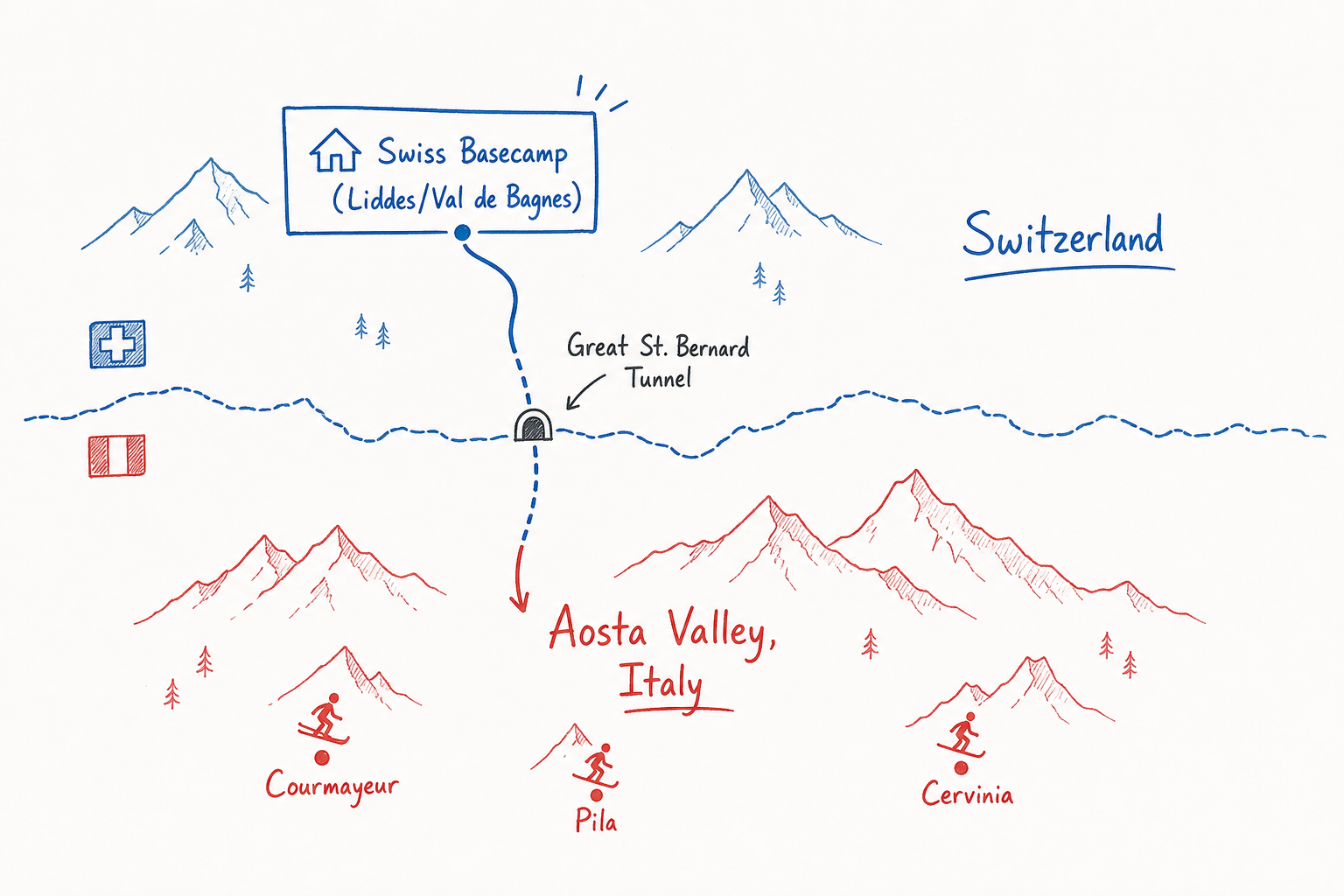
Because of its strategic location, Aosta is the undisputed champion of the cross-border ski trip. From a base in the Swiss Liddes or Val de Bagnes regions, Aosta is accessible via the Great St. Bernard Tunnel. This geographic loophole allows you to sleep in Switzerland, ski in Italy, and be back in time for a communal BBQ dinner at your hostel.
Why the “Swiss Basecamp, Italian Day Trip” Strategy Wins
You might wonder: If Italian skiing is so great, why not just stay there?
You certainly can. Many travelers book all-inclusive stays deep in the Italian valleys. However, there are a few structural reasons why a hybrid approach—basing at a Swiss adventure lodge and day-tripping to Italy—provides a superior experience for socially motivated, budget-conscious travelers.
- The Community Vibe: Traditional Italian mountain accommodation heavily skews toward either expensive luxury chalets or isolated, family-run pensiones. While charming, they lack the “hub” atmosphere. Social lodges like Ski Hostel provide a curated weekly adventure program, high-speed Wi-Fi for remote workers, and shared spaces designed for international backpackers. You get the social lodge experience rather than sterile luxury.
- Weather Flexibility: The Alps create massive weather divides. A blizzard might be hammering the northern (Swiss) side of the mountains, causing whiteout conditions, while the southern (Italian) side of the Aosta Valley is basking in bluebird sunshine. Having a Swiss base with a vehicle gives you the tactical advantage to “chase the sun” across the border.
- Cost Control: While Italian lift passes and food are cheaper, Italian resort accommodation during peak season is not. By staying in a budget-friendly, all-inclusive Swiss hostel that manages your transport and gear, you lock in your major costs. You can read more about finding a Swiss ski resort that fits a backpacker’s budget to understand how regional pricing works.
- Variety of Terrain: A Swiss basecamp in Liddes gives you direct access to Swiss freeride meccas (like Verbier/4 Vallées) and Italian groomers. You never get bored of the same mountain.
The Top Aosta Valley Ski Resorts for a Day Trip
If you are making the jump across the border for the day, you need a resort that delivers immediate impact. Here is a breakdown of the best targets in the Aosta region.
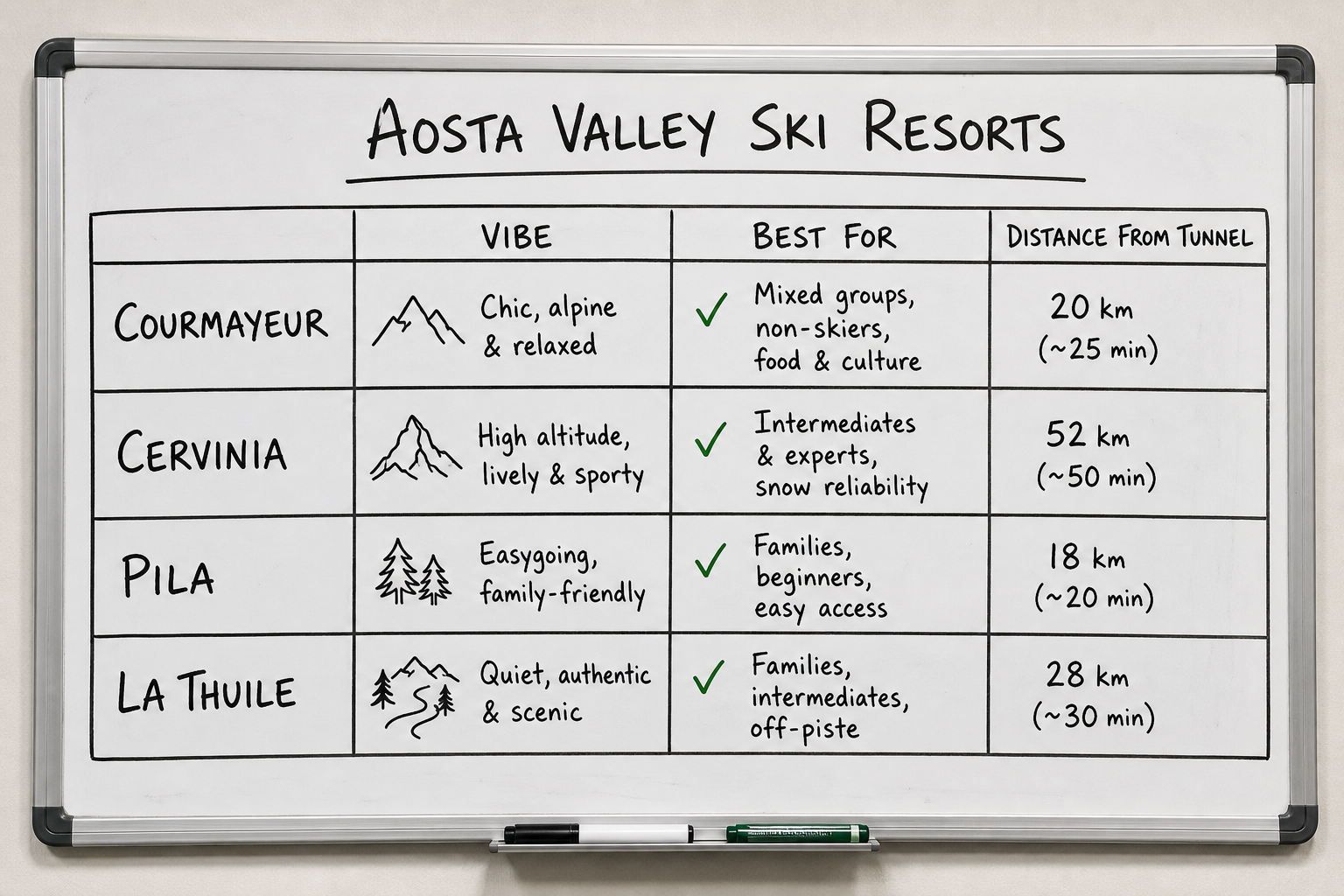
1. Courmayeur: Style, Sun, and Mont Blanc
Located at the Italian end of the Mont Blanc Tunnel, Courmayeur is the glamorous sister to France’s Chamonix. But where Chamonix is known for extreme, shaded, north-facing steeps, Courmayeur offers sunny, wide-open bowls and a decidedly more relaxed atmosphere.
- The Vibe: Chic but accessible. The pedestrianized town center is filled with high-end boutiques, but the slopes are welcoming to all.
- The Terrain: The piste skiing is predominantly intermediate (red runs), making it fantastic for cruising. For experts, the real draw is the off-piste access via the Skyway Monte Bianco, offering massive vertical descents back down to the valley.
- Day Trip Viability: High. It’s an easy drive down the Aosta highway once you exit the St. Bernard tunnel.
- Pro Tip: If you want to experience the sheer scale of the region without necessarily skiing extreme lines, look into alternative ways to experience Mont Blanc without the crowds.
2. Cervinia (Breuil-Cervinia): Where Beginners Become Skiers
Cervinia sits on the Italian side of the Matterhorn, sharing a massive ski domain with Switzerland’s Zermatt. However, the skiing here feels completely different from its Swiss counterpart.
- The Vibe: High altitude, stark, and expansive. The architecture in the village is functional rather than charming, but you are here for the snow.
- The Terrain: European skiers frequently note on forums like Reddit that Cervinia is arguably the best place in Europe for beginners to transition into intermediates. The runs are incredibly long, wide, and gently pitched. You can ski for miles without encountering a terrifying drop-off.
- Day Trip Viability: Moderate. It requires driving further up a winding valley road from Aosta town, adding about 45 minutes to your journey from the tunnel.
3. Pila: The Ultimate Quick Strike
Pila is the unsung hero of the Aosta Valley, especially for day-trippers. Unlike most resorts where you have to drive up a treacherous mountain pass, Pila is accessed via a fast, 18-minute gondola ride that departs directly from the city of Aosta itself.
- The Vibe: Local, sporty, and pragmatic. This is where the residents of Aosta go for their weekend turns.
- The Terrain: Surrounded by forests, Pila offers excellent tree skiing when visibility is poor, and perfectly pitched red runs that hold their grooming beautifully due to a north-facing aspect.
- Day Trip Viability: Extremely High. You park in a massive lot at the valley floor right off the highway, hop in the gondola, and you are skiing.
4. La Thuile: The Quiet Cross-Border Giant
La Thuile links with the French resort of La Rosière to form the Espace San Bernardo. It is notoriously snowy, catching weather systems from multiple directions.
- The Vibe: Sleepy, unpretentious, and wild.
- The Terrain: It features some genuinely steep black runs dropping through the trees back into the village, alongside vast, open intermediate bowls up high.
- Day Trip Viability: Moderate. It sits higher up in a side valley, meaning the drive can be slow if it is actively dumping snow.
The Logistics: Crossing the Border in Winter
Pulling off a seamless cross-border ski day requires a bit of logistical finesse. If you are staying at an organized adventure lodge, the host and volunteers often manage the transport and itinerary, taking the stress out of the equation. However, if you are planning the details yourself, here is what you need to know.
The Route: Great St. Bernard Pass vs. Tunnel
In the summer, driving the Great St. Bernard Pass is a spectacular, winding journey past the famous hospice (home of the St. Bernard rescue dogs). However, in winter, the pass is buried under meters of snow and completely closed to vehicles.
Your only route is the Great St. Bernard Tunnel (Tunnel du Grand Saint-Bernard).
- Cost: There is a toll for the tunnel (around €30-€45 each way, or cheaper if you buy a return ticket). Factor this into your daily budget.
- Time: The tunnel is roughly 6 kilometers long. From a base in Liddes, you can be through the tunnel and descending into the Aosta Valley in under 30 minutes.
- Border Control: Switzerland is in the Schengen Area but not the EU customs union. Italy is in both. There is a physical border checkpoint at the tunnel. Always pack your physical passport or national ID card. Random checks are common, and forgetting your ID will end your ski day before it begins.
Gear and Preparation
Moving between microclimates means you need to be prepared for anything. The Swiss side might be -10°C, while the Italian side could be a balmy +2°C.
While packing for winter requires heavier gear, the principles of modular layering remain the same year-round. Much like preparing for a Swiss Alps summer, your ski daypack should rely on a robust base layer, a versatile mid-layer, and a reliable shell.
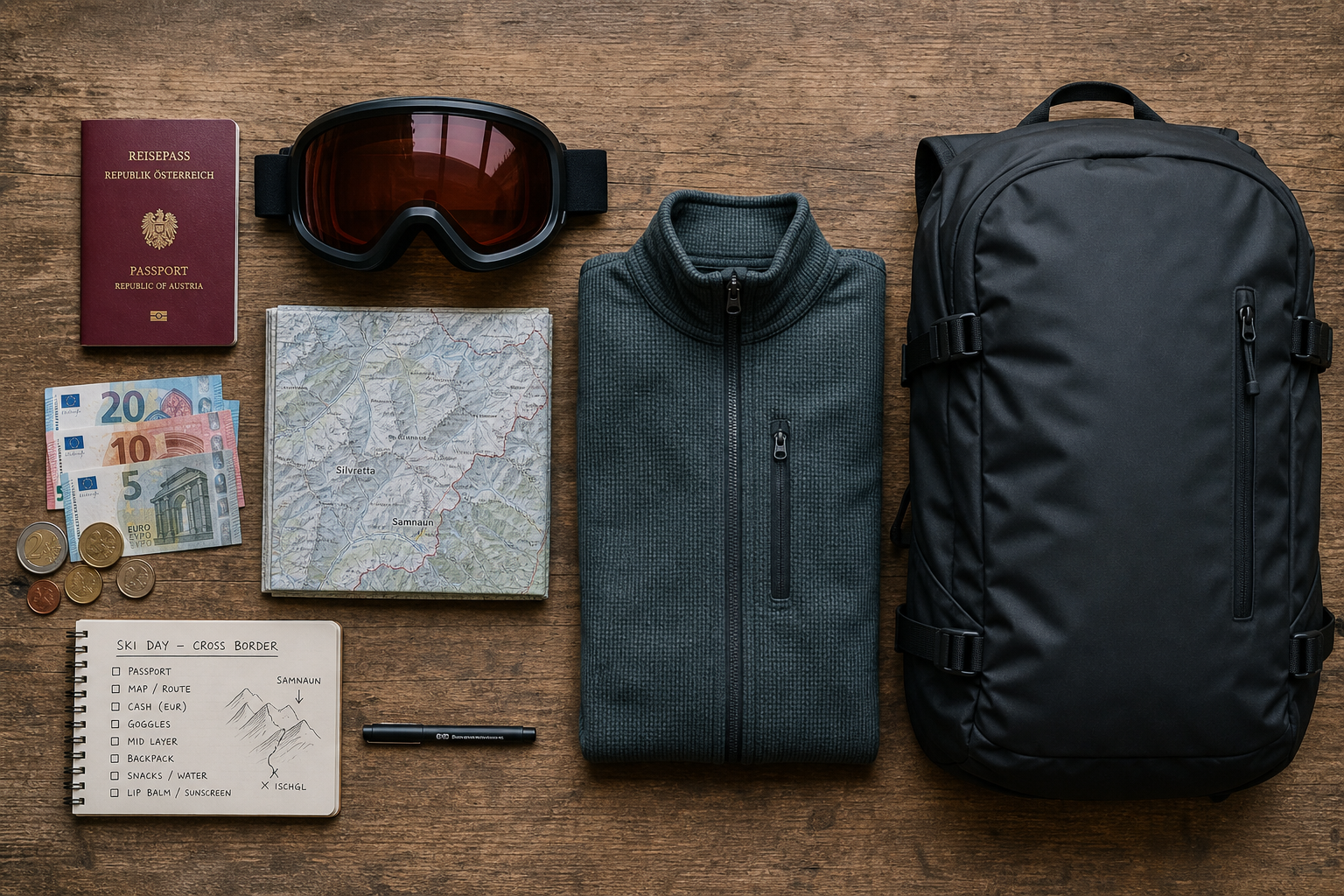
Cross-Border Day Trip Checklist:
- Passport / Valid ID.
- Euros (While most Italian mountain huts accept cards, Wi-Fi can drop. Having €50 in cash ensures you can always buy lunch).
- International roaming activated on your phone (Switzerland and Italy have different telecom networks; ensure your data plan covers both seamlessly).
- Sunglasses (Italian resorts often have south-facing terraces perfect for midday lounging).
The Culture of Italian Slope-Side Dining
You cannot discuss skiing in the Italian Alps without dedicating serious time to the food. In many Alpine countries, mountain restaurants hold a captive audience and serve overpriced, mediocre cafeteria food. Italy aggressively bucks this trend.
According to rankings from Snow Magazine, the culinary scene is a primary driver for Italian ski tourism. Mountain huts (rifugios) are often family-owned, serving recipes passed down through generations.
When day-tripping to Aosta, structure your ski day around lunch. Ski hard from 9:00 AM to 1:00 PM, then sit down for a proper hour-and-a-half meal. Here is your Italian ski food glossary:
- Polenta Concia: A regional Aosta specialty. Coarse cornmeal slow-cooked and heavily folded with local Fontina cheese and butter. It is dense, incredibly high in calories, and perfect fuel for a cold day.
- Lardo di Arnad: Cured pork fatback infused with herbs. Served in paper-thin slices that melt on warm bread. Do not skip this.
- Bombardino: The legendary Italian après-ski drink. It is a hot, thick mixture of Advocaat (egg liqueur) and brandy, topped with a mountain of whipped cream. It looks like a dessert but hits like a freight train.
- Espresso: Ordered at the bar, consumed standing up. It will cost you €1.50, and it will be infinitely better than the €6 machine-drip coffee across the border.
Debunking Italian Ski Myths
If you talk to enough international backpackers or read enough travel forums, you will encounter a few persistent stereotypes about skiing in Italy. Let’s separate fact from fiction.
Myth 1: “The Snow Quality is Worse in Italy”
False (mostly). The Italian Alps lie south of the main Alpine ridge. Weather systems in the Alps generally come from the northwest (favoring France and Switzerland) or the south (favoring Italy). While it is true that northern slopes preserve snow better in the late spring due to less sun exposure, Italy frequently receives massive “Return from the East” or Mediterranean storm cycles that completely bypass Switzerland. Furthermore, Italian ski resorts—particularly in the Dolomites and Aosta—possess arguably the most advanced and extensive snowmaking infrastructure in the world.
Myth 2: “Italian Lift Queues are Chaotic”
Nuanced. Historically, Italian lift lines were infamous for a lack of organized queuing, resembling a localized rugby scrum. However, modern lift infrastructure (especially in Aosta resorts like Courmayeur and Pila) relies on high-speed chairlifts and gondolas that chew through crowds efficiently. Weekdays are generally deserted. On busy weekends, simply employ a bit of polite assertiveness.
Myth 3: “It’s Only for the Wealthy”
False. While destinations like Cortina d’Ampezzo attract the Milanese elite, the Aosta Valley is incredibly pragmatic. Lift passes are generally 20-30% cheaper than equivalent resorts in France or Switzerland. If you manage your accommodation costs by staying at a budget-friendly hostel and cooking communal dinners, the actual skiing component in Italy is highly affordable.
Integrating Skiing with Summer Alpine Skills
For many digital nomads and outdoor enthusiasts, a winter trip to the Alps is just a precursor to a summer return. The terrain you ski in the Aosta Valley in February transforms into some of the most spectacular hiking and mountain biking trails in Europe by July.
The communal nature of an adventure lodge means you are likely sharing a ski lift with people who know the summer trails intimately. The logistics of organizing a winter day trip translate perfectly to summer excursions. If you thrive on the social dynamic of a shared ski trip to Aosta, you will likely benefit from finding the right mountain bike group for alpine trails or learning how to organize guided hiking in Switzerland when the snow melts.
Furthermore, the multi-day stamina you build crushing 4,000 meters of vertical descent on skis is exactly the physical baseline required to tackle hut-to-hut hiking in Switzerland. The mountains demand respect year-round, and the cross-border logistical skills you learn in winter pay dividends in summer.
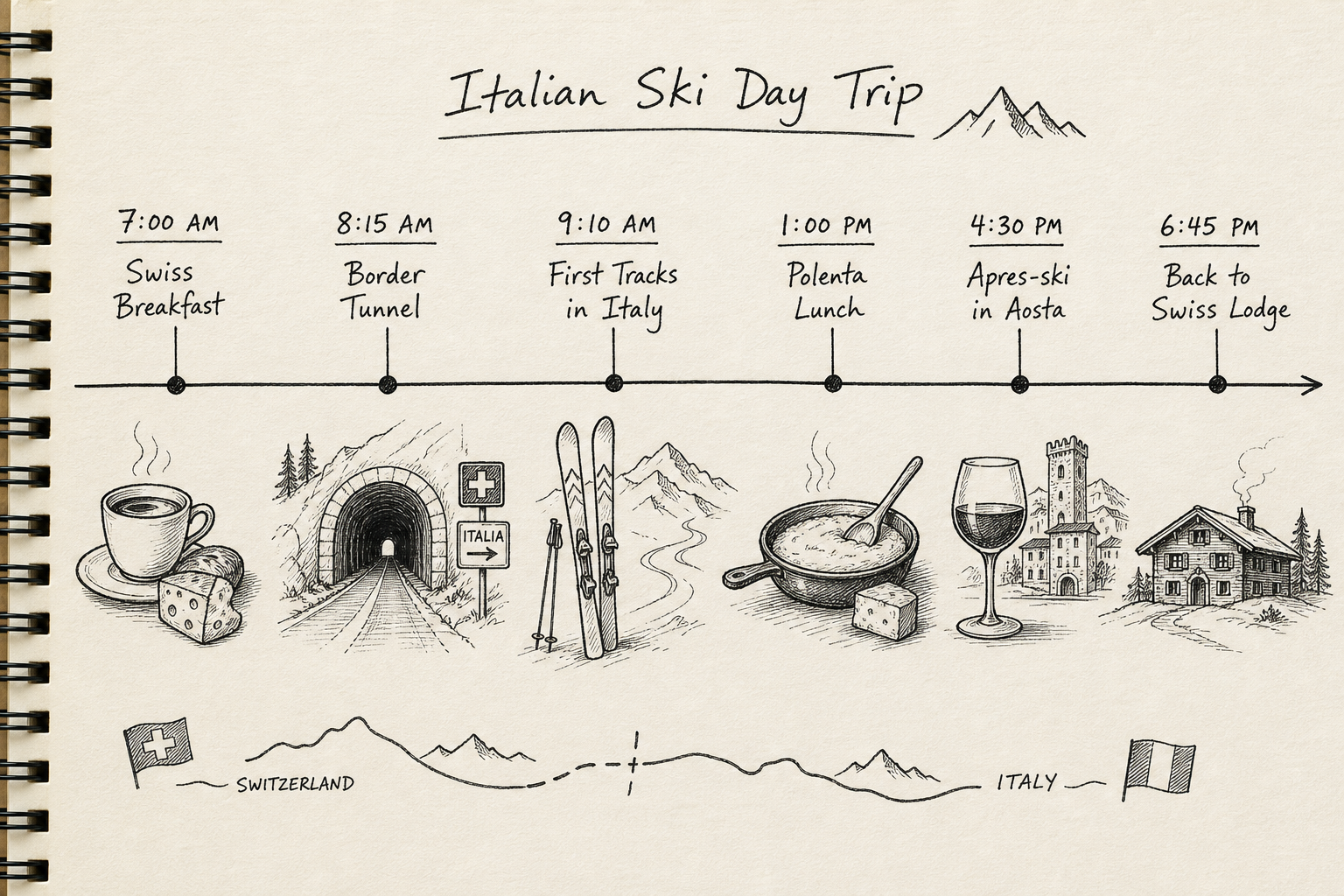
Timeline of a Perfect Aosta Ski Day
To prove just how accessible this is, here is what a typical curated day trip looks like when operating out of a Val de Bagnes / Liddes basecamp:
- 07:00 AM: Wake up at the hostel. Communal breakfast. Double-check your pack for passport, euros, and goggles.
- 07:45 AM: Load the hostel van. Drive south up the valley toward the Great St. Bernard Pass.
- 08:15 AM: Enter the tunnel. Clear border control.
- 08:45 AM: Arrive at the Aosta Valley floor. Pull into the Pila gondola parking lot.
- 09:10 AM: First tracks. The sun is cresting the ridge, illuminating Mont Blanc in the distance.
- 11:00 AM: Stop for a mid-morning espresso and a pistachio croissant at a mid-station rifugio.
- 01:00 PM: Lunch time. Find a sun-drenched terrace. Order Polenta Concia and a glass of local Torrette wine.
- 03:30 PM: The shadows lengthen. Ski the long, sweeping red run back down to the gondola mid-station.
- 04:30 PM: Après-ski in Aosta town. Walk among Roman ruins (Aosta is known as the “Rome of the Alps” due to its well-preserved Roman walls and theater) while sipping an Aperol Spritz.
- 06:00 PM: Back in the van. Through the tunnel.
- 06:45 PM: Arrive back at the Swiss lodge. Boots on the drying rack. Join the communal dinner (perhaps a Brazilian-influenced stew prepared by the host) and swap stories with hikers, remote workers, and fellow skiers.
Final Thoughts on the Borderlands
Skiing in the Italian Alps does not have to mean committing to a single, expensive resort for an entire week. By treating the border as an opportunity rather than a barrier, you open up a massive geographic playground.
Basing yourself in a Swiss community-driven lodge offers the best of both worlds: the camaraderie, reliable logistics, and stunning freeride terrain of the Swiss side, combined with the culinary excellence, sunny disposition, and budget-friendly appeal of an Italian day trip.
Whether you are a solo traveler looking to link up with a group for a trip to Courmayeur, or a digital nomad wanting to ski Pila in the morning and work on high-speed Wi-Fi in the afternoon, the Aosta Valley strike mission is an alpine tactic you will want to repeat year after year. Pack your passport, wax your skis, and prepare for the best mountain lunch of your life.