
Hiking Mont Blanc Mountain from Italy (The Aosta Route)
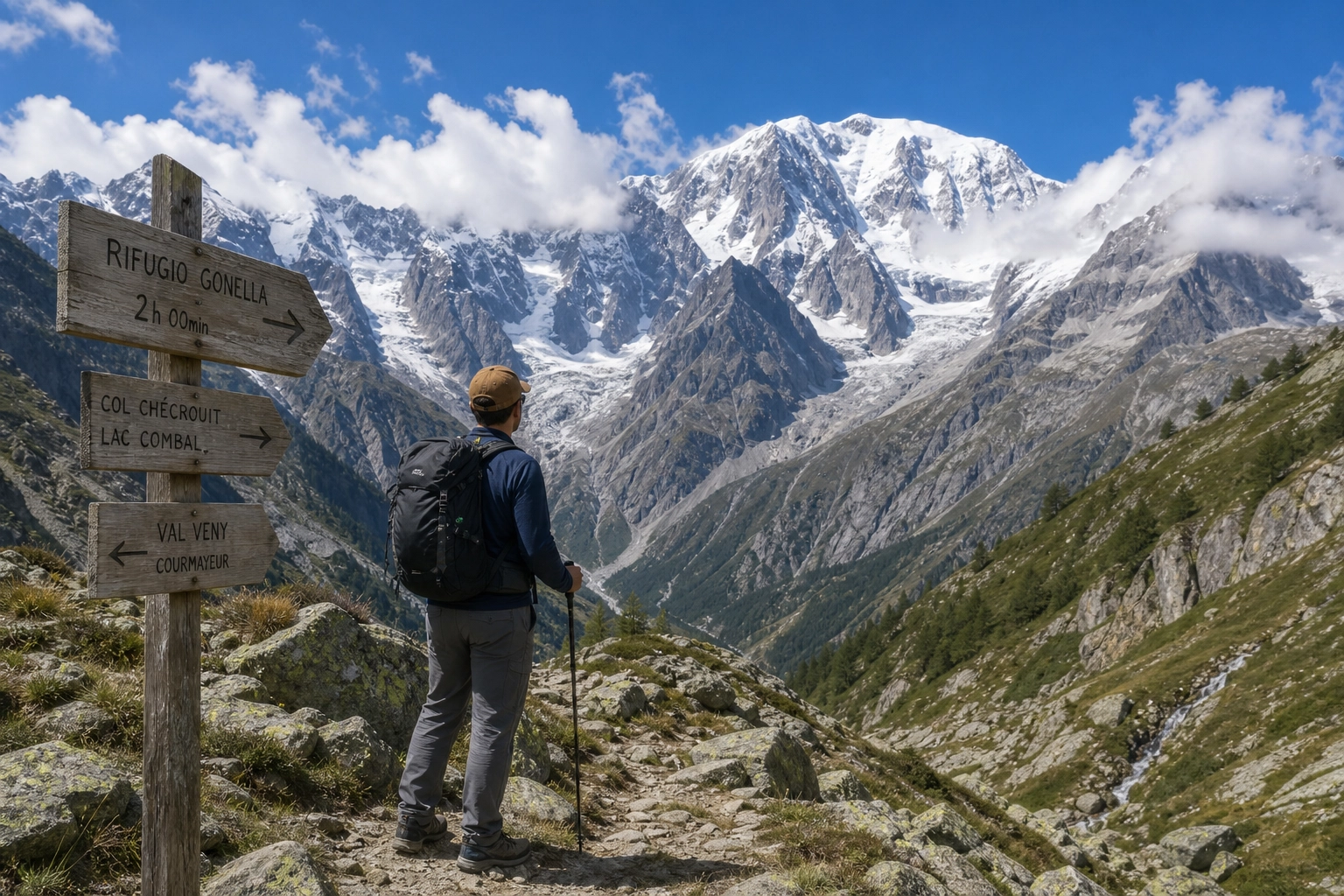
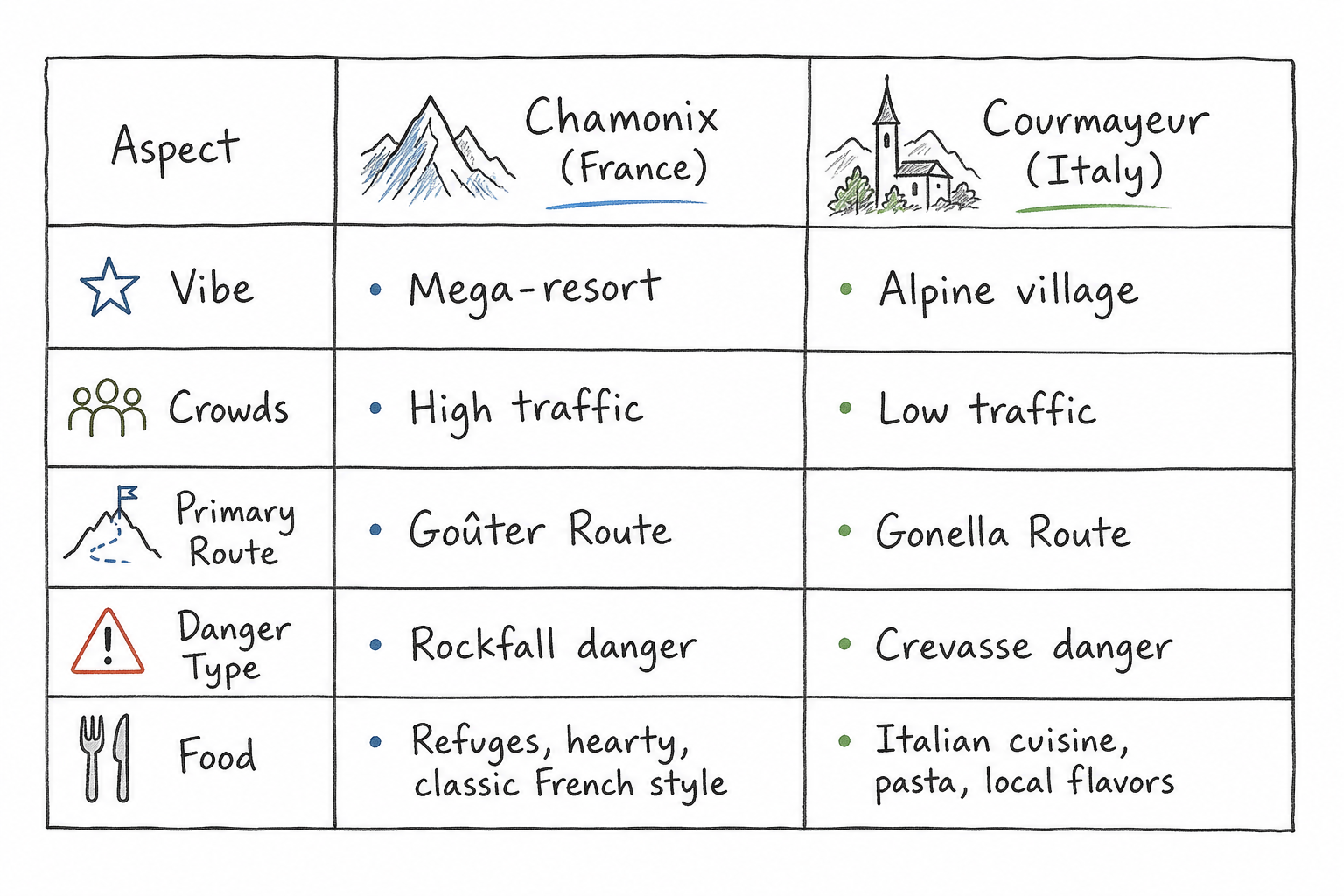
If you tell a climber you are heading to Mont Blanc, they will almost certainly picture you standing in the chaotic, gear-laden streets of Chamonix, France. They will imagine you queuing for the Aiguille du Midi cable car, fighting for space in crowded French refuges, and navigating the notorious rockfall of the Grand Couloir on the Goûter route.
But there is another side to the massif. Literally.
Cross the border into the Aosta Valley, and Mont Blanc becomes Monte Bianco. The sprawling commercial infrastructure fades, replaced by the rugged, sun-drenched flanks of the Italian Alps. The gateway shifts from a mega-resort to the sophisticated yet understated alpine village of Courmayeur. Most importantly, the trails swap human traffic congestion for raw, technical wilderness.
At Ski Hostel, our base in the Swiss Alps sits perfectly positioned for cross-border alpine travel. While we spend plenty of time in our local Val de Bagnes, we regularly run group excursions over the Grand St. Bernard pass into Italy. Why? Because for budget-conscious backpackers, solo travelers, and digital nomads seeking a genuine mountain experience, the Italian side of Mont Blanc offers a wilder, more authentic, and arguably safer alpine environment than its famous French counterpart.
This guide breaks down exactly how to hike Mont Blanc mountain from Italy, whether you are tackling the balcony trails of the Aosta Valley or roping up for a summit push via the historic Gonella Route.
The Dual Identity: Monte Bianco vs. Mont Blanc
Before you pack your boots, you need to understand the geography and the politics of the mountain you are visiting. The massif forms a natural border between France and Italy, but the exact ownership of the 4,805-meter summit has been disputed for centuries.
France claims the peak lies entirely within its territory, citing maps drawn during the French Revolution. Italy maintains the border runs directly through the highest point, based on the 1860 Treaty of Turin.
For the modern hiker, this geopolitical quirk creates two distinct cultures on the same mountain.
The French side (Chamonix) is characterized by massive glaciation that flows gently down into the valley, making it relatively accessible. It is heavily developed, highly commercialized, and designed to push maximum volume up the mountain.
The Italian side (Courmayeur) is a towering, near-vertical wall of granite. The elevation gain from the valley floor to the summit is steeper and more abrupt. Because the terrain is harder to develop, it has remained far less commercialized. The glaciers here, such as the Brenva and the Miage, are jagged, debris-covered, and intimidating.
If you want to read more about avoiding the primary tourist traps across the whole massif, you can check out our guide on Mountain Mont Blanc: 7 Ways to Visit Without the Crowd.
Why the Italian Flanks Offer Better Trekking
The standard narrative in mountaineering circles is that if you want an easy summit, you go to France. If you want a real adventure, you go to Italy.
This reputation stems from the physical reality of the routes. The standard French ascents (the Goûter and the Trois Monts) are less technically demanding but plagued by objective hazards. The Goûter route forces climbers to cross the Grand Couloir, informally known as “Death Gully,” where melting permafrost causes unpredictable and deadly rockfalls daily.
The Italian routes, conversely, are physically longer and technically more demanding, requiring serious crevasse navigation and mixed rock climbing. However, they are vastly less exposed to random rockfall. You are trading objective danger (things falling on you) for subjective danger (your own physical limits and technical skill).
But you do not need to be pushing for the summit to benefit from the Italian side. For those hiking the famous Tour du Mont Blanc (TMB), the Aosta Valley segments offer the most dramatic views of the trip. From the Italian balcony trails, you look directly up at the sheer south face of the massif, an unbroken wall of rock and ice that rises 3,000 meters straight up from the valley floor.
Basecamp Aosta: Starting in Courmayeur
If Chamonix is the capital of extreme sports, Courmayeur is the capital of alpine lifestyle. Tucked at the top of the Aosta Valley, just south of the Mont Blanc Tunnel, Courmayeur feels like a traditional mountain village that happens to sit beneath Europe’s highest peak.
Getting There
For our Ski Hostel community based in Switzerland, reaching Courmayeur is a scenic journey. We usually drive down through the Great St. Bernard Pass (or take the tunnel in winter), dropping into the historic city of Aosta before winding our way up to Courmayeur. The journey takes roughly 1.5 to 2 hours.
For backpackers relying on public transit, you can take a bus from Aosta directly to Courmayeur, or cross over from Chamonix via the Mont Blanc Tunnel bus (though tunnel tolls make this pricier).
The Aosta Vibe and Costs
Courmayeur is known as a luxury destination for Italians from Milan and Turin, but backpackers can easily navigate it on a budget. The trick is to avoid the high-end boutiques on Via Roma and focus on the valley’s incredible, hearty gastronomy.
Aosta Valley food is heavy, caloric, and cheap—perfect for hikers. Instead of expensive French tartiflette, look for local polenta concia (polenta baked with copious amounts of butter and Fontina cheese) or wild boar ragù. You can easily find small trattorias tucked away in the side streets where a massive plate of pasta and a quarter-liter of house wine will cost you less than a basic sandwich in Chamonix.
If you happen to be visiting us during the colder months, the Aosta Valley also offers incredible budget-friendly winter sports. Read our breakdown on Skiing in the Italian Alps? Try This Aosta Day Trip for winter logistics.
Choosing Your Route: Hiking the Italian Flanks
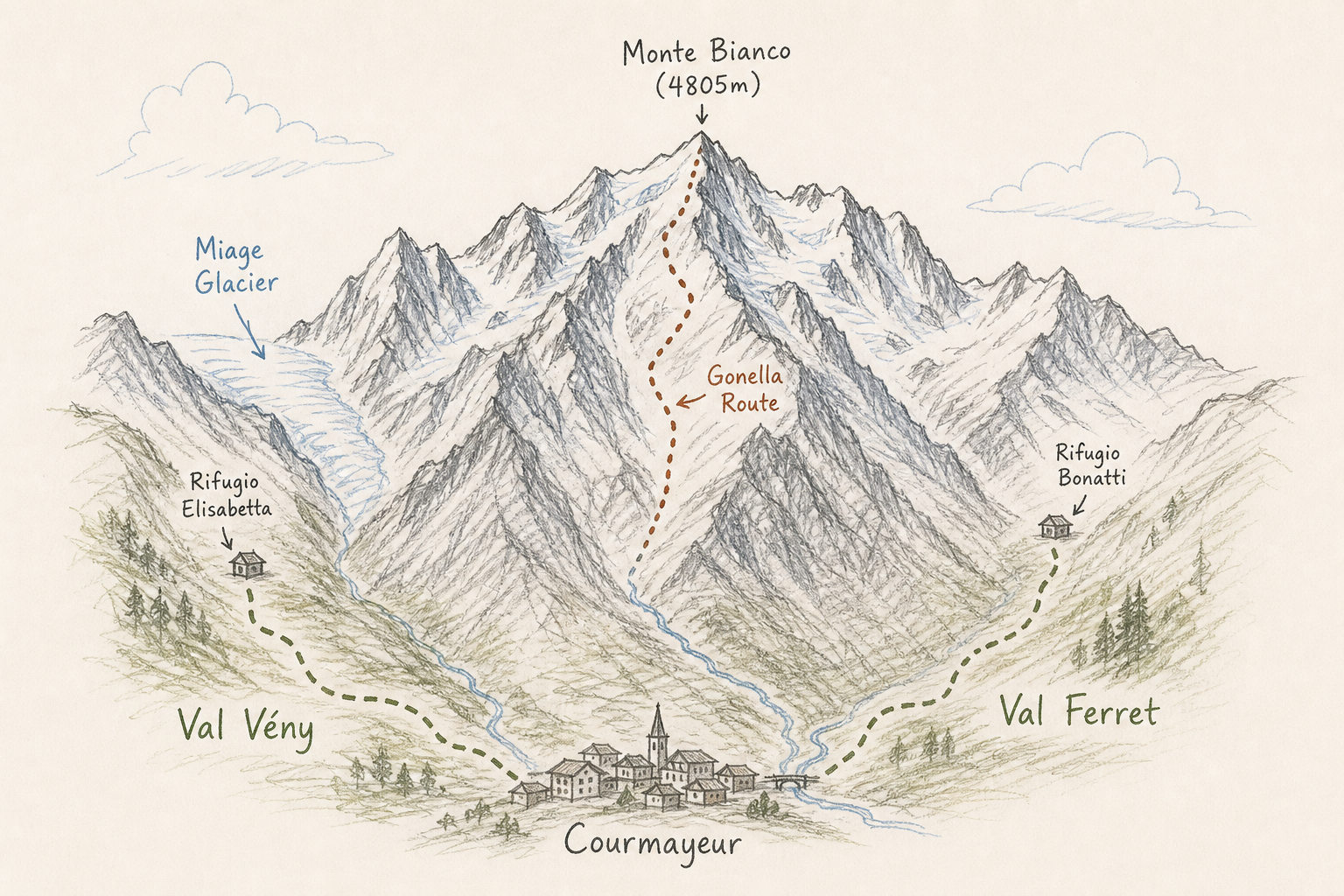
The beauty of Monte Bianco is that it accommodates everyone from casual day-hikers to elite alpinists. The Aosta Valley splits into two distinct lateral valleys at the foot of the mountain: Val Ferret to the northeast and Val Vény to the southwest.
Here is how to choose your objective based on your experience level.
1. The Low-Altitude Balcony: Val Ferret (Beginner to Intermediate)
If you want world-class views without roping up or navigating glaciers, the Val Ferret balcony trail is arguably the best day hike in Europe. This path forms a segment of the Tour du Mont Blanc.
Starting from the village of Planpincieux, you hike up through larch forests to the Rifugio Walter Bonatti (2,025m). From here, the trail runs horizontally along the side of the valley. Across the narrow gorge, the entire Mont Blanc massif is laid out in front of you, including the terrifying, sheer rock face of the Grandes Jorasses.
- Distance: ~12km round trip.
- Elevation Gain: ~600m.
- Vibe: Highly social, popular with international TMB hikers, well-marked, and safe.
2. The Mid-Altitude Glacier Approach: Val Vény (Intermediate)
Val Vény feels much wilder than Val Ferret. It is darker, narrower, and dominated by the massive Miage Glacier, which pushes a wall of rock and debris right down to the road.
A classic hike here starts at the road’s end at La Visaille. You hike up a closed alpine road past the glacial moraine to the vast, flat wetlands of Lac de Combal. From there, a steep climb takes you to Rifugio Elisabetta (2,195m), perched on a rocky outcrop beneath the Lex Blanche and Tré la Tête glaciers.
- Distance: ~15km round trip.
- Elevation Gain: ~700m.
- Vibe: Rugged, desolate, and heavily influenced by glacial geology. You will hear the ice cracking and groaning across the valley.
3. The High-Altitude Challenge: The Gonella Route (Advanced Alpinists Only)
If your goal is the absolute summit of Monte Bianco, and you refuse to use the crowded French routes, the historic Italian normal route is the way to go. Known as the “Pope Route” (because Achille Ratti, who later became Pope Pius XI, climbed it in 1890), it is a serious mountaineering endeavor.
The approach alone is a grueling multi-hour trek up the debris-covered Miage glacier to the Rifugio Francesco Gonella (3,071m), which sits like an eagle’s nest on a rocky spur.
Summit day begins at midnight. Climbers must navigate a heavily crevassed section of the Dôme Glacier in the dark, ascending steep snow slopes to reach the Col des Aiguilles Grises. From there, a long, exposed, razor-thin snow ridge connects to the main summit at 4,805m.
- Requirements: A hired IFMGA mountain guide, crampons, ice axe, crevasse rescue knowledge, and excellent cardiovascular fitness.
- Why do it? You will likely see fewer than 20 people on summit day, compared to the 200+ attempting the French side.
Skyway Monte Bianco & Rifugio Torino
Not every trip up the mountain requires physical suffering. Even purist hikers utilize the remarkable engineering of the Italian side to gain quick access to the high-alpine zone.
While France has the famed Aiguille du Midi, Italy has the Skyway Monte Bianco. Opened in 2015 after a €110 million construction project, this cable car is a marvel of modern engineering. The cabins rotate 360 degrees as they ascend, ensuring everyone gets a panoramic view of the changing landscape.
The lift departs from Courmayeur (1,300m), stops at the mid-station of Pavillon du Mont Fréty (2,173m), and terminates at Punta Helbronner (3,466m).
Stepping out at Punta Helbronner is a shock to the system. You are immediately thrust into a world of permanent ice and thin air. From the viewing deck, you can look straight across the Géant Glacier to the summit of Mont Blanc.
For mountaineers, Punta Helbronner is the access point for Rifugio Torino (3,375m). Built on a rocky outcrop, this high-altitude hut is the starting point for dozens of technical climbing routes, including the traverse of the Aiguilles d’Entrèves and the ascent of the Dent du Géant (The Giant’s Tooth).
Even if you aren’t an elite climber, you can hire a guide to take you on a roped glacier walk from Rifugio Torino across the Vallée Blanche. Walking among the massive, blue-tinted crevasses is an experience that cannot be replicated on standard dirt trails.
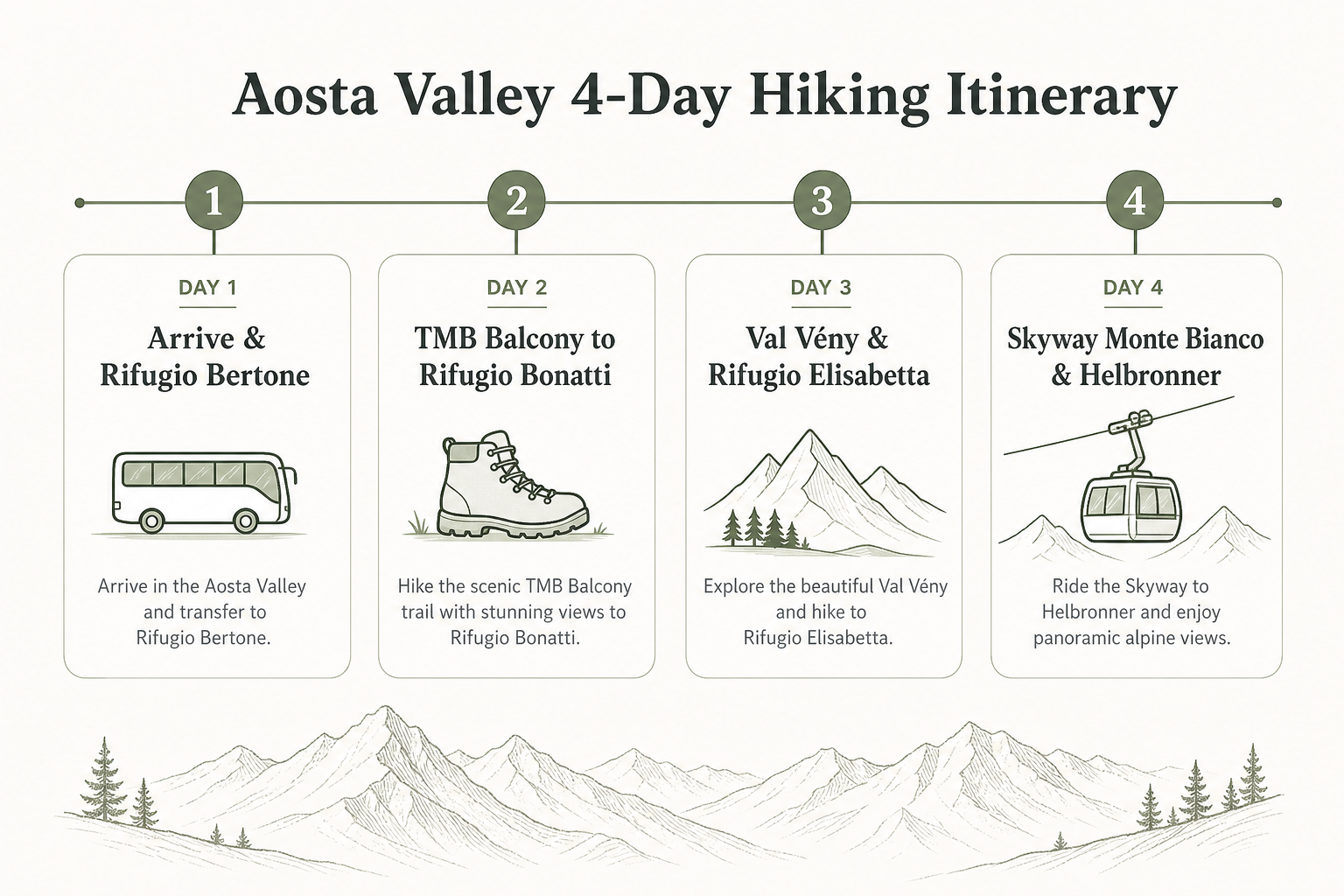
A Practical Itinerary: A 4-Day Aosta Adventure
At Ski Hostel, we structure our cross-border itineraries to maximize acclimatization, scenery, and group bonding. Here is a proven 4-day blueprint for budget-conscious hikers wanting to experience the Italian side without committing to a dangerous summit push.
Day 1: Arrival and The Balcony Warm-Up
- Morning: Travel to Courmayeur. Drop heavy luggage at a budget guesthouse or campsite in the valley.
- Afternoon: Take the local bus to Planpincieux in Val Ferret. Hike up to Rifugio Bertone (1,989m).
- Evening: Enjoy a massive communal dinner at the hut. This is where you meet other international hikers and digital nomads. Watch the sunset turn the Grandes Jorasses a vibrant pink (the “Alpenglow”).
Day 2: The TMB High Trail to Bonatti
- Morning: Leave Bertone and hike the high variant of the TMB. This undulating trail stays high above the valley floor, offering uninterrupted views of the Mont Blanc massif’s Italian face.
- Afternoon: Arrive at Rifugio Walter Bonatti. This is widely considered one of the finest mountain huts in the Alps, complete with hot showers and incredible food.
- Evening: Review the map for tomorrow’s valley transfer.
Day 3: Glacial Geology in Val Vény
- Morning: Descend steeply back to the valley floor and catch the bus through Courmayeur to the opposite valley, Val Vény.
- Afternoon: Hike from La Visaille up the moraine to Lac de Combal. The landscape here is stark and lunar. Continue up to Rifugio Elisabetta for the night.
- Evening: Sit on the stone terrace and watch the icefalls of the Lex Blanche glacier.
Day 4: The Roof of Europe
- Morning: Descend Val Vény early and head directly to the Skyway Monte Bianco base station.
- Midday: Ride the rotating cabins up to Punta Helbronner (3,466m). Spend two hours at altitude, visiting the crystal museum and walking the secure viewing platforms.
- Afternoon: Descend, grab a final celebratory pizza in Courmayeur, and begin the journey back to your base (or back to us at Ski Hostel in Switzerland).
Packing for the Italian Side of Mont Blanc
Packing for the Aosta Valley requires acknowledging a unique microclimate. The Mont Blanc massif acts as a massive weather shield. Atlantic storms rolling in from the west dump their moisture on the French side, leaving the Italian side distinctly drier and sunnier.
However, a sunny day at 2,500 meters still demands respect. High-altitude winds over the ridges can drop the perceived temperature below freezing even in July.
If you are sticking to the valley hikes (Val Ferret, Val Vény) and staying in huts:
- Footwear: Sturdy, broken-in trail runners or lightweight hiking boots. You do not need heavy mountaineering boots for the TMB segments.
- Layers: A merino wool base layer, a mid-weight fleece, and a high-quality Gore-Tex shell. Leave the heavy winter down jackets at home, but bring a packable synthetic puffy.
- Sun Protection: Category 3 or 4 sunglasses, SPF 50 lip balm, and a wide-brimmed hat. The UV radiation bouncing off the Italian glaciers is intense.
- Hut Gear: A lightweight silk sleeping bag liner (mandatory in all alpine huts), earplugs (crucial for dormitories), and a headlamp.
If you want a more comprehensive breakdown of how to pack light for the region, review our Swiss Alps Summer: A Simple 5-Step Packing Guide.
Navigating Logistics: Transport, Huts, and Costs
A common misconception is that because Italy is generally cheaper than Switzerland or France, a Mont Blanc trip from Courmayeur will cost pennies. The reality is more nuanced.
Courmayeur itself is a premium destination. However, the mountain huts (Rifugios) operate on a fixed-price system that heavily favors budget travelers. A night in a dormitory with “half-board” (a massive multi-course dinner and a basic breakfast) typically costs between €60 and €85.
To keep costs down, avoid buying lunches at the high-altitude restaurants. Instead, buy local cheese, cured meats, and bread from a bakery in Aosta or Courmayeur before heading up the trail.
Booking huts on the Italian side requires serious forward planning. Huts like Bonatti and Elisabetta lie directly on the Tour du Mont Blanc route, meaning they book out months in advance for the July and August peak season. If you are struggling with the booking systems, read our guide on How to Plan Hut to Hut Hiking in Switzerland (7 Tips), as the etiquette, timelines, and booking strategies are identical across the border.
The Ski Hostel Advantage: Guided Excursions
Coordinating transport to Italy, booking popular refuges, and deciding whether a trail is safe given current glacial conditions can be overwhelming for a solo traveler. This is exactly why we integrated cross-border excursions into our Ski Hostel model.
We handle the logistics so you can focus on the hiking. Our volunteer-led vans take the stress out of navigating the winding mountain passes, and our community-driven approach means you never have to hike alone unless you want to.
More importantly, having a built-in social group completely changes the dynamic of an alpine trip. Sharing a hard-won view of the Brenva Glacier with friends, followed by a communal dinner back at the lodge, beats sitting alone in a crowded, expensive Chamonix hotel room every time.
If you are a solo traveler nervous about tackling the Alps alone, check out our advice on Guided Hiking in Switzerland: Finding Your Social Group.
Overcoming the Environment: Climate Change on the Masiff
You cannot write a guide about Mont Blanc today without addressing the rapid environmental changes occurring on its flanks. The Italian side, facing south and catching the brunt of the Mediterranean sun, is experiencing dramatic glacial retreat.
The Miage Glacier, which you hike alongside in Val Vény, is covered in a thick layer of rock and debris. This debris historically insulated the ice, but rising summer temperatures are causing rapid internal melting. Glacial lakes that existed a decade ago have vanished, and the trails that cross the moraines must be rerouted frequently due to instability.
For hikers tackling the Gonella route to the summit, the shrinking of the Dôme Glacier has turned late-summer ascents into a dangerous game of crevasse roulette. Twenty years ago, the Italian route was viable into September. Today, local guides often refuse to guide the Gonella route after mid-July due to open, uncrossable crevasses and collapsing snow bridges.
If you plan to do any high-altitude hiking, check local conditions with the Courmayeur guide office (Società delle Guide Alpine di Courmayeur) the week of your trip. The mountains are moving faster than the guidebooks can be printed.
Frequently Asked Questions (FAQ)
Is the summit of Mont Blanc in France or Italy?
Legally, it depends on who you ask. France claims the entire summit based on Revolutionary-era maps, while Italy claims the border splits the summit precisely in half based on the 1860 Treaty of Turin. Practically speaking, both countries share administrative and rescue duties on the mountain, and hikers can cross the summit freely without passport checks.
Do I need a mountain guide for the Italian side?
If you are hiking the valley trails (Val Ferret, Val Vény) or the Tour du Mont Blanc segments, you do not need a guide. The trails are well-marked and heavily trafficked. However, if you are stepping onto a glacier, attempting the Gonella summit route, or doing the Vallée Blanche crossing from Skyway Monte Bianco, an IFMGA-certified guide is absolutely mandatory for safety.
Can a beginner hike Mont Blanc from Italy?
A beginner cannot climb to the summit of Mont Blanc from Italy—the routes are highly technical and require serious mountaineering experience. However, a beginner can absolutely hike the lower flanks of the mountain. The Val Ferret balcony trail to Rifugio Bonatti is perfectly suited for fit beginners and offers some of the best views in the entire Alps.
The Final Ascent
The Italian side of Mont Blanc is not for the hiker who wants convenient selfies, paved trails, and a Starbucks at the base station. It demands a bit more logistical effort, a tolerance for rugged terrain, and a respect for the raw power of the high Alps.
But the rewards are immense. By starting in Aosta, you bypass the industrial-scale tourism of the northern flanks. You trade stressful queues for sprawling alpine meadows, and overpriced resorts for humble, historic refuges serving honest local food.
Whether you are joining us at Ski Hostel for a curated cross-border adventure or strapping on your backpack to tackle the TMB solo, Monte Bianco awaits. Just remember to pack your sun cream, practice your Italian greetings, and prepare for the steepest, most awe-inspiring granite walls in Europe.