Hiking Hostel vs Eurohike
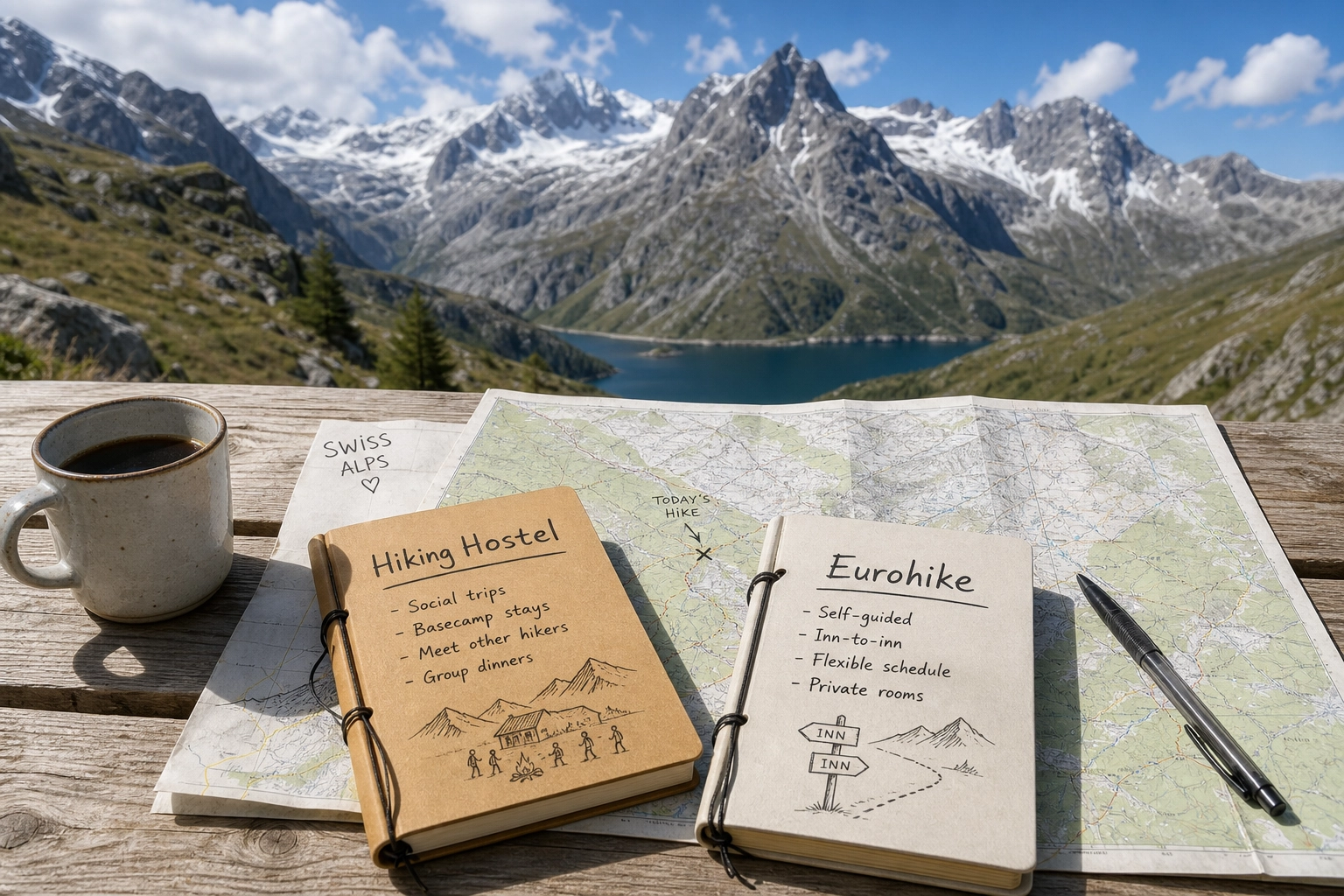
If you want to hike the Swiss Alps without the eye-watering price tag, you quickly discover that fully guided luxury tours run anywhere from $5,000 to $8,000 per week. To bring that cost down, most hikers turn to self-guided package operators.
Eurohike is the undeniable giant in this space. They offer inn-to-inn, self-guided walking holidays that bundle your accommodations, breakfast, route maps, and daily luggage transfers for roughly $1,900 to $2,300. It is a highly efficient, well-oiled machine for hiking the Via Alpina or the Bernese Oberland.
But for solo travelers, backpackers, and digital nomads, the traditional inn-to-inn model has a few structural flaws. Single supplements destroy your budget. Moving hotels every single morning gets exhausting. And hiking self-guided means you miss out on the social dynamics that make group travel so rewarding.
This is where the “basecamp” model comes in. By setting up at a central hub—like the programs offered by Hiking Hostel in Liddes and St. Stephan—you get a dramatically different alpine experience. You trade the daily hotel hopping for a stationary home base, organized daily trail transport, bundled meals, and a built-in community of fellow hikers.
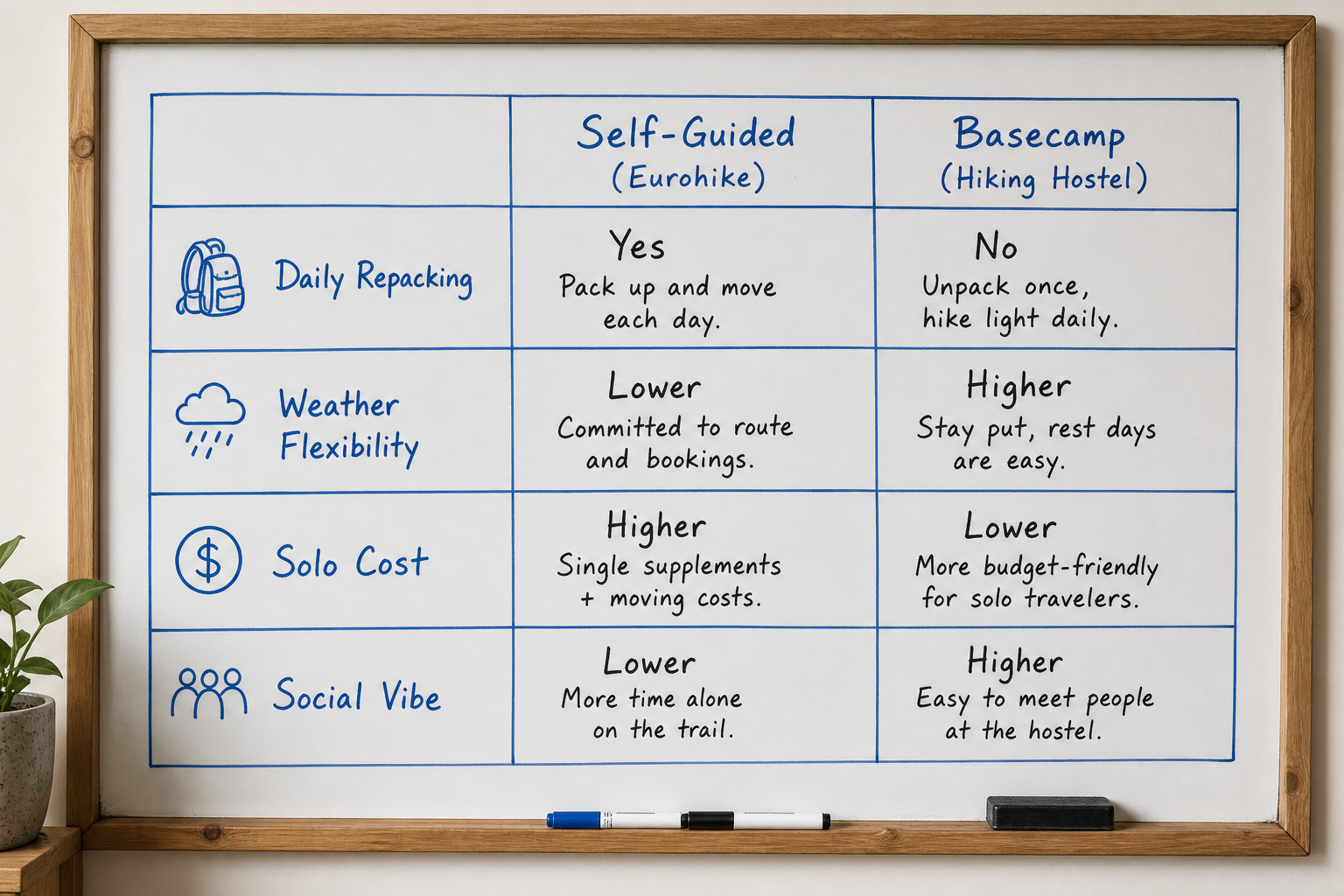
Here is a detailed breakdown of how the traditional self-guided model (Eurohike) compares to the social, hostel-based model (Hiking Hostel), and how to decide which approach fits your travel style.
The Core Difference: Inn-to-Inn vs. Hub-and-Spoke
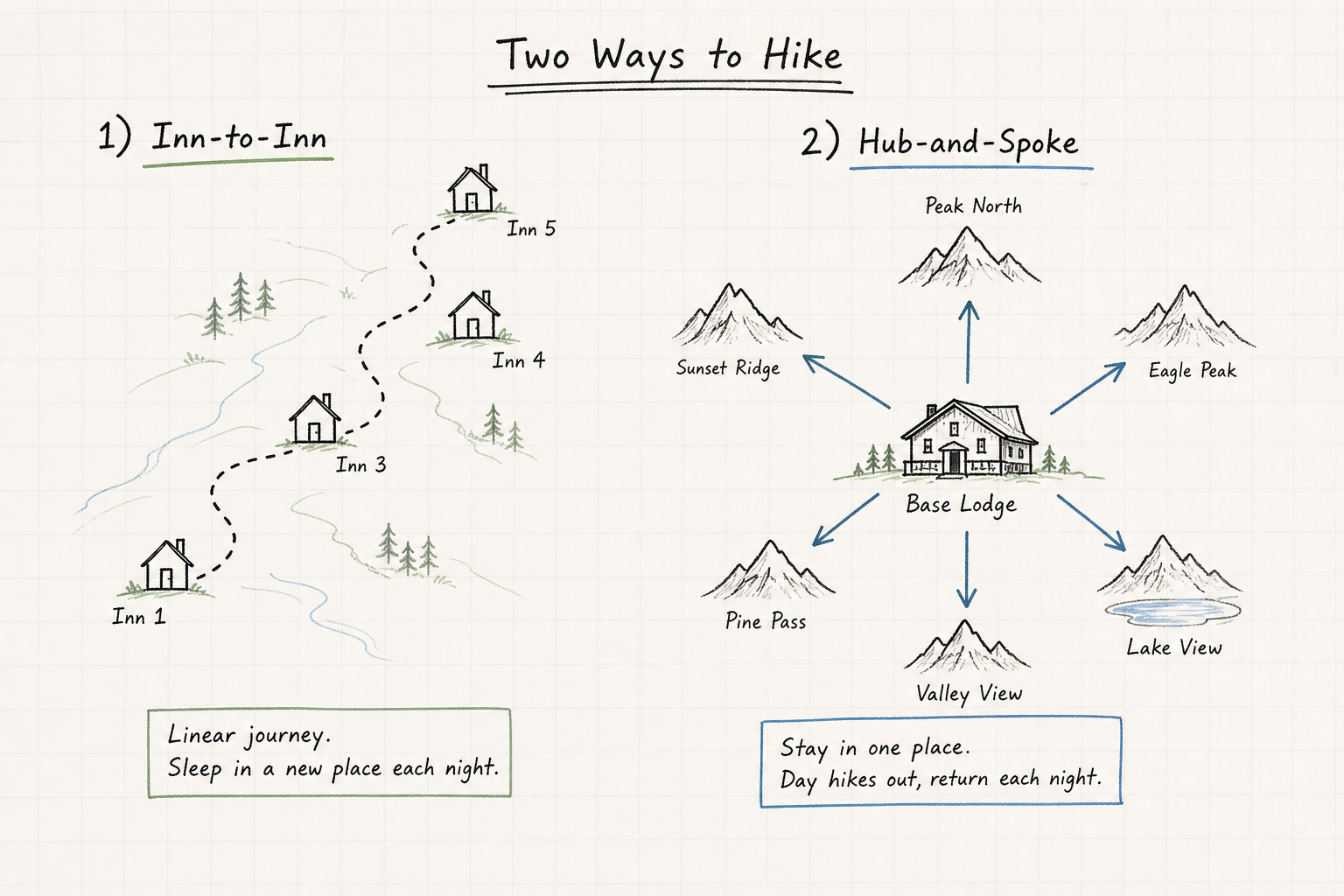
The fundamental difference between these two approaches dictates everything about your week, from what time you wake up to what happens when it rains.
The Eurohike Model: Linear Progression
Eurohike operates on a linear, point-to-point model. You start in town A, sleep, wake up, leave your bag at the reception desk, and hike to town B. Your luggage is driven ahead of you.
This gives you a tremendous sense of physical progress. Walking from one valley to the next feels like a true expedition. You get to see a wide slice of the country, and you never have to carry more than a daypack. However, the logistical rigidity is high. You must hike to your next destination, regardless of how your knees feel or what the weather is doing.
The Hiking Hostel Model: Hub-and-Spoke
Hiking Hostel operates on a hub-and-spoke model. You check into your room in Liddes or St. Stephan on day one and unpack your bag for the entire week. Each morning, you join an organized group excursion, utilizing Switzerland’s flawless transport network or private shuttles to reach different trailheads. In the evening, you return to the same lodge.
This allows for targeted trail selection. Instead of walking the connective tissue between two valleys (which sometimes means miles of paved farm roads), you skip straight to the alpine highlights. One day you might tackle trails in the Valais, and the next you might hop across the border for an Aosta excursion.
Cost Breakdown: What You Actually Pay
Switzerland is notoriously expensive. When evaluating affordable hiking packages, you have to look closely at what is excluded from the sticker price.
The Hidden Costs of Self-Guided Trips
A typical 8-day Eurohike package on the Bear Trek (Bernese Oberland) runs around $2,100 per person based on double occupancy.
Here is where the budget stretches:
- Single Supplements: If you are traveling solo, operators charge a premium to cover the cost of a private hotel room. This often adds $300 to $500 to your bill.
- Dinners: Most self-guided packages include breakfast only. Eating out in Swiss mountain towns is expensive. A basic dinner with a drink will easily cost $40 to $60 per night. Over seven nights, you should budget an extra $350+ for food.
- Trail Transport: While luggage transfers are included, cable cars to avoid steep, brutal ascents often are not.
The Basecamp Budget Reality
Hiking Hostel is designed specifically to capture 7 Tips for Hiking in Switzerland (Without the High Cost). The basecamp model strips out the overhead of daily luggage logistics and leverages economies of scale through group meals.
- Accommodation Included: You stay in a social hostel environment, which lowers the nightly overhead significantly compared to 3-star valley hotels.
- Meals Handled: By providing bundled meals (often breakfast, packed trail lunches, and communal dinners), the daily food budget drops close to zero.
- No Solo Penalties: Because the accommodation is hostel-style, solo travelers slot perfectly into the pricing structure without punishing single supplement fees.
When you factor in food and solo fees, a week-long stay at a hub-and-spoke lodge often comes in at half the total out-of-pocket cost of a traditional inn-to-inn hotel tour.
Social Dynamics: Solitude vs. Community
The people you hike with shape your memory of the Alps just as much as the mountains themselves.
Eurohike: Built for Couples and Quiet Partners
Self-guided walking holidays are deeply intimate. You are navigating, walking, and dining with your specific travel partner. If you want uninterrupted quality time with your spouse or best friend, Eurohike provides the perfect backdrop.
However, it can be isolating for solo travelers. At the end of a long hiking day, you sit at a private table in a quiet, formal Swiss hotel dining room. There is very little cross-pollination between hiking groups. You are on your own schedule.
Hiking Hostel: Built for Nomads and Solo Travelers
If you want a social alpine experience without planning the logistics yourself, the hostel model wins outright. It is engineered to foster connections.
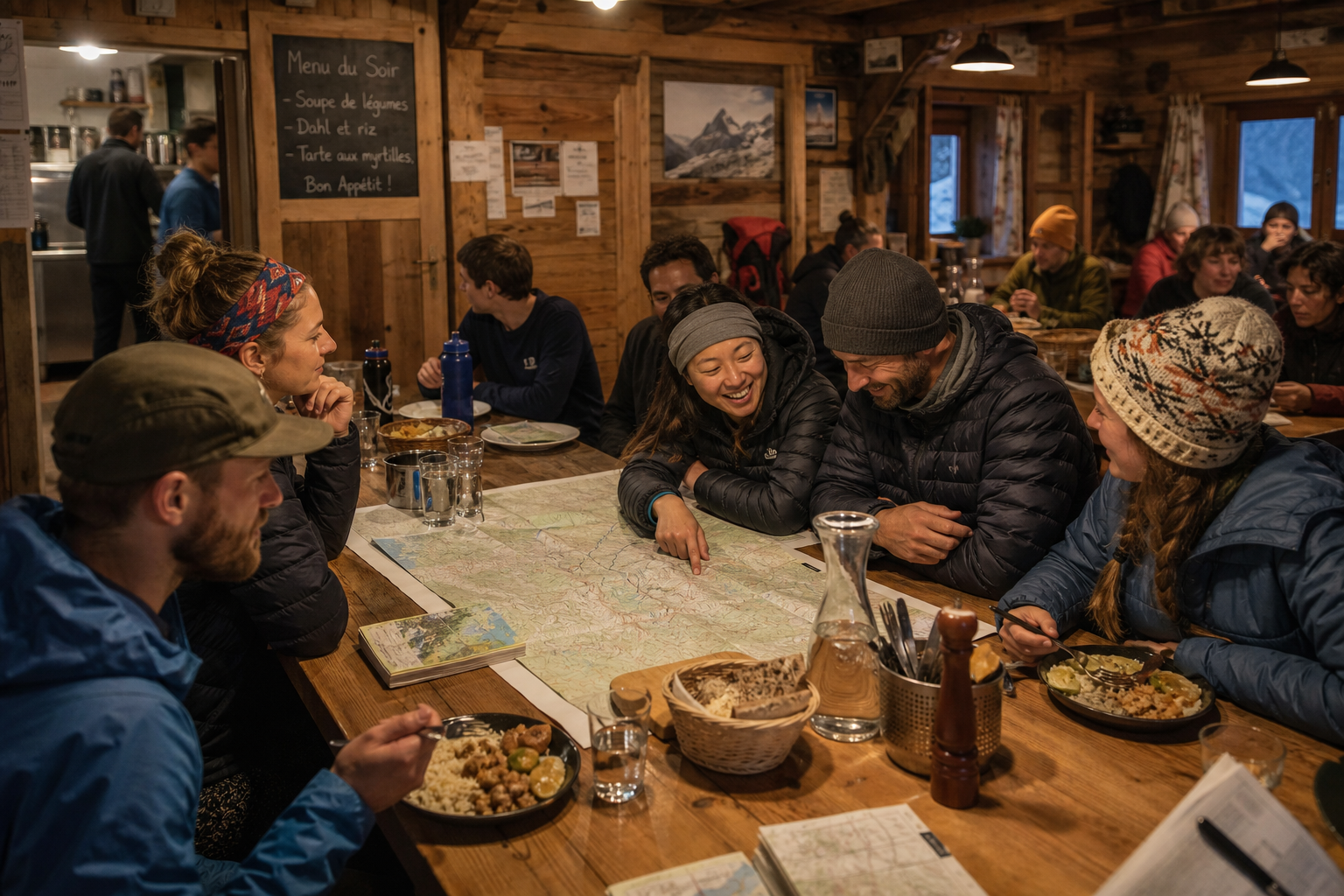
Instead of quiet hotel dining rooms, you eat family-style communal dinners. You share trail stories, compare blister treatments, and make plans for the next day. If you want to know Hotels in Swiss Mountains? Why Social Lodges Beat Luxury, the answer is almost always the community. You have a built-in group of like-minded hikers to tackle the trails with, which is a massive advantage for safety and morale.
Managing the Weather and Failure Modes
One of the least discussed aspects of alpine hiking is failure modes. Things go wrong. You get a bad blister. You twist an ankle. A massive summer thunderstorm rolls into the valley.
The Inn-to-Inn Trap
On a linear Eurohike trip, your luggage is moving to the next town. If you wake up and it is pouring rain, or your knee is swollen, your options are limited. You either hike through the pain and weather, or you spend the day figuring out local bus and train schedules to bypass the hike and meet your bag at the next hotel.
The Hub-and-Spoke Pivot
When you are based out of one lodge for the week, bad weather or sore legs become minor inconveniences rather than trip-ruining disasters.
If your legs are dead on a Wednesday, you simply sleep in. You can stay at the hostel, read a book on the balcony, work from the lounge (a huge perk for digital nomads), and join the group for dinner that night.
Furthermore, the organizers can pivot based on the forecast. If the weather in St. Stephan is miserable, the group might load up and drive toward Glacier 3000 or shift to an itinerary that stays below the tree line. If Liddes is socked in with fog, an organized excursion through the Mont Blanc region might offer clearer skies. Being stationary gives you tactical flexibility.
Packing and Daily Logistics
The daily routine looks very different depending on which style of trip you choose.
The Eurohike Routine:
- Wake up by 7:00 AM.
- Repack your entire suitcase.
- Drag your suitcase to the lobby by 8:30 AM for the luggage transfer.
- Eat breakfast.
- Hike 10 to 14 miles.
- Arrive at the new hotel, wait for your bag, unpack what you need.
- Repeat.
The Hiking Hostel Routine:
- Wake up, leave your clothes scattered on your bed.
- Grab your pre-packed day bag.
- Eat breakfast with the group.
- Hop in the transfer vehicle or walk to the trailhead.
- Hike, return to the same bed.
For travelers who hate living out of a suitcase, the lack of daily repacking is a massive psychological relief. It also simplifies what you need to bring. (For a breakdown of exactly what gear you need, review our Swiss Alps Summer: A Simple 5-Step Packing Guide).
Comparing the Trails: Valais vs. Bernese Oberland
Both operators offer access to world-class scenery, but the regions they focus on offer slightly different flavors of the Alps.
Eurohike is famous for its Bernese Oberland routes (the Bear Trek), which takes you under the looming north faces of the Eiger, Mönch, and Jungfrau. It is classic, dramatic, chocolate-box Switzerland, complete with heavy crowds and high prices.
Hiking Hostel focuses its core operations around Liddes (Valais) and St. Stephan. The Valais region is arguably the hiking capital of Switzerland, boasting dramatic 4,000-meter peaks and a slightly wilder, less manicured feel than the Bernese Oberland.
From a hub in Liddes, you have access to incredible diversity. You are a stone’s throw from the Italian border, making it easy to cross over for different terrain. You also have access to the trails circling the highest peak in Western Europe. If that interests you, check out the 5 Best Hiking Trails in Switzerland Near Mont Blanc.
Which Hiking Package is Right For You?
To make the decision simple, weigh these criteria against your travel style.
Choose a traditional self-guided tour (Eurohike) if:
- You are traveling as a couple and want complete privacy and solitude.
- You strongly prefer the psychological reward of walking continuously from point A to point B over a week.
- You have a higher budget and do not mind paying a premium for 3-star hotel privacy.
- You enjoy quiet, formal dinners.
- You are willing to hike through bad weather to maintain your itinerary.
Choose a basecamp social package (Hiking Hostel) if:
- You are a solo traveler, backpacker, or digital nomad looking to avoid single supplement fees.
- You want to meet people and prefer the energy of Guided Hiking in Switzerland: Finding Your Social Group.
- You hate packing and unpacking your suitcase every morning.
- You want an all-inclusive budget where meals and local transport are handled.
- You want the flexibility to take a rest day without disrupting your luggage logistics.
Frequently Asked Questions
Do I need to be an expert hiker for basecamp excursions?
No. Because hub-and-spoke models do not require you to hike to your next bed, there is usually much more flexibility in route choice. Guides or organizers can often recommend shorter turn-around points or alternative paths. On a linear inn-to-inn hike, you must complete the mileage for the day to reach your hotel, which requires a more rigid baseline of fitness.
How does the cost of food impact the overall budget?
It is the most underestimated expense of Swiss travel. If a package does not include dinners, you should add a minimum of $350 to your weekly budget. Packages that bundle hostel accommodation with breakfasts, packed lunches, and communal dinners will save you hundreds of dollars by the end of the week.
Can I still see famous peaks like Mont Blanc from a basecamp?
Yes. Hubs like Liddes are strategically located to allow for spectacular day excursions. You can easily access the Mont Blanc massif. For tips on managing the busy season in this specific area, read Mountain Mont Blanc: 7 Ways to Visit Without the Crowd.
Final Thoughts on Affordable Swiss Trails
Hiking in the Swiss Alps does not have to drain your savings, nor does it require you to spend your evenings alone in a quiet hotel room. While traditional self-guided tours offer a fantastic linear journey for those who can afford them, they are not the only way to experience the mountains.
By staying in one place, sharing meals, and utilizing organized excursions, you eliminate the friction of daily travel. You get to keep your budget intact, skip the pain of repacking every morning, and most importantly, you gain a community to share the trails with.