Hiking Hostel vs Switzerland Hiking Trip: choosing a guided alpine tour
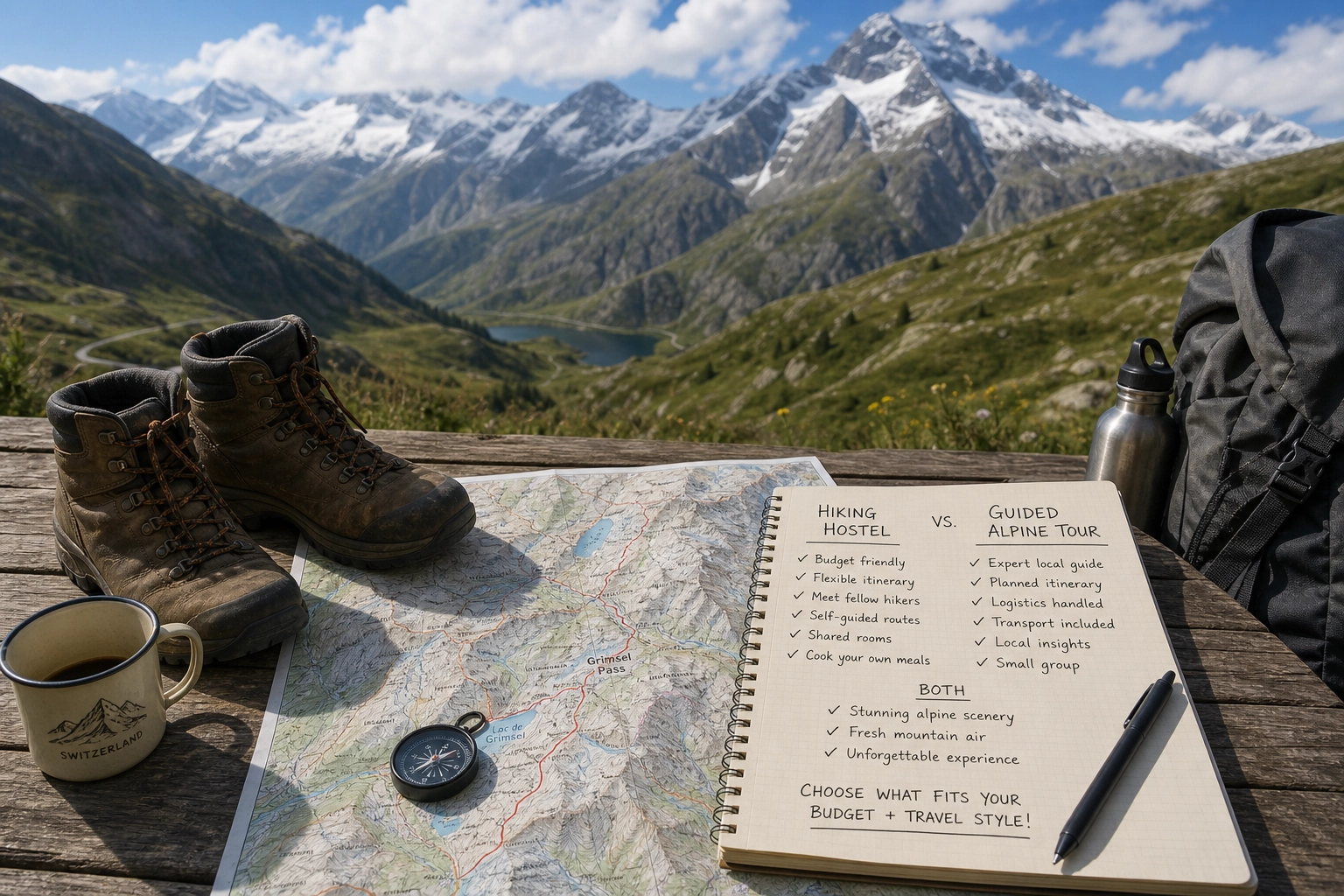
Arriving at Geneva Airport (GVA) with hiking boots in your carry-on is an exciting feeling—until you check the train schedules to remote alpine trailheads. Getting from the arrivals hall to the heart of the Swiss Alps, such as the rugged Valais or the sprawling Bernese Oberland, often involves multiple train transfers, expensive tickets, strict timetables, and dragging your gear through crowded stations.
This logistical hurdle is exactly why a “hiking holiday in Switzerland with Geneva airport transfer” is one of the most sought-after search queries for outdoor enthusiasts planning a summer trip. Travelers want the majesty of the Alps without the headache of transit planning.
Today, we are comparing two major approaches to solving this problem: the traditional, customizable packages offered by prominent operators like Switzerland Hiking Trip, and the community-driven, basecamp-style experience offered by Hiking Hostel.
Whether you are a budget-conscious solo traveler, a digital nomad looking for a weekend escape, or a small group wanting a seamless alpine adventure, choosing the right guided alpine tour dictates your entire experience. Let’s break down the logistics, accommodations, social dynamics, and costs of both models so you can make the right decision for your summer trek.
The Hidden Complexity of Alpine Logistics from Geneva Airport
Geneva Airport is the premier gateway to the western Swiss Alps and the neighboring French and Italian massifs. Geographically, it is perfectly positioned. Logistically, however, getting to the actual mountains requires careful orchestration.
The Swiss Train Illusion
Switzerland boasts arguably the best public transportation network in the world. The trains are punctual, clean, and offer breathtaking views. However, they are also highly fragmented once you leave the main intercity lines.
If you want to reach a high-altitude basecamp or a specific trailhead in the Valais region, your journey from GVA might look like this:
- Train from Geneva Airport to Geneva Cornavin (City Center).
- Intercity train from Geneva to Martigny.
- Regional train from Martigny to Orsières.
- PostBus from Orsières to a remote mountain village like Liddes.
Miss one connection, and you might be waiting an hour or more at a rural station. Furthermore, point-to-point tickets can be painfully expensive if you haven’t invested in a Swiss Travel Pass or a Half Fare Card. For a traveler simply trying to reach their hiking destination, this multi-step transit puzzle is exhausting. This is the primary reason an included airport transfer is not just a luxury—it is a critical stress-reliever.
Arriving Early? Navigating Pre-Trip Airport Stays
Because most guided alpine tours coordinate a single, unified pickup time at the airport, many hikers choose to fly into Geneva a day early. If your tour shuttle leaves at noon on Sunday, a flight delay on a Sunday morning arrival could jeopardize your entire first day.
For those arriving a night early, staying close to the airport is essential. The Mercure Geneva Airport offers a seamless 4-star experience with mountain views and easy transport access, making it a comfortable buffer before heading into the wild. Alternatively, for budget-conscious backpackers who want to save their funds for the trails, the MEININGER Hotel Genève Centre Charmilles provides streamlined dorms and rooms with communal spaces, bridging the gap between hostel culture and modern hotel convenience.
Contender 1: The Traditional “Switzerland Hiking Trip” Model
When you search for guided hiking packages in the Alps, traditional tour operators (often dominating search results under umbrellas like “Switzerland Hiking Trip”) present a classic approach to mountain tourism.
Core Philosophy and Structure
Traditional hiking tour operators focus on high customization, point-to-point trekking, and premium comfort. These trips are often structured as either self-guided itineraries (where they move your luggage between hotels while you navigate via an app) or fully guided private/small-group excursions.
In this model, the focus is heavily on the journey rather than a central community. You wake up in a different hotel every morning, hike 15-20 kilometers, and arrive at the next village by late afternoon.
Target Audience and Accommodations
These tours typically cater to older demographics, couples, and travelers with higher budgets who prefer privacy. Accommodations usually range from 3-star alpine inns to 4-star luxury hotels. Meals might be included, but often travelers are left to find their own dinners in the upscale resort towns they pass through.
Pros of the Traditional Model:
- High Customization: You can often tailor the difficulty and length of your hiking days.
- Privacy: Private rooms and private guides are the norm.
- Point-to-Point Progression: You get the satisfaction of crossing long distances, such as completing the Haute Route or the Tour du Mont Blanc step-by-step.
Cons of the Traditional Model:
- High Cost: Luggage transfers, private guides, and hotel stays inflate the price rapidly.
- Isolation: If you are a solo traveler, these tours can feel lonely, as you aren’t integrating into a larger social group.
- Rigidity: If bad weather hits a specific pass, your non-refundable hotel booking on the other side forces you into complicated detours.
Contender 2: The “Hiking Hostel” Model
On the other end of the spectrum is Hiking Hostel, which strips away the bloated costs and isolating luxury of traditional tours in favor of community, centralized logistics, and high-impact daily adventures.
Core Philosophy and Structure
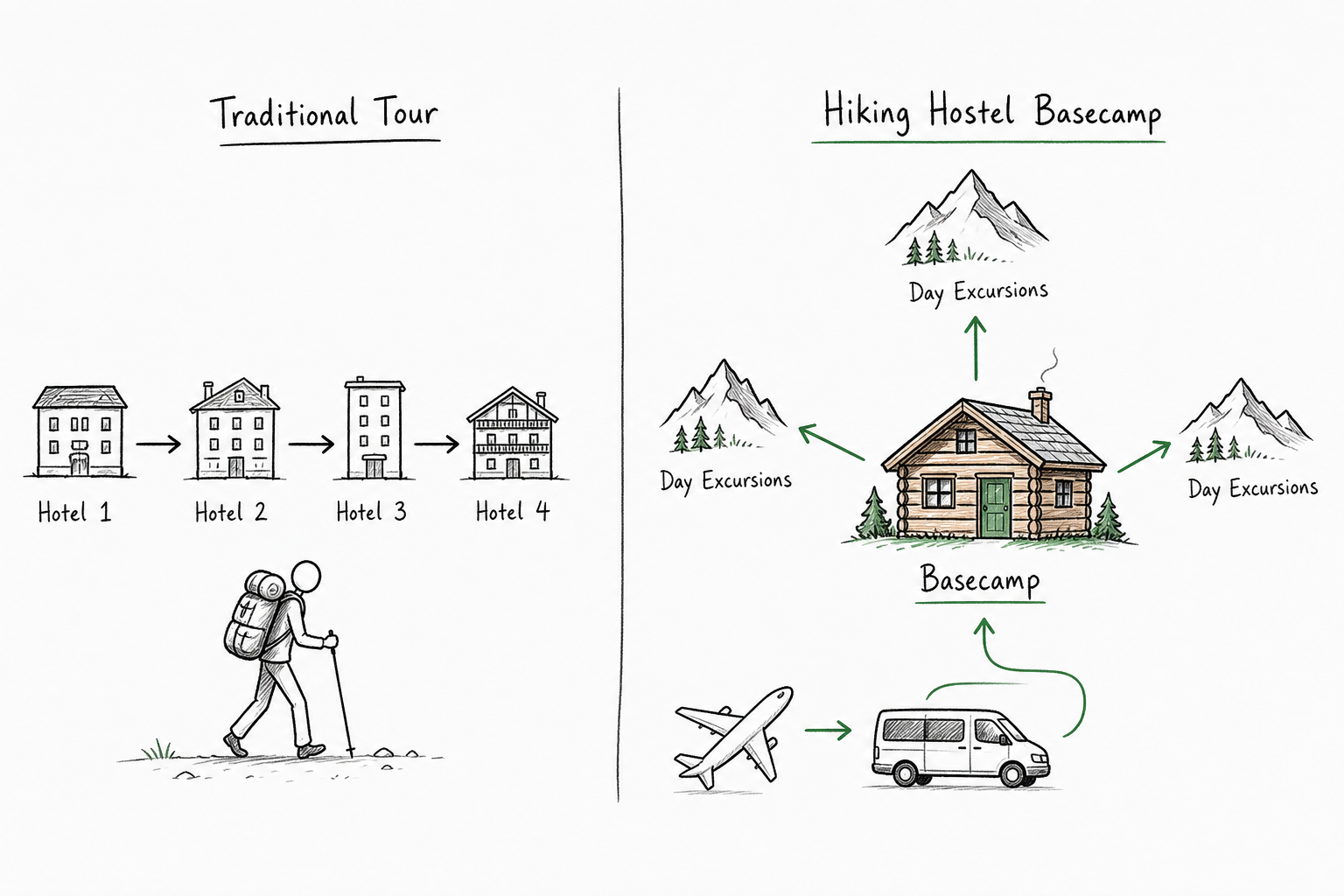
Hiking Hostel operates on a “basecamp” philosophy. Instead of packing up your suitcase every single morning, you unpack once for a week-long summer hiking holiday. The trips are centered in strategic alpine hubs—specifically Liddes (in the Valais region) and St. Stephan (in the Bernese Oberland).
From these basecamps, Hiking Hostel provides daily trail transport, taking the group to different trailheads, valleys, and iconic excursions each day. The package is comprehensive: it includes hostel accommodation, meals, Geneva airport transfers, and organized daily excursions to world-renowned spots like Aosta, Chamonix, Interlaken, and Glacier 3000.
Target Audience and Accommodations
This model is explicitly built for solo travelers, backpackers, digital nomads, and budget-conscious outdoor enthusiasts. The goal is to provide a highly social, guided alpine experience where the logistics are handled, but the vibe remains relaxed and communal.
Pros of the Hiking Hostel Model:
- Community: You hike, eat, and relax with the same group of like-minded travelers all week.
- Budget-Friendly: Hostel-style accommodations and inclusive meal plans keep costs drastically lower than traditional hotel-to-hotel treks.
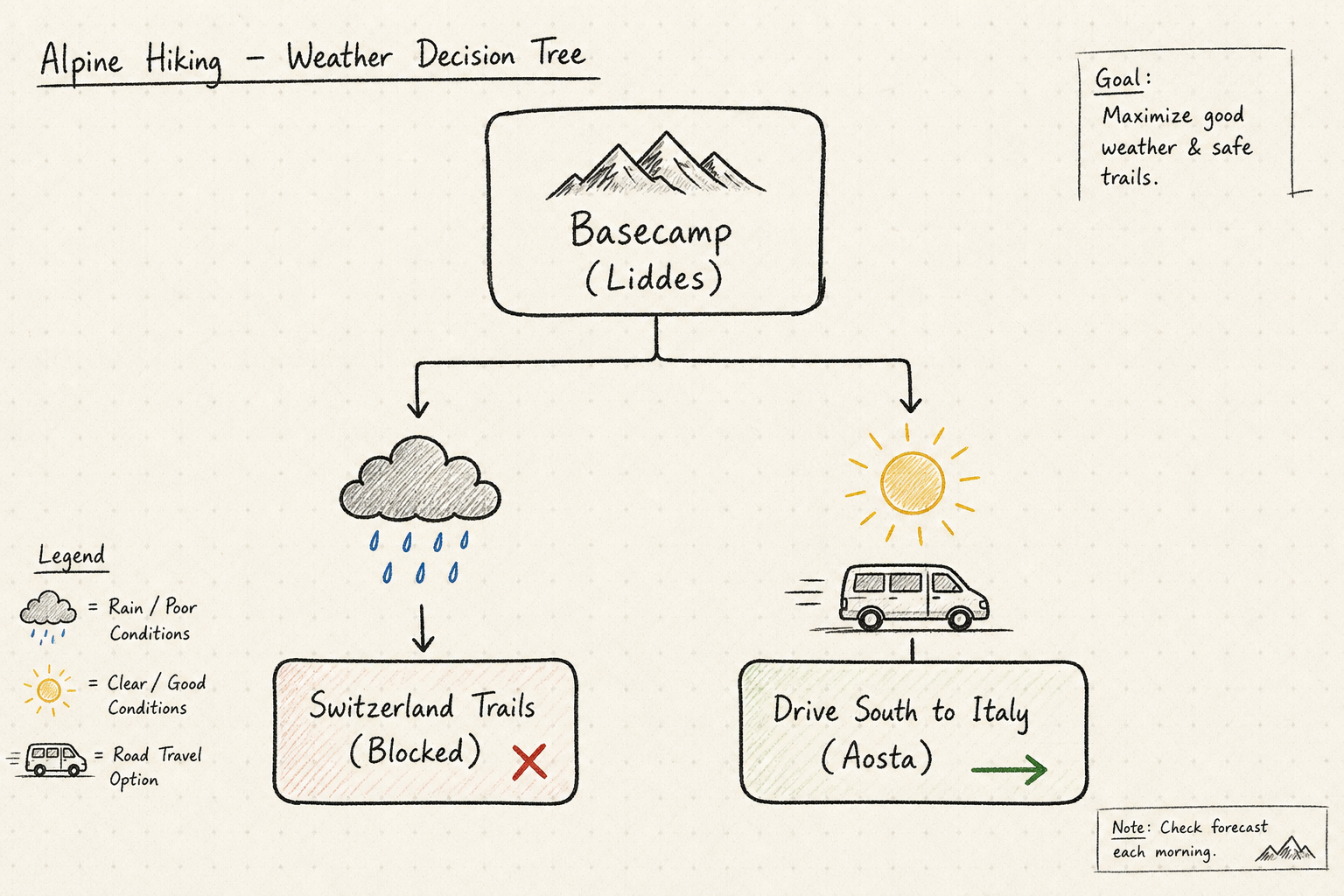
- Weather Flexibility: Because you return to a central basecamp, the daily itinerary can be swapped based on weather. Raining in Valais? The transport van can drive the group through the St. Bernard tunnel to Italy for a sunny hike in Aosta.
- Effortless Logistics: The Geneva airport transfer and daily trailhead shuttles mean you never have to look at a Swiss train timetable.
Cons of the Hiking Hostel Model:
- Shared Spaces: If you require absolute privacy and a quiet hotel suite, the communal nature of a hostel is not for you.
- Hub-and-Spoke Hiking: You won’t complete a linear, point-to-point through-hike; you are doing exceptional day hikes instead.
Head-to-Head: Evaluating the Guided Alpine Tour Experience
To determine which model fits your travel style, we need to compare them across five critical decision criteria: Logistics, Accommodation, Social Dynamics, Route Flexibility, and Budget.
1. Geneva Airport Transfers and Daily Transport
Switzerland Hiking Trip (Traditional):
Airport transfers are often an “add-on” rather than a core feature. Many traditional operators will provide you with a Swiss Travel Pass and instructions on how to navigate the trains to your starting hotel. While this allows flexibility in arrival times, it puts the logistical burden squarely back on your shoulders. If a private transfer is offered, it is usually a costly premium upgrade.
Hiking Hostel:
The Geneva airport transfer is a fundamental pillar of the package. At a designated time, the group meets the Hiking Hostel van at GVA and is driven directly to the basecamp in Liddes or St. Stephan. This eliminates the multi-train transit puzzle. Furthermore, this same dedicated transport is used daily to reach trailheads that are entirely inaccessible by public transport, saving hours of walking on paved access roads.
2. Accommodation: Luxury Hotels vs. Social Lodges
After a grueling 15-kilometer hike with 1,000 meters of elevation gain, where do you want to rest?
Traditional Tours place you in standard hotels. You check in, take a private shower, and perhaps sit at a small desk or watch TV. It is comfortable, but it isolates you from the mountain environment and other hikers.
Hiking Hostel utilizes social alpine lodges. These environments feature large communal dining tables, lounges where hikers swap stories over beers, and shared spaces that foster immediate connections. As detailed in our guide on Hotels in Swiss Mountains? Why Social Lodges Beat Luxury, a social lodge provides the authentic, communal mountain culture that luxury hotels actively sanitize away. You sacrifice a private en-suite bathroom, but you gain a community.
3. Group Dynamics and Finding Your Tribe
The most significant differentiator between these two models is the human element.
Traditional tours are heavily indexed toward couples or pre-formed private groups. If you book a self-guided traditional tour as a solo traveler, you will spend your evenings eating dinner alone in a resort town restaurant.
Hiking Hostel is engineered for the solo traveler and the digital nomad. When you book a week-long package, you are immediately slotted into a cohort of 10-15 other adventurous, budget-conscious travelers. You share meals, tackle challenging ascents together, and celebrate at the end of the day. If you are traveling alone, this is the safest and most enjoyable way to explore the Alps. For more on how to navigate group travel, check out our resource on Guided Hiking in Switzerland: Finding Your Social Group.
4. Route Flexibility and Excursions
Mountain weather is notoriously fickle. A bluebird morning can turn into a dangerous afternoon thunderstorm.
The Traditional Point-to-Point Trap:
If you are on a traditional hut-to-hut or hotel-to-hotel trek, you must reach your next destination because your luggage is being sent there and your bed is booked. If the high pass is blocked by an unexpected snowstorm, you are forced into long, expensive, and frustrating valley detours via train and bus.
The Basecamp Advantage:
Hiking Hostel’s centralized model offers ultimate flexibility. If a storm is hammering the Swiss side of the Mont Blanc massif, the guides simply pivot. The group jumps into the transport van and heads south. From the Liddes basecamp, it is incredibly easy to access diverse microclimates.
Excursions are a major part of the Hiking Hostel appeal. Rather than being stuck in one valley, a week-long trip might include:
- Chamonix and Mont Blanc (France): Crossing the border for world-class views of the highest peak in the Alps. (Read our guide on Mountain Mont Blanc: 7 Ways to Visit Without the Crowd).
- Aosta Valley (Italy): Dipping into the Italian Alps for phenomenal food, distinct geology, and sunnier microclimates.
- Glacier 3000 & Gstaad: Experiencing high-alpine glacier walks and the iconic Peak Walk by Tissot suspension bridge.
- Interlaken: Exploring the heart of the Bernese Oberland and the shadows of the Eiger, Mönch, and Jungfrau.
This variety—hiking in three different countries (Switzerland, France, Italy) in a single week—is nearly impossible on a traditional linear hiking tour, but it is standard practice when utilizing the Hiking Hostel basecamps.
5. Cost and Budget Considerations
Switzerland is famously expensive. A simple dinner in a mid-range restaurant can easily cost 40 CHF, and point-to-point train tickets add up terrifyingly fast.
Traditional “Switzerland Hiking Trip” packages often start around 1,500 CHF for a short 4-day self-guided trip, and easily exceed 3,500 CHF for a fully guided week with luggage transfers. Furthermore, these packages rarely include lunches or dinners, meaning you must budget an additional 50-80 CHF per day for food.
Hiking Hostel is built for the budget-conscious traveler. By utilizing hostel-style accommodations and including meals (breakfast, packed trail lunches, and communal dinners), the financial anxiety of traveling in Switzerland is eliminated. Because the Geneva airport transfer and daily trail transports are included, you won’t be nickel-and-dimed by Swiss public transit. To understand just how much you can save by avoiding standard tourist traps, read our 7 Tips for Hiking in Switzerland (Without the High Cost).
Case Study: Sarah’s Swiss Alps Decision
To illustrate the difference, consider Sarah, a 28-year-old digital nomad from Canada. She has exactly one week off in July, a moderate budget, and wants to hike the Swiss Alps. She is traveling solo and flying into Geneva.
Option A: Sarah books a traditional self-guided tour.
She arrives at GVA. Her tour instructions tell her to buy a train ticket to Zermatt (approx. 100 CHF). After 4 hours of trains, she checks into a quiet 3-star hotel. Over the next five days, she hikes beautiful trails using an app, but she speaks to almost no one. Every night, she eats alone in expensive tourist restaurants, blowing past her food budget. By day four, it rains heavily, but she has to hike 18km in the downpour because her next hotel is non-refundable. She leaves Switzerland having seen beautiful mountains, but feeling isolated and financially drained.
Option B: Sarah books a Hiking Hostel week.
She arrives at GVA. At 2:00 PM, she meets the Hiking Hostel van right outside the arrivals hall, along with 10 other travelers from around the world. They drive directly to the Liddes basecamp, chatting and sharing travel stories. Over the next week, the group tackles the 5 Best Hiking Trails in Switzerland Near Mont Blanc. When it rains in Switzerland on Wednesday, the guide drives them through the tunnel to Italy for a sunny hike and authentic espresso. Sarah spends her evenings drinking local wine in the hostel lounge, playing board games, and editing photos with new friends. All her meals and transport are covered in her upfront cost. She leaves Switzerland with a network of global friends and money left in her bank account.
For the solo traveler, the choice is clear.
Day Trip Alternatives for the Time-Strapped
Not everyone has a full week to commit to a Hiking Hostel package or a traditional multi-day trek. If you are in Geneva for a business trip or a short weekend and just want a quick taste of the Alps, day trips are a viable alternative.
Several operators specialize in executing rapid, single-day excursions straight out of Geneva:
- Keytours Switzerland: A long-standing agency in Geneva, Keytours operates large coach bus tours to popular destinations like Chamonix and the Jungfrau region. This is highly commercialized but extremely convenient if you just want to see a glacier and buy some chocolate.
- Clan Sauvage: For a slightly more rugged day trip, Clan Sauvage focuses on tailored nature experiences, including guided refuge outings and specific wilderness treks closer to the Lake Geneva region.
- Swisstours: If the Matterhorn is on your bucket list, Swisstours offers a direct day trip to Zermatt from Geneva. Be warned: it is a very long day of driving for a relatively short time in the village, but it accomplishes the goal of seeing the iconic peak without spending the night.
These day trips are excellent “appetizers,” but they do not replace the immersive experience of spending a full week waking up in an alpine basecamp.
The Ultimate Packing Framework for Summer Alpine Hiking
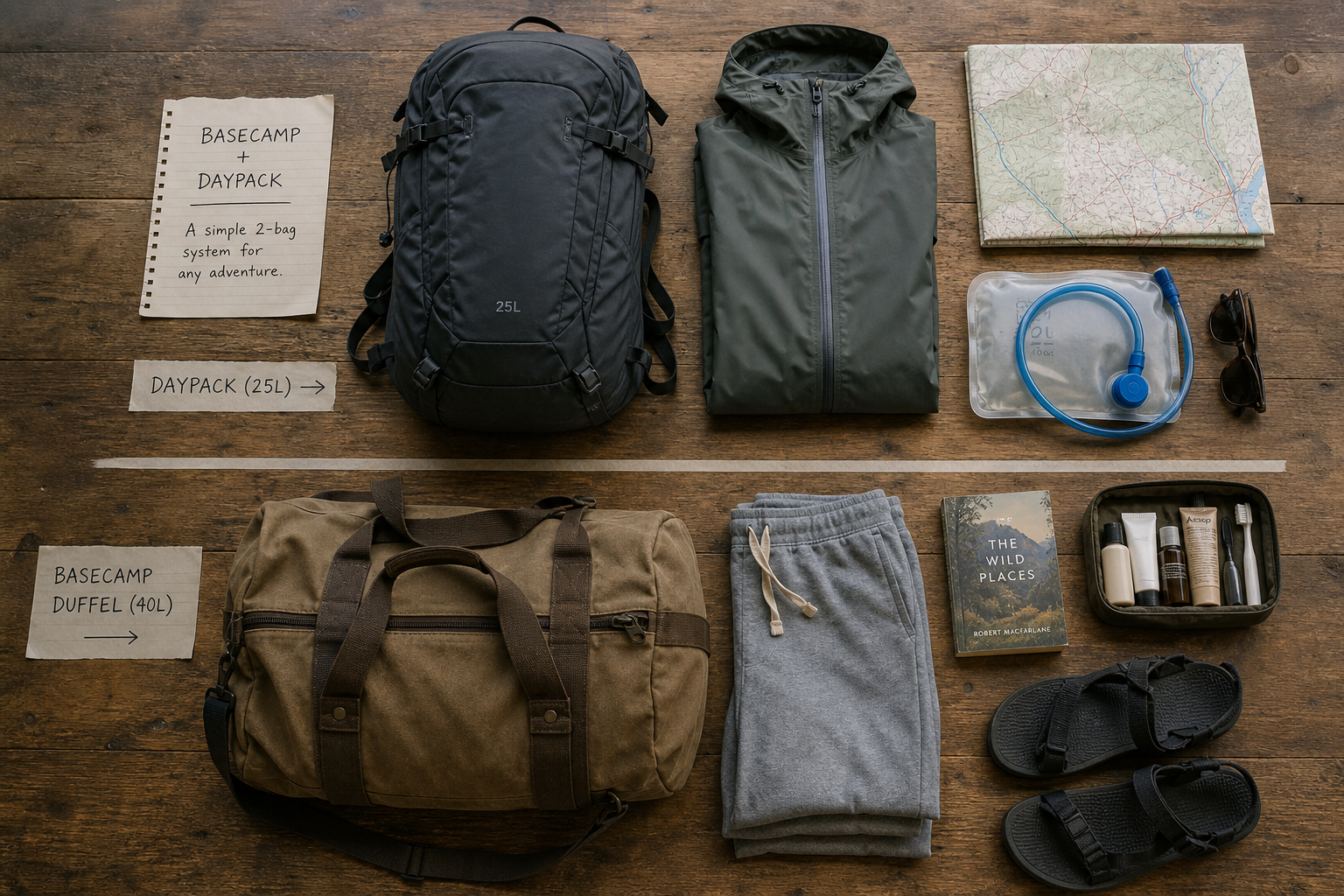
If you have decided on a centralized, basecamp-style guided tour like Hiking Hostel, your packing strategy changes significantly from a traditional point-to-point trek. Because you are not carrying your entire life on your back every day, you can afford to pack for comfort at the hostel while maintaining a lightweight daypack for the trails.
The “Basecamp + Daypack” System
1. The Basecamp Duffel (Stays at the Hostel)
- Casual Clothing: Comfortable jeans, sweatpants, and hoodies for lounging in the communal areas after a hike.
- Toiletries and Recovery: Full-sized shampoo, blister care kits, massage balls for sore feet, and a dedicated travel towel.
- Entertainment: Books, a tablet, or a deck of cards for social evenings.
- Extra Footwear: Lightweight sneakers or sandals/crocs to give your feet a break from rigid hiking boots.
2. The Alpine Daypack (Goes on the Trail)
Since Hiking Hostel’s transport van drops you at the trailhead, your daypack (ideally 20-30 liters) only needs to carry the essentials for 6-8 hours of movement.
- Layering System: A moisture-wicking base layer, an insulating mid-layer (fleece or synthetic down), and a mandatory waterproof hardshell jacket. Mountain weather changes in minutes.
- Hydration and Nutrition: A 2-liter water bladder and the packed lunch provided by the hostel.
- Protection: High SPF sunscreen (alpine sun is brutal), polarized sunglasses, and a wide-brimmed hat.
- Navigation & Safety: While the guide manages the route, always carry a personal basic first aid kit, a whistle, and a physical map or downloaded GPS track on your phone.
For a more detailed breakdown of exactly what fabrics and brands hold up best in the Swiss mountains, review our Swiss Alps Summer: A Simple 5-Step Packing Guide.
Final Verdict: Which Guided Alpine Tour Should You Choose?
The choice between a traditional “Switzerland Hiking Trip” and the Hiking Hostel experience comes down to your personal travel identity and what you value most in a vacation.
Choose a Traditional Tour Operator if:
- You are traveling as a couple or a private family group and want zero interactions with strangers.
- You have a high budget and prefer the luxury of 4-star hotels with private spas.
- You are determined to complete a specific, linear point-to-point through-hike (like the Haute Route) and are willing to accept the weather risks and logistical complexities that come with it.
Choose Hiking Hostel if:
- You are a solo traveler, backpacker, or digital nomad looking to meet a community of like-minded adventurers.
- You want absolute logistical ease—stepping off the plane at Geneva Airport and letting the transport van handle the rest of the week.
- You want to hike the absolute best trails across Switzerland, France, and Italy without the nightmare of train schedules and heavy backpacks.
- You are budget-conscious and appreciate a package where accommodations, transport, and meals are comprehensively covered.
Switzerland is too beautiful to spend your time stressing over transit connections and hotel transfers. By choosing a basecamp model with built-in Geneva airport transport, you reclaim your time, your budget, and your peace of mind—allowing you to focus entirely on the trails ahead.
Frequently Asked Questions
How long is the transfer from Geneva Airport to the alpine basecamps?
The drive from GVA to the Valais region (such as the Liddes basecamp) typically takes about 1 hour and 45 minutes to 2 hours in a private transfer van. Reaching the Bernese Oberland (St. Stephan) takes roughly 2 to 2.5 hours. This is significantly faster and easier than navigating the train connections.
Do I need a high level of fitness for a basecamp hiking holiday?
While you don’t need to be an elite mountaineer, a moderate level of fitness is required. Because Hiking Hostel offers day hikes from a central location, you won’t be carrying a heavy 15kg backpack. However, you should be comfortable hiking 10-15 kilometers a day with 500-1000 meters of elevation gain. The guides pace the group appropriately.
What happens if my flight into Geneva is delayed and I miss the transfer?
When booking a tour with a scheduled group transfer, communication is key. Operators like Hiking Hostel track flight numbers. If there is a minor delay, the van will often wait. In the event of a massive delay, the team will assist you with the exact train schedule needed to reach the basecamp independently, ensuring you safely join the group as soon as possible.