
Best Swiss Alps hiking trips with day trips to Chamonix and Aosta
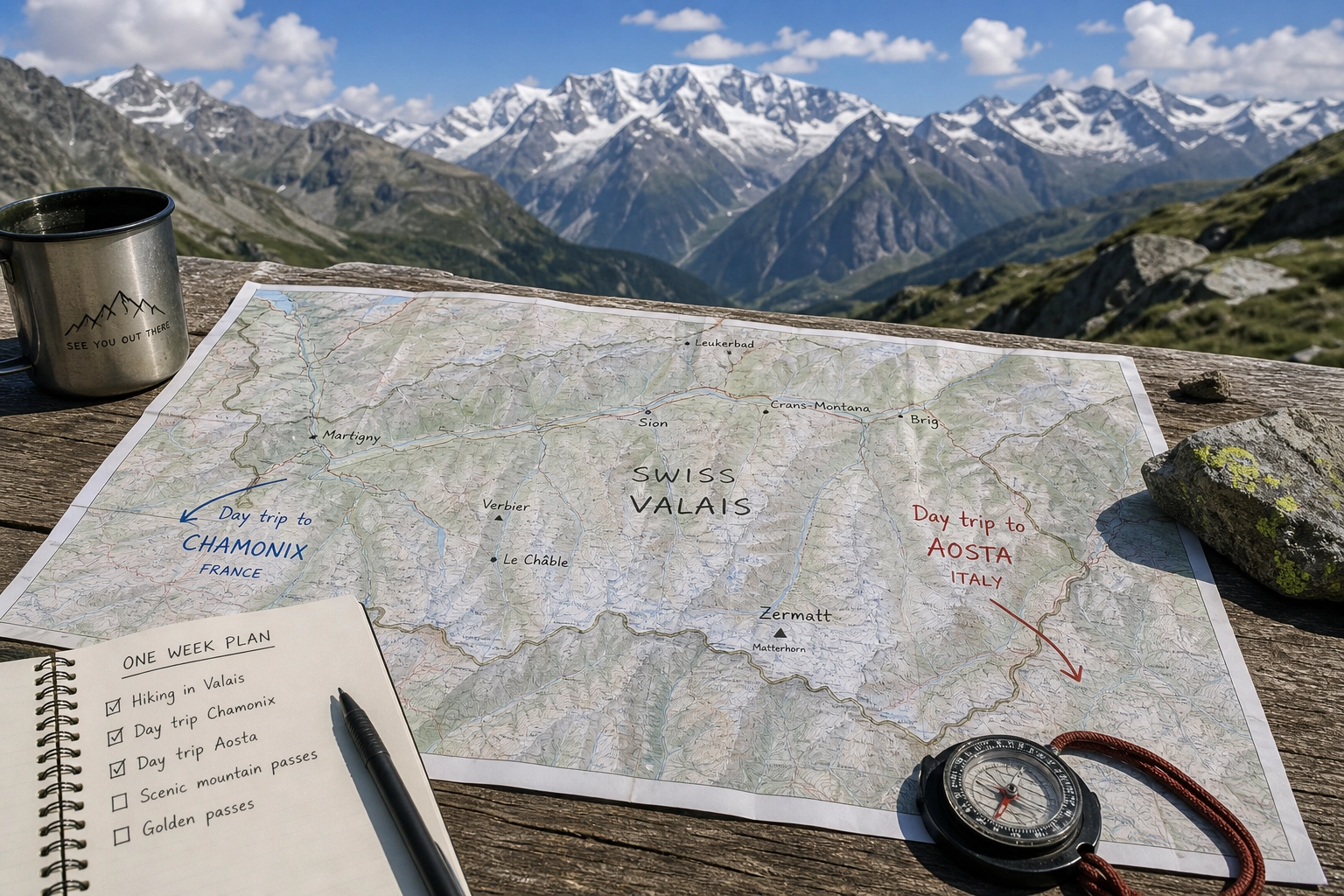
Choosing a single base for an alpine hiking holiday usually feels like a compromise. If you choose France, you get the dramatic granite spires of the Chamonix Valley. If you pick Italy, you get sunlit valleys, rich Roman history, and incredible mountain food in Aosta. If you land in Switzerland, you get pristine alpine trails, efficient transport systems, and massive glaciers.
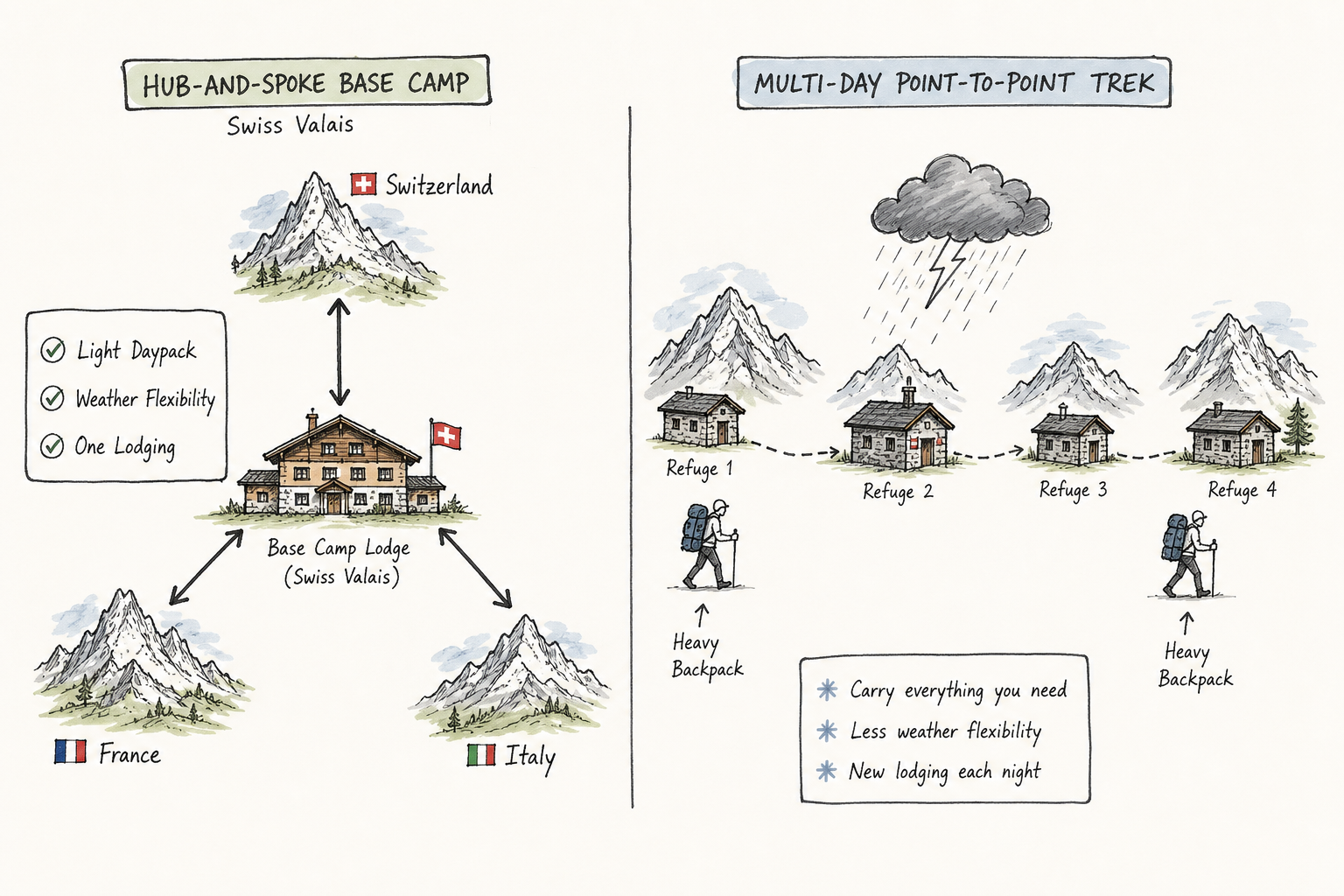
Most travelers think they have to pick one country or commit to a multi-day point-to-point trek like the Tour du Mont Blanc, packing up a heavy backpack and sleeping in a new mountain refuge every night. However, there is a far smarter way to experience all three countries in a single week.
By setting up your base camp in the lower Valais region of southwestern Switzerland, specifically around Liddes or Martigny, you place yourself at the geographical crossroad of Western Europe’s highest mountains. From this Swiss valley, you can hike legendary Valais routes by day, take a quick trip over the Col de la Forclaz into Chamonix for breakfast under Mont Blanc, and drive through the Great St. Bernard Pass for lunch in the ancient Italian city of Aosta.
Here is how to design the ultimate Swiss Alps hiking trip that delivers world-class Swiss trails alongside cross-border day trips to France and Italy, all from a single, stress-free home base.
The Tri-Border Advantage: Why Lower Valais Wins
The geographical magic of southwestern Switzerland lies in the Val d’Entremont and the surrounding lower Valais region. Sitting right at the intersection of Switzerland, France, and Italy, this region provides direct access to three distinct mountain cultures within a 45- to 75-minute radius.
                  ┌──────────────────────────────┐
                  │    CHAMONIX (FRANCE)         │
                  │  Granite Spires & Mont Blanc │
                  └──────────────┬───────────────┘
                                 │
                   45 min via Col de la Forclaz
                                 │
  ┌──────────────────────────────┴──────────────────────────────┐
  │                   SWISS VALAIS HUB                          │
  │              (Liddes / Martigny / Entremont)                │
  │     Swiss Valleys, Glaciers & Alpine Ridge Trails           │
  └──────────────────────────────┬──────────────────────────────┘
                                 │
                    50 min via St. Bernard Pass
                                 │
                  ┌──────────────┴──────────────┐
                  │      AOSTA (ITALY)          │
                  │ Roman Ruins & Italian Alps   │
                  └─────────────────────────────┘
When planning an alpine trek, hikers often debate between a fixed base camp model and moving point-to-point along famous trails like the Tour du Mont Blanc. While continuous circuit treks are legendary, according to Active Travel Adventures, completing the full 110-mile circuit requires moving accommodation every single night, rigid booking timelines, and lugging heavy gear over high mountain passes regardless of daily weather shifts.
In contrast, a hub-and-spoke model based in the Swiss Valais allows you to keep your gear in one bedroom, adjust your daily itinerary based on micro-climates, and hike light with only a daypack. If a storm hits the French side of Mont Blanc, you simply drive south through the Great St. Bernard Tunnel into sunlit Italian valleys. If the Swiss peaks are wrapped in high clouds, you can head down to lower-altitude trails in the Aosta Valley or explore local cultural sites.
Setting up camp in a dedicated alpine lodge like Hiking Hostel, which operates out of Liddes, combines social atmosphere with streamlined trail logistics. Rather than spending hours coordinating cross-border bus schedules or navigating toll passes, you get structured group excursions, local trail leadership, and communal evening meals with fellow outdoor travelers.
Fixed Base Camp vs. Point-to-Point Trekking
To understand why a Swiss base camp with day trips is becoming the preferred format for modern mountain travelers, consider how it compares directly against standard multi-day point-to-point treks.
| Feature | Fixed Swiss Base Camp (Hub & Spoke) | Multi-Day Point-to-Point Trek |
|---|---|---|
| Luggage Handling | Unpack once; carry only a 20L daypack daily | Carry full pack daily or pay expensive luggage transfers |
| Weather Flexibility | Easy to pivot between CH, FR, and IT based on radar | Must walk the scheduled route regardless of rain or fog |
| Accommodation | Consistent private or shared room, hot showers, Wi-Fi | Mixed mountain huts, dorm beds, strict check-in windows |
| Multi-Country Access | Day trips to Chamonix and Aosta tailored to clear skies | Fixed multi-day transit across borders on foot |
| Social Environment | Stable group dynamic with shared dinners and trail stories | Rotating guests every night at different alpine refuges |
| Cost Control | Fixed weekly package covering meals and daily shuttles | Variable mountain hut fees, paid showers, high food costs |
A fixed base camp significantly lowers daily friction. High-altitude trekking takes a heavy toll on knees and feet. Returning to the same comfortable lodge every evening allows proper recovery, easy gear drying, and flexible rest days without losing pre-paid hut bookings down the trail. If you want to dive deeper into smart budgeting strategies for alpine travel, read our guide on 7 tips for hiking in Switzerland without the high cost.
The Ultimate 7-Day Tri-Border Hiking Itinerary
This 7-day itinerary balances iconic Swiss ridge walks with high-reward excursions into France and Italy. It uses the Val d’Entremont as its central base, ensuring travel time to any trailhead remains under 75 minutes.
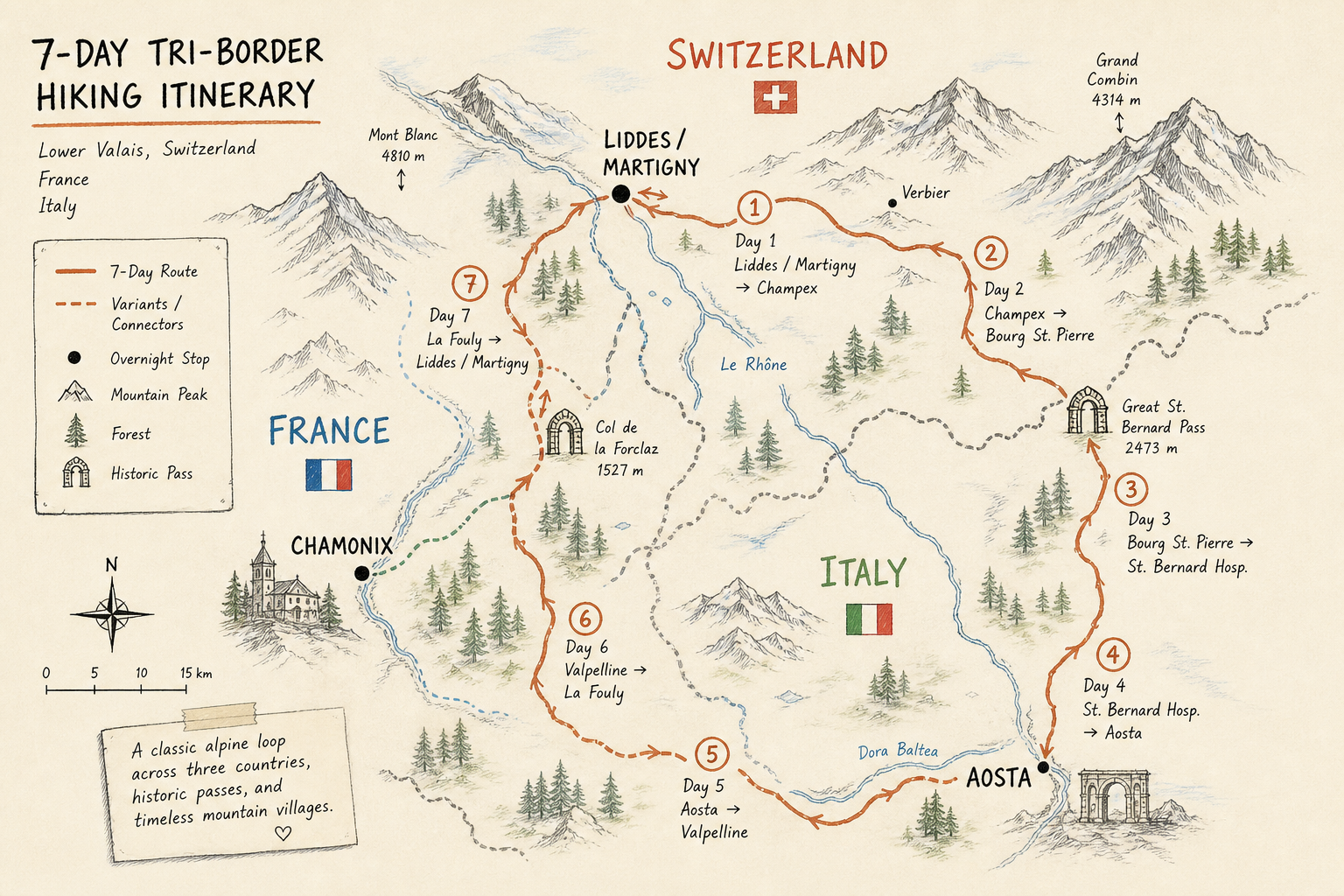
Day 1: Arrival in Valais & Warm-Up Ridge Hike
- Location: Lower Valais / Val d’Entremont (Switzerland)
- Distance: 8 km (5 miles) | Elevation Gain: +450m / -450m
- Highlights: Arrive at your Swiss base in Liddes or Orsières. Stretch your legs on an afternoon warm-up trail along the bisses (historic Swiss irrigation channels) near St-Pierre-de-Clages or through the pine forests above Liddes.
- Trail Insight: High-altitude mountain hiking requires steady acclimatization. Starting with a moderate trail along irrigation channels lets you absorb sweeping views of the Grand Combin massif without burning out your legs on day one.
Day 2: High Alpine Valais Classic – Lac de Louvie & Val de Bagnes
- Location: Val de Bagnes (Switzerland)
- Distance: 14 km (8.7 miles) | Elevation Gain: +850m / -850m
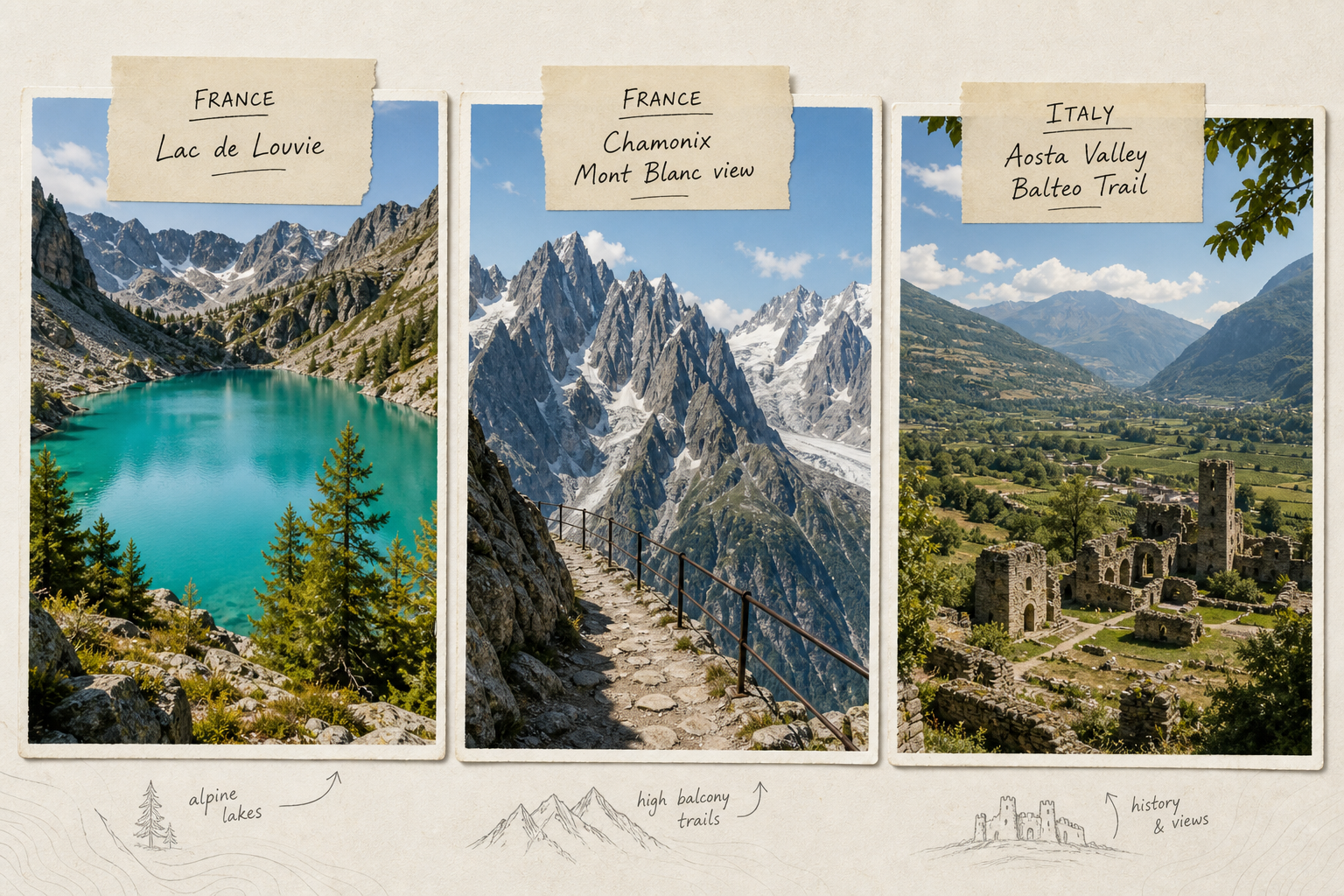
- Highlights: Steep ascent from Fionnay up through alpine pastures to Lac de Louvie, a turquoise glacial lake surrounded by steep rock faces. Keep an eye out for alpine ibex grazing on the cliffs.
- Trail Insight: Lac de Louvie offers pure Swiss wilderness without the heavy cable-car crowds found in major resort centers. The lakeside Cabane de Louvie provides an ideal spot for homemade soup before descending along panoramic balconies.
Day 3: Cross-Border Excursion to Chamonix & Grand Balcon Sud
- Location: Chamonix Valley (France)
- Distance: 12 km (7.5 miles) | Elevation Gain: +500m / -750m (using cable car assistance)
- Highlights: Cross the Col de la Forclaz into France. Take the Flégère cable car up and trek along the Grand Balcon Sud toward Planpraz, enjoying continuous face-to-face views of the Mont Blanc massif and the Bossons Glacier.
- Trail Insight: As noted by Alpine Hikers, the trails around Mont Blanc rank among the most popular in the world. Arriving early from Switzerland allows you to hit the upper balcony trails before the main afternoon day-trippers arrive from Geneva.
Day 4: High Pass History – Col du Grand-Saint-Bernard
- Location: Swiss / Italian Border
- Distance: 11 km (6.8 miles) | Elevation Gain: +620m / -620m
- Highlights: Hike the historical pilgrim trail leading up to the Great St. Bernard Pass (2,469m). Visit the ancient Hospice, meet the famous St. Bernard dogs, and stand right on the border marker dividing Switzerland and Italy.
- Trail Insight: This pass has been used since the Bronze Age. Walking up the ancient stone path toward the pass gives you a tangible sense of history while keeping you surrounded by dramatic alpine scree and high mountain lakes.
Day 5: Cross-Border Excursion to Aosta Valley & Italian Val Ferret
- Location: Aosta Valley (Italy)
- Distance: 13 km (8 miles) | Elevation Gain: +550m / -550m
- Highlights: Travel through the Great St. Bernard Pass into Italy. Hike the Italian side of the Mont Blanc range along Val Ferret toward Rifugio Elena, taking in massive, sheer granite faces from the south. Afterward, head down to ancient Aosta for espresso and Roman architecture.
- Trail Insight: The south-facing slopes of the Italian Alps offer warmer, sunnier micro-climates. The contrast between Swiss pine forests and sunny Italian alpine meadows makes this one of the most memorable days of the week.
Day 6: Panoramic Swiss Summit – Pierre Avoi Peak
- Location: Verbier / Saxon Region (Switzerland)
- Distance: 10 km (6.2 miles) | Elevation Gain: +700m / -700m
- Highlights: Summit Pierre Avoi (2,473m), a striking rock spire protruding above the Rhone Valley. The final scramble features secured ladders and chains, rewarding you with a 360-degree panorama stretching from the Bernese Alps to Mont Blanc.
- Trail Insight: This route delivers incredible high-reward scenery. Standing at the peak gives you a clear bird’s-eye view of your entire week’s geography, looking back toward France, Italy, and deeper into Switzerland.
Day 7: Easy Bisse Walk & Alpine Departure
- Location: Martigny / Val d’Entremont (Switzerland)
- Distance: 6 km (3.7 miles) | Elevation Gain: +150m / -200m
- Highlights: Relaxed morning walk along historic waterways before heading to Martigny train station for onward travel to Geneva or Zurich airports.
Deep Dive Day Trip 1: Chamonix & The Mont Blanc Massif
Crossing into France from a Swiss base is seamless. Taking the road over the scenic Col de la Forclaz brings you into the Chamonix Valley in under an hour. Alternatively, the Mont-Blanc Express alpine train winds along dramatic mountain gorges, connecting Martigny directly to Chamonix.
[Martigny / Valais Base] ──(Col de la Forclaz)──> [Le Châtelard Border] ──> [Chamonix Valley]
       │                                                                         │
       └────────────────── Mont-Blanc Express Scenic Train ──────────────────────┘
Chamonix is the capital of European mountaineering, dominated by Mont Blanc rising to 4,807 meters. While the valley floor can feel busy during peak summer, entering the high-altitude balcony trails quickly puts you into pristine mountain terrain.
Top Chamonix Trail Recommendations
- Grand Balcon Sud (Flégère to Planpraz):
- Why Walk It: This balcony trail runs high along the northern wall of the Chamonix Valley. Because it sits directly across from Mont Blanc, you get unobstructed, front-row views of the entire massif, the Mer de Glace, and the Aiguille du Midi.
- Logistics: Take the Flégère cable car up, walk across to Planpraz (approx. 3.5 hours), and ride the Planpraz gondola back down into Chamonix town.
- Lac Blanc Loop:
- Why Walk It: Lac Blanc is famous for reflecting the jagged peaks of the Aiguilles de Chamonix in its clear waters.
- Avoiding Crowds: Lac Blanc gets heavily visited. To enjoy it without packed trails, head up on the first lift of the morning or take the steep ascent route from Col des Montets through the Aiguilles Rouges Nature Reserve.
       LAC BLANC (2,352m)  ◄── Alpine Reflection Spot
              ▲
              │ 2.5 hrs steep climb
              │
       COL DES MONTETS  (Quieter Nature Reserve Trailhead)
              ▲
              │ 20 min drive
              │
   SWISS BORDER (Le Châtelard)
If you are looking for more ways to experience Mont Blanc away from tourist bottlenecks, check out our guide on Mountain Mont Blanc: 7 ways to visit without the crowd.
Deep Dive Day Trip 2: Aosta Valley & Italian Alpine Culture
Heading south from lower Valais brings you directly to Italy via the Great St. Bernard Pass. As you cross the border, the scenery changes rapidly from Swiss granite peaks to broad, sunlit Italian slopes.
Aosta itself is a fascinating mountain city filled with well-preserved Roman monuments, including a 22-meter-high Roman Arch of Augustus, an ancient theater, and thick city walls.
[Swiss Valais Base] ──(Great St. Bernard Pass / Tunnel)──> [Valle d'Aosta] ──> [Aosta Historic Center]
        │                                                                             │
        └────── High Alpine Hiking (Val Ferret / Gran Paradiso) ──────────────────────┘
Top Aosta & Italian Alps Trail Recommendations
- Italian Val Ferret (Rifugio Elena Trail):
- Why Walk It: Situated at the head of the Italian Val Ferret right below the Grandes Jorasses, this trail offers steep, dramatic scenery. The walk up to Rifugio Elena puts you face-to-face with massive glacier tongues hanging off the back side of Mont Blanc.
- Culinary Reward: Alpine refuges in Italy take mountain food seriously. Stop at Rifugio Elena for hot polenta topped with melted Fontina cheese, followed by a double espresso.
- Gran Paradiso Foothills (Val de Rhêmes):
- Why Walk It: Located just south of the main Aosta Valley, Gran Paradiso is Italy’s oldest National Park. It remains one of the best places in Europe to spot wild ibex and chamois in quiet alpine meadows.
  RIFUGIO ELENA (2,061m)  ◄── Glacial Views & Italian Cuisine
         ▲
         │ 1.5 hrs steady climb
         │
  ARNUVA (Val Ferret)
         ▲
         │ 50 min drive
         │
  GREAT ST. BERNARD PASS (Swiss/Italian Border)
Cross-border day trips highlight how distinct local cultures are across short distances in the Alps. To learn more about winter and summer options on the Italian side, explore our article on skiing in the Italian Alps and trying an Aosta day trip.
Top Swiss Valais Trails Right Outside Your Doorstep
While day trips into France and Italy add huge variety to your week, the trails immediately surrounding lower Valais are easily on par with Europe’s finest high-mountain routes.
Trail Comparison: Regional Highlights
| Trail Name | Country / Area | Distance | Difficulty | Key Feature |
|---|---|---|---|---|
| Lac de Louvie | Switzerland (Valais) | 14 km | Challenging | High glacial lake, marmots, pure tranquility |
| Pierre Avoi Peak | Switzerland (Valais) | 10 km | Moderate-Hard | 360° panorama with summit ladders |
| Grand Balcon Sud | France (Chamonix) | 12 km | Moderate | Continuous face-to-face Mont Blanc views |
| Val Ferret / Elena | Italy (Aosta Valley) | 13 km | Moderate | Massive glacier faces and Italian refuge meals |
| Bisse du Levron | Switzerland (Valais) | 9 km | Easy-Moderate | Historic canal walk above Verbier |
Local Hidden Gems
- Lac de Louvie (Val de Bagnes): Starting in the hamlet of Fionnay, this trail climbs steadily up a steep valley wall before opening into a quiet alpine basin home to Lac de Louvie. The lack of major cable cars keeps crowds minimal, making it a peaceful sanctuary for wildlife.
- Pierre Avoi Ridge Walk: Rising high above Verbier and the Rhone Valley, Pierre Avoi offers expansive visual range. On clear days, you can stand at the peak and trace your entire week’s journeys into France and Italy.
- Bisse du Levron: For days when your legs need a break from high elevation gains, walking along a flat historic bisse provides gentle, shaded forest trails accompanied by continuous views down into the valley.
For a curated selection of additional alpine walks near the border, read our full breakdown on the 5 best hiking trails in Switzerland near Mont Blanc.
Practical Logistics: Border Crossings, Currency, and Transport
Crossing international borders twice or three times in a week requires basic practical preparation. Because Switzerland, France, and Italy sit within the Schengen Zone, physical border control checks are rare along main highways, but you must keep proper documentation with you at all times.
                        ┌─────────────────────────────────────┐
                        │   LOGISTICS & BORDER CHECKLIST      │
                        ├─────────────────────────────────────┤
                        │ [ ] Passport (Required for Schengen)│
                        │ [ ] Dual Currency (CHF & EUR)       │
                        │ [ ] Multi-Country Mobile Roaming    │
                        │ [ ] Mountain Pass Weather Check     │
                        │ [ ] Swiss Highway Vignette (Driving)│
                        └─────────────────────────────────────┘
Essential Border Travel Tips
- Passports & Documents: Always carry your passport, not just a national ID card or driver’s license. Occasional border spot-checks take place along the Great St. Bernard Pass and the Le Châtelard crossing near Chamonix.
- Currencies: Switzerland uses the Swiss Franc (CHF), while France and Italy use the Euro (EUR). While credit cards are widely accepted across all three countries, small mountain huts in Italy and high alpine cheese farms in Valais often accept cash only. Keep a modest amount of both currencies on hand.
- Mobile Data & Roaming: Swiss mobile networks fall outside the standard EU free roaming zone. Ensure your mobile carrier includes Switzerland in your data plan, or download offline trail maps (via Gaia GPS or AllTrails) before heading into high-mountain zones.
- Driving vs. Shuttles: If you rent a car in Switzerland, ensure it carries the Swiss highway vignette sticker. If driving into Italy via the Great St. Bernard Tunnel, be aware that toll fees apply per passage. Joining an organized base camp like Hiking Hostel eliminates these transport hassles entirely, as daily trail shuttles and cross-border transport are included directly in your stay.
Packing Guide for Tri-Border Alpine Hiking
Alpine weather varies significantly between mountain valleys. A sunny morning in the Italian Aosta Valley can turn into a cool, windy afternoon high on a Swiss ridge. Packing a simple, modular layering system ensures you stay comfortable across changing micro-climates.
       [BASE LAYER]        ──> Moisture-wicking synthetic or Merino tee
       [MID LAYER]         ──> Lightweight fleece or grid-fleece jacket
       [INSULATION LAYER]  ──> Packable down or synthetic puffy jacket
       [SHELL LAYER]       ──> Waterproof/windproof Gore-Tex jacket
Essential Alpine Gear Checklist
- Footwear: Broken-in mid-to-high hiking boots with vibrant Vibram lugs. Mountain trails feature loose scree, wet granite, and exposed roots.
- Layering System: Synthetic or merino wool base layers, a breathable fleece mid-layer, a packable puffy jacket for high summits, and a reliable waterproof shell jacket.
- Daypack (20L - 28L): Sized for rain gear, extra warm layers, 2 liters of water, camera, snacks, and a first-aid kit.
- Sun Protection: High-altitude UV rays are intense. Bring polarized sunglasses, high-SPF sunscreen, wide-brimmed hat, and lip balm with UV protection.
- Trekking Poles: Highly recommended for steep ascents and heavy descents down high mountain passes, reducing stress on knees.
For a detailed breakdown on gear selection and packing weight, review our Swiss Alps summer 5-step packing guide.
Social Alpine Lodging: Why Group Base Camps Beat Luxury Hotels
For solo backpackers, digital nomads, and budget-conscious outdoor travelers, traditional luxury hotels in Swiss resort towns often feel isolated and expensive. Sitting alone in a high-priced hotel room in Verbier or Chamonix takes away from the shared spirit of mountain exploration.
Hostel-style social lodges solve both the cost hurdle and the social gap. A social lodge setting brings together like-minded travelers from all over the world to share family-style dinners, swap daily trail stories, and hike together as a unified group.
    TRADITIONAL HOTEL                       SOCIAL MOUNTAIN LODGE
  ┌───────────────────┐                     ┌───────────────────┐
  │ Isolated rooms    │                     │ Shared lounge     │
  │ High nightly cost │        VS           │ Communal dinners  │
  │ Separate dining   │                     │ Group trail rides │
  │ Solo planning     │                     │ Daily itineraries │
  └───────────────────┘                     └───────────────────┘
Choosing a fixed, guided hostel package based in Liddes gives you a turn-key experience. You get comfortable accommodation, nutritious breakfast spreads, packed trail lunches, warm evening meals, and daily trail shuttles. This lets you focus entirely on high-country hiking without worrying about bus schedules or complex logistics.
If you are traveling solo and want to find a great community on the trail, explore our complete article on guided hiking in Switzerland and finding your social group. For an in-depth breakdown of mountain lodging styles, read hotels in Swiss mountains: why social lodges beat luxury.
Frequently Asked Questions
Can you do day trips to France and Italy from Switzerland without a car?
Yes. The lower Valais region connects well via public transportation. The Mont-Blanc Express train runs directly from Martigny, Switzerland to Chamonix, France. Regional buses run over the Great St. Bernard Pass into Aosta during summer months. However, using private mountain shuttles or an organized week with Hiking Hostel saves significant transit time, giving you maximum hours on the trail.
Do I need a passport check when taking day trips to Chamonix or Aosta?
Because Switzerland, France, and Italy are all part of the Schengen Area, physical border checkpoints are standardly open without routine stops. However, border police carry out random spot-checks. You must carry a valid passport at all times when crossing borders.
Is it better to base in Chamonix, Aosta, or Switzerland?
Switzerland’s lower Valais offers the best geographical hub for a multi-country week. Sitting right in the center, Valais yields the fastest average drive times to both Chamonix (west) and Aosta (south), while providing immediate access to quiet, uncrowded Swiss valleys.
What is the best time of year for a tri-border alpine hiking trip?
The optimal window runs from late June through late September. During this period, high mountain passes like the Col du Grand-Saint-Bernard clear of winter snow, cable cars operate at full capacity, and alpine wildflowers peak across high meadows.
Final Trail Notes & Next Steps
Experiencing the Swiss Alps does not mean choosing between expensive luxury stays or carrying heavy multi-day trekking packs. By setting your home base in the tri-border region of lower Valais, you can experience the best mountain scenery in Western Europe across three separate countries in a single week.
You will stand under the granite needles of Mont Blanc in France, walk historic Roman routes into sunny Italian valleys, and hike turquoise lake trails in Switzerland, all while returning every evening to a hot meal, comfortable bed, and a welcoming group of fellow travelers.
If you are ready to explore the Alps without the stress of self-planning logistics, explore the summer packages offered by Hiking Hostel. With bases in Liddes and St. Stephan, your ultimate multi-country Swiss hiking adventure is ready to go.