Best hiking hostels list
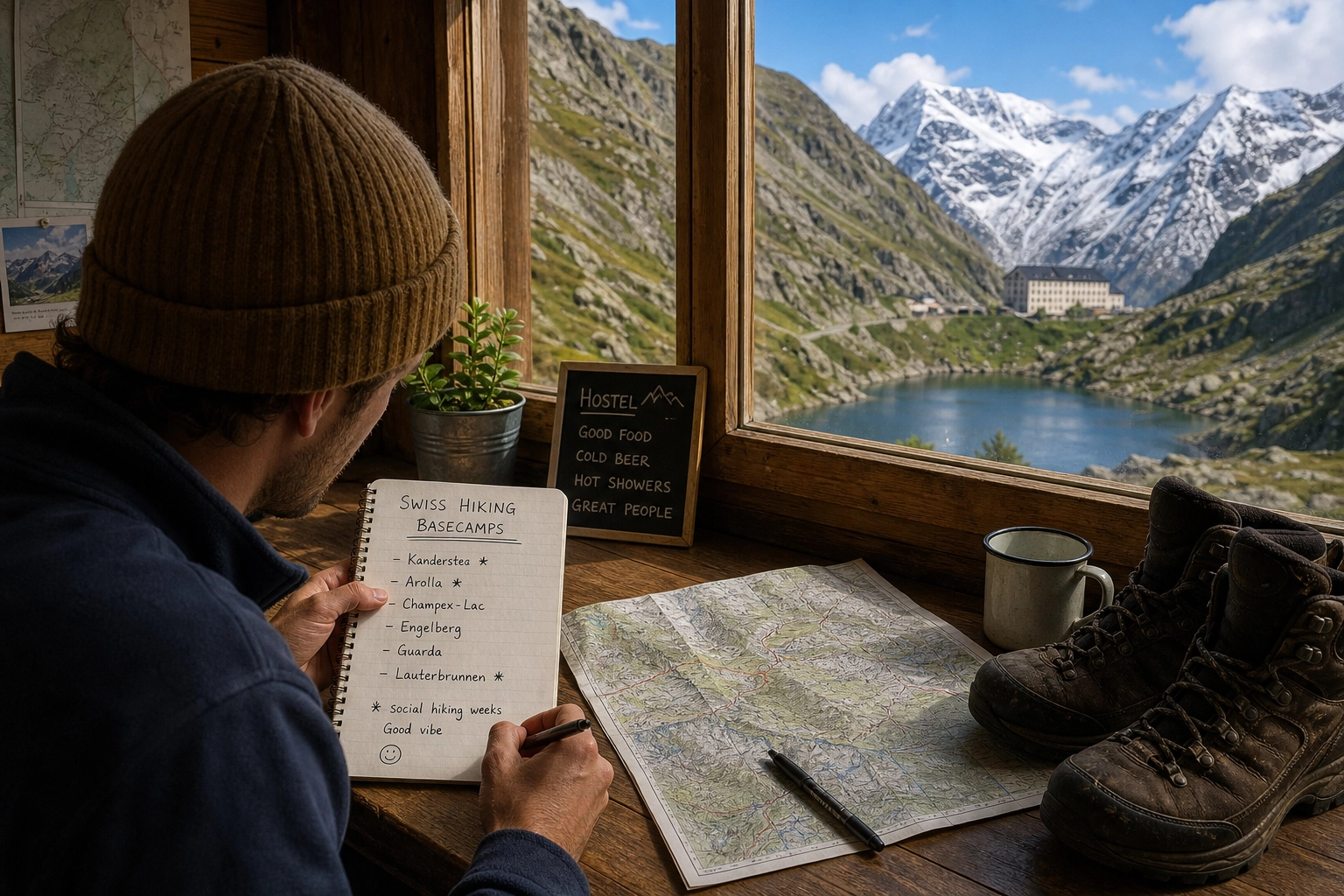
Showing up in a Swiss alpine village as a solo hiker usually results in one of two scenarios: you spend a small fortune on a traditional chalet hotel where everyone is asleep by 9 PM, or you spend your evenings alone in a quiet, overpriced Airbnb. Switzerland’s mountain infrastructure was largely built for affluent couples, families, and luxury ski tourists. For the solo backpacker, finding accommodation that balances budget, proximity to high-alpine trails, and a built-in community of potential hiking partners requires a highly specific type of basecamp.
The solution lies in a specialized tier of accommodation: the Swiss hiking hostel. Unlike standard city backpacker hostels focused on nightlife and bar crawls, a true alpine hiking hostel is engineered for the mountains. It has drying rooms for wet gear, commercial-grade communal kitchens to bypass thirty-franc restaurant burgers, and common areas where route planning maps are spread across tables every evening.
Whether you are looking to base yourself in the shadow of the Eiger, navigate the lakes of Central Switzerland, or join an organized, social hiking week in the Valais region, choosing the right basecamp dictates the success of your trip. Here is the comprehensive breakdown of the best hiking hostels in Switzerland, the trails they unlock, and the logistics of navigating the Alps alone.
The Anatomy of a Proper Swiss Hiking Hostel
Before detailing the specific locations, it is crucial to understand what separates a generic cheap bed from a functional alpine basecamp. When reviewing hotels in Swiss mountains, social lodges consistently beat luxury for solo travelers simply because of their utilitarian design.
The Boot Room and Drying Facilities
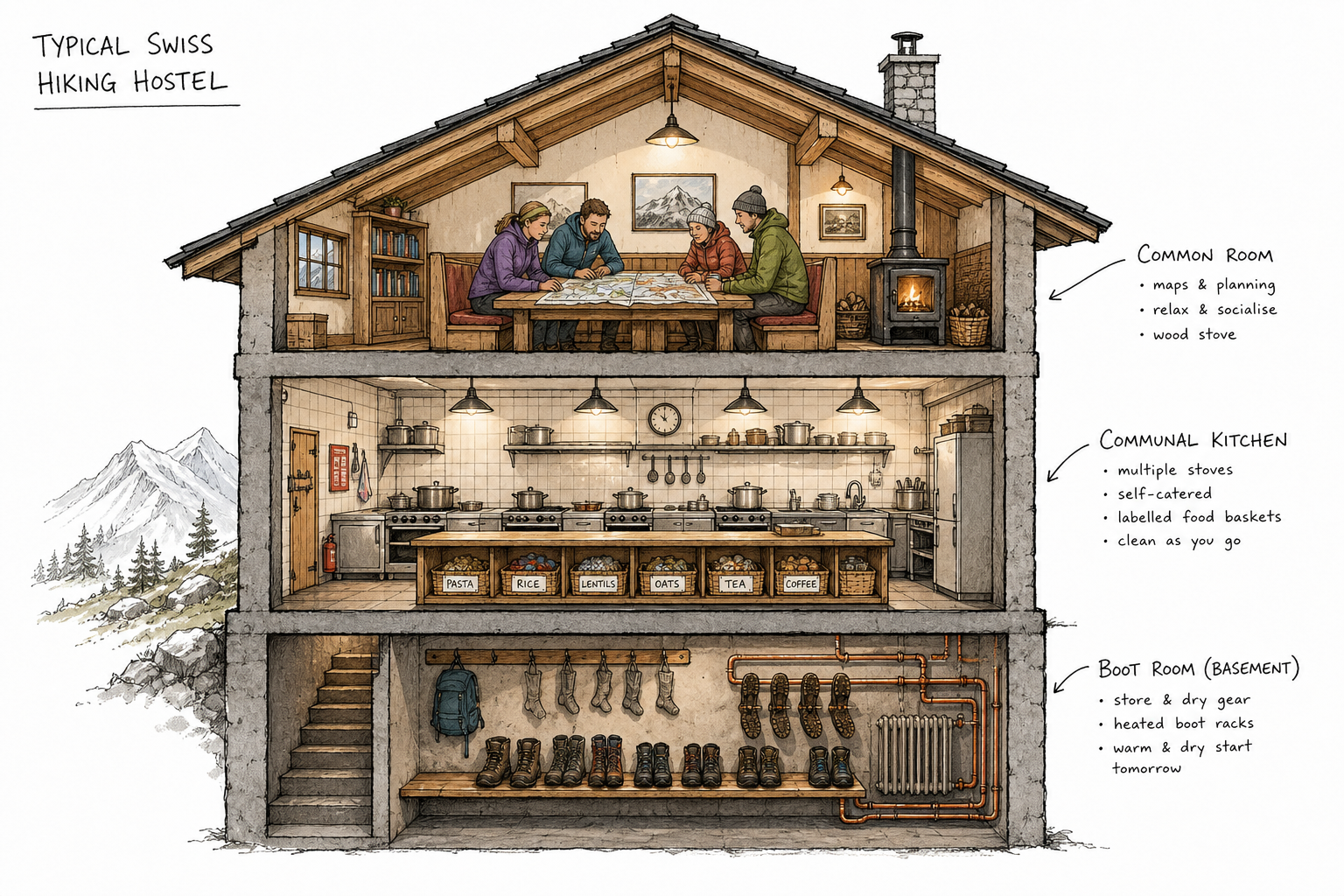
Swiss mountain weather is notoriously volatile. A sunny July morning can easily become a torrential afternoon thunderstorm. If your hostel lacks a dedicated, heated boot room or drying facility, you will be putting on cold, wet hiking boots the next morning. True hiking hostels enforce a strict “no boots in the dorms” policy, providing dedicated racks and heated pipes in the basement to ensure gear is trail-ready by dawn.
The High-Capacity Communal Kitchen
Eating out in Switzerland is a budget-killer. A standard dinner with a drink can easily exceed 40 CHF ($45 USD). For a solo backpacker staying a week, relying on restaurants is mathematically unsustainable. A proper hiking hostel offers a massive communal kitchen equipped with multiple stovetops, industrial sinks, and—most importantly—refrigerators organized by room number or color-coded baskets. This allows you to shop at local Migros or Coop supermarkets, meal-prep your trail lunches, and cook hearty dinners alongside other hikers.
Trailhead Proximity and Transit Integration
The best hiking hostels are either located directly on the trail network or sit adjacent to a primary transit hub (a train station or postbus stop). Waking up and having to walk three miles along a paved highway just to reach the trailhead wastes energy. Your hostel should offer immediate access to cable cars, funiculars, or trailheads.
The Route-Planning Culture
A city hostel has a party board; a hiking hostel has a weather and trail board. The staff at these accommodations know which high passes are blocked by late-season snow and which cable cars are down for maintenance. The common areas are designed for social interaction, making it incredibly easy to sit down with a beer, look at someone’s topographical map, and ask to join them on their hike the next morning.
The Bernese Oberland: Iconic Peaks and High-Energy Hostels
The Bernese Oberland (specifically the Jungfrau Region) is the postcard image of Switzerland. It is home to the Eiger, Mönch, and Jungfrau peaks, the Lauterbrunnen Valley, and some of the most dramatic hiking terrain in Europe. Because of its popularity, it also holds the highest concentration of quality hiking hostels.
Mountain Hostel Gimmelwald
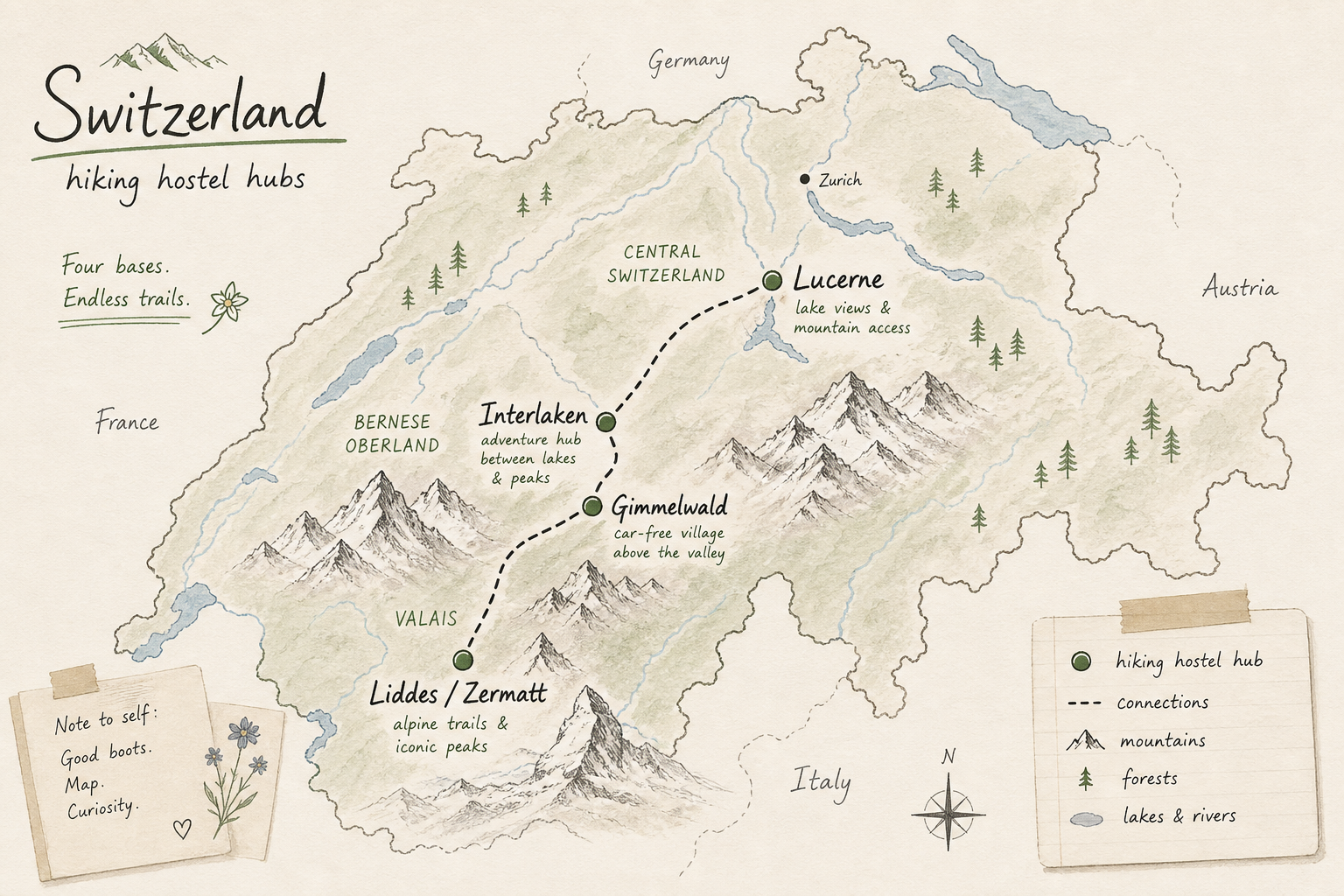
Perched on a cliffside at 1,367 meters, Gimmelwald is a car-free village accessible only by cable car or foot. The Mountain Hostel Gimmelwald is arguably the most famous hiker’s hostel in the Alps, operating less like a traditional hostel and more like an accessible mountain hut.
- The Vibe: Rustic, intimate, and hyper-focused on the outdoors. The hostel is essentially an old farmhouse converted into bunk rooms. The evenings revolve around their famous wood-fired pizzas, local Rugenbräu beer, and live acoustic music or card games in the main dining room.
- The Hiking: You step out the front door directly onto the trail network. You can hike the steep ascent up to the Schilthorn (Piz Gloria), take the Northface Trail toward Mürren, or tackle the grueling but rewarding hike up to the Tanzbödeli for panoramic views of the Lauterbrunnen valley.
- The Solo Experience: Because the village is isolated, everyone staying at the hostel eats and socializes together. It is virtually impossible to leave Gimmelwald without making friends to hike with.
- Limitations: The isolation means you must buy your groceries down in the valley (Lauterbrunnen or Interlaken) before ascending, as Gimmelwald has no real supermarket. Space is incredibly tight, and it books out months in advance during the summer.
Backpackers Villa Sonnenhof, Interlaken
If Gimmelwald is the rustic mountain outpost, Interlaken is the strategic logistical hub. Sitting between Lake Thun and Lake Brienz, Interlaken is the gateway to the entire Bernese Oberland. Many solo travelers debate how to structure their time here, with Reddit users frequently suggesting Interlaken as a base for exploring the Jungfrau region without having to move luggage daily.
Backpackers Villa Sonnenhof is highly regarded for its sheer operational efficiency. It is clean, incredibly well-organized, and acts as a perfect launchpad for day trips.
- The Vibe: Institutional but comfortable. It feels like a premium budget hotel. It lacks the rustic charm of a mountain hut but makes up for it in flawless amenities.
- The Hiking: From Interlaken, you have to take a train to reach the high-alpine trailheads. However, this gives you flexibility. One day you can take the train to Grindelwald to hike the Eiger Trail; the next day, you can head up to Schynige Platte for the panoramic ridge walk to First.
- The Solo Experience: The hostel is massive, meaning you will meet a wide variety of travelers, from hardcore alpinists to casual sightseers. They offer free access to local buses and public pools.
- Amenities: Exceptional communal kitchens, on-site laundry, and a highly professional staff that can help decipher the complex Swiss railway timetables. Booking details for Backpackers Villa consistently highlight its cleanliness and free breakfast.
Balmers Hostel, Interlaken
Balmers is the oldest private hostel in Switzerland and sits on the opposite end of the spectrum from the quiet mountain retreats.
- The Vibe: Lively, loud, and social. Balmers is famous (or infamous) for its basement nightclub and party atmosphere. Discussions among hosteling veterans frequently mention Balmers as the go-to spot for an energetic crowd.
- The Solo Experience: If you are a solo traveler in your early twenties looking to combine daytime hiking with nighttime socializing, Balmers is unmatched. They host regular BBQ nights and have a massive outdoor hammock and biergarten area.
- The Hiking: Like Sonnenhof, it requires a train ride to get into the deep mountains. It is a great base for combining hiking with adventure sports like paragliding or canyoning.
Valley Hostel, Lauterbrunnen
Nestled directly in the valley of 72 waterfalls, the Valley Hostel is the compromise between Interlaken’s transit convenience and Gimmelwald’s mountain immersion.
- The Vibe: Calm, scenic, and practical. You are surrounded by towering vertical cliffs.
- The Hiking: You can walk out the door and hike the valley floor, or take the immediate cable cars up to Wengen or Mürren. It is an excellent base for hiking to Trümmelbach Falls or starting the ascent toward the Kleine Scheidegg.
- Amenities: Multiple small kitchens scattered throughout the buildings prevent the chaotic bottlenecking often seen in single-kitchen mega-hostels at dinnertime.
Central Switzerland: Lake Views and Mountain Trails
While the Bernese Oberland gets the majority of the international hype, Central Switzerland offers incredible hiking with the added benefit of swimming in pristine alpine lakes at the end of the day.
Backpackers Lucerne
Lucerne serves as the perfect introduction to the Swiss Alps. It is easily accessible from Zurich Airport and sits right on the edge of Lake Lucerne.
- The Vibe: Relaxed and scenic. Travelers on the Rick Steves forums recommend Backpackers Lucerne for its quiet demeanor and lakeside access.
- The Hiking: From Lucerne, you have immediate access to Mount Pilatus and Mount Rigi. A classic solo route is taking the boat across the lake to Vitznau, riding the cogwheel train up Rigi, and hiking the panoramic trails back down.
- The Solo Experience: It is less intense than the deep alpine hostels, making it ideal for those who want to mix hiking with exploring a historic Swiss city.
Valais & The Mont Blanc Border: Rugged Trails and Authentic Alpine Living
The Valais region, home to the Matterhorn and bordering the French and Italian Alps, offers some of the most dramatic, demanding, and visually stunning hiking in Europe. This is where the trails get steeper, the glaciers get closer, and the logistics become slightly more complex for the solo traveler.
Zermatt Youth Hostel
Zermatt is notoriously expensive, but the local Youth Hostel (part of the Swiss Youth Hostels association) provides a legitimate budget loophole.
- The Vibe: Clean, functional, and modern. It offers a spectacular, unobstructed view of the Matterhorn directly from the dining room.
- The Hiking: Base yourself here to hike the 5-Seenweg (Five Lakes Walk) or the Gornergrat trails. You are surrounded by 4,000-meter peaks.
- The Solo Experience: The hostel is quite large and caters to a mix of school groups and solo hikers. The half-board option (which includes dinner) is highly recommended here, as cooking facilities can be limited and Zermatt restaurants are incredibly pricey.
The Organized Alternative: Hiking Hostel Basecamps (Liddes & St. Stephan)
While piece-mealing a trip together through standard hostels is a rite of passage, the logistical burden of booking beds six months in advance, navigating complex train schedules, and hoping you find compatible hiking partners can be exhausting.
For solo travelers, digital nomads, and budget-conscious hikers who want the social environment of a hostel without the stress of DIY planning, guided hiking in Switzerland has evolved. Rather than traditional stuffy tour groups, modern alpine packages are built specifically around the hostel ethos.
Hiking Hostel operates dedicated basecamps in Liddes (Valais) and St. Stephan, providing a week-long summer hiking holiday designed specifically for this demographic.
- How it Works: You book a week-long package that includes your hostel accommodation, all your meals (breakfast, packed trail lunches, and communal dinners), and daily trail transport.
- The Vibe: It is the ultimate social hack for solo backpackers. You get the authentic hostel experience—communal dining, shared spaces, and outdoor camaraderie—but with a cohesive group of like-minded hikers who are there for the exact same week.
- The Hiking: From the Liddes basecamp, you are perfectly positioned to access the rugged trails of the Valais, the iconic mountain Mont Blanc region, and even jump across the border for skiing in the Italian Alps or Aosta day trips. From St. Stephan, excursions run to Interlaken and the dramatic Glacier 3000/Gstaad areas.
- The Advantage for Solo Travelers: You eliminate the friction. There is no waiting for the postbus, no mapping out grocery store hours, and no anxiety about hiking a high pass alone. Everything is organized, yet it retains the laid-back, budget-conscious spirit of a backpacking trip.
The True Cost of Hosteling and Hiking in Switzerland
Even when staying in hostels, Switzerland is not Southeast Asia. Budgeting correctly is the difference between a dream trip and running out of funds by day four.
Bed Prices and Seasonal Spikes
A dorm bed in a Swiss hiking hostel during the peak summer season (July and August) will typically range from 40 CHF to 70 CHF per night. Prices dip slightly in the shoulder seasons (June and September), but so does trail accessibility, as high passes may still hold snow. If you are planning a DIY trip, you must book these beds by March. The best hostels—like Gimmelwald—sell out their summer inventory months in advance.
The Supermarket Strategy
To keep costs down, you will become intimately familiar with the two dominant Swiss supermarket chains: Coop and Migros.
- Migros: Generally slightly cheaper, produces its own in-house brands, and famously does not sell alcohol.
- Coop: Slightly more premium, carries name brands, and sells beer and wine.
A realistic food budget for a solo hiker cooking all meals in a hostel kitchen is about 20-30 CHF per day. This covers oats and coffee for breakfast, bread, cheese, and cured meats for a trail lunch, and pasta or rice dishes for dinner. If you add one beer at a mountain hut during your hike (approx. 7 CHF), factor that into the daily spend.
Navigating the Swiss Transit System
If you are independently hosteling, you will need to pay for transport. The Swiss travel network is a marvel of engineering, seamlessly connecting trains, postbuses, and cable cars. However, paying point-to-point fares will bankrupt you.
You have two main options:
- The Swiss Travel Pass: Offers unlimited travel on consecutive days on trains, buses, and boats, plus a 50% discount on most mountain cable cars. It is expensive upfront but offers total freedom. If you wake up in Interlaken, you can hop on any train without buying a ticket.
- The Swiss Half-Fare Card: Costs 120 CHF for a month and gives you 50% off almost every ticket in the country. For a hiker staying in one or two valleys for a week, this is usually the mathematically superior choice.
For an in-depth breakdown of budgeting, review these tips for hiking in Switzerland without the high cost.
Overcoming the Solo Hiker’s Biggest Challenge: Route Logistics
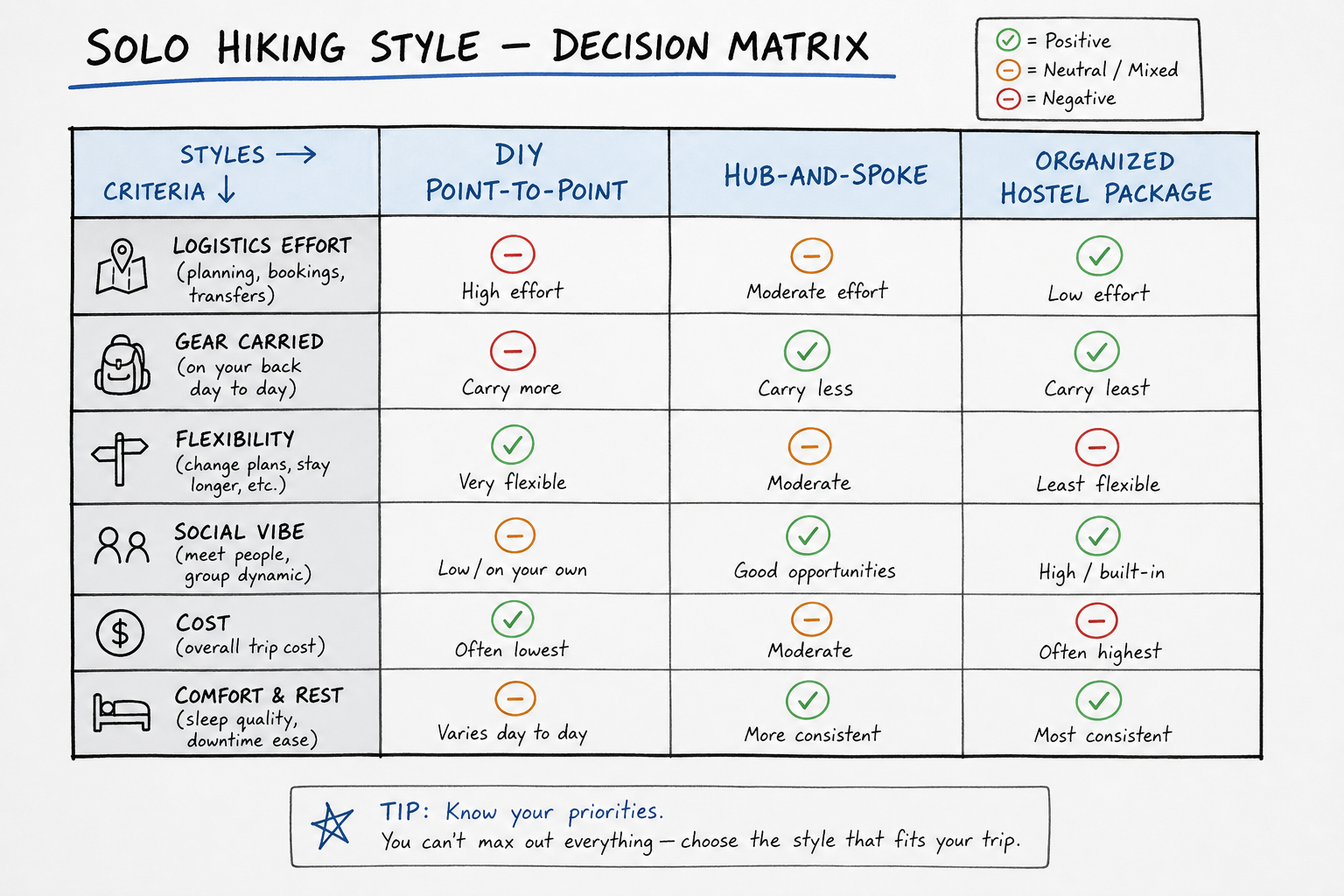
The actual hiking in Switzerland is immensely rewarding, but the logistics of executing those hikes as a solo backpacker require strategy. You have three primary ways to structure your trip.
Strategy 1: Point-to-Point (Hut-to-Hut) Hiking
This involves hiking from one accommodation to another every day. The Via Alpina or the Walker’s Haute Route are prime examples.
- Pros: You cover massive distances and never retrace your steps.
- Cons: You must carry all your gear (a 40L+ backpack) every single day. Hut to hut hiking in Switzerland requires meticulous planning, as missing a single booking disrupts the entire chain of the hike.
Strategy 2: Hub-and-Spoke Hiking
This is the traditional hostel approach. You book a bed in a central location (like Interlaken or Lucerne) for 5-7 days and take daily trains or buses out to different trailheads, returning to the same bed each night.
- Pros: You hike with a lightweight daypack. You only unpack once. You get to know the staff and the local grocery store.
- Cons: You spend 1-2 hours a day on trains commuting to the mountains.
Strategy 3: The Organized Hostel Package
This blends the best of both worlds. By joining a structured week like the ones based in Liddes or St. Stephan, you maintain a single basecamp (hub-and-spoke), but the daily transit is handled by private shuttles rather than public trains.
- Pros: You get immediate access to the best trails—even those not easily serviced by public postbuses. You hike with a lightweight daypack, and your social circle is guaranteed.
- Cons: Less schedule flexibility, as you are moving with the planned itinerary of the group.
Packing for a Swiss Hostel Hike
Packing for a high-alpine environment while living out of a communal dorm requires a distinct setup. Your gear needs to transition from a freezing mountain pass to a humid basement boot room to a busy hostel kitchen.
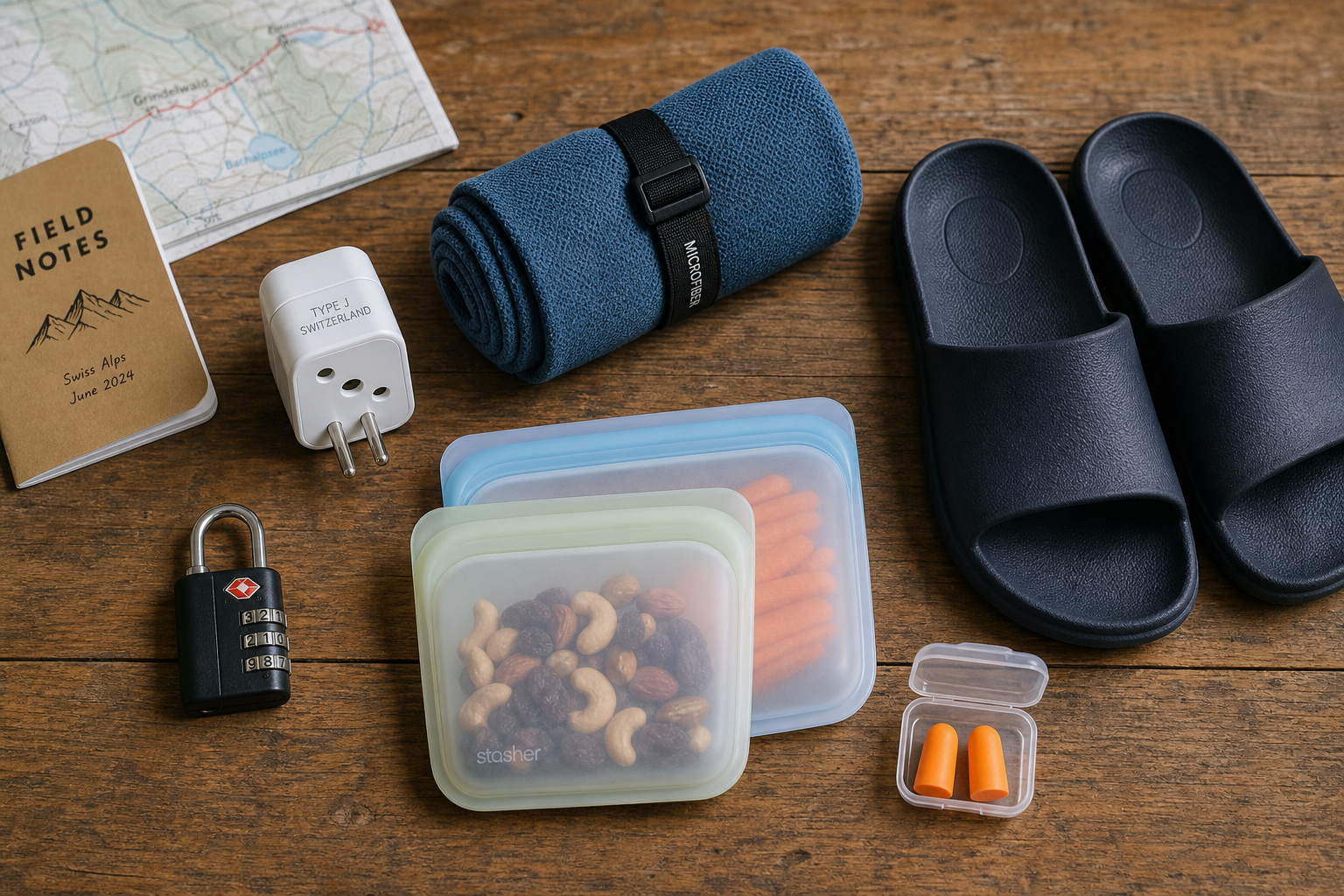
When preparing for a Swiss Alps summer, limit yourself to a 35L-45L travel backpack (like an Osprey Farpoint) plus a 20L packable daypack for the actual hikes.
Hostel-Specific Essentials to Pack:
- Swiss Adapter (Type J): Switzerland does not use the standard European (Type C/F) plug. The hexagonal Type J plug is required. Many hostlers arrive with dead phones because they brought a standard Euro plug.
- Microfiber Towel: Most budget mountain hostels charge 3-5 CHF to rent a towel.
- Padlock: Bring a sturdy combination lock for the dorm lockers.
- Tupperware or Stasher Bags: Essential for packing your DIY sandwiches and trail snacks from the breakfast buffet or your grocery run.
- Earplugs and Eye Mask: Mandatory for dorm sleeping, especially when alpinists in your room set their alarms for a 4:00 AM summit attempt.
- Indoor Shoes/Flip Flops: Your heavy hiking boots will live in the basement drying room. You need lightweight shoes or sliders for navigating the hostel hallways and communal showers.
5 Unwritten Rules of Swiss Mountain Hostels
To seamlessly integrate into the alpine backpacking community, you must understand the etiquette of mountain hostels. These spaces function smoothly because of mutual respect among hikers.
- The Alpine Start Quiet Hours: Unlike city hostels where the night is just starting at 10 PM, hiking hostels shut down early. Many hikers wake up before dawn to beat the afternoon thunderstorms on high passes. If you are in the dorm after 9:30 PM, use a red-light headlamp and pack your daybag the night before to minimize rustling plastic bags in the morning.
- Kitchen Choreography: At 7:00 PM, a 20-person kitchen might have 15 people trying to cook. Clean your pots immediately after plating your food, before you sit down to eat. Do not leave dirty pans on the stove while you dine.
- The Boot Room Boundary: Never walk past the basement or lobby threshold wearing your hiking boots. Swiss trails are muddy, and cow pastures mean you are often stepping in manure. Respect the clean zones.
- Weather Board Dominance: The physical weather board or printed avalanche/trail closure bulletin at the front desk takes precedence over whatever weather app you have on your phone. Mountain micro-climates are highly localized, and the hostel staff update those boards based on real-time cable car reports.
- Share the Route: If you have a detailed topographical map or a premium subscription to a trail app, share your knowledge. The communal tables are meant for leaning over maps and discussing the next day’s elevation gains.
Making the Right Choice for Your Trip
The