Affordable Swiss hiking trips
To get the most out of the Swiss Alps without the eye-watering price tag, you have to rethink how you travel. The traditional approach to hiking in Switzerland is binary: you either spend weeks meticulously planning a DIY trip only to get hammered by unexpected dynamic pricing, or you max out a credit card on a $6,000 fully guided luxury tour.
For solo travelers, digital nomads, and budget-conscious hikers, neither option works.
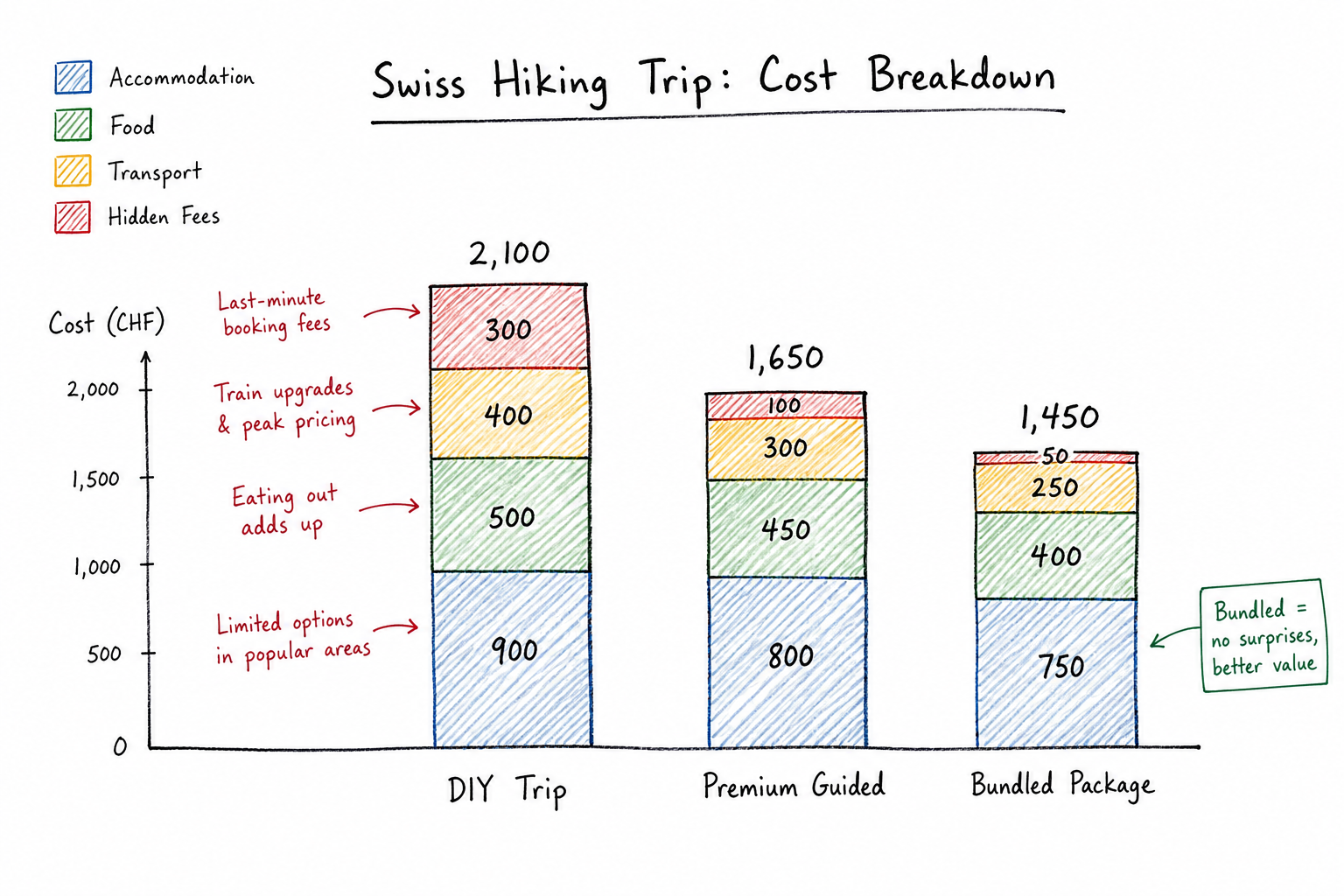
The middle ground—and the secret to actually enjoying the Alps without financial anxiety—is booking bundled hiking trips with accommodation included. By securing your bed, meals, and trail logistics in a single package, you insulate yourself from the notoriously high day-to-day cost of living in Switzerland. While fully guided tours often run $5,000 to $8,000+, self-guided or center-based hostel packages typically cost between $1,300 and $2,400 for a full week.
In this guide, we will break down the mechanics of affordable Swiss hiking trips, compare the best routes and basecamps, and show you exactly what to look for when choosing a package that won’t empty your bank account.
The Real Cost of Hiking in Switzerland (And How Packages Cut It)
Switzerland operates on a high-cost, high-quality baseline. If you attempt to piece together a hiking trip on the fly, you fall victim to the “Swiss Franc death by a thousand cuts.”
Here is a realistic look at daily expenses when traveling piecemeal during the summer peak:
- Last-Minute Accommodation: 120–250 CHF per night for a basic 2-star hotel or inn.
- Cable Cars & Mountain Trains: 30–80 CHF per round trip (mountain transport is incredibly efficient but rarely cheap).
- Food & Dining: 40–60 CHF for a modest dinner; 25 CHF for a mountain hut lunch.
- Logistics & Luggage: 30 CHF+ per bag per transfer if organizing privately.
If you multiply those daily out-of-pocket costs by a seven-day trip, the DIY budget quickly surpasses $2,500 just for the basics, without accounting for the stress of routing and daily bookings.
When you book an all-inclusive or accommodation-included package, the operator leverages bulk buying power. They secure rooms months in advance, negotiate group rates for half-board meals (breakfast and dinner), and bundle regional transport passes. More importantly, it gives you a fixed cost. You know exactly what your week will cost before you board your flight.
If you want more foundational advice on trimming margins, check out our guide on 7 Tips for Hiking in Switzerland (Without the High Cost).
Point-to-Point vs. Center-Based: Choosing Your Format
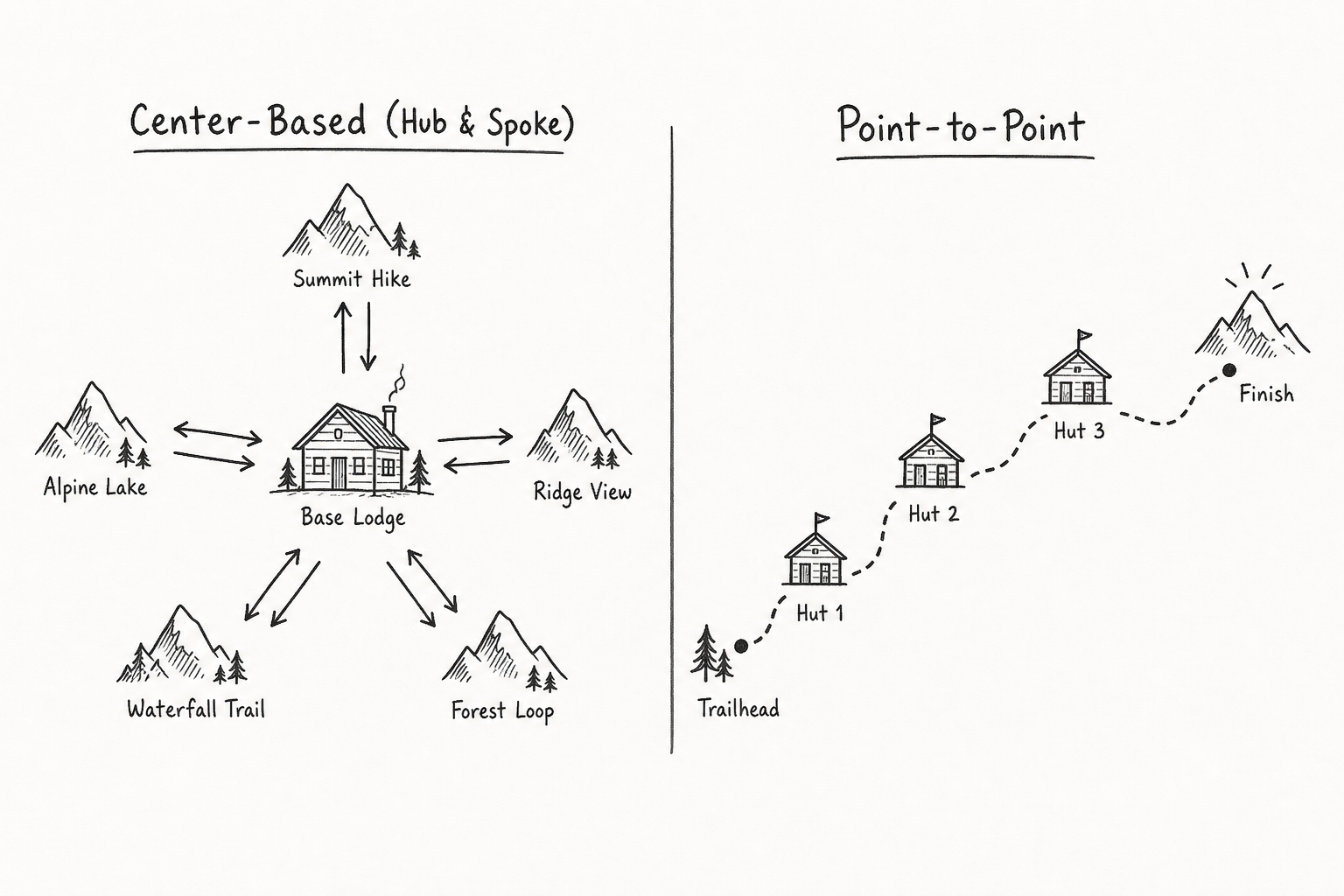
Affordable hiking packages in the Swiss Alps generally fall into two distinct structural categories. Understanding which format fits your travel style and budget is the first major decision you have to make.
1. Point-to-Point (Hut-to-Hut or Inn-to-Inn)
In a point-to-point itinerary, you wake up, hike 10 to 18 kilometers to the next village or mountain pass, and sleep in a new location every night.
- The Experience: Highly immersive. You cross distinct geographical boundaries, moving from lush valleys up to glacial passes and down into new cantons.
- The Logistics: In premium or standard packages, a service transfers your main luggage to your next hotel, meaning you only hike with a light daypack. In true budget packages, you carry all your own gear between mountain huts.
- The Cost: Moderate to high. Because you are constantly moving, you are subjected to the pricing of different micro-regions. Luggage transfers also add a premium to these packages.
- Best For: Purists who want the traditional trekking experience and don’t mind living out of a duffel bag or backpack.
2. Center-Based (Hub-and-Spoke)
In a center-based trip, you unpack your bags once at a central lodge, hostel, or inn. Each morning, you use the region’s flawless train and bus network (or dedicated trip transport) to access a different trailhead, returning to your home base each evening.
- The Experience: Highly flexible. If a thunderstorm rolls in, or your knees need a rest day, you aren’t forced to hike 15 kilometers to your next bed. You can simply take a rest day, work from the hostel lounge, or choose a lower-elevation valley walk.
- The Logistics: Seamless. You only carry water, layers, and lunch.
- The Cost: Lowest. Operators save massive amounts of money by not paying for daily luggage transfers and by negotiating long-term rates with a single accommodation provider. These savings are passed directly to you.
- Best For: Digital nomads, solo travelers wanting a social atmosphere, backpackers, and anyone prioritizing value and flexibility.
Top Affordable Hiking Packages & Routes in the Swiss Alps
Not all regions of Switzerland are priced equally. If you want affordability, you have to look strategically at where you base yourself. Here are some of the most cost-effective and spectacular hiking regions and package structures available.
The Hub-and-Spoke Alpine Basecamps: Liddes and St. Stephan
For budget-conscious outdoor travelers, setting up basecamp in strategic satellite villages is the ultimate hack. Two of the best-positioned hubs in the Swiss Alps are Liddes (in the Valais region) and St. Stephan (in the Bernese Oberland).
Liddes (Valais)
Located on the road to the Great St. Bernard Pass, Liddes is a quiet, authentic alpine village that serves as a launchpad for some of the most dramatic terrain in Europe. Packages based here typically utilize social hostels or alpine lodges, creating a brilliant community feel for solo travelers.
- Why it’s affordable: Liddes sits just outside the hyper-expensive resort zones of Verbier, yet shares the exact same mountain ranges.
- Hiking Highlights: You have immediate access to the trails surrounding the Mont Blanc massif. A week-long package based here often includes organized day excursions to the Italian side of the Alps, such as the Aosta Valley, or day trips into Chamonix, France.
- Flexibility: Because you are situated near international borders, you get a tri-country alpine experience on a single-country budget.
If you want to read more about accessing the highest peaks without the premium price tags, read Mountain Mont Blanc: 7 Ways to Visit Without the Crowd and our guide on exploring the region just south of the border: Skiing in the Italian Alps? Try This Aosta Day Trip (which highlights terrain that is equally stunning in summer).
St. Stephan (Bernese Oberland/Gstaad Region)
St. Stephan is a classic Simmental village surrounded by rolling green pastures and jagged limestone peaks.
- Why it’s affordable: It sits in the valley just below the luxury epicenter of Gstaad. You get the same trails, the same cable cars, and the same views, but your accommodation costs are a fraction of what they would be up the road.
- Hiking Highlights: Packages based out of St. Stephan offer incredible access to Glacier 3000, the high-altitude trails of the Bernese Oberland, and easy transit to Interlaken for day excursions into the Jungfrau region.
The Via Alpina “Bear Trek” (Self-Guided, Point-to-Point)
If you have your heart set on a multi-day point-to-point journey, the “Bear Trek” (Bärentrek) section of the Via Alpina in the Bernese Oberland is the most visually rewarding route for the price.
- The Route: Meiringen to Kandersteg.
- The Views: You will hike directly under the massive north faces of the Eiger, Mönch, and Jungfrau peaks, passing through car-free villages like Wengen and Mürren.
- Average Cost: ~$1,900 – $2,300 per person for an 8-day package.
- What’s Included: 7 nights in traditional valley hotels/inns, breakfasts, luggage moving ahead of you each day, and digital route navigation.
While more expensive than a center-based hostel trip, it represents excellent value compared to fully guided tours of the same route.
The Kandersteg Classic Walk (Center-Based)
Kandersteg is a world-renowned hiking hub that functions beautifully as a center-based destination. Packages built around Kandersteg usually involve staying in a fixed 3-star mountain hotel and using the regional cable cars and trains to reach a different trail every day.
- The Route: Day hikes branching out to the Oeschinensee glacier lake, the Sunnbüel pass, and the Gemmi Pass.
- Average Cost: ~$1,600 – $1,950 per person for an 8-day package.
- What’s Included: Accommodation, breakfast, and often regional pass discounts for the local cable cars.
The Obwalden High Trail (Point-to-Point)
Central Switzerland is often bypassed by international tourists rushing to Zermatt or Grindelwald. The Obwalden High Trail offers spectacular pre-alpine and alpine scenery at a lower price point.
- The Route: Pilatus to Engelberg, crossing ridges that look down over Lake Lucerne.
- Average Cost: ~$1,300 – $1,600 per person for 6-7 days.
- What’s Included: Usually luggage transfers, standard inn accommodations, and detailed route notes.
For more ideas on specific trail access, check out our roundup of the 5 Best Hiking Trails in Switzerland Near Mont Blanc.
Accommodations: What to Expect on a Budget Trip
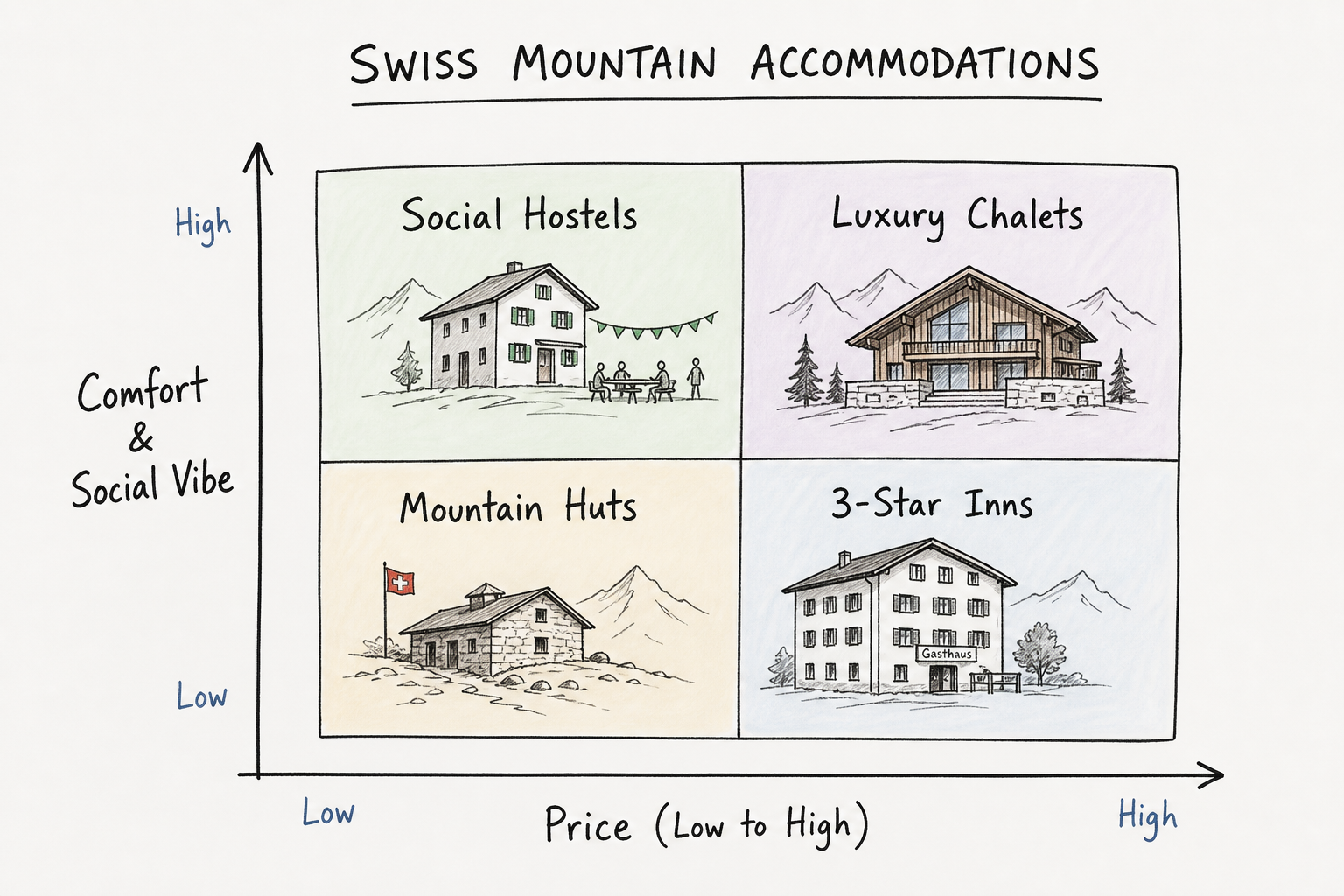
When booking an affordable hiking trip with accommodation included, the type of lodging will dictate both your comfort level and your daily routine. Understanding the tiers of Swiss mountain accommodations helps set proper expectations.
1. The Social Hiking Hostel (Best Overall Value)
In recent years, the “hiking hostel” model has revolutionized the Swiss Alps for budget travelers. These aren’t the chaotic, party-centric city hostels you might find in Berlin or Barcelona. They are purpose-built, community-driven lodges designed specifically for outdoor enthusiasts.
- Vibe: Quiet after 10 PM, social in the evenings, communal dinners, and early breakfasts.
- Room Types: Ranging from 4-6 bed dorms (perfect for solo backpackers) to private double rooms for couples or digital nomads needing quiet space.
- Amenities: Drying rooms for wet hiking boots, secure gear storage, massive communal kitchens, and fast Wi-Fi.
- Why it works: You get the low cost of a shared space with the high utility of a basecamp built for hikers. Plus, it solves the isolation problem for solo travelers. To dive deeper into this accommodation style, read Hotels in Swiss Mountains? Why Social Lodges Beat Luxury.
2. Mountain Huts (Cabanes / Hütten)
If you are doing a high-altitude point-to-point trek without luggage transfers, you will be staying in the famous Swiss mountain huts.
- Vibe: Utilitarian, breathtakingly scenic, and communal.
- Room Types: Mostly large dormitory-style “lager” rooms with long continuous mattresses. Private rooms are incredibly rare.
- Amenities: Basic. Showers are often coin-operated (if they exist at all), electricity is limited, and Wi-Fi is non-existent. Meals are hearty and served at a strict, fixed time.
- Why it works: Huts are the only way to sleep above 2,500 meters without a tent (which is heavily restricted in Switzerland). They offer an unbeatable alpine atmosphere. For logistical advice on hut living, see How to Plan Hut to Hut Hiking in Switzerland (7 Tips).
3. The 2- or 3-Star Alpine Inn (Gasthaus / Auberge)
Traditional village inns are the backbone of self-guided luggage-transfer packages.
- Vibe: Quiet, traditional, slightly dated but immaculately clean.
- Room Types: Private singles, twins, and doubles with en-suite bathrooms.
- Amenities: Standard hotel amenities, often with a highly rated ground-floor restaurant serving local specialties like Rösti or fondue.
- Why it works: They provide the privacy and comfort of a hotel without the spa-resort markups found in 4-star properties.
The Logistics of “Included”: What You Actually Get
When evaluating an “accommodation included” package, you need to read the fine print. The word “included” does not mean “all-inclusive.” Here is exactly what you should look for in a high-quality affordable package.
The Half-Board Advantage
If there is one non-negotiable feature you should look for in a hiking package, it is “Half-Board” (Halbpension).
Half-board means that both your breakfast and your dinner are included in the nightly rate of your accommodation. In Switzerland, a standard restaurant dinner with a drink will easily cost 40 to 60 CHF per person. Over a seven-day trip, paying out-of-pocket for dinner adds an easy $400 to your budget.
Hostels and mountain inns that offer half-board serve a set menu—often a soup/salad starter, a hearty carbohydrate-heavy main course, and a simple dessert. It is exactly the kind of fuel you need after 15 kilometers on the trail, and buying it bundled into your package saves you hundreds of dollars.
Transportation and Transfers
Switzerland’s public transport is world-class, but single tickets are expensive. A good hiking package will manage transport in one of two ways:
- Dedicated Trail Transport: (Common in hostel-based hub-and-spoke models). The operator has a dedicated van or minibus that shuttles the group to the trailhead each morning and picks them up in the afternoon. This is the ultimate convenience.
- Discount Cards & Regional Passes: The package includes a local guest card or a half-fare card, significantly reducing the cost of the buses and cable cars you need to reach the high trails.
Ensure that your package specifies whether airport transfers (from Geneva or Zurich) to your basecamp are included. If they aren’t, you will need to budget another 70–120 CHF each way for the train.
Route Maps and Excursions
Self-guided packages rely heavily on the quality of their route notes. A good operator will provide GPX files for your phone, detailed physical topographic maps, and alternative routes for bad weather.
If you opt for a social, center-based package, look for operators that include organized excursions. Even if you are hiking independently during the day, having a structured day trip to a major site like Glacier 3000 or the Aosta Valley included in your week adds immense value and breaks up the routine.
Finding Your People: Solo Traveling & Group Dynamics
Hiking in the Alps can be an isolating experience if you are traveling alone and staying in traditional hotels.
This is why center-based trips utilizing hiking hostels have exploded in popularity among solo travelers and digital nomads. When you book a week-long package at a hiking basecamp, you are instantly plugged into a community. You eat breakfast at communal tables, easily find partners to tackle a difficult trail with, and swap route conditions over dinner.
If you prefer a bit more structure, you might look into small-group guided packages. While standard guided tours are expensive, some operators offer “social group” weeks where a guide leads a specific itinerary, but guests stay in budget-friendly hostels to keep the overall price down. For advice on navigating these options, read Guided Hiking in Switzerland: Finding Your Social Group.
5 Hidden Traps to Avoid When Booking a Package
Even when booking a budget package, hidden costs can sneak up on you. Here is how to protect your budget:
1. The “Cable Car Not Included” Trap
Many point-to-point itineraries assume you will take a cable car to bypass a grueling, boring section of a valley floor. These tickets are rarely included in the base price of a self-guided package. Review the itinerary and look for “optional cable car” notes. If a route requires three cable cars to complete, add 100 CHF to your mental budget.
2. The Lunch Gap
Half-board covers breakfast and dinner, leaving you to fend for yourself at lunch. Do not fall into the trap of eating at mountain top restaurants every day. A plate of fries and a sausage at 2,500 meters will cost you 25 CHF. Instead, buy bread, cheese, and cured meats from the valley supermarket (Coop or Migros) before you hike.
3. Overpacking and Transfer Fees
If you are on a point-to-point trip with luggage transfers, you are usually limited to one bag of 15kg to 20kg. If you show up with massive suitcases, you will be hit with exorbitant excess weight fees by the transfer company. Pack strategically. You only need a few high-quality layers. For a bulletproof packing system, follow our Swiss Alps Summer: A Simple 5-Step Packing Guide.
4. Ignoring the Terrain Grade
Affordable packages are non-refundable. If you book a package that tackles “T3” (challenging mountain hiking) trails, and you are only comfortable on “T1” (flat walking paths), you will be miserable, and you cannot ask the operator to move you to a different valley mid-week. Always verify the trail grades before you lock in your accommodation.
5. The Peak Season Premium
August 1st is Swiss National Day, and the first two weeks of August are absolute peak season across Europe. If you have flexibility, book your package for late June, early July, or September. The weather is often more stable in September anyway, the trails are quieter, and operators sometimes drop their package rates by 10% to 15% to fill shoulder-season beds.
Packing Strategy for a Bundled Trip
When your accommodation is included, your packing strategy shifts from survival to efficiency. Because you aren’t carrying a tent, sleeping pad, or cooking gear, you can afford to travel exceptionally light.
Here is a quick framework for packing for a center-based or luggage-transfer trip:
- The Daypack (20-25L): This is your mobile office. It needs to hold 2 liters of water, your supermarket lunch, a first aid kit, and your layers.
- The Layering System: Bring one moisture-wicking base layer, one active mid-layer (like a fleece grid), a lightweight puffy jacket for summit stops, and a Gore-Tex shell. The weather in the Alps can shift from 25°C (77°F) and sunny to freezing rain in thirty minutes.
- Footwear: Ditch the heavy, stiff mountaineering boots unless you are crossing glaciers. Modern, aggressive trail running shoes or lightweight mid-rise hiking boots are vastly superior for the well-maintained trails of the Via Alpina or Valais region.
- Hostel Comforts: If you are staying in a hiking hostel, bring a lightweight pair of slip-on sandals (shoes are banned upstairs in almost all Swiss alpine lodgings), a travel towel (if not provided), and earplugs.
Frequently Asked Questions
How much should a 7-day Swiss Alps hiking trip cost?
If you book an affordable package with a hub-and-spoke hostel model or a basic self-guided inn-to-inn setup, expect to pay between $1,300 and $2,400 USD. This should include your accommodation, most meals (half-board), and luggage transfers or trail transport. If you do it entirely DIY with budget accommodations, you might scrape by on $1,200, but you assume all logistical stress. Fully guided premium tours start around $5,000.
Do I need to be an expert hiker to book a package?
Not at all. The beauty of center-based packages is that you can choose your difficulty each day. If you book a point-to-point trek, operators usually grade them (e.g., Easy, Moderate, Challenging). As long as you can walk 10-15 kilometers a day with some elevation gain, you will find a package that fits your fitness level.
Are meals typically included in these packages?
Budget-friendly packages heavily rely on the “half-board” model. This means breakfast and dinner are included. Lunch is almost always up to you, allowing you to picnic on the trail or stop at a mountain hut at your discretion. Always verify if half-board is included before booking.
Can I work remotely during a hiking package?
If you book a point-to-point trip, remote work is difficult due to exhaustion and patchy Wi-Fi in remote mountain inns. If you book a center-based trip at a modern hiking hostel (like those in Liddes or St. Stephan), they are expressly designed for digital nomads, offering high-speed internet and quiet lounge spaces to work after your hike.
Final Thoughts on Hacking the Alps
The Swiss Alps are unequivocally one of the most spectacular mountain ranges on earth, and they do not have to be reserved for luxury travelers.
By abandoning the traditional DIY scramble and ignoring the exorbitant fully guided luxury tours, you can unlock incredible value. Whether you choose a sweeping self-guided point-to-point trek like the Bear Trek, or establish a social, cost-effective basecamp in a hiking hostel in Liddes or St. Stephan, bundling your accommodation and logistics is the ultimate budget cheat code.
Decide what kind of daily routine you want, prioritize half-board packages, and get ready to experience the high alpine without the financial hangover.