Best group hiking trips for solo travelers in Chamonix and Mont Blanc
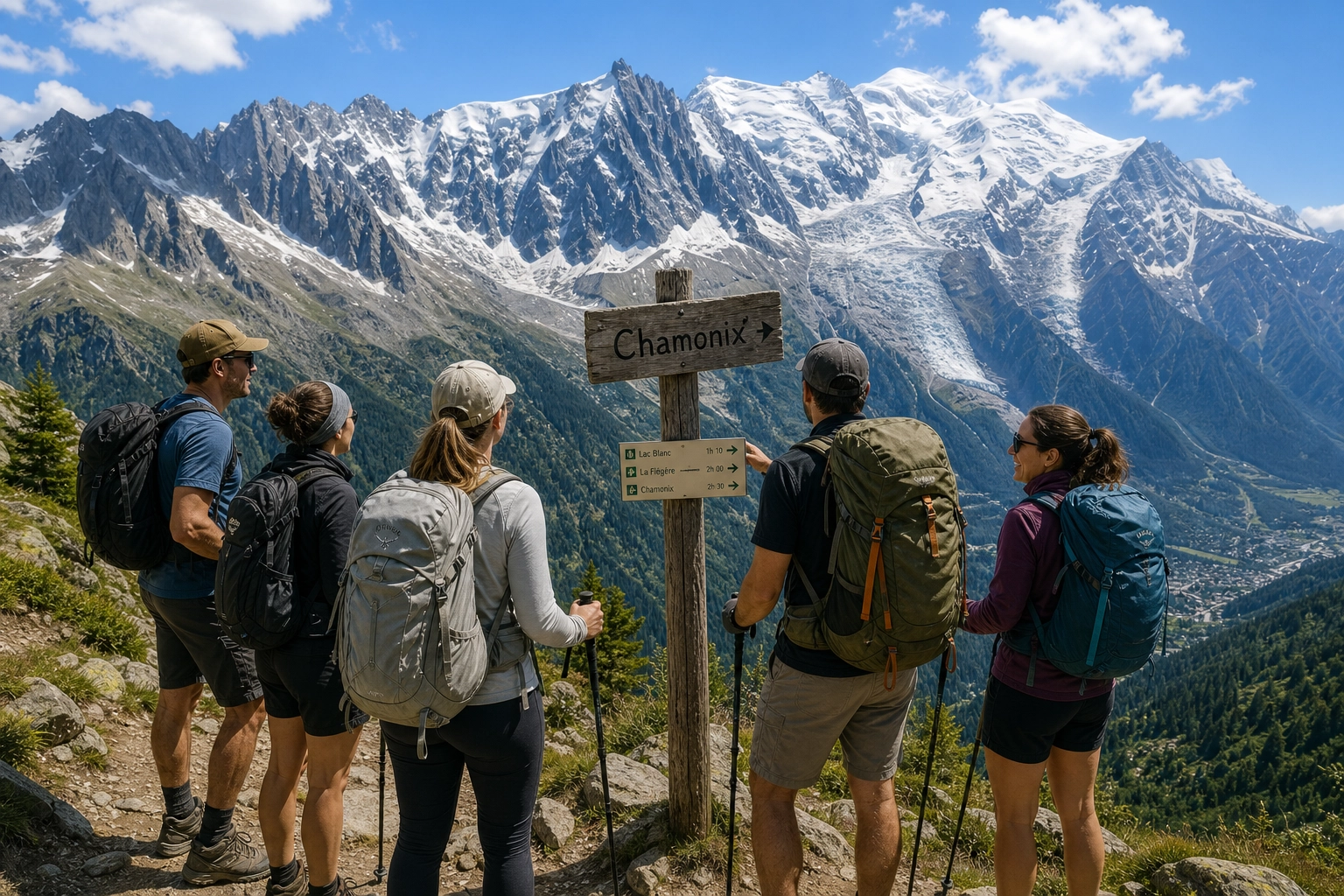
Booking a solo mountain holiday around Mont Blanc often leads to a quick reality check. You either spend months fighting for refuge reservations along the Tour du Mont Blanc, or you face eye-watering single supplement fees from commercial trekking agencies. Joining a group hiking trip solves the logistical headache, but choosing the right trip structure determines whether you end up on a rigid, over-priced march or a flexible, high-energy mountain holiday.
The Mont Blanc massif spans three nations: France, Italy, and Switzerland. Standing in Chamonix, you look up at vertical granite spires and blue glaciers. A short drive through the Mont Blanc tunnel puts you in the Val d’Aosta in Italy, while heading east over the Col de Balme drops you into the Swiss Canton of Valais. For solo travelers, backpackers, and digital nomads, this region offers some of the most dramatic trail networks on earth.
Choosing the right itinerary comes down to how you prefer to travel: carrying a heavy pack between high mountain huts each night, or returning to a comfortable social lodge each evening after exploring a new alpine valley.
Why Chamonix and Mont Blanc Excel for Solo Group Hikers
Solo hiking in high alpine terrain brings genuine rewards, but it also carries real safety and logistical burdens. Alpine weather shifts rapidly. Snow can hold on high passes like the Col du Bonhomme well into July, and navigating trail junctions in dense mountain fog requires sharp navigation skills. Joining an organized group provides immediate safety margins without requiring you to hire a private guide.
       [ Group Hiking Trip Structures Around Mont Blanc ]
                               |
       +-----------------------+-----------------------+
       |                                               |
[ Multi-Day Hut-to-Hut ]                    [ Stationed Basecamp ]
  - Heavy packs / haul bags                   - Fixed accommodation
  - New hut every night                       - Daypack hiking only
  - Strict daily schedules                    - Flexible trail options
  - Steep single supplements                  - Built-in social hub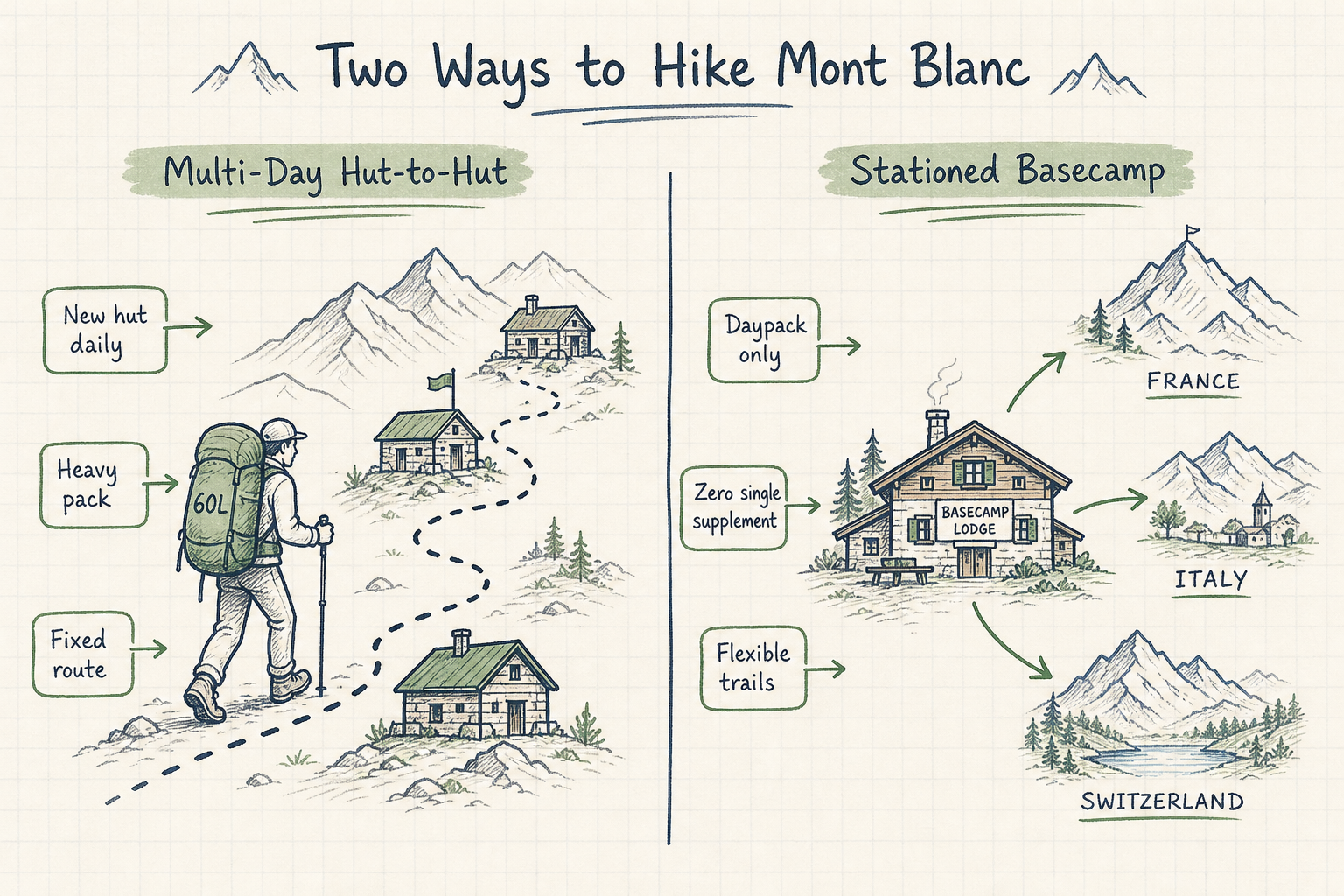
Beyond safety, group trips eliminate the isolation that sometimes accompanies solo travel. Shared meals after a 1,000-meter ascent build natural camaraderie. You sit down with people who spent the last six hours pushing up the same steep switchbacks, sharing the same panoramic views over the Bossons Glacier.
The Single Supplement Trap
traditional trekking companies operate on a double-occupancy business model. If you book as a solo traveler, these agencies usually charge a single supplement fee ranging from $400 to $1,200 just to secure a private room in valley hotels. Even in high mountain refuges, where hikers sleep in shared dormitories, some operators add administrative surcharges for solo bookings.
Alternative trip structures overcome this financial penalty. Social hostels and basecamp lodges accommodate solo travelers naturally in shared dorms or twin-share rooms without added penalties. You get all the social perks of a group holiday, professional logistics, and daily trail transfers while keeping your total trip cost predictable.
Comparing Group Hiking Trip Formats
Not all group hiking trips near Mont Blanc follow the same pattern. Understanding the differences between moving multi-day treks, highlights tours, and basecamp-style holidays helps you match a trip to your fitness level, packing preferences, and budget.
| Feature | Classic Multi-Day Circuit (TMB) | Highlights / Shortened Trek | Hub-and-Spoke Basecamp Model |
|---|---|---|---|
| Duration | 9 to 11 Days | 5 to 7 Days | 7 Days (Week-long) |
| Accommodation | Refuges, mountain inns, dorms | Valley hotels, gîtes | Central social hostel / lodge |
| Packs | Large trek pack or luggage transfer | Medium pack / transport supported | Light daypack only |
| Trail Flexibility | Fixed daily route (must reach next hut) | Fixed core route with transfers | High (tailored daily to weather/fitness) |
| Cross-Border Scope | France, Italy, Switzerland | Select sections across borders | Daily excursions to France, Italy, Valais |
| Single Supplement | High ($400–$1,200+) | Moderate ($300–$700) | None (Built for solo travelers) |
| Best For | Endurers wanting a full loop | Hikers short on time | Solo travelers, nomads, budget hikers |
1. Classic Circuit Treks
The classic loop circles the entire Mont Blanc massif over 170 kilometers with roughly 10,000 meters of cumulative elevation gain and loss. Operators like Alpine Hikers Classic TMB and Trekking Mont Blanc lead international groups along this full circuit.
- Pros: You hike an iconic world-class trail from start to finish.
- Cons: Rigid schedules mean you must trek through severe rain or lightning storms to reach the night’s designated hut. Single supplements are steep, and booking must happen up to ten months in advance due to refuge capacity constraints.
2. Highlights & Shortened Group Treks
If you lack two full weeks, condensed options like the Alpine Hikers Best of TMB trim the route using cable cars and private shuttles. These trips skip lower valley walks to focus entirely on high alpine pass crossings.
- Pros: Hits top mountain vistas in under a week.
- Cons: Still requires moving accommodation every night, meaning you unpack and pack your bag continuously throughout the trip.
3. The Hub-and-Spoke Basecamp Model
Instead of moving to a new bed every night, you stay at a dedicated social lodge or hostel positioned strategically near Chamonix and the Swiss Valais border. Each morning, direct trail transport takes your group to a premier trailhead in France, Italy, or Switzerland. You carry only a lightweight daypack containing water, extra layers, and food.
- Pros: Maximum comfort, low luggage stress, zero single supplement penalties, and high flexibility to alter trail routes based on cloud cover or rain.
- Cons: You do not sleep in remote mountain refuges high above the treeline.
If you are weighing moving treks against stationary options, reading about hotels in swiss mountains explains how social lodges provide better value and community for solo travelers than traditional hotels.
Top 5 Group Hiking Trips Near Mont Blanc and Chamonix
Here are the top five group hiking trips and itineraries operating around Mont Blanc and Chamonix, tailored for solo hikers seeking solid mountain terrain and vibrant group dynamics.
                  [ MONT BLANC MASSIF ]
                            |
   +------------------------+------------------------+
   |                        |                        |
[ FRANCE ]              [ ITALY ]              [ SWITZERLAND ]
Chamonix Valley        Courmayeur / Aosta      Val Ferret / Valais
- Grand Balcon Sud     - Val Vény              - Grand St. Bernard Pass
- Lac Blanc            - Rifugio Bonatti       - Col de la Forclaz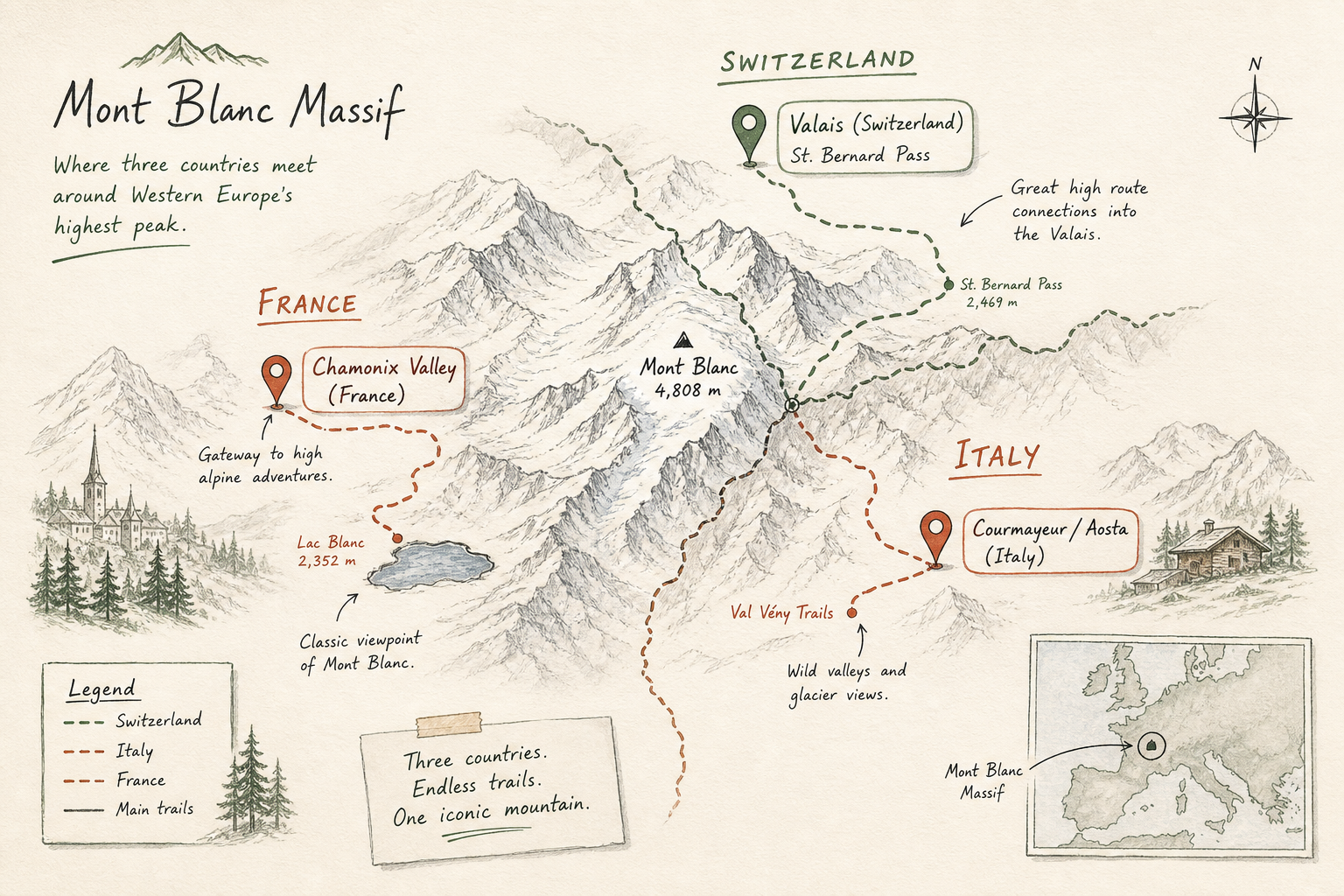
1. The Classic 11-Day Tour du Mont Blanc Circuit
The full circuit remains the gold standard for endurance trekkers. Starting in Les Houches near Chamonix, the route proceeds counter-clockwise through Les Contamines, crosses into Italy over the Col de la Seigne, traverses above Courmayeur, passes into Switzerland through Val Ferret, and crosses back into France over the Col de Balme.
Operators like Tours Du Mont Blanc coordinate these group departures, arranging mountain guide service, refuge bookings, and optional luggage haulage.
- Distance: 170 km
- Elevation Gain: ~10,000 m
- Best Suited For: Fit endurance hikers who enjoy multi-day point-to-point challenges.
2. Best of the Mont Blanc Massif (5–7 Day Express)
For hikers with limited holiday time, express group itineraries deliver high-altitude rewards without requiring 11 straight days on trail. Trips like the Alpine Hikers Great Hikes highlight iconic sections: the steep climb to Lac Blanc, the balcony path over Courmayeur, and the high pass of Grand Col Ferret.
By skipping long valley descents with quick vehicle transfers, group participants spend maximum time on high ridges with views of Mont Blanc, Grandes Jorasses, and Mont Dolent.
- Distance: 75–90 km
- Elevation Gain: ~5,500 m
- Best Suited For: Hikers seeking highlight mountain views within a standard week of vacation.
3. Valais & Mont Blanc Basecamp Week (Social Hostel Format)
For solo backpackers, digital nomads, and budget-conscious outdoor travelers, basecamp weeks offer an effective balance of structured group hiking and social lodge comfort. Based out of traditional alpine hubs like Liddes in the Swiss Valais, trips run by Hiking Hostel combine guided and organized group hikes with inclusive logistics.
A typical basecamp week features daily trail transport to premier routes across three countries:
- Day 1 (France): Chamonix valley traverse along the Grand Balcon Sud to Lac Blanc for iconic views of the Mont Blanc summit ridge.
- Day 2 (Italy): Crossing the border via the St. Bernard Pass to hike the high slopes above Aosta or Val Vény under the southern face of Mont Blanc.
- Day 3 (Switzerland): Swiss Val Ferret ridge trails or the high alpine lakes of Lacs de Fenêtre near the Italian border.
- Day 4 (Rest & Excursion): Cultural or high-alpine rest day taking in Glacier 3000, Interlaken, or thermal spas.
- Days 5-6 (Valais High Trails): Traversing historic passes and glacier overlooks in the Grand Entremont region.
Because accommodation remains fixed at a social lodge, participants enjoy chef-prepared group dinners, comfortable beds, fast Wi-Fi for remote work, and zero luggage-repacking stress. The single supplement disappears completely because lodging centers on shared dorms or simple twin rooms tailored for solo guests.
To understand how high-altitude trails on the Swiss side connect directly to Mont Blanc, explore our guide on the best hiking trail in switzerland.
4. Chamonix Valley Grand Balcon Day-Trek Series
If you prefer to stay directly in Chamonix town, local guide associations lead multi-day series focused entirely on the Chamonix needle spires (Aiguilles de Chamonix). These group trips move along the Grand Balcon Nord and Grand Balcon Sud, positioned high on opposite sides of the valley floor.
Hikers take cable cars like the Plan de l’Aiguille or Brévent to enter high terrain instantly, spending six to eight hours sweeping along balcony trails with views straight across at the Mont Blanc ice cap.
- Distance: 12–18 km per day
- Elevation Gain: 600–1,100 m per day
- Best Suited For: Hikers who want strong daytime elevation gains paired with lively Chamonix nightlife.
5. Italian Val Vény & Val Ferret Cross-Border Group Hikes
The Italian side of Mont Blanc presents a dramatic vertical wall of granite and ice. Group trips focusing on the Val Vény and Italian Val Ferret offer steep climbs to historic mountain huts like Rifugio Bonatti and Rifugio Elisabetta.
These itineraries feature exceptional food, warmer mountain microclimates, and direct views of the Brenva glacier face. Groups usually assemble in Courmayeur before making daily loops or traverse legs along the southern flanks of the range.
- Distance: 14–20 km per day
- Elevation Gain: 800–1,300 m per day
- Best Suited For: Alpine enthusiasts looking for dramatic terrain, quiet trails, and Italian cuisine.
If you are interested in expanding an Italian alpine itinerary beyond day hikes, check out our companion piece on taking an Aosta day trip.
Evaluating Fitness and Trail Technicality
Alpine trails near Mont Blanc demand standard endurance and sure-footedness. While most standard group itineraries involve non-technical hiking (no ropes, crampons, or climbing harness required), the vertical scales catch many visitors off guard.
[ Fitness Level Assessment Matrix ]

   Elevation Gain / Day    Recommended Fitness Standard      Weekly Prep Work
   --------------------    ----------------------------      ----------------
   400m - 700m             Moderate / Casual Hiker           3-5 km road runs, light stairs
   700m - 1,100m           Strong Alpine Fitness             10 km hill runs, weighted stair climbs
   1,100m - 1,600m+        Endurance Athlete                 Back-to-back 20 km mountain days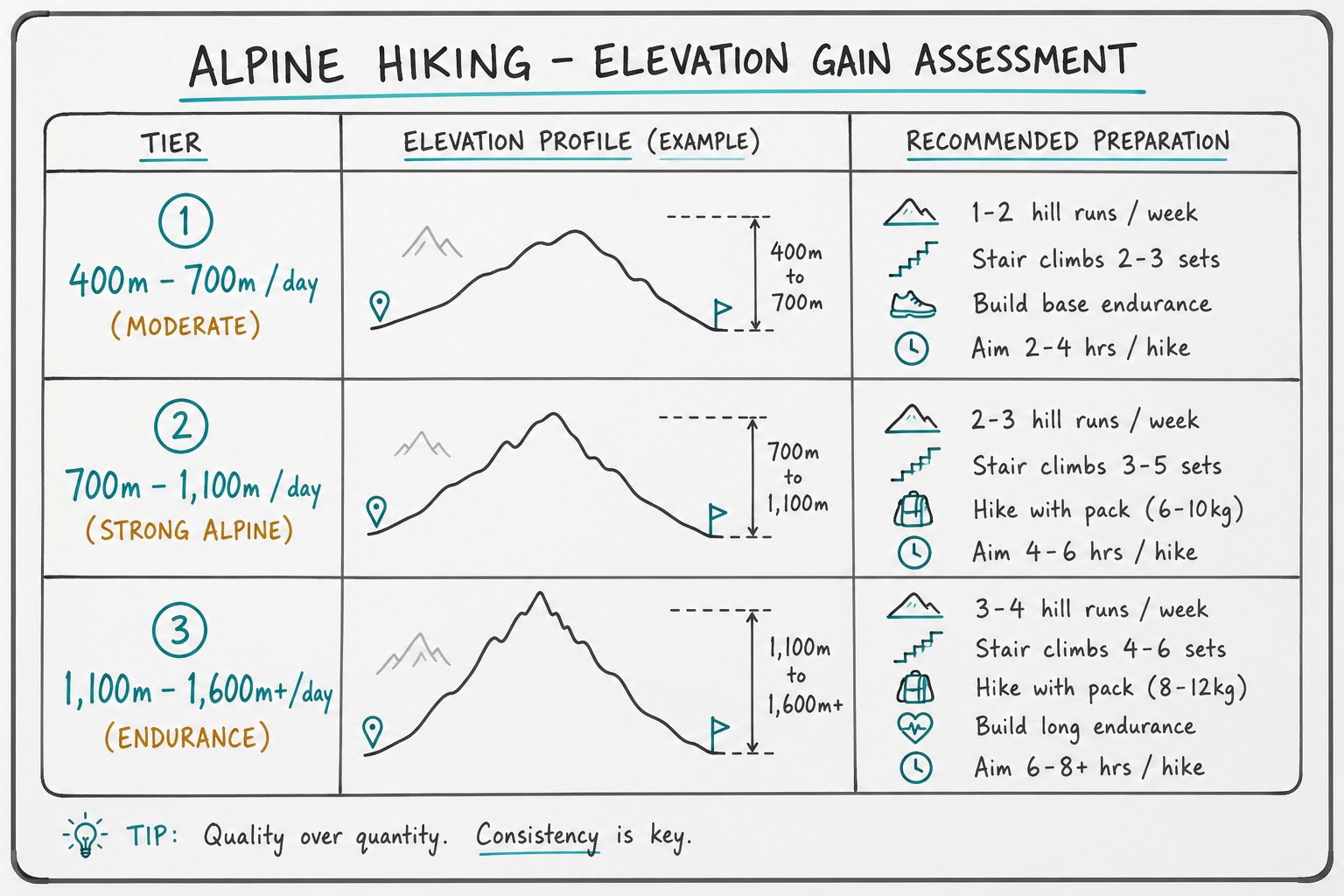
Understanding Elevation Gain vs. Horizontal Distance
Distance metrics in the Alps can be misleading. A 12-kilometer trail with 1,200 meters of vertical ascent feels harder than a flat 25-kilometer walk. You will spend two to three hours climbing continuously uphill before reaching a pass, followed by two hours of sustained downhill movement that puts heavy stress on knees and quads.
Before selecting a group trip, evaluate how your knees handle long descents. Trekking poles are essential alpine gear, reducing joint impact on steep downhills like the descent from Col de la Forclaz into Trient.
Technical Rating Spectrum
Most group trips around Chamonix classify trails into three main categories:
- Grade 1 (Moderate Alpine Walking): Well-maintained dirt paths, wide switchbacks, clear signage. Example: Grand Balcon Sud lower sections.
- Grade 2 (Challenging Alpine Hiking): Steep rocky trails, loose scree fields, narrow ridge lines with wire handrails or timber steps in short sections. Example: Crossing the Fenêtre d’Arpette or climbing to Lac Blanc via metal ladders.
- Grade 3 (Technical Alpine Route): Glaciated terrain, steep snowpack crossings requiring microspikes, exposed scrambling. Requires mountaineering oversight.
The vast majority of group hiking trips stay firmly within Grade 1 and Grade 2 terrain. For advice on preparing for high mountain passes, read our complete overview of hut to hut hiking in switzerland.
Cost Analysis: Commercial Guided Tours vs. Social Hostel Basecamps
Pricing for Mont Blanc group hiking holidays varies dramatically based on operator overhead, accommodation style, and included services. Solo travelers should analyze what is included in listed rates to uncover hidden line items.
| Expense Category | Guided Tour du Mont Blanc (High-End Agency) | Mid-Range Guided Trek | Basecamp Social Hostel Week (e.g., Hiking Hostel) |
|---|---|---|---|
| Base Tour Price | $3,200 – $5,500 | $1,800 – $2,800 | $900 – $1,400 |
| Single Supplement Fee | $500 – $1,200 | $350 – $700 | $0 (Shared dorm / twin) |
| Airport Transfers | Rarely included ($100–$200 extra) | Sometimes included | Included (e.g., Geneva pick-up) |
| Daily Luggage Transfers | Included or +$300 | Optional extra | Not needed (Fixed room) |
| Meals Included | Breakfast & Dinner (Lunch extra) | Breakfast & Dinner | Full Board / Daily trail lunches |
| Local Trail Shuttles | Included on route | Limited to public buses | Included daily private transfers |
| Total Out-of-Pocket | $3,800 – $7,000+ | $2,300 – $3,800 | $900 – $1,400 |
Uncovering Hidden Costs
When comparing options, verify whether lunch is provided. Buying sandwiches and coffee daily in Chamonix valley towns or remote Swiss mountain huts adds $25 to $40 per day to your running total.
Airport transfers are another frequently overlooked expense. Reaching Chamonix or the Valais from Geneva Airport via commercial minibus services costs between $50 and $90 each way. Packages that include airport pickups eliminate these additional fees.
For budget-conscious hikers looking to stretch their funds, read our practical guide to hiking in switzerland.
Group Dynamics for Solo Travelers
Joining a group of strangers in high-altitude terrain can feel intimidating. Understanding how group mechanics function on mountain trails makes for a smoother, more enjoyable trip.
       [ Group Hiking Pace Architecture ]

  [ Fast Hikers ]  ---> Moves ahead to designated regroup points
  [ Main Group  ]  ---> Holds steady, consistent baseline tempo
  [ Tail End    ]  ---> Swept by rear guide / steady pace keeper
Pace Management and Split Groups
In an average group of ten to twelve hikers, natural fitness differences emerge quickly. Experienced group leaders manage pace variation by setting clear regroup milestones: high passes, trail junctions, or alpine huts.
- The Lead Rule: Fast hikers are permitted to push ahead on long ascents provided they stop at marked junctions or high passes.
- The Sweep system: On larger organized trips, a tail guide keeps pace with the slowest hiker, ensuring no solo traveler gets separated or feels pressured to push beyond safe limits.
In a basecamp setting, group dynamics are flexible. If your legs need a rest day after three consecutive 1,000-meter climbs, you can opt out of the scheduled trek, stay at the lodge to catch up on remote work, or take a scenic train journey to nearby alpine villages without disrupting the group itinerary.
If you prefer two-wheeled mountain adventures with structured social dynamics, check out our guide to finding a mountain bike group.
Essential Packing Blueprint for Mont Blanc Group Treks
Mountain weather in the Mont Blanc massif changes rapidly. A warm 22°C morning in Chamonix valley can transition into a 2°C sleet storm high on the Col de la Seigne by mid-afternoon.
     [ Alpine 3-Layer System ]

  [ Outer Layer ] -> Hardshell Waterproof Jacket (Gore-Tex / Pertex)
  [ Mid Layer   ] -> Breathable Fleece or Lightweight Down Jacket
  [ Base Layer  ] -> Synthetic or Merino Wool Long-Sleeve Shirt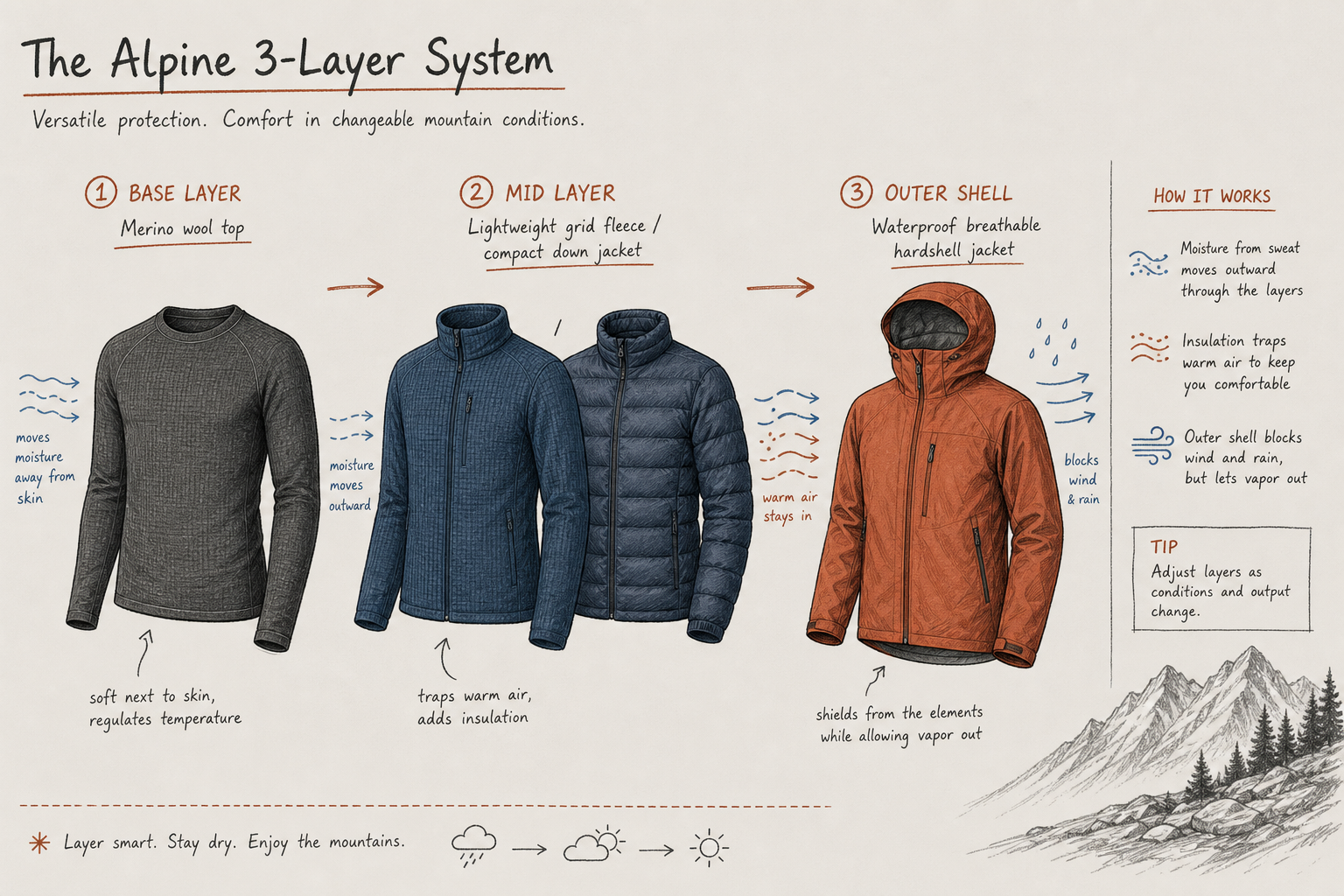
The 3-Layer System
- Base Layer: Merino wool or high-performance synthetic fabric. Never wear cotton on alpine trails; it retains sweat, stays cold against your skin, and accelerates hypothermia during windy ridge breaks.
- Mid Layer: A lightweight grid fleece or compact down jacket that stows away easily in your daypack.
- Outer Shell: A breathable waterproof jacket rated to at least 15,000mm hydrostatic head with fully taped seams. Lightweight rain ponchos are inadequate for high alpine ridge winds.
Footwear: Boots vs. Trail Runners
The ongoing debate over footwear comes down to pack weight and ankle stability:
- Trail Running Shoes: Excellent for day-hiking basecamp options where you carry only a 20-liter daypack. They dry quickly, weigh significantly less, and reduce foot fatigue over long miles.
- Ankle-High Hiking Boots: Necessary if you are carrying a 12 to 15 kg multi-day backpack on a self-supported hut tour, or if you require extra ankle stability on steep scree descents.
Essential Accessories Checklist
- High-altitude sunglasses (Category 3 or 4 UV protection)
- Broad-spectrum sunscreen (SPF 50+) and lip balm with UV block
- Trekking poles with quick-lock adjustment mechanisms
- 2-liter water capacity (hydration bladder or durable wide-mouth bottles)
- Compact personal first aid kit containing blister blister pads, ibuprofen, and athletic tape
- Lightweight power bank to keep phone navigation apps charged cold alpine air
For a comprehensive packing breakdown designed specifically for mountain holidays in this region, consult our swiss alps summer packing guide.
Alternative Basecamp Options: Exploring Beyond Chamonix
While Chamonix serves as the traditional gateway to Mont Blanc, staying directly inside the bustling French valley has distinct drawbacks. Traffic along the valley floor can be heavy, accommodation rates remain exceptionally high, and popular trails like the path to Lac Blanc can feel crowded during peak July and August weeks.
[ Mont Blanc Massif Border Geography ]

  (Chamonix, France) <--- Col de Balme ---> (Valais, Switzerland)
         |                                         |
   Busy Tourist Hub                        Quiet Valleys, Traditional Villages
   Glacier Views                           Liddes, St. Stephan, High Passes
The Swiss Valais Corridor (Liddes & St. Bernard Region)
Positioned just over the border in the Swiss Canton of Valais, towns like Liddes offer quiet, traditional alpine surroundings with immediate trail access to both the Swiss and Italian sides of Mont Blanc.
Staying on the Swiss side allows hikers to access quiet routes in the Grand Entremont area, explore high mountain passes like the Grand St. Bernard, and take day trips into Chamonix or Aosta without dealing with commercial valley noise every night.
To learn how to explore the Mont Blanc range away from heavy summer foot traffic, read our guide on mountain mont blanc.
Frequently Asked Questions
What is the best month for group hiking trips near Mont Blanc?
July and August offer optimal trail conditions across the Mont Blanc region. High alpine passes are generally clear of winter snowpack, mountain refuges operate at full capacity, and valley shuttle networks run frequently. Early July brings brilliant wildflower displays along high balcony trails. Late August features stable weather patterns, though mornings feel noticeably crisp. September provides clear skies and quieter trails, though cable cars and valley shuttles begin reducing operating hours by mid-month.
How far in advance should solo travelers book a Mont Blanc group trip?
If you plan to book a traditional moving hut-to-hut trip like the Classic Tour du Mont Blanc, book six to nine months in advance. Mountain refuges along the international circuit operate at strict capacity limits and fill up by January or February for summer departures. If you choose a hub-and-spoke basecamp trip at a social hostel or lodge, booking windows are more flexible, often accommodating reservations two to three months before departure.
Can solo travelers join a group hike without paying a single supplement fee?
Yes. Basecamp-style group hiking holidays and social lodges cater directly to solo outdoor travelers by offering shared dormitories or twin-share rooming without extra fees. When looking at traditional guided trekking companies, check whether they offer a “matched share” option, where they pair you with another solo hiker of the same gender to help you avoid single supplement charges.
Is Chamonix better as a basecamp or as a starting point for multi-day trekking?
It depends on your travel goals. Chamonix functions exceptionally well as a multi-day starting point if your priority is completing a continuous, unbroken circuit like the TMB. However, as a stationary basecamp, Chamonix can be busy and expensive during peak summer. Choosing a basecamp location slightly outside the main Chamonix valley, such as the Swiss Valais border region, gives you easy day-trip access to Chamonix’s top trails while offering quieter evenings, lower accommodation costs, and flexible daily route selection.
Finding Your Ideal Alpine Group Holiday
Choosing the right group hiking trip near Mont Blanc comes down to how you balance physical challenge, logistics, social environment, and budget. Moving hut-to-hut along the classic circuit provides an iconic multi-day endurance challenge. Selecting a stationary basecamp week based at a social lodge offers flexibility, financial predictability, lightweight daypack hiking, and natural group camaraderie.
By clarifying your trail preferences, fitness capacity, and rooming needs before booking, you can secure an alpine group holiday that matches your expectations. Whether traversing high ridges above Courmayeur, climbing to glacier overlooks in the Swiss Valais, or gazing across at Mont Blanc from the Grand Balcon Sud, sharing the trail with an international group of outdoor enthusiasts creates mountain memories that last long after you descend from the pass.