Best social hiking trips in Europe for solo backpackers
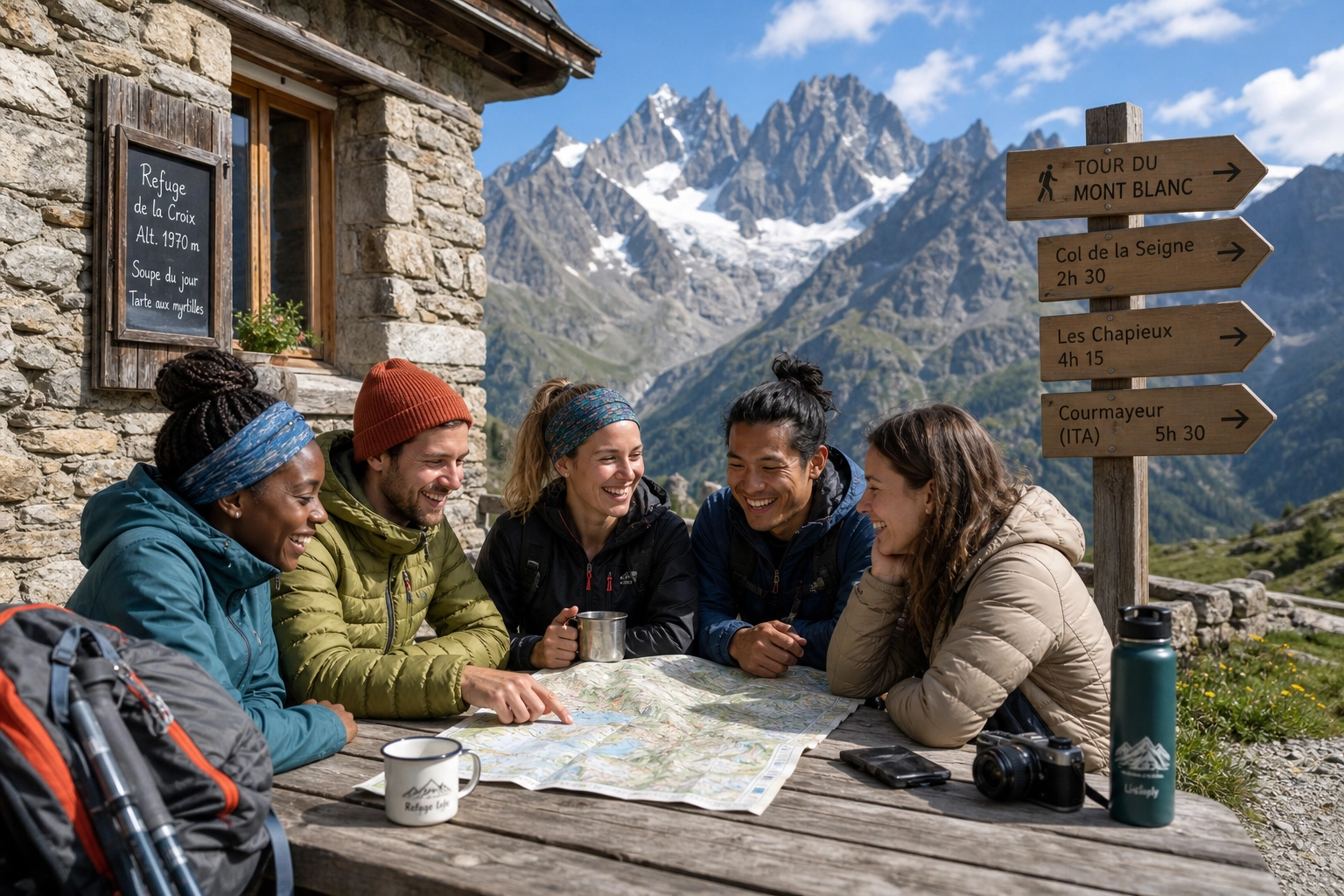
Stepping onto a mountain trail alone brings unmatched freedom, but after four hours of quiet steep climbs, even the most independent solo backpacker starts craving someone to share the view with. Solo hiking in Europe often comes with an unexpected trade-off. You enjoy complete schedule flexibility, but you miss out on shared stories over dinner, communal route planning, and the spontaneous camaraderie that makes travel memorable.
The European continent offers dozens of world-class mountain routes, but they are not all built equally when it comes to social connection. Some trails leave you feeling isolated in overcrowded commercial hotels. Others drop you directly into vibrant “trail families” where lifelong friendships form over shared pots of pasta.
Whether you want to walk historic pilgrim paths, traverse dramatic alpine passes, or settle into a high-altitude basecamp where social activities happen naturally every night, this guide breaks down the best social hiking trips in Europe for solo backpackers.
The Solo Hiking Dilemma: Why Stunning Scenery Can Feel Surprisingly Lonely
Many solo travelers book high-alpine treks expecting constant social interaction at mountain huts, only to encounter closed social circles, language barriers, or exhaustion levels that kill evening conversations. A solo travel discussion on Reddit highlights how busy European trails can still feel isolating if the social setup is wrong.
                                  EUROPEAN SOCIAL HIKING SPECTRUM

  HIGH LOGISTICAL FRICTION                                            LOW LOGISTICAL FRICTION
  HIGH SOCIAL UNCERTAINTY                                             BUILT-IN TRAIL COMMUNITY

  [ Point-to-Point Camping ] ----> [ Classic Hut-to-Hut ] ----> [ Pilgrim Routes ] ----> [ Social Basecamp Weeks ]
    Wild tents, cook alone          Refuge dorms, strict schedules    Albergues, easy walking   Social lodges, daily transfers,
    No guaranteed social hub        Bookings required 6 months prior  Communal dinners          organized group hikes
When evaluating a social hiking trip, three core friction points determine whether you will easily meet people or spend your evenings staring at your phone:
- Accommodation Layout: Open-plan dorms and communal dining tables facilitate conversation automatically. Private hotel rooms enforce boundaries that keep backpackers apart.
- Logistical Burden: If you spend your afternoon worrying about bus schedules, trail transfers, grocery shopping, or securing tomorrow’s bed, you have less energy to socialize.
- Group Dynamics: Fixed groups or structured communal hubs pull solo travelers together. Unstructured trails rely purely on luck and your willingness to start cold conversations with strangers.
Top 6 Social Hiking Experiences in Europe Compared
To help you find the right balance between social vibe, trail difficulty, budget, and planning effort, here is how Europe’s top social trekking routes stack up.
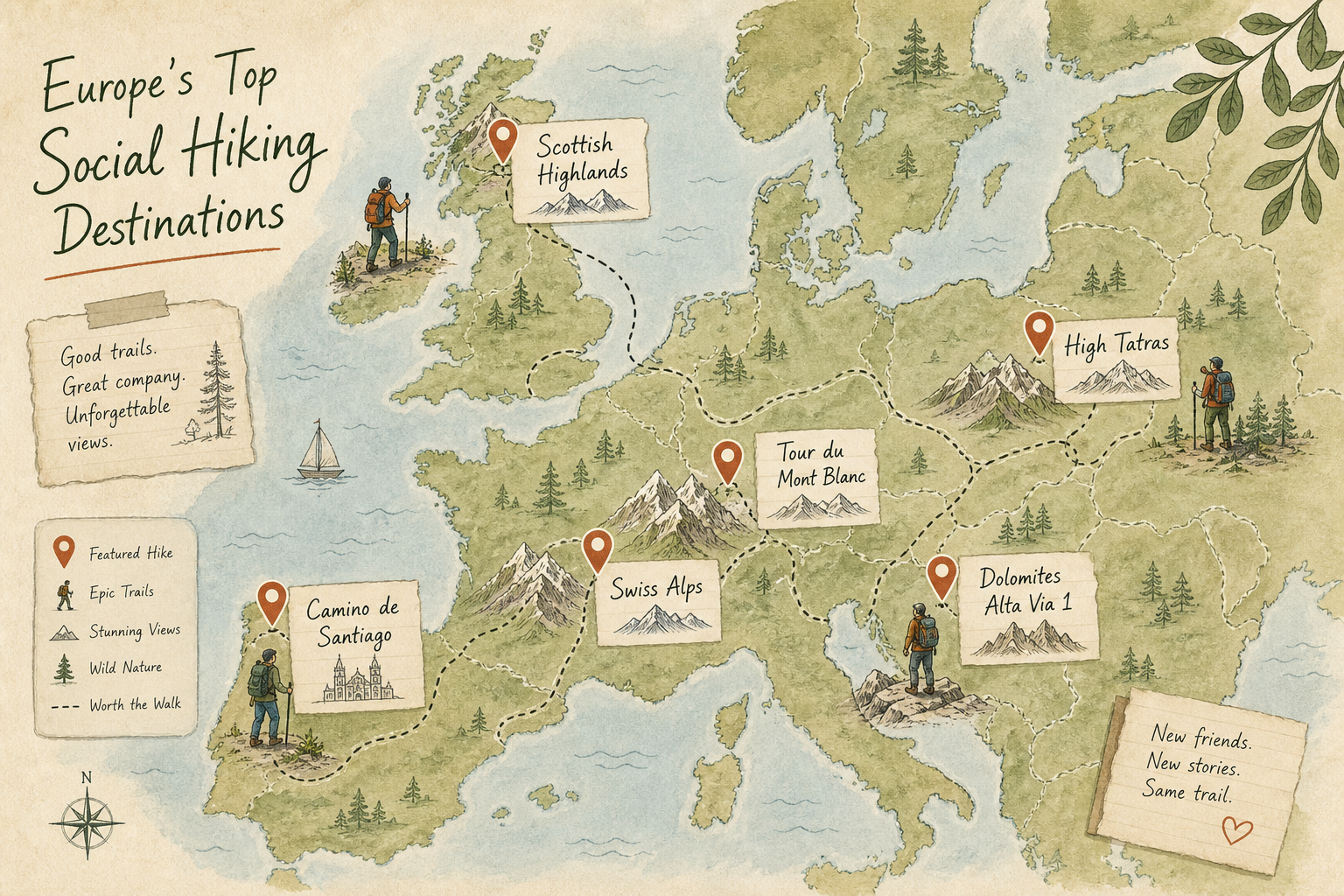
| Region / Route | Social Style | Terrain Difficulty | Logistical Friction | Average Daily Budget | Primary Social Hub |
|---|---|---|---|---|---|
| Camino de Santiago (Spain/France) | Continuous Pilgrim Community | Easy to Moderate | Low | €30 – €50 | Pilgrim Hostels (*Albergues*) |
| Tour du Mont Blanc (France/Italy/Switzerland) | Classic Alpine Trail Family | Strenuous Alpine | High (Huts book out months early) | €80 – €130 | Mountain Refuges (*Refugios*) |
| Alta Via 1 (Dolomites, Italy) | High-Altitude Hut Dinners | Technical Alpine | High | €80 – €120 | Dolomite Mountain Huts (*Rifugi*) |
| West Highland Way (Scotland) | Evening Pub Culture | Moderate | Medium | €50 – €90 | Village Pubs & Bunkhouses |
| High Tatras (Poland / Slovakia) | Basecamp Backpacking | Moderate to Technical | Low | €35 – €60 | Social Hostels (Zakopane / Ždiar) |
| Swiss Alps Basecamp Weeks (Switzerland) | Organized Communal Living | Moderate to Strenuous | Very Low (All-inclusive transfers/meals) | Included in Package | Mountain Hiking Lodges (Liddes / St. Stephan) |
1. Camino de Santiago (Spain, Portugal, France)
The Camino de Santiago remains the gold standard for social long-distance walking in Europe. Because thousands of pilgrims walk the same path every day, making friends happens effortlessly. You walk at your own pace during the morning and naturally run into the same familiar faces at village cafes by afternoon.
The Social Vibe
Socializing on the Camino is practically built into the trail rules. Stay in communal pilgrim hostels (albergues), where shared dinners feature large pots of soup, crusty bread, and local wine. Backpackers, retirees, digital nomads, and gap-year travelers break bread together, eliminating age or background barriers.
                  TYPICAL CAMINO DAYTIME SOCIAL FLOW

  07:00 AM ──> Morning departure with quiet solo walking
  10:30 AM ──> Cafe con leche stop with fellow walkers on the path
  02:00 PM ──> Check into albergue dorms & boot drying room
  06:30 PM ──> Communal pilgrim dinner & group route planning
The Trade-offs
While highly social, the Camino is a pilgrimage route rather than a rugged mountain trek. Long stretches follow asphalt roads or gravel agricultural tracks. If you are seeking dramatic alpine peaks, deep gorges, and technical ridge walks, the terrain might feel repetitive.
2. Tour du Mont Blanc (France, Italy, Switzerland)
Circumnavigating the Mont Blanc massif through three countries is a dream trek for mountain lovers. The Tour du Mont Blanc (TMB) draws hikers from across the globe, creating an international trail family atmosphere. As documented by hikers on Substack, the high-altitude scenery makes every exhausting ascent worthwhile.
The Social Vibe
Because hikers cover similar daily stages, you keep seeing the same hikers at mountain refuges (refugios). Dining in mountain huts is communal by default: everyone sits at long wooden tables, passes platters of fondue or polenta, and recaps the day’s high passes.
                    TOUR DU MONT BLANC TRAIL FAMILY FORMATION

     Day 1: Chamonix Start ──> Awkward nod on steep climb
     Day 2: Refuge Bonatti  ──> Sharing table space & blister tape
     Day 3: Val Ferret Pass ──> Walking together in bad weather
     Day 4+: Champex-Lac    ──> Fully formed "Trail Family" celebrating together
The Trade-offs
Logistics for the TMB are notoriously difficult. Refuges book out six to nine months in advance, making spontaneous adjustments hard. Carrying a heavy multi-day backpack over high passes like the Col du Bonhomme demands strong physical conditioning, and bad weather can disrupt tight itineraries.
If you want to experience the majesty of the Mont Blanc region without the stress of rigid refuge bookings, consider visiting via day excursions. You can read more about alternative approaches in our guide on Mountain Mont Blanc: 7 Ways to Visit Without the Crowd.
3. Alta Via 1 (Dolomites, Italy)
Traversing the dramatic limestone spires of the Italian Dolomites, the Alta Via 1 delivers breathtaking views alongside rich mountain hut culture. It attracts adventurous solo hikers looking for sharp peaks and historic wartime tunnels.
The Social Vibe
Dolomite mountain huts (rifugi) are famous for warm hospitality and incredible northern Italian cuisine. Evenings revolve around shared carafes of local wine, warm dining halls, and multi-course meals. Solo travelers are routinely seated next to other solo hikers, making conversation simple.
The Trade-offs
Terrain on the Alta Via 1 can be intimidating for novice hikers. Some sections involve steep drop-offs, exposed scree fields, and optional via ferrata iron-rung climbs. Carrying full gear across multi-day elevation changes requires careful packing.
4. West Highland Way (Scotland)
Stretching 96 miles from Milngavie outside Glasgow to Fort William at the foot of Ben Nevis, the West Highland Way showcases Scotland’s lochs, glens, and sweeping moorlands.
The Social Vibe
Scotland’s famous pub culture fuels the social atmosphere on this trek. At the end of a wet afternoon on the trail, backpackers gather in warm village pubs to dry out jackets by open fires, drink real ale, and swap stories. Scottish locals and international walkers mingle freely, creating an accessible environment for solo backpackers.
The Trade-offs
Midges (tiny biting flies) can be relentless in July and August, and rainfall is frequent year-round. Hikers need high-quality waterproof gear and a sense of humor about challenging weather.
5. High Tatras Basecamp Hostels (Poland & Slovakia)
For budget-conscious backpackers, the High Tatras offer alpine mountain hiking at a fraction of Western European prices. Backpackers frequently share tips on Reddit’s r/solotravel regarding how affordable eastern European mountain bases can be.
The Social Vibe
Instead of moving hut-to-hut every night, backpackers base themselves in famous social hostels like the Ginger Monkey in Ždiar (Slovakia) or backpacker lodges in Zakopane (Poland). In the morning, groups form in the hostel kitchen to tackle day hikes together. In the evening, everyone returns to cook shared meals and relax.
The Trade-offs
Because you return to the same village base every night, day hikes require bus or train transfers to trailheads. Trails near popular cable cars can get crowded during summer peak hours.
6. Swiss Alps Basecamp Hiking Weeks (Liddes & St. Stephan, Switzerland)
For solo backpackers who want dramatic alpine scenery, social hostelling, and communal atmosphere without carrying heavy packs or spending months booking individual huts, hosted basecamp hiking weeks offer an ideal solution.
                SWISS BASECAMP WEEK: COMBINING FREEDOM & COMMUNITY

   MORNING                     DAYTIME                       EVENING
  ┌─────────────────────────┐ ┌───────────────────────────┐ ┌─────────────────────────┐
  │ Communal breakfast      │ │ Guided/group day hike    │ │ Family-style dinner     │
  │ Pack daypack (light!)   │ │ Choose your trail pace   │ │ Board games & drinks    │
  │ Shuttle to trailhead    │ │ Excursions (Aosta/Chamonix│ │ Plan tomorrow's route   │
  └─────────────────────────┘ └───────────────────────────┘ └─────────────────────────┘
The Social Vibe
Basecamp packages—like those run at Hiking Hostel in Liddes (Valais) and St. Stephan (Bernese Oberland)—are designed specifically around social cohesion. Solo travelers, digital nomads, and budget outdoor enthusiasts stay together in a shared lodge.
Daily activities are structured around group meals, shared airport transfers, provided trail transport, and organized excursions across borders into spots like Aosta (Italy) or Chamonix (France). Because everyone eats together and relaxes in communal spaces every night, group bonding happens instantly without any forced icebreakers. You can read more about how this structure builds natural trail friendships in our guide on Guided Hiking in Switzerland: Finding Your Social Group.
The Trade-offs
Unlike a linear hut-to-hut trek where you walk to a new destination each day, basecamp weeks return to the same lodge every night. While this means you travel with a light daypack instead of a heavy multi-day backpack, purists who insist on continuous linear walking might miss the moving-on feeling.
Basecamp Hostels vs. Point-to-Point Huts: Which Format Fits Your Style?
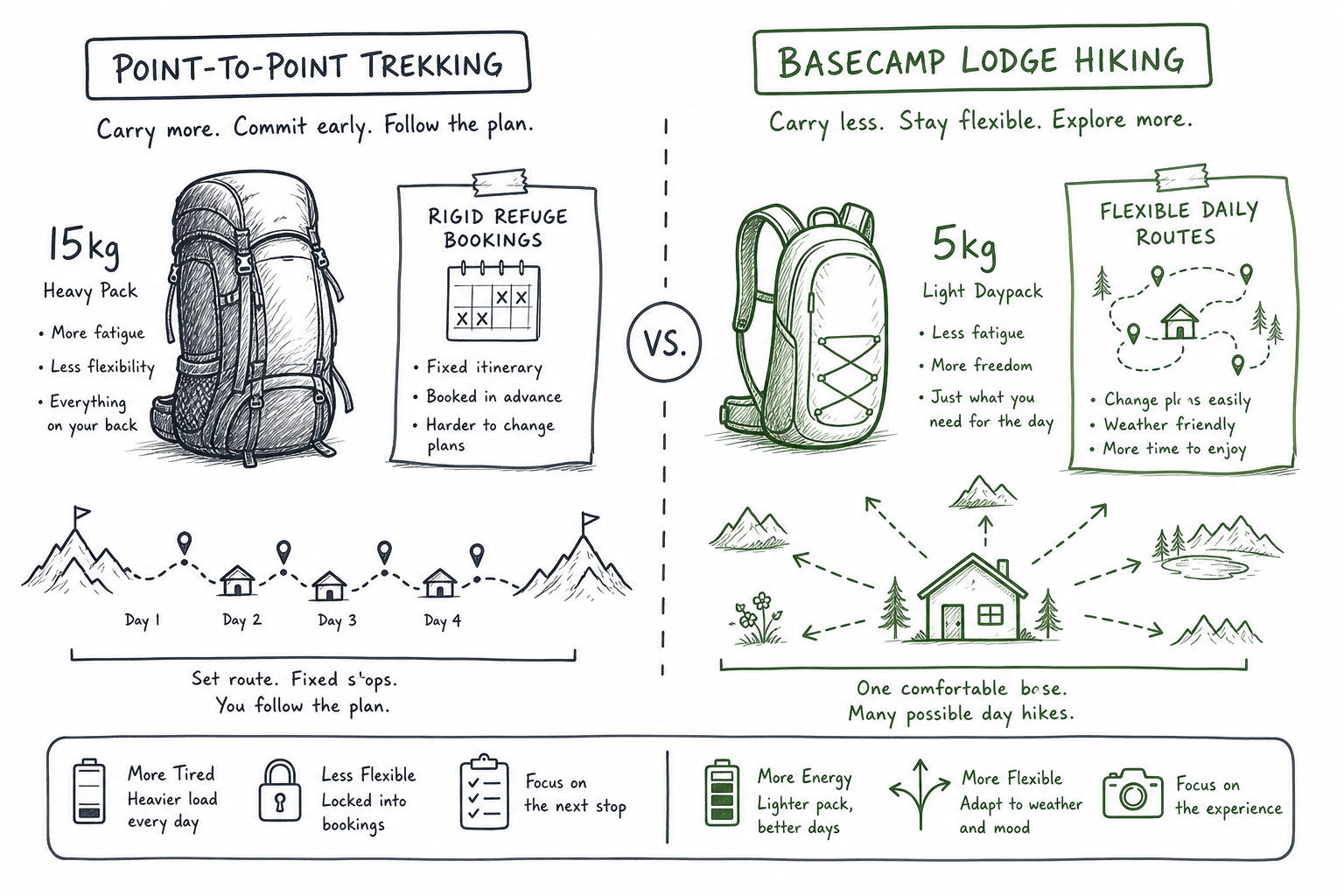
Choosing between a continuous hut-to-hut trek and a basecamp-style hiking trip depends on what kind of social experience you want, your budget, and how much gear you want to carry.
               DECISION TREE: POINT-TO-POINT VS. BASECAMP HIKING

                         What matters most to you on this trip?
                                          │
       ┌──────────────────────────────────┴──────────────────────────────────┐
       │                                                                     │
  [ Continuous Linear Journey ]                                     [ Comfort & Social Flexibility ]
       │                                                                     │
  Do you mind carrying a 12-15kg pack                              Do you prefer daypacks (<5kg)
  and booking huts 6+ months ahead?                                 and zero daily packing friction?
       │                                                                     │
       ├──► YES: Choose Point-to-Point                                       └──► YES: Choose Basecamp
       │    (Tour du Mont Blanc, Alta Via 1)                                          (Swiss Alpine Basecamp Weeks)
       │                                                                     │
       └──► NO: Consider Pilgrim Walk                                        └──► NO: Choose Village Hostels
            (Camino de Santiago)                                                  (High Tatras, Zakopane)
Here is a detailed look at how these two main formats perform across key categories:
1. Daily Backpack Weight
- Point-to-Point: You carry everything you need for the duration of your trip—sleeping liners, spare clothes, extra food, toiletries, and foul-weather gear. Packs typically weigh between 10 kg and 15 kg.
- Basecamp Model: You leave your main luggage at the hostel and carry only a light daypack containing water, extra layers, a camera, and a packed lunch. Your shoulders stay relaxed, and your pace is faster.
2. Logistical Flexibility
- Point-to-Point: Strict reservations mean you must reach your assigned hut every single day regardless of fatigue, blisters, or mountain thunderstorms. Missing a reservation can leave you stranded at high altitude.
- Basecamp Model: If rain moves in or your legs need a break, you can skip a hike, hang out at the hostel, work remotely, or join a low-key excursion to a nearby alpine town like Interlaken or Gstaad.
3. Community Continuity
- Point-to-Point: You meet people in passing, but unless your daily stages match perfectly, trail friends often scatter after a day or two.
- Basecamp Model: You stay with the same core group of fellow solo travelers for an entire week. You cook together, hike together, and relax together every evening, building stronger group bonds.
Myth-Busting: “Switzerland is Too Expensive and Unfriendly for Solo Backpackers”
A common myth among budget backpackers is that Switzerland is unreachable unless you have a massive budget. Advice on Reddit’s r/hiking notes that Switzerland offers unmatched public transport and safe alpine routes, but solo travelers often worry about costs.
                    SWISS ALPS TRAVEL COSTS: MYTH VS REALITY

  MYTH: "You need $300/night luxury hotels to experience the Swiss Alps."
  REALITY: Hostel-based hiking lodges provide affordable stays with meals included.

  MYTH: "Public train passes will drain your whole backpacker budget."
  REALITY: Organized hiking weeks include daily trailhead shuttles & airport pickups.

  MYTH: "Solo backpackers will feel isolated among luxury tourists."
  REALITY: Communal lodges gather like-minded outdoor lovers at shared dinner tables.
Let’s break down why this myth persists and what the actual reality looks like for savvy solo hikers:
- Myth 1: Swiss accommodation prices kill backpacker budgets.
- Reality: While luxury hotels in Zermatt or St. Moritz are expensive, choosing communal lodges or hosted mountain hostels cuts costs dramatically. For a breakdown on why lodges beat hotels for solo travelers, see our guide on Hotels in Swiss Mountains? Why Social Lodges Beat Luxury.
- Myth 2: Food in Switzerland makes long stays impossible.
- Reality: Eating out at mountain restaurants three times a day adds up quickly. Basecamp hosts eliminate this expense by providing family-style home-cooked dinners, hearty breakfasts, and trail lunch supplies included in your stay.
- Myth 3: Transport between trailheads costs a fortune.
- Reality: Buying individual mountain train and cable car tickets gets costly fast. All-inclusive group hiking packages include local group transport, taking you straight to trailheads in the Valais or Bernese Oberland without requiring complex train passes.
For more strategies on keeping costs low, read our guide on 7 Tips for Hiking in Switzerland (Without the High Cost).
Case Study: How Maya Traded Booking Friction for a Social Trail Family
Maya, a 28-year-old remote graphic designer from Toronto, planned a solo trek across Europe. She dreamed of hiking in the Alps but ran into major roadblocks while trying to organize her trip.
                    MAYA'S TMB VS. BASECAMP DECISION MATRIX

  CHALLENGE              OPTION A: SOLO TMB TENTATIVE PLAN      OPTION B: SWISS BASECAMP WEEK
  ─────────────────────  ─────────────────────────────────────  ───────────────────────────────
  Hut Reservations       3 out of 10 huts fully booked          1 booking covers 7 nights accommodation
  Pack Weight            13 kg (sleeping sack, gear, food)     4 kg (daypack only)
  Work / Wifi Access     No connectivity in high refuges        Reliable wifi at basecamp lodge
  Social Environment     Random nightly dorm mates              Core group of 10-15 solo backpackers
  Logistical Stress      High (daily route planning)            Zero (transfers & meals provided)
The Problem
In March, Maya started trying to book mountain refuges along the Tour du Mont Blanc for July. Half the huts were sold out, leaving huge gaps in her itinerary. She faced two choices: carry heavy camping gear over steep passes or spend hours hunting for expensive last-minute hotel detours. On top of that, she worried about feeling isolated if she ended up walking alone all day.
The Solution
Instead of forcing a fragmented point-to-point schedule, Maya booked a week-long summer hiking holiday at a basecamp hostel in Liddes, Valais.
Upon arrival at Geneva airport, she was met by her lodge shuttle along with four other solo travelers. Over the next seven days, the group tackled day hikes across the Swiss Valais, took a day trip through the Grand St. Bernard Pass into Aosta for Italian pasta, and spent an afternoon exploring trail views near Mont Blanc.
For details on similar regional border crossings, read our guide on Skiing in the Italian Alps? Try This Aosta Day Trip.
                      MAYA'S WEEK AT A GLANCE (VALAIS BASECAMP)

  MON: Arrival & Geneva pickup ──► Group welcome dinner in Liddes
  TUE: Alpine ridge trail       ──► Evening board games & fondue
  WED: Cross-border day trip    ──► Gelato & trail walk in Aosta, Italy
  THU: High mountain pass hike ──► Sunset drinks at the lodge terrace
  FRI: Glacier views near Gstaad ──► Final group campfire night
The Result
Maya experienced high-alpine scenery, walked across border passes, and made friends with hikers from four different continents. She carried a light daypack every day and spent zero hours stressing over logistics or trail transport.
Daily Logistics Breakdown: What Makes a Hiking Trip Truly Social?
The success of a social hiking trip comes down to how your day is structured. Here is a comparison of how a typical day unfolds in a traditional mountain refuge versus an organized basecamp lodge.
                  DAILY LOGISTICS: MOUNTAIN HUT VS. SOCIAL BASECAMP

  TIME     TRADITIONAL MOUNTAIN REFUGE              HOSTED SOCIAL BASECAMP
  ───────  ───────────────────────────────────────  ───────────────────────────────────────
  06:00    Strict breakfast call, fast pack-up       Relaxed communal breakfast & coffee
  07:30    Hit trail carrying 12kg pack              Board shuttle to select trailhead
  12:00    Solo trail lunch on pass                  Group trail lunch at high alpine lake
  16:00    Arrive exhausted at crowded refuge dorm   Return to lodge, shower, relax on patio
  18:30    Fixed seating, early quiet hours          Family-style dinner, chat, social games
Key Factors That Encourage Friendship
- Shared Meals: Breaking bread at a common table is the single most effective way to start conversations. When meals are included and served family-style, introverts do not have to worry about finding someone to sit with.
- Flexible Trail Paces: On structured group trips, hikers naturally split into smaller subgroups on climbs based on pace, recombining at mountain passes or lunch spots. This takes away the pressure to match someone else’s speed.
- Dedicated Common Areas: Lodges with cozy lounges, sun terraces, and board game corners give travelers a place to unwind together after showers.
Practical Checklist and Packing Strategy for Social Backpackers
Packing light keeps your energy high so you can enjoy socializing after a day on the trail. Here is a practical gear setup tailored for European social hiking trips.
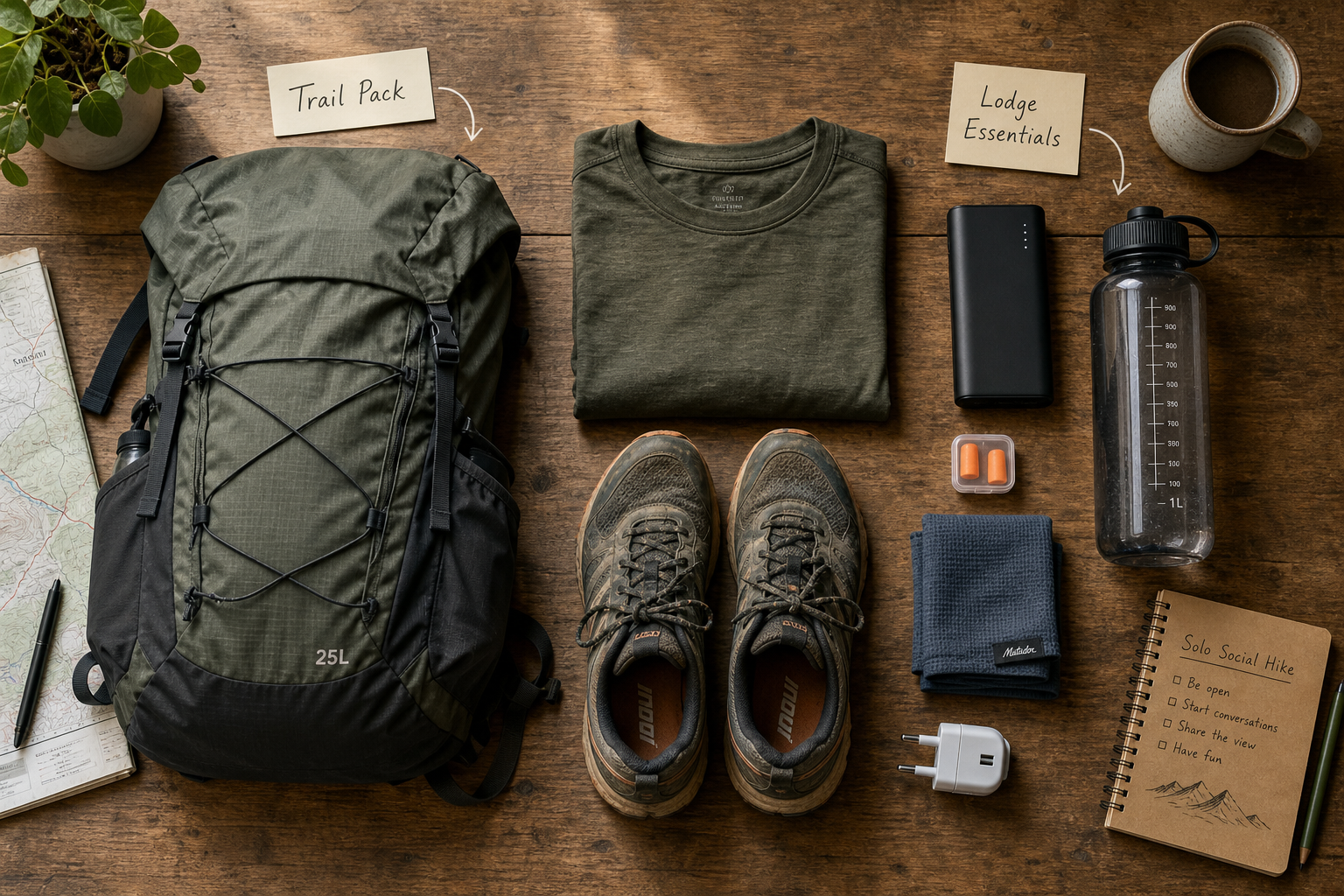
                     SOLO BACKPACKER PACKING FRAMEWORK

    CLOTHING & LAYERS           TRAIL PACK (20-30L)          SOCIAL & LODGE ESSENTIALS
  ┌───────────────────────┐   ┌───────────────────────┐   ┌───────────────────────┐
  │ 2x Merino T-shirts    │   │ Waterproof jacket     │   │ Earplugs & eye mask   │
  │ 1x Hiking pants/shorts│   │ 1.5L water bottle     │   │ Multi-plug adapter    │
  │ 1x Mid-layer fleece   │   │ Trail snacks / nuts   │   │ Compact microfiber towel│
  │ 1x Lightweight down   │   │ Mini first-aid & tape │   │ Casual lodge shoes    │
  │ 3x Merino wool socks  │   │ Sun hat & sunglasses  │   │ Portable power bank   │
  └───────────────────────┘   └───────────────────────┘   └───────────────────────┘
Gear Checklist
- Footwear: Broken-in trail running shoes or lightweight hiking boots. Heavy high-top boots are rarely needed unless you are crossing technical glaciers.
- Layering System: A moisture-wicking merino base layer, a warm fleece or grid-fleece mid-layer, and a reliable rain jacket. Weather in the Alps can shift quickly. For a step-by-step gear breakdown, check out our Swiss Alps Summer: A Simple 5-Step Packing Guide.
- Daypack (20L to 30L): Must feature a comfortable hip belt and an integrated rain cover.
- Lodge Comforts: Compact slip-on shoes or sandals for evening wear, a universal European power adapter, earplugs for dorm rooms, and a lightweight personal towel.
Planning Your Social Hiking Trip: A Step-by-Step Selection Guide
If you are trying to decide which European hiking experience to book, follow this decision checklist:
                       TRIP SELECTION FLOWCHART

  STEP 1: Determine Your Timeframe
          ├── 1 to 2 Weeks ──► Alpine Basecamp Week or TMB Highlights
          └── 3+ Weeks     ──► Camino de Santiago or Full Alpine Crossing

  STEP 2: Assess Your Fitness & Experience
          ├── Beginner / Casual     ──► Camino de Santiago or Scottish Lowlands
          └── Intermediate / Fit    ──► Swiss Valais Basecamp or High Tatras

  STEP 3: Evaluate Your Social Comfort Level
          ├── Highly Introverted   ──► Basecamp Hostel (Structured daily routines)
└── Highly Extroverted ──► Independent Hut-to-Hut Trekking- Assess your physical preparation: If you rarely hike with weight, do not start with a 14kg backpack trek over 1,000-meter vertical passes. Opt for a basecamp week where you carry only a light daypack.
- Review route difficulty: Trails around Mont Blanc and the Swiss Valais offer rewarding views, but require steady footwork. If you prefer flat, easy paths, look into pilgrim routes in Spain or Portugal.
- Decide how much time you want to spend planning: If you love managing logistics, mapping GPS coordinates, and booking accommodation six months in advance, independent multi-day treks fit well. If you prefer to show up, hike, and relax without administrative stress, pick a hosted hiking week.
If you are planning to extend your stay in Switzerland for other activities, read our budget guide on Which Swiss Ski Resort Fits a Backpacker’s Budget? or explore options for group trail rides in our post on how to Find the Right Mountain Bike Group for Alpine Trails.
Frequently Asked Questions About Solo Hiking in Europe
How do I make friends while solo hiking in Europe?
To make friends easily, choose accommodations that encourage social interaction. Stay in hostel dorms or mountain lodges with communal dining tables and shared spaces. Joining organized group hikes or hosted basecamp weeks naturally pairs you with other solo travelers who share your interest in outdoor adventure.
Do I need to be an expert hiker to join a social trekking trip?
Not at all. While high alpine routes like the Alta Via 1 or Tour du Mont Blanc demand good physical fitness, many social hiking trips—including pilgrim walks like the Camino de Santiago and hosted basecamp weeks—cater to a wide range of experience levels. Basecamp lodges often offer flexible route choices so you can adjust your distance and elevation each day.
Is solo hiking safe for female solo travelers in the European Alps?
Yes, the European Alps are considered one of the safest regions in the world for female solo hikers. Marked trail networks, reliable mobile phone coverage in most passes, and well-maintained trail infrastructure make navigation straightforward. Choosing social hostels or organized group basecamps adds an extra layer of security and peace of mind.
What if I want privacy after a long day on the trail?
Many social lodges and mountain hostels offer private room options alongside shared dormitories. This gives you the best of both worlds: you enjoy communal meals, group transfers, and social evenings while retaining a quiet private space to recharge at night.
Finding Your Ideal Alpine Social Community
Solo travel does not mean walking alone. Whether you decide to log long miles across the sunny plateaus of Spain, tackle historic passes around Mont Blanc, or anchor yourself in a cozy mountain lodge in the Swiss Valais, Europe offers social hiking options for every style of traveler.
By choosing trips built around communal dining, shared spaces, and hassle-free logistics, you can trade travel friction for great trails and lasting friendships. Pack your daypack, lace up your boots, and prepare to share the trail with outdoor lovers from around the world.