Best group hiking holidays in Switzerland for social travelers
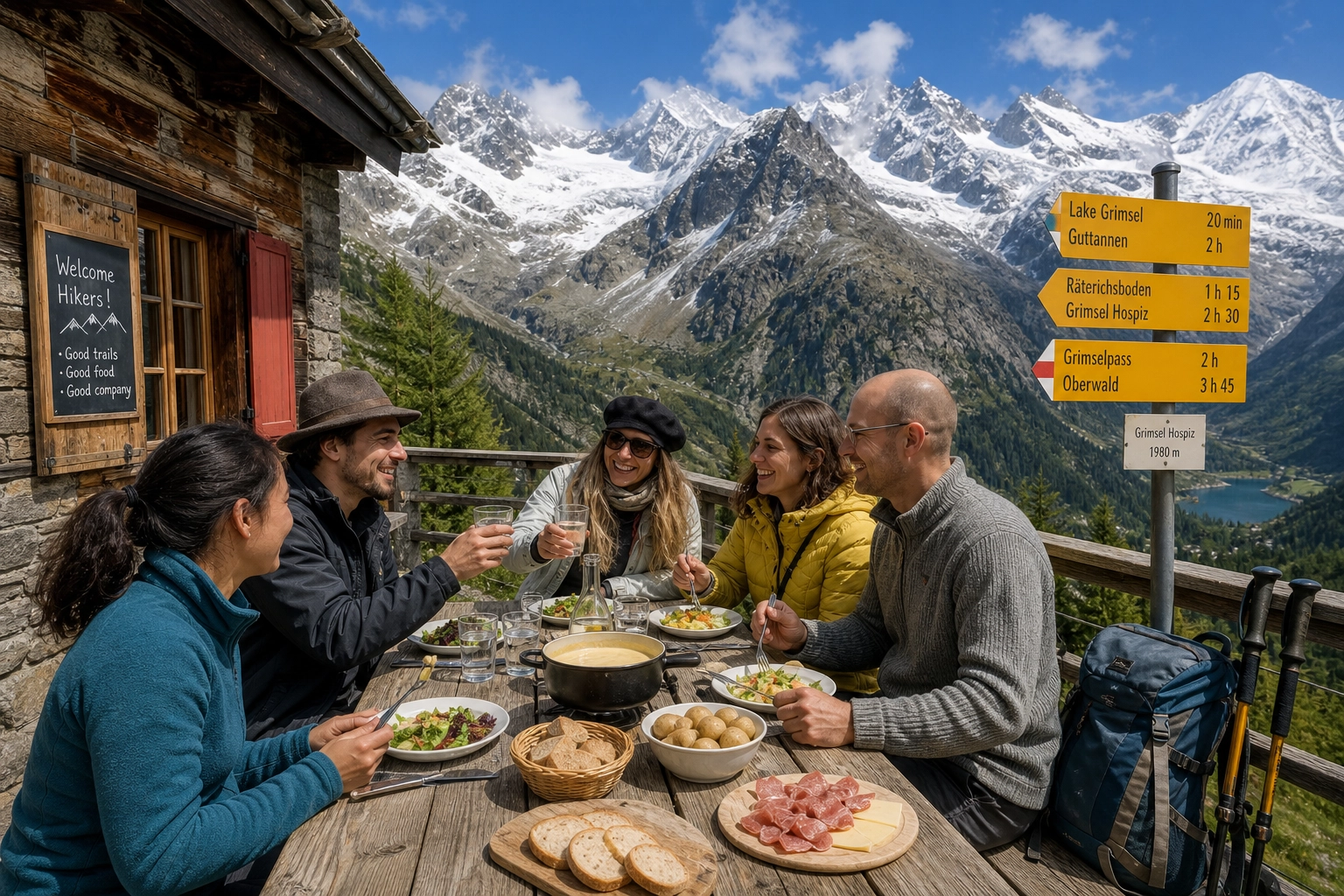
There is a specific kind of magic that happens at 7:00 PM in the Swiss Alps. After a long day of navigating rocky inclines, dodging marmots, and taking in jagged, snow-capped peaks, you finally take your muddy boots off. You step into a warm dining room smelling of melting Gruyère and roasted potatoes. You sit down at a long wooden table with twelve strangers. Two hours and three bottles of local Valais wine later, those strangers feel like old friends.
For solo travelers, digital nomads, and backpackers, the trail is only half the experience. The other half happens around the table.
However, finding a group hiking holiday in Switzerland with communal meals and a genuinely social atmosphere can be frustrating. The Swiss tourism market largely caters to two extremes: fiercely independent (and logistically complex) hut-to-hut trekking, or highly sanitized, ultra-expensive luxury tours where everyone retreats to their private suites at 8:00 PM.
If you want the camaraderie of a shared experience without carrying a 40-liter backpack—and without draining your savings account—you have to look closely at how the trip is structured.
Here is exactly how to navigate the options, choose the right group dynamic, and find the best social hiking holidays in Switzerland.
The Psychology of the Trail and the Table
Why does a shared meal matter so much on a hiking trip?
In standard travel, social interactions are often fleeting—a brief chat at a hostel bar or a quick exchange on a walking tour. Mountain travel accelerates bonding. Shared physical exertion breaks down social barriers rapidly. When you have all just survived a brutal 800-meter ascent to the Cabane de Mille, pretenses vanish.
Communal dining in Switzerland is a deeply ingrained cultural tradition. The Stammtisch (regulars’ table) in local taverns has long been a place for community gathering. On a group hiking holiday, the communal dinner serves as the daily debrief. It is where trail plans are adjusted, blisters are commiserated over, and the group identity forms.
If you are traveling solo or in a small group and want to lean into this social aspect, finding your social hiking group depends entirely on the lodging and logistics model you choose. There are three main ways to do this in the Swiss Alps.
Option 1: The Traditional Route — Hut-to-Hut Trekking
If your idea of a communal meal involves high-altitude rustic charm, Switzerland’s network of over 150 mountain huts operated by the Swiss Alpine Club (SAC) is the traditional gold standard.
The Experience
You carry everything you need in a mid-sized backpack, hiking from one remote mountain hut to the next on multi-day routes like the Tour du Mont Blanc or the Bear Trek in the Bernese Oberland.
The Communal Meals
This is the purest form of alpine communal dining. Huts operate with military precision. At a designated time (usually 6:30 PM), a bell rings. Hikers are assigned to long trestle tables, often packed shoulder-to-shoulder with people from all over the world.
The hut warden serves a hearty, fixed three-course menu—typically a thick vegetable soup, a main course like sausage and polenta or hearty vegetable stew, and a simple dessert. You pass the bread basket down the line and pour tea for your neighbor.
The Drawbacks for Social Travelers
While authentic, hut-to-hut hiking has severe logistical hurdles:
- The Planning Nightmare: Huts book out months in advance. Piecing together a consecutive 6-night itinerary as a solo traveler requires immense foresight. If one hut is full, your entire route falls apart.
- The Pack Weight: You must carry all your clothing, sleep sheet, and toiletries over high mountain passes.
- The Sleep Quality: You are almost always in large dormitories (Massenlager). If you are a light sleeper, a room of 20 snoring hikers can ruin your recovery.
If you want to tackle this independently, you will need to learn exactly how to plan hut-to-hut hiking in Switzerland long before the summer season begins.
Option 2: Premium Inn-to-Inn Boutique Tours
To avoid carrying heavy backpacks, many travelers look to guided, inn-to-inn group tours.
The Experience
A tour company handles the route, the guide, and the luggage transfers. You hike with a daypack, and a van moves your suitcase from hotel to hotel.
The Communal Meals
Meals are usually taken in the restaurants of 3- or 4-star alpine hotels. While you eat with your tour group, the experience is often formal. You might sit at separate four-tops rather than one large table.
The Drawbacks for Social Travelers
- The Vibe: These tours often attract an older, wealthier demographic. The atmosphere leans more toward polite dinner conversation than a raucous, story-filled backpacker gathering.
- The Cost: This level of logistical support in Switzerland is incredibly expensive, often running $3,000 to $5,000+ for a week.
- The Isolation: As we have noted before, social lodges consistently beat luxury hotels if your primary goal is meeting like-minded outdoor enthusiasts.
Option 3: The Basecamp Model (The Sweet Spot)
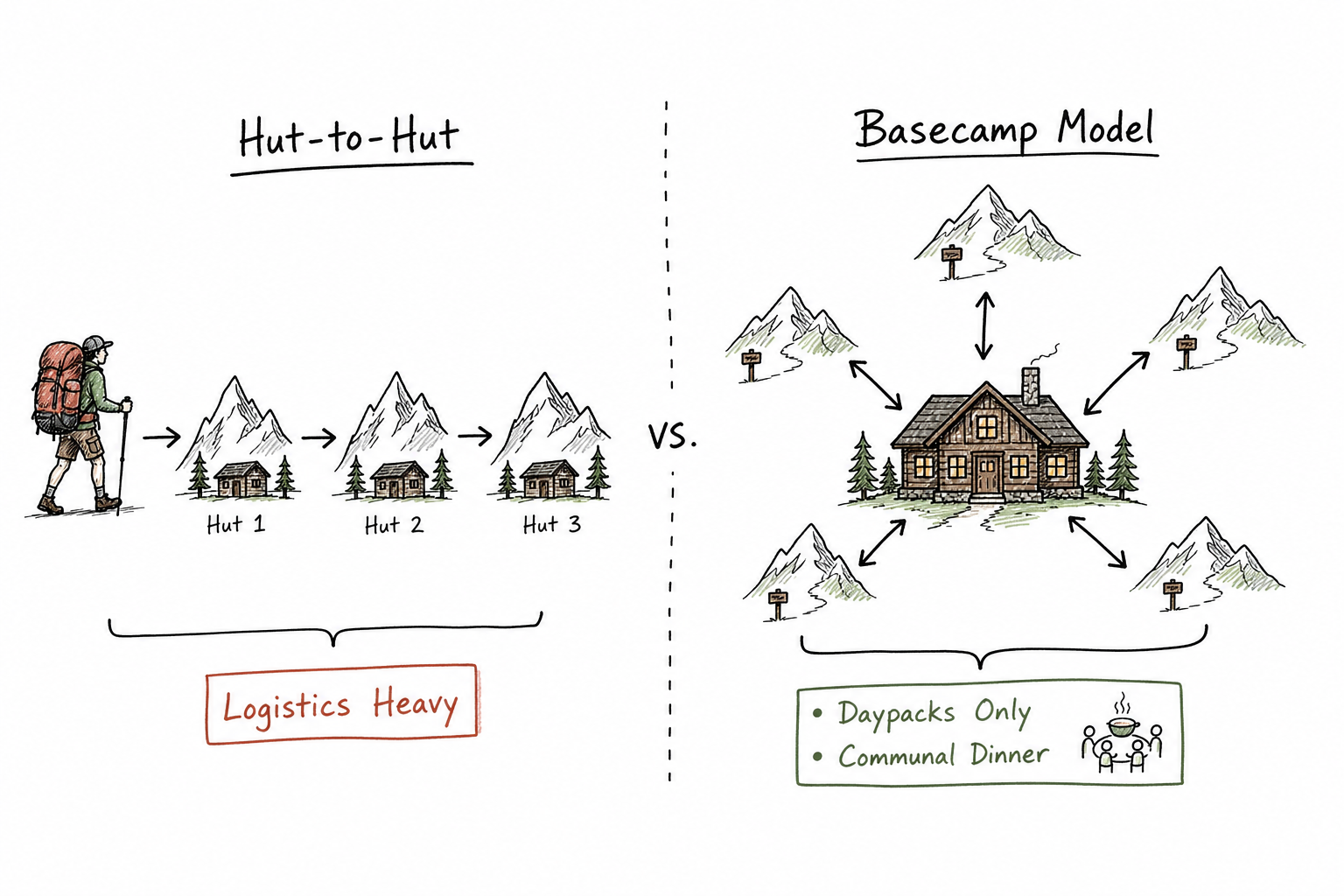
For solo travelers, digital nomads, and budget-conscious hikers who want the social atmosphere of a hostel but the organized adventure of a premium tour, the “Basecamp Model” is the ultimate solution.
The Experience
Instead of moving every night, you base yourself in a social mountain lodge for the week (such as Liddes in the Valais or St. Stephan in the Bernese Oberland). You unpack once. Every morning, organized daily trail transport—like a private hostel van—takes you and the group to a different trailhead in the region. You hike incredible trails with just a daypack, then return to your home base.
The Communal Meals
Because you are returning to a dedicated social space every evening, the communal aspect is amplified. Groups of 10 to 20 hikers gather in the lodge’s main dining room. Meals are cooked in-house, focusing on local, hearty ingredients.
This model creates a recurring rhythm. You aren’t meeting new strangers every night like in a mountain hut; you are building rapport with the exact same group of travelers over a week. By day three, inside jokes have formed. By day six, you are planning future trips together.
Why This Works Best for Social Travelers
- Logistics Handled: You do not have to navigate the complex Swiss PostBus schedules or train transfers. The daily transport is baked into the holiday.
- Budget-Friendly: By centralizing accommodation and utilizing a hostel-style lodge, the cost drops dramatically compared to premium inn-to-inn tours. This makes it one of the best ways to go hiking in Switzerland without the high cost.
- Flexibility: Because you return to basecamp, you can take a rest day if your knees are aching, hanging out at the lodge or exploring the local village, while the rest of the group hikes.
Top Regions for Basecamp Hiking Holidays
If you opt for an organized basecamp hiking week, the location dictates your experience. The best group holidays position you in a valley that offers 360-degree access to diverse micro-regions.
1. Liddes and the Valais Region
Located on the road up to the Great St. Bernard Pass, Liddes is a perfect strategic outpost. The Valais region is known for getting over 300 days of sunshine a year and features dramatic, rocky terrain and massive glaciers.
From a basecamp here, a group can tackle a section of the Tour du Mont Blanc one day, and explore the remote Val Ferret the next. You can even access some of the best hiking trails in Switzerland near Mont Blanc, experiencing the grandeur of the massif without the exorbitant prices of staying in Chamonix proper.
2. St. Stephan and the Bernese Oberland
Nestled in the Simmental valley, St. Stephan offers a totally different aesthetic. This is the postcard version of Switzerland: impossibly green rolling hills, wooden chalets, and the ringing of cowbells.
A basecamp here allows a group to access the dizzying heights of Glacier 3000 near Gstaad, or take a quick transfer toward the famous peaks around Interlaken and Grindelwald.
3. Cross-Border Excursions
The hidden benefit of a well-placed Swiss basecamp is the ability to do cross-border day trips. A group based in Liddes, for example, can easily hop in the van and drive through the St. Bernard tunnel for an excursion into the Aosta Valley in Italy. (Aosta is brilliant year-round; even if you return for winter sports, this Aosta day trip is a must-do).
Similarly, you can take a day trip to Chamonix, France, allowing you to visit the Mont Blanc region without the crowd by retreating to your quiet Swiss lodge in the evening.
What to Expect on a Swiss Mountain Menu
If you are signing up for a holiday built around communal meals, you need to know what you will be eating. Mountain food in Switzerland is designed for one thing: caloric replenishment. It is heavy, rich, and deeply satisfying.
On a structured group holiday, the food rhythm usually looks like this:
- The Alpine Breakfast: A sprawling buffet of dense mountain bread, local cheeses, cold cuts, homemade jams, and Birchermüesli (oats soaked in milk/yogurt with grated apples and nuts). You eat enough to power you up the first ascent.
- The Trail Lunch: Most basecamp holidays provide a packing station at breakfast. You will wrap up sandwiches, hard-boiled eggs, Landjäger (smoked, dried sausage), and chocolate to eat on a scenic ridge overlooking a glacier.
- The Communal Dinner: The main event. Expect iconic dishes like Älplermagronen (Swiss macaroni and cheese cooked with potatoes and served with applesauce), thick cuts of roast pork, or hearty vegetable curries to cater to modern diets.
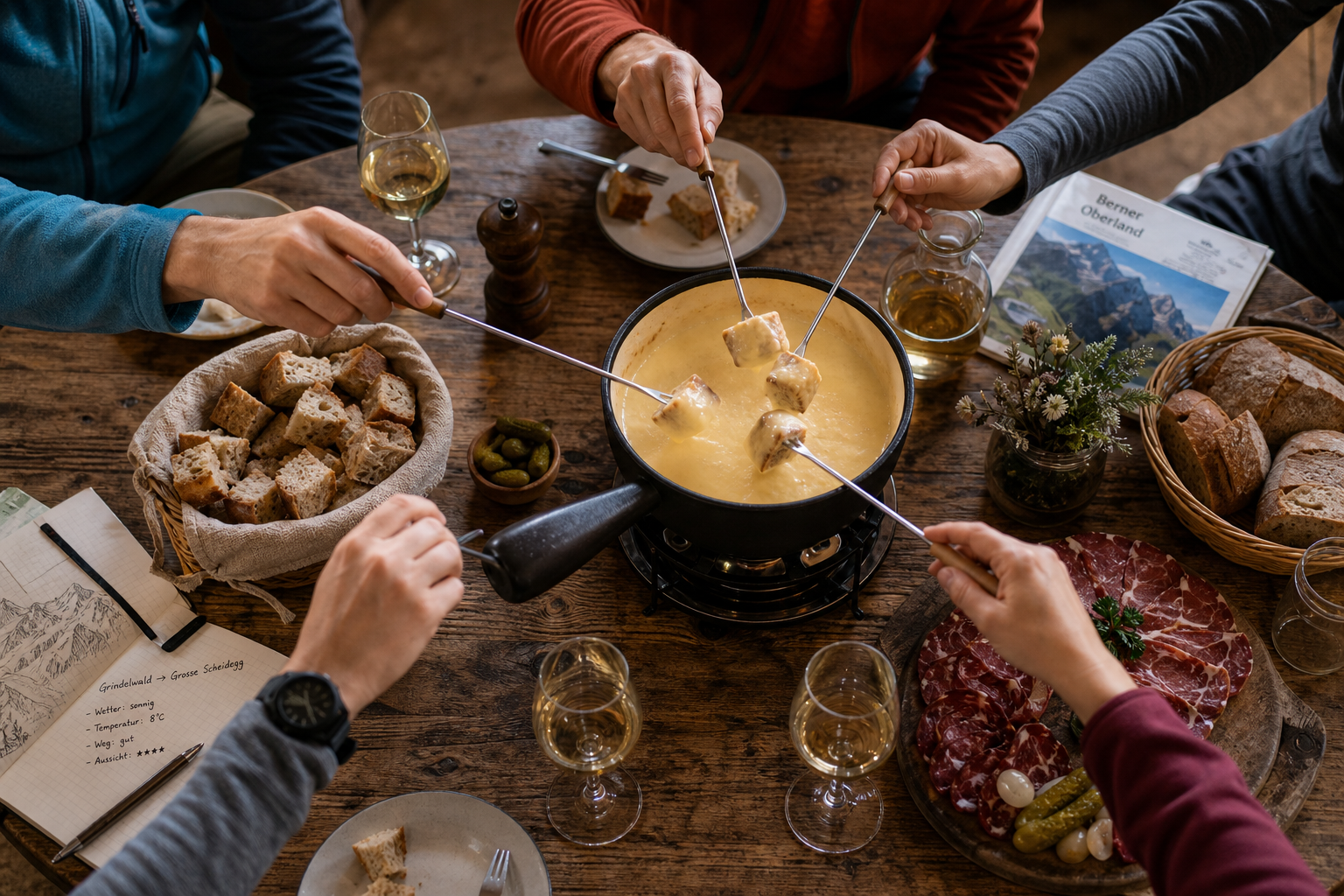
And of course, at least one night of the week will usually be dedicated to a massive, bubbling pot of cheese fondue. Eating fondue is inherently social—losing your bread in the pot comes with a traditional penalty (usually buying the next round of drinks or completing a dare).
A quick note on dietary restrictions: This is where the basecamp model vastly outperforms high-altitude huts. While a remote SAC hut simply cannot cater to a gluten-free or strict vegan diet (they cook one giant pot of food), a valley-based hiking lodge has access to supermarkets and can easily accommodate dietary needs while keeping the communal spirit alive.
How to Choose Your Group Dynamic
Not all group hiking holidays are created equal. The right choice depends on your travel style. Use this matrix to figure out which group setup fits you best:
| Your Profile | Traditional Hut-to-Hut | Premium Inn-to-Inn | Social Basecamp (Hostel Model) |
|---|---|---|---|
| Solo Backpacker | Great, but hard to plan alone. High chance of meeting people. | Poor fit. Too expensive, highly coupled demographic. | Perfect. High density of solo travelers, shared rooms, automatic friends. |
| Digital Nomad | Impossible. No Wi-Fi, no charging outlets, zero desk space. | Good, but expensive if you just need a laptop spot. | Perfect. Great Wi-Fi at the lodge, communal workspaces, hike during the day. |
| Small Friend Group (3-4) | Excellent, if you can book a 4-person room 6 months ahead. | Great, but limits interaction with other travelers. | Excellent. You can book a private dorm together but eat with the larger group. |
| Luxury Hiker | Terrible. You will hate the shared bathrooms. | Perfect. Baggage transfers, private suites, fine dining. | Poor fit. You may find the shared spaces too informal. |
Packing for a Basecamp Hiking Holiday
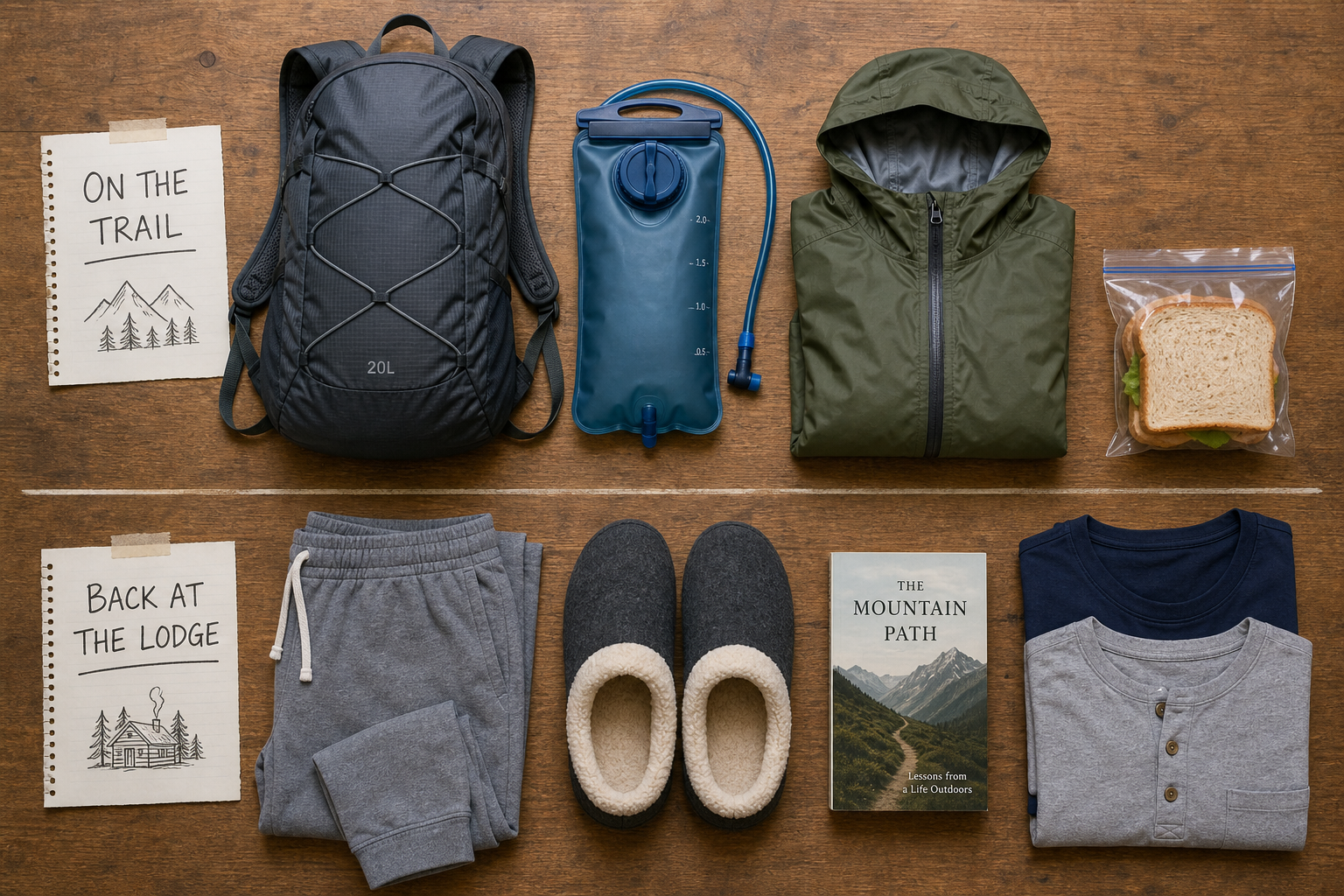
Because the basecamp model allows you to leave your main luggage at the lodge, your packing strategy changes significantly compared to traditional trekking.
You only need to carry a lightweight 20L to 30L daypack on the trail. This transforms the hiking experience. Instead of suffering under a heavy load, you can move quickly, enjoy the scenery, and finish the day with energy to spare for the evening’s social events.
Your daily trail pack only needs:
- Water (2 liters minimum)
- Rain shell and an insulating mid-layer (mountain weather changes fast)
- Sun protection (sunglasses, SPF 50, hat)
- Your packed communal lunch
- Basic first aid and blister care
For your main luggage left at the lodge, you can afford to bring comfortable “apres-hike” clothing, slippers for the dining room (hiking boots are never allowed inside Swiss lodges), and evening toiletries. For a complete breakdown, check out our simple 5-step packing guide for a Swiss Alps summer.
The Real Value of Guided Logistics
The most exhausting part of hiking in Switzerland isn’t the elevation gain; it is the logistics. Figuring out which post bus connects to which cable car, reading topographical maps to ensure a trail isn’t washed out, and trying to decipher train ticket zones can take hours of your vacation time.
When you book a group holiday that handles the daily trail transport and excursions, you buy back your mental energy. You wake up, eat breakfast, get in the van, and hike. The guide ensures you are on the best trail for that day’s specific weather conditions.
By removing the friction of planning, you are left with the two things you actually came for: the staggering beauty of the Swiss Alps, and the people you share it with at the dinner table.