Mont Blanc Mountain Climb: A Solo Traveler’s Guide (2026)
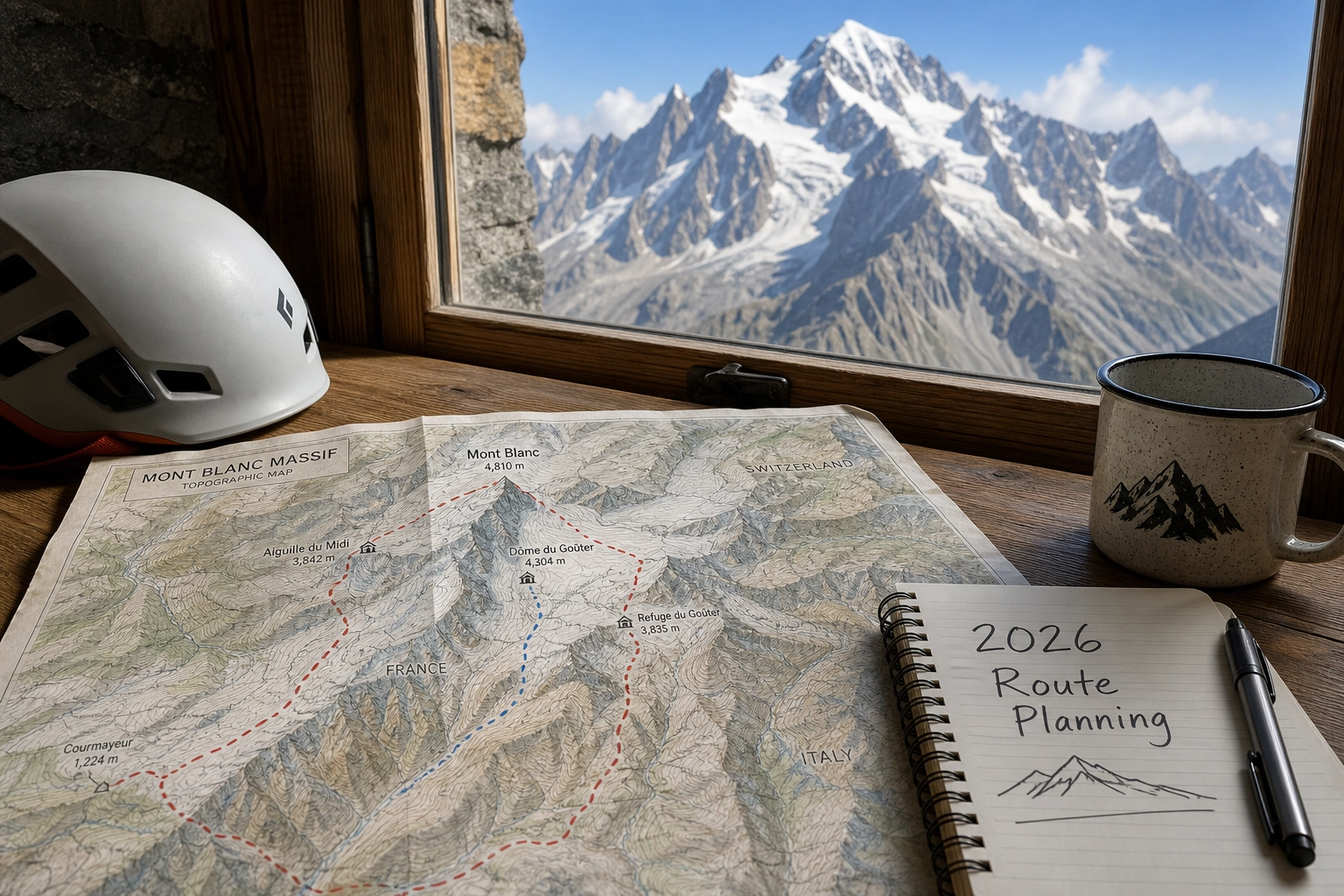
Standing at 4,809 meters (15,777 feet), Mont Blanc is the undisputed roof of Western Europe. For many outdoor enthusiasts, reaching its summit is a defining lifetime achievement. But if you are a solo traveler, digital nomad, or backpacker, planning a Mont Blanc mountain climb can feel like an insurmountable logistical wall.
Between coordinating rope partners, securing elusive European mountain hut reservations, navigating high-altitude safety, and managing an alpine budget, the barrier to entry isn’t just physical fitness—it’s organization.
Historically, Mont Blanc was seen either as the domain of elite alpinists or a luxury excursion for those who could afford private, all-inclusive guiding services. Today, community-driven mountain hubs, social lodges, and accessible transport have democratized the Alps. It is entirely possible to organize a safe, socially engaging, and budget-conscious ascent if you understand the terrain, the legal requirements, and how to plug into the right community.
This guide breaks down exactly what you need to know to climb Mont Blanc in 2026, from selecting the safest route and managing acclimatization to finding a climbing group and keeping your costs out of the luxury stratosphere.
Why Climb Mont Blanc? The Solo Adventurer’s Perspective
Mont Blanc bridges the gap between strenuous high-altitude trekking and technical mountaineering. For solo travelers, attempting this peak offers something unique: forced camaraderie.
You cannot safely cross a heavily crevassed glacier alone. The inherent dangers of the mountain require teamwork, which means solo travelers must join open groups, hire a guide with mixed rosters, or integrate into established rope teams. This shared reliance creates profound, fast-tracked friendships that traditional sightseeing rarely offers.
Beyond the social aspect, Mont Blanc is a deeply rewarding physical puzzle. It forces you to master new skills—like self-arresting with an ice axe and moving efficiently in crampons—while pushing your cardiovascular limits. If you want to experience the peak’s majesty without committing to a full summit bid, there are plenty of lower-altitude alternatives. You can explore Mountain Mont Blanc: 7 Ways to Visit Without the Crowd to get a feel for the massif before committing to the top.
1 | How Difficult is Climbing Mont Blanc?
The most dangerous misconception about Mont Blanc is that it is a high-altitude hike. It is not. It is a serious alpine mountaineering objective that requires specific technical skills and significant physical endurance.
Fitness Requirements
To climb Mont Blanc, you need to be capable of ascending 1,000 to 1,500 vertical meters (3,200 to 5,000 feet) per day, for multiple consecutive days, while carrying a 10-15 kg pack. More importantly, you must be able to do this in thin air, where oxygen levels are roughly half of what they are at sea level.
Technical Level Required
While you do not need to be an expert rock climber, you must be proficient in basic mountaineering techniques. This includes:
- Cramponing: Walking efficiently on steep ice and hard snow without tripping.
- Ice Axe Use: Knowing how to perform a self-arrest if you slip on a steep slope.
- Glacier Travel: Understanding how to move safely roped to a team, and possessing basic crevasse rescue knowledge.
- Scrambling: Moving confidently over exposed, loose rock formations, particularly on the Goûter Ridge.
Experienced alpinists on Tips on climbing Mount Blanc : r/alpinism consistently highlight that the real difficulty often lies in managing objective hazards—like rockfall in the notorious Grand Couloir—rather than the pure physical exertion of the hike itself.
2 | What Are the Most Popular Routes to the Summit?
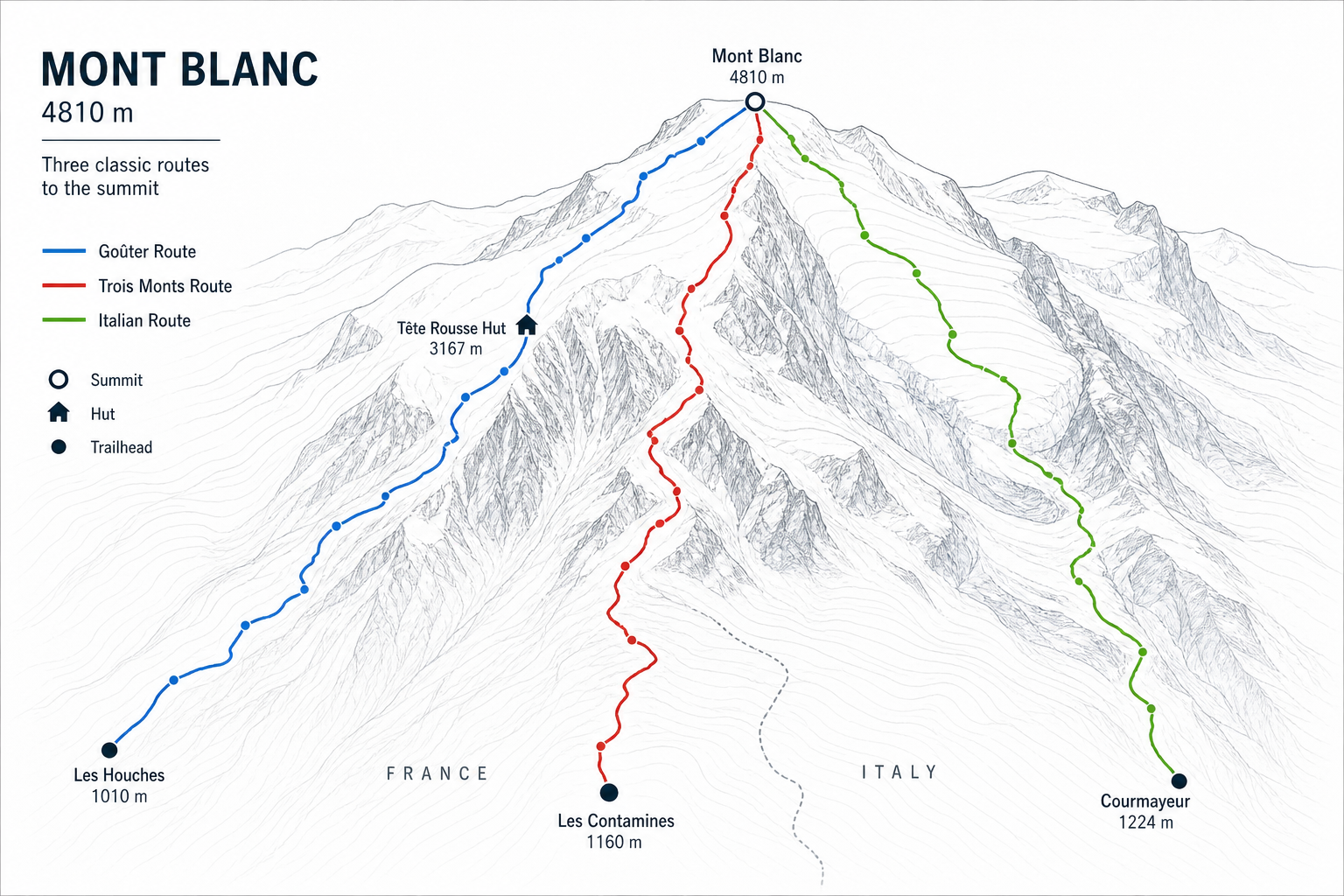
There is no single path to the top of Mont Blanc. The route you choose dictates the technical difficulty, the crowds, and the style of your climb. According to comprehensive route breakdowns like those from Climbing Mont Blanc in the Summer: Popular Routes, three primary paths dominate the summer climbing season.
The Goûter Route (The Classic Route)
Often referred to as the “Normal Route,” this is the most popular and arguably the least technically demanding path to the summit. However, “least demanding” does not mean “easy.” It involves significant objective dangers.
- Day 1: Les Houches to Tête Rousse. You begin by taking the Bellevue cable car from Les Houches, followed by the Tramway du Mont Blanc to the Nid d’Aigle (Eagle’s Nest) at 2,372m. From here, a rugged hike takes you to the Refuge de Tête Rousse (3,167m) for the night.
- Day 2: Tête Rousse to Mont Blanc Summit and the Refuge du Goûter. This is the crux day. You must cross the Grand Couloir—a bowling alley of falling rocks—as early as possible. After a steep rock scramble, you reach the Refuge du Goûter (3,835m). From there, you cross the Dôme du Goûter, traverse the narrow Bosses Ridge, and push to the summit (4,809m). You then descend back to the Goûter Hut to sleep.
- Day 3: Refuge du Goûter to Les Houches. A long, punishing descent back across the Grand Couloir, down to the tram, and back to civilization.
The Trois Monts Route
This route is steeper, longer, and significantly more technical than the Goûter Route. It is often preferred by those wanting to avoid the massive crowds of the normal route.
Starting from the Aiguille du Midi cable car (3,842m), climbers spend the night at the Cosmiques Hut. The route traverses the shoulders of Mont Blanc du Tacul and Mont Maudit before reaching the final summit ridge of Mont Blanc. It features steep snow/ice sections up to 50 degrees and heightened avalanche risk, making it suitable only for experienced climbers.
The Italian Route via the Gonella Hut
For those seeking a wilder, more remote experience, the Italian side offers a stunning alternative. Starting from the Val Veny near Courmayeur, the route approaches via the Miage Glacier to the spectacularly situated Rifugio Gonella. The climb from Gonella to the summit is long and demanding, navigating heavily crevassed glaciers and merging with the Goûter Route at the Dôme du Goûter. It requires excellent fitness and solid glacier travel skills.
3 | Do You Need a Guide to Climb Mont Blanc?
Legally, no. You are not required by French, Swiss, or Italian law to hire a mountain guide to climb Mont Blanc. Practically, however, attempting Mont Blanc unguided as a beginner is exceptionally dangerous.
Guided Ascents
For over 90% of climbers, hiring an IFMGA/UIAGM certified mountain guide is the right choice. Guides manage the route finding, assess weather windows, handle the complex hut booking system, and dictate the pace to ensure you don’t burn out at 4,000 meters. Premier outfits like Climb Mont Blanc With Alpine Ascents or Adventure Consultants offer structured programs that include skills training prior to the summit bid.
Independent Ascents and Finding a Group
If you have the requisite skills and choose to go unguided, the primary challenge for a solo traveler is finding a rope partner. You should never cross a wet glacier alone.
Hostels and social lodges are the lifeblood of independent climbers. Staying at an adventure hub—like the Ski Hostel in the Swiss Alps—allows you to meet potential climbing partners over communal dinners or map-planning sessions. You can vet each other’s skills on lower-altitude hikes before committing to a summit bid. For strategies on building these connections, read Guided Hiking in Switzerland: Finding Your Social Group.
4 | What Does it Cost to Climb Mont Blanc? (Budgeting for Backpackers)
Mont Blanc can drain your wallet quickly if you default to luxury operators. However, with strategic planning, you can significantly reduce costs. Here is a realistic cost breakdown for 2026 based on different styles of climbing, drawing on industry averages from resources like Climb Mont Blanc: Routes, Difficulty, Costs & Preparation.
| Expense Category | All-Inclusive Guided Tour (6 Days) | Independent Climb (Hostel Base) | Notes |
|---|---|---|---|
| Guiding Fees | €1,800 - €2,500 | €0 | Guides usually take 2 clients max. |
| Accommodation (Valley) | Included | €35 - €60/night | Using social lodges/hostels. |
| Mountain Huts (Half-Board) | Included | €100 - €130/night | Mandatory for summit attempts. |
| Cable Cars / Trams | Included | €50 - €80 | Aiguille du Midi or Tramway du Mont Blanc. |
| Gear Rental | Included | €80 - €150 | Boots, crampons, axe, harness, helmet. |
| Food (Outside Huts) | Included | €30 - €50/day | Grocery runs and communal hostel meals. |
| Estimated Total | €1,800 - €2,500+ | €400 - €700 | Excludes international flights. |
For budget-conscious hikers, utilizing a Swiss adventure lodge as your primary basecamp before moving to Chamonix for the actual climb is a massive cost-saver. You get home-cooked meals, affordable beds, and invaluable local knowledge. See why this model works in Hotels in Swiss Mountains? Why Social Lodges Beat Luxury.
5 | Hut Reservations: The European Mountain Hut System
The days of simply showing up on Mont Blanc and pitching a tent are over. To combat overcrowding, environmental degradation, and safety hazards, local authorities instituted strict rules for the Goûter Route.
The Legal Reality in 2026
Wild camping is strictly prohibited along the standard routes of Mont Blanc. Furthermore, if you are climbing via the Goûter Route, you must carry proof of a reservation for the Refuge du Goûter, Refuge de Tête Rousse, or the Nid d’Aigle. The local gendarmerie (mountain police) actively check for these reservations at the base of the climb. If you do not have one, you will be turned around and potentially fined heavily.
The Booking Process
Hut reservations open months in advance (usually early spring) and sell out within hours.
- Create an account: Register on the official French Alpine Club (FFCAM) website well before the opening date.
- Be flexible: Have multiple dates in mind. Mid-week dates are slightly easier to secure than weekends.
- Check for cancellations: If you miss the initial window, keep checking daily. Cancellations happen frequently as weather patterns shift.
Understanding how mountain huts operate is critical for any alpine objective. For a primer on hut etiquette and booking strategies, review How to Plan Hut to Hut Hiking in Switzerland (7 Tips).
6 | Acclimatization Strategy: Preparing Your Lungs
Altitude sickness does not care about your marathon times or your gym routine. If you ascend too quickly to 4,809 meters, you risk Acute Mountain Sickness (AMS), High Altitude Pulmonary Edema (HAPE), or High Altitude Cerebral Edema (HACE).
Proper acclimatization is the secret to a successful Mont Blanc climb. The golden rule is “climb high, sleep low.”
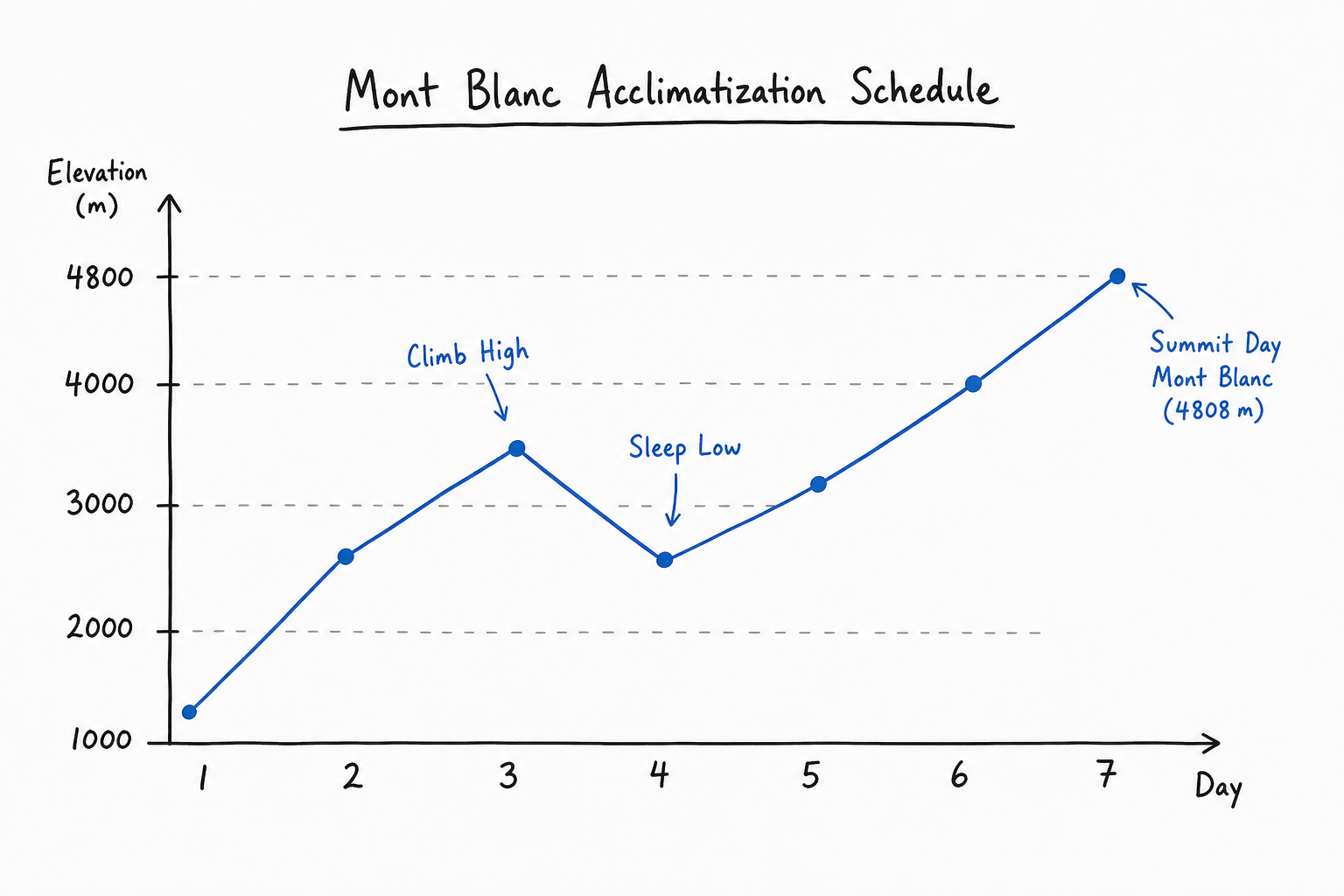
A Standard 5-Day Acclimatization Schedule
- Day 1: Arrive at your basecamp (e.g., a hostel in the Val de Bagnes region at ~1,000m - 1,500m). Do a light hike.
- Day 2: Hike to an elevation of 2,500m - 3,000m. Spend a few hours at the top, then descend back to the valley to sleep.
- Day 3: Ascend a 3,500m+ peak and sleep at a high-altitude mountain hut (around 2,700m - 3,200m). Many climbers use Gran Paradiso in Italy (4,061m) or the Aiguille du Tour (3,540m) as training peaks.
- Day 4: Rest day in the valley. Rehydrate, organize gear, and eat heavily.
- Day 5: Begin the Mont Blanc approach.
Using a hub like Liddes or St. Stephan in the Swiss Alps provides direct access to excellent training peaks. You can read about the best preparation routes in 5 Best Hiking Trails in Switzerland Near Mont Blanc.
Furthermore, if you want to use Gran Paradiso as your warmup, the logistics of crossing the border are surprisingly straightforward. Explore options like Skiing in the Italian Alps? Try This Aosta Day Trip for insights on how easily you can hop between Swiss, French, and Italian alpine zones.
7 | Mont Blanc Packing List: Equipment for Solo Travelers
Packing for Mont Blanc is an exercise in ruthless prioritization. Every gram counts when you are struggling for breath at 4,500 meters, but missing a critical piece of safety gear can be fatal.
If you are traveling solo or backpacking through Europe, you likely don’t want to carry heavy ice axes and stiff mountaineering boots on trains for months. The good news is that you can rent virtually all technical equipment in mountain towns like Chamonix, Courmayeur, or nearby Swiss hubs.
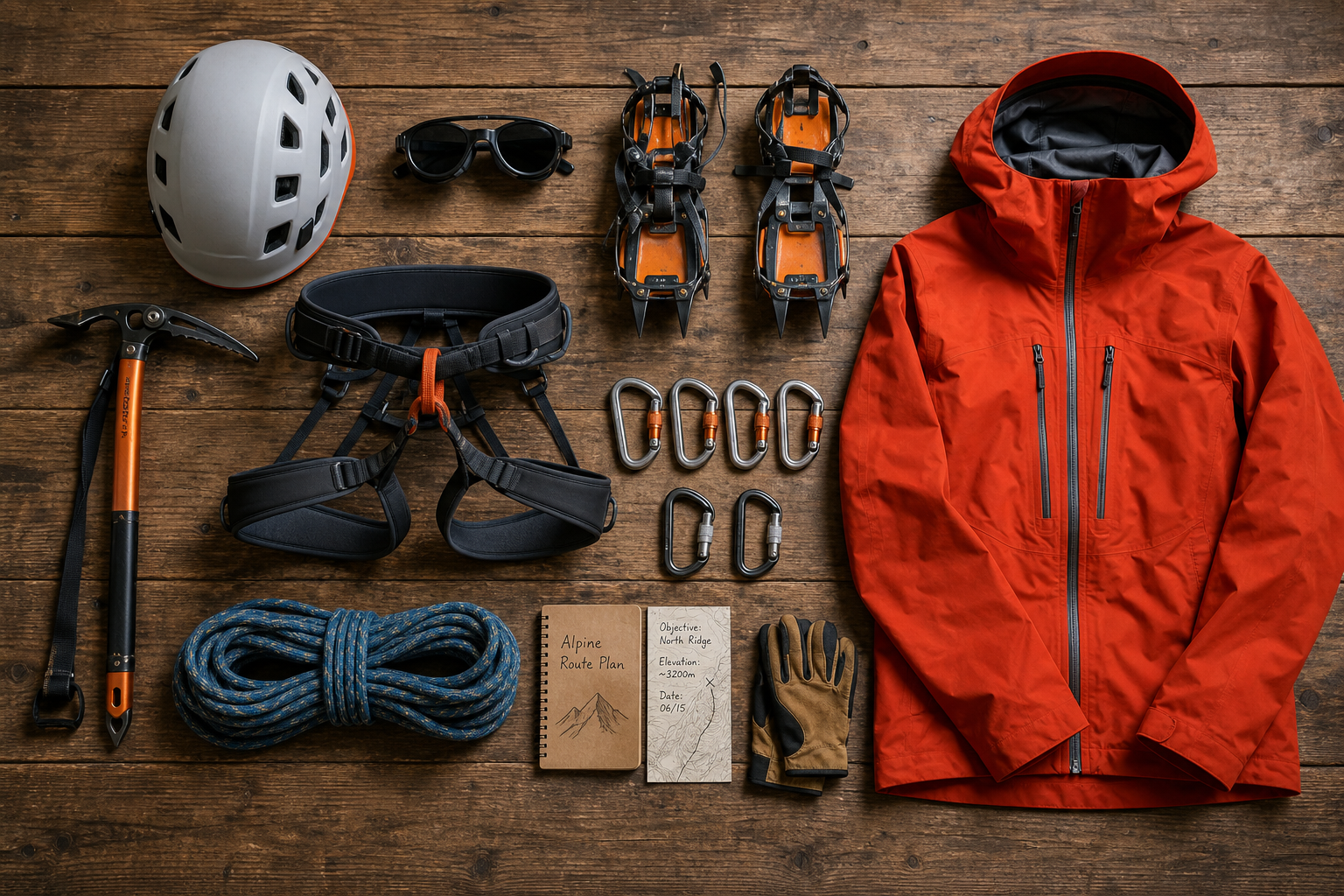
Clothing (Layering System)
- Base Layers: Moisture-wicking merino wool top and bottom.
- Mid-Layers: Fleece jacket and a lightweight synthetic or down insulated jacket.
- Outer Shell: Gore-Tex (or equivalent) waterproof/breathable jacket and trousers.
- Gloves: One pair of thin liner gloves (for the approach) and one pair of heavily insulated, waterproof mountaineering gloves or mittens.
- Headwear: Warm beanie, buff/neck gaiter, and a sun hat.
Technical Equipment
- Mountaineering Boots: Stiff-soled (B2 or B3 rated), insulated boots compatible with crampons.
- Crampons: 12-point steel crampons fitted perfectly to your boots.
- Ice Axe: A standard, straight-shaft walking axe.
- Harness & Hardware: Climbing harness, 2-3 locking carabiners, a prusik cord, and a sling.
- Helmet: UIAA-certified climbing helmet.
Other Essentials
- Eyewear: Category 4 glacier glasses (wrap-around to prevent snow blindness) and ski goggles for high winds.
- Backpack: 35-45 liter alpine pack.
- Headlamp: With spare lithium batteries (cold drains batteries fast).
- Hydration & Nutrition: Insulated water bottle (hydration hoses freeze) and high-energy snacks.
For a broader look at packing for the region before your climb, our Swiss Alps Summer: A Simple 5-Step Packing Guide covers the valley-level essentials.
8 | Starting Point: Where to Travel and Stay
Chamonix, France, is the traditional epicenter for Mont Blanc climbs. It is bustling, beautiful, and extremely expensive.
For backpackers, digital nomads, and budget-conscious solo travelers, staying slightly outside the immediate Chamonix bubble offers a better experience. Basing yourself in the Swiss Alps—specifically in areas like the Val de Bagnes—gives you access to world-class acclimatization hikes, lower accommodation costs, and a community atmosphere that luxury hotels in Chamonix lack.
Social adventure lodges act as staging grounds. You can spend a week remote working using high-speed Wi-Fi, joining communal BBQ nights, taking guided hikes to build your red blood cell count, and eventually taking organized transport directly to the Mont Blanc trailheads. If you also enjoy two-wheeled adventures during your rest days, you can even Find the Right Mountain Bike Group for Alpine Trails right from your lodge.
FAQs
How long does it take to climb Mont Blanc?
The climb itself typically takes 2 to 3 days depending on the route and weather. However, you should allocate a minimum of 7 to 10 days for the entire expedition. This allows for 3-4 days of acclimatization and training, the climb itself, and a buffer of 2-3 days in case bad weather forces you to delay your summit bid.
When is the best time to climb Mont Blanc?
The summer climbing season runs from mid-June to late September. July and August offer the warmest temperatures and the most stable weather, but they are also the most crowded. In recent years, severe heat waves in August have caused increased rockfall in the Grand Couloir, occasionally forcing authorities to close the route. Late June or early September often provide the best balance of stable snow conditions and manageable crowds.
How dangerous is it to climb Mont Blanc?
Mont Blanc has a high fatality rate, largely due to its accessibility drawing inexperienced climbers. The primary objective dangers are rockfall (especially on the Goûter route), hidden crevasses, avalanches, and rapidly changing weather. While the normal route is not technically extreme, exposure to severe elements at high altitude means small mistakes can escalate into life-threatening situations quickly.
Final Thoughts for the Solo Climber
Climbing Mont Blanc is a monumental undertaking, but it is deeply achievable for the prepared solo traveler. The secret isn’t just physical strength; it’s smart logistics. By leveraging social mountain lodges for acclimatization, understanding the strict hut booking systems, and realistically assessing whether to join a guided group or find experienced partners, you can turn a daunting alpine expedition into the highlight of your summer.
The mountain demands respect, patience, and preparation. Train hard, pack smart, embed yourself in the local climbing community, and you will be well on your way to standing on the roof of Western Europe.