Mountain Bike Group Rides Near Me (Liddes Social Trips)
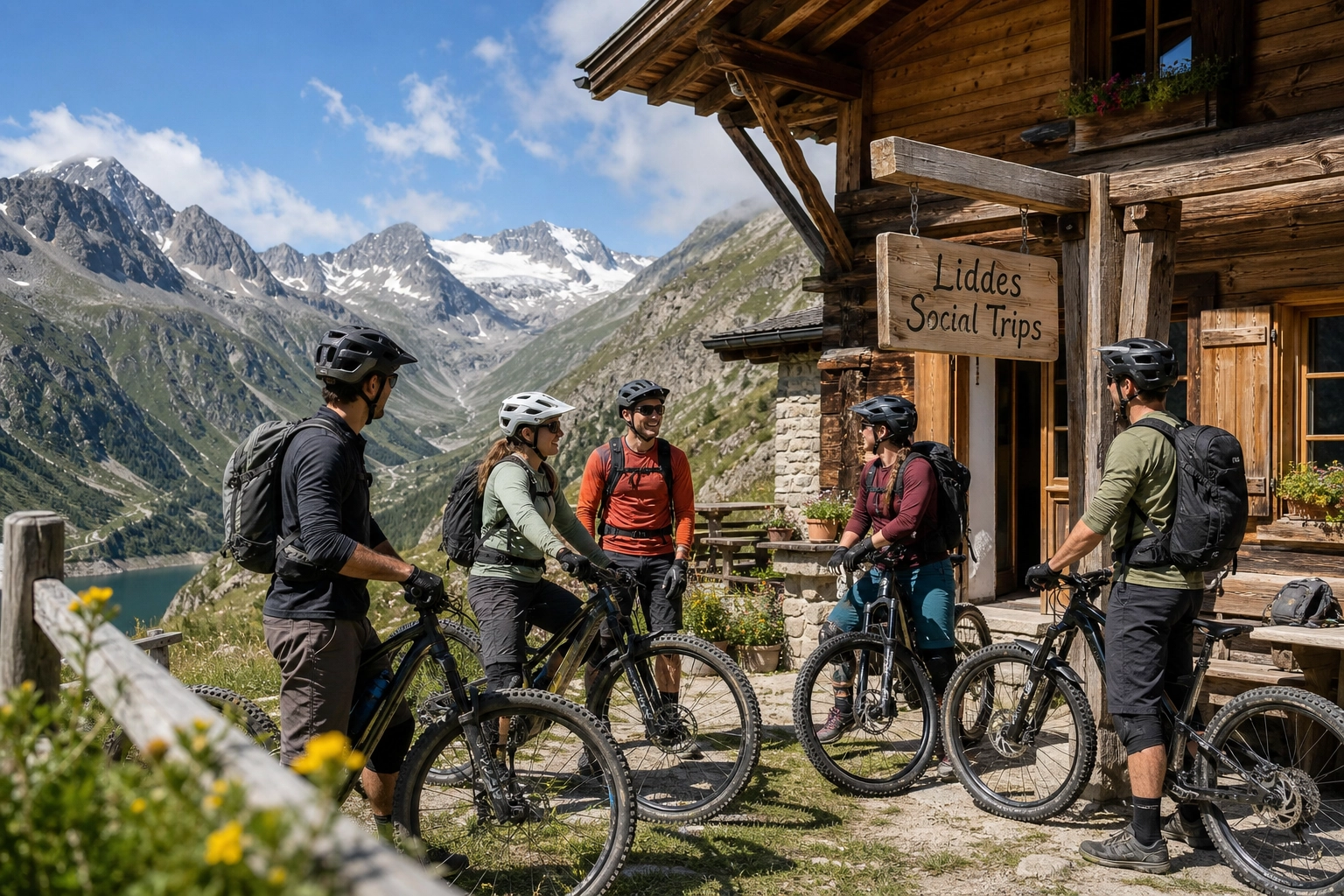
You have just finished rebuilding your mountain bike in the parking lot of a foreign town. The rotors are aligned, the tires are inflated, and the suspension is dialed. You pull out your phone, open a search engine, and type: “mountain bike group rides near me.”
If you are in your hometown, this search probably yields a few local bike shop spins, a reliable Wednesday night Facebook group, or a weekend trailhead meetup. But when you are traveling—especially in the massive, intimidating, and awe-inspiring terrain of the Swiss Alps—that same search often leads to dead ends. You might find an outdated forum post from 2019, a luxury guiding service charging 400 CHF a day, or a local club ride where the “casual pace” actually requires professional-level fitness.
The reality of traveling as a mountain biker is that navigating trail networks is only half the battle. The other half is finding your people. Mountain biking is inherently tribal. We rely on the pack for safety in remote alpine environments, for mechanical help when a derailleur snaps, and for the shared stoke of navigating a blind, rooty chute.
When your “near me” radius encompasses the Val de Bagnes region and the high-altitude trails of Liddes, the traditional methods of finding a group ride go out the window. Here, the best group rides are not found on social media apps—they are formed at the breakfast table.
This guide breaks down how to navigate the complex world of alpine group rides, how to choose the right pack for your skill level, and why community-driven adventure lodges have completely redefined the mountain bike travel experience.
The Traveling Rider’s Dilemma: Finding the Right Pack
Dropping into an unfamiliar trail system alone is a daunting prospect. Apps like Trailforks or Strava can show you heatmaps and GPS tracks, but they cannot tell you that a specific north-facing trail holds moisture for three days after a rainstorm, or that a “blue” trail in Switzerland might feature exposure that would be labeled a “black diamond” in North America.
Joining a local group ride is the fastest way to download this local knowledge. However, finding these rides as a transient visitor introduces immense friction.
The Friction Points of Local Searches
- The Pacing Trap: Every region has its own definition of “party pace.” In the Swiss Alps, a local rider’s casual spin might involve 1,000 meters of vertical climbing before lunch. Joining a group without understanding their baseline fitness can turn a fun day into a miserable sufferfest.
- The Logistics Gap: Even if you find a group meeting at a specific trailhead, how do you get there? If the ride is a point-to-point shuttle, you need a vehicle that can carry bikes, which is a rare and expensive rental car luxury.
- The Language and Culture Barrier: While mountain biking is a universal language, the nuance of trail safety, passing etiquette, and emergency communication requires clear understanding.
To effectively bypass these hurdles, savvy traveling riders are shifting away from piecing together DIY itineraries and instead anchoring their trips at social hubs designed specifically for mountain sports.
Why Social Adventure Lodges Beat Local Bike Shops
For decades, the local bike shop (LBS) was the undisputed hub for group rides. While that holds true for locals, the model breaks down for international backpackers, digital nomads, and budget-conscious solo travelers.
Enter the community-driven adventure lodge.
Places like Ski Hostel, nestled in the Liddes and St. Stephan regions, have effectively replaced the local bike shop as the ultimate connector for traveling riders. Rather than spending your first three days trying to decipher local trail maps and hunting for riding partners, a social lodge builds the group ride directly into your accommodation.
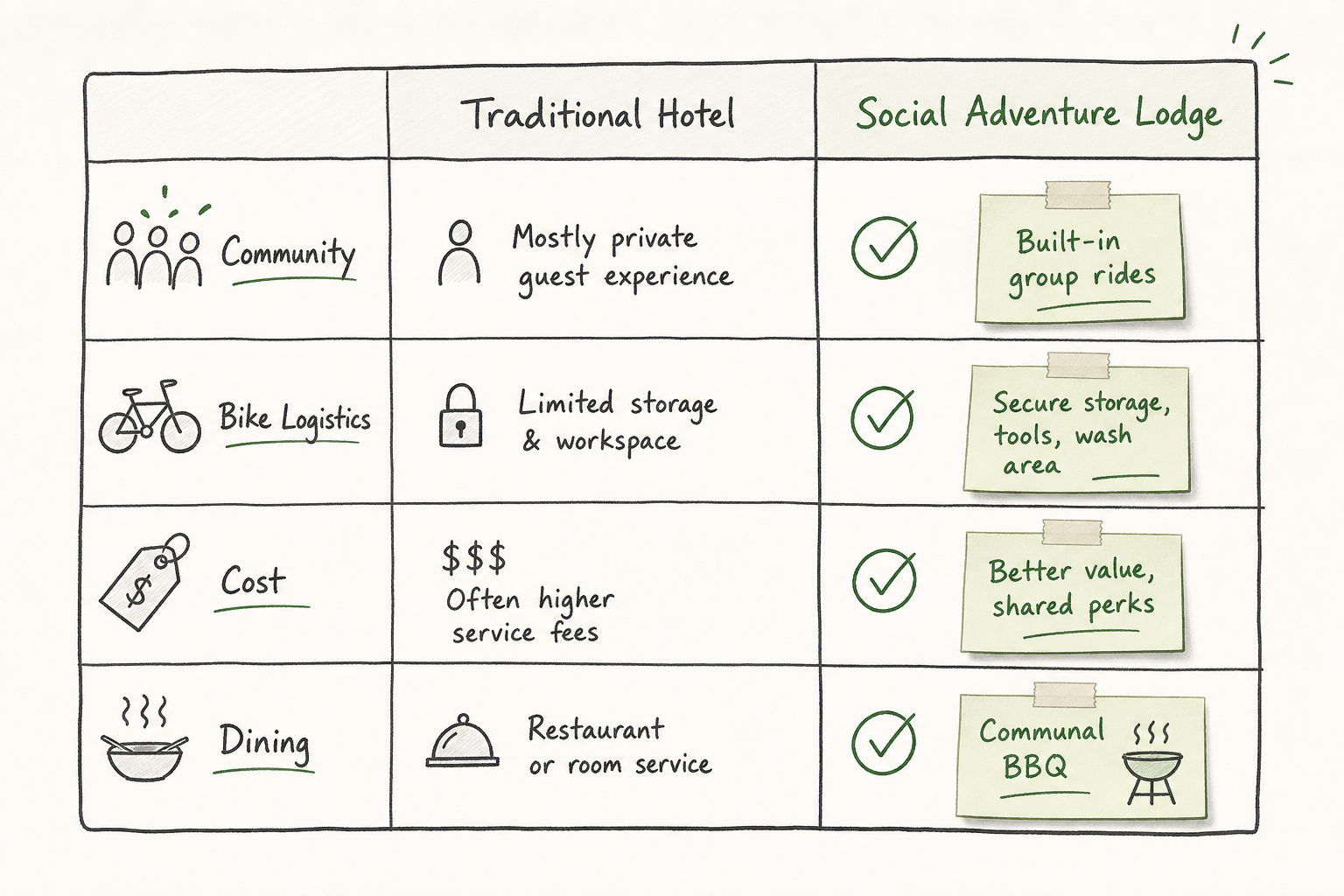
When you book a stay at a traditional luxury hotel, your interaction with other guests rarely goes beyond a polite nod in the elevator. If you want to read more about this stark contrast, our guide on Hotels in Swiss Mountains? Why Social Lodges Beat Luxury breaks down the financial and social math.
The Built-In Basecamp Advantage
At an adventure lodge, the “near me” search is obsolete. Your riding group is literally sleeping down the hall. The daily rhythm naturally fosters group rides:
- Communal Breakfast Planning: Over home-cooked meals and strong coffee, the host or volunteer guides assess the weather, review who wants to ride park versus who wants to pedal backcountry singletrack, and naturally split guests into appropriate pods.
- Shared Logistics: The lodge manages the transport. If the group decides to do a massive descent into the valley, the hostel’s shuttle van acts as the retrieval vehicle. You share the fuel cost, eliminate the rental car headache, and maximize descending time.
- On-Site Gear and Mechanics: When someone realizes their brake pads are glazed the night before a big ride, the hostel’s communal tool bench and spare parts bin (often stocked by previous travelers) save the day.
Decoding Alpine Group Ride Formats
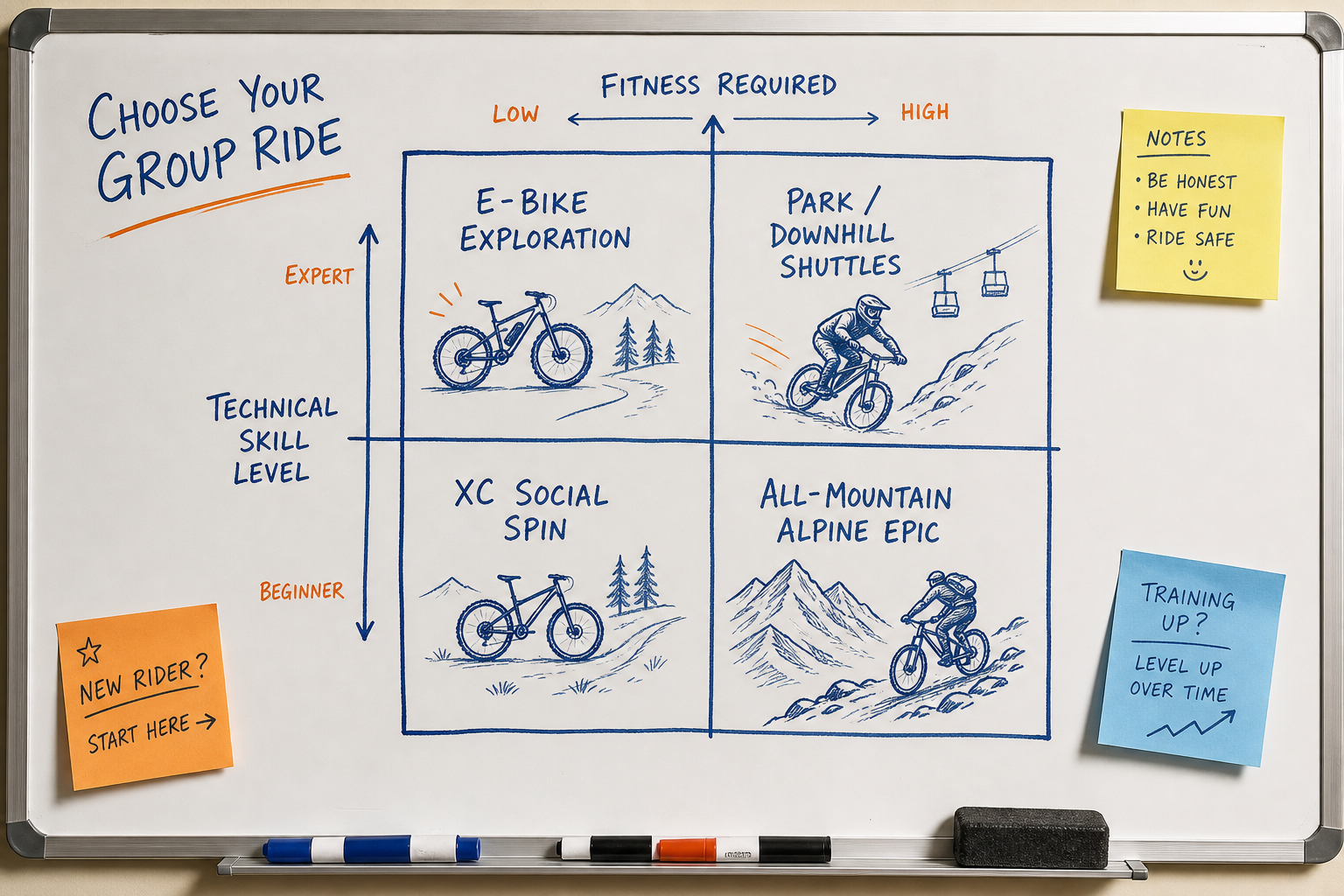
Before you commit to a group, you must honestly assess your own capabilities and understand the distinct formats of alpine riding. The mountains around Val de Bagnes offer over 250 kilometers of diverse trails, catering to highly specific riding styles.
If you want a deeper dive into vetting these dynamics, review our comprehensive breakdown on how to Find the Right Mountain Bike Group for Alpine Trails. For a quick primer, here are the core formats you will encounter:
1. The “Earn Your Turns” Alpine Epic (All-Mountain/Enduro)
These are full-day missions. The group typically utilizes a mix of pedal power, occasional post bus shuttles, or a single morning gondola bump to reach high-altitude passes.
- The Vibe: Cooperative, endurance-focused, and highly rewarding.
- The Terrain: Expect everything from pristine alpine scree fields to tight, rooty, steep switchbacks in the lower timberline.
- The Catch: You must be self-sufficient. These rides venture far from mobile reception and bike shops. If you suffer a mechanical failure, you and the group must fix it on the trail.
2. The Gravity/Park Shuttle Crew
These groups are focused purely on descending. They congregate around resorts with heavy lift infrastructure or utilize private shuttle vans to run laps.
- The Vibe: High-energy, adrenaline-fueled, with frequent stops to session jumps or technical features.
- The Terrain: Man-made berms, massive braking bumps, wooden features, and steep, sustained descents.
- The Catch: The physical toll on your upper body is immense. “Arm pump” (the fatigue of your forearms from sustained braking) will end your day long before your legs give out.
3. The E-Bike Exploration Ride
The proliferation of E-mountain bikes has completely changed the landscape of alpine group rides. What used to be a grueling 4-hour climb is now a fun, chatty 90-minute power hour.
- The Vibe: Social, expansive, and democratizing. E-bikes allow riders of varying baseline fitness levels to ride together seamlessly.
- The Terrain: Often utilizing steep, technical climbs that would be impossible on an acoustic bike, opening up entirely new loops.
- The Catch: Battery management is a real skill. Running out of battery at the bottom of a Swiss valley leaves you pedaling a 25kg anchor up a mountain.
4. The “No-Drop” Casual Spin
Perfect for beginners, digital nomads taking a quick lunch break, or those seeking an active recovery day.
- The Vibe: Conversational, relaxed, and strictly “no-drop” (meaning the group waits for the slowest rider at every intersection).
- The Terrain: Gravel fire roads, smooth valley trails, and scenic viewpoints.
How to Evaluate a “Near Me” Group Ride While Traveling
When you are invited to join a group—whether it is a crew you met at the hostel’s communal BBQ or a local club you found online—use this five-point checklist to ensure it is a safe and enjoyable fit.
1. Define “Swiss Flat”
Mountain bikers are notorious for lying about elevation. When a local rider in the Alps tells you a route is “mostly flat,” they usually mean it only has 400 meters of punchy, lung-busting climbs. Always ask for the exact elevation gain and the expected distance.
2. Clarify the Drop Policy
Never assume a ride is “no-drop.” In high alpine environments, a group might have a strict turnaround time due to incoming afternoon thunderstorms. If you cannot maintain the pace, a “drop” ride might ask you to turn back alone. Ensure expectations are perfectly clear before you leave the trailhead.
3. Ask About the Technical Baseline
Does the route require mandatory drops? Are there highly exposed sections where a mistake means a serious fall? Ask the ride leader to compare the hardest feature of the day to a known trail standard.
4. Verify the Gear Requirements
In a bike park, you might need a full-face helmet and chest protection. For a backcountry epic, the group might require you to carry a survival blanket, a specific volume of water, and a spare derailleur hanger.
5. Assess the Post-Ride Culture
A great group ride doesn’t end at the trailhead. The best groups plan for the “après-ride”—sharing a beer, grabbing food, or simply hanging out by the vans to swap stories. At Ski Hostel, this naturally flows into communal dinners, where Brazilian-influenced cuisine meets Swiss alpine traditions, creating the perfect environment to relive the day’s best sections.
Liddes & Val de Bagnes: Your Basecamp for Adventure
Positioning yourself in the right location is the ultimate hack for incredible group rides. Liddes, situated in the heart of the Val de Bagnes region, is a strategic masterpiece for mountain biking.
Rather than staying directly inside an expensive, hyper-commercialized resort town, establishing a basecamp in Liddes gives you quiet, affordable tranquility with immediate access to world-class terrain.
The Local Terrain
The immediate vicinity boasts trails that wind through ancient pine forests, dropping into lush valleys. You get the authentic, rugged Swiss riding experience without the braking bumps and massive crowds found at mega-resorts. The dirt here ranges from tacky loam after a light rain to loose, rocky scree up high.
Border-Crossing Excursions
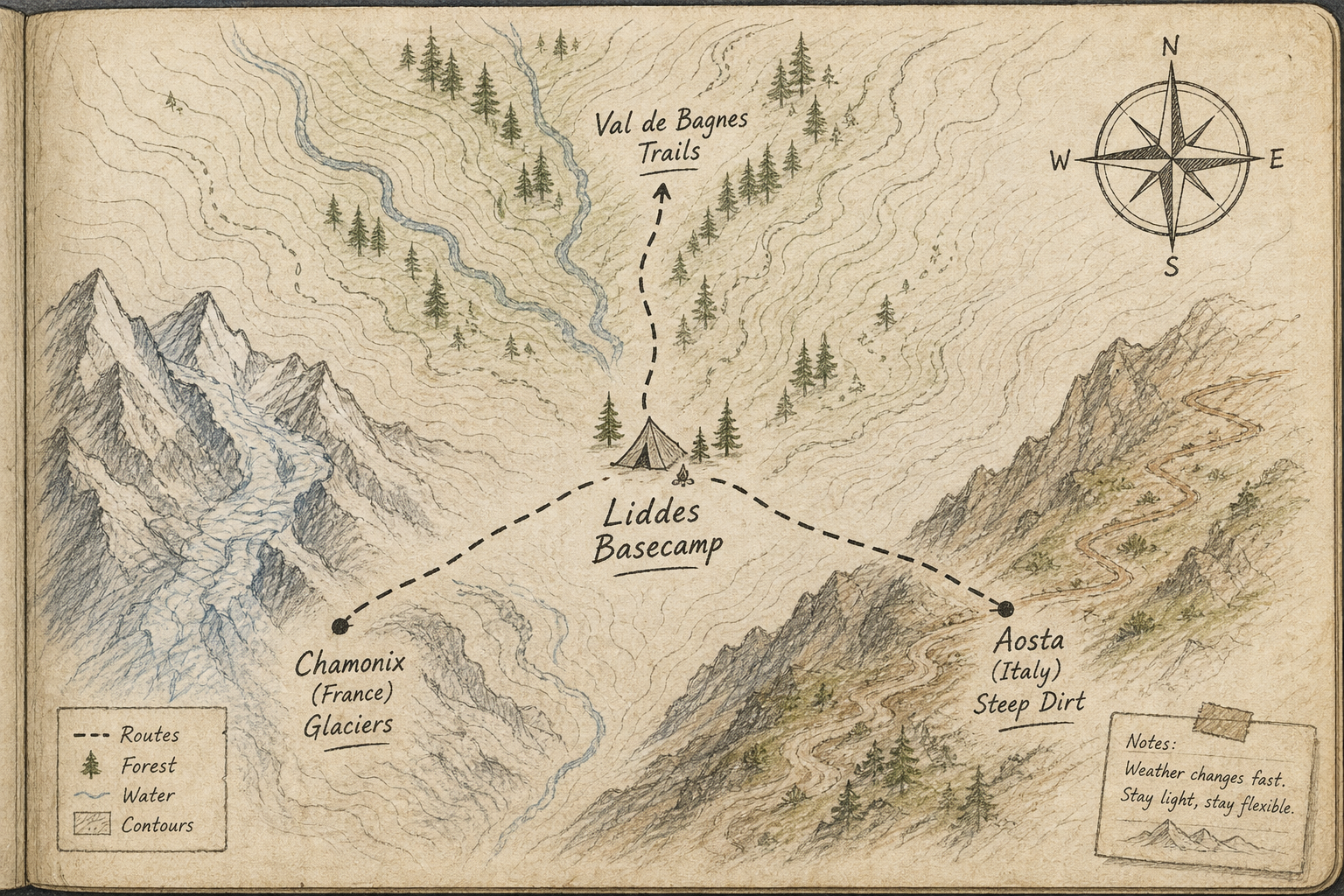
One of the most unique aspects of joining a socially organized hostel group is the ability to execute cross-border missions. Because Liddes is perfectly positioned near international borders, a typical week might include loading up the vans and heading into Italy or France.
Just as winter visitors might execute a border run—detailed in our post, Skiing in the Italian Alps? Try This Aosta Day Trip—summer mountain bikers can drop into the legendary, dusty, steep descents of the Aosta Valley in Italy, or head west to tackle the dramatic, glaciated backdrops of Chamonix, France. Experiencing three distinct mountain biking cultures (Swiss precision, Italian steep-and-deep, French flow) in a single week is a logistical feat made effortless by communal hostel travel.
A Week in the Life: The Ski Hostel Summer MTB Itinerary
To understand why the “near me” search is obsolete in a community lodge, let’s look at a hypothetical, yet typical, week-long itinerary for a traveling rider staying at Ski Hostel.
Monday: Arrival and The Shakeout
- Morning: Arrive at the lodge, unpack your gear, and use the communal tools to assemble your bike.
- Afternoon: Join the “shakeout ride.” This is a low-stakes, 90-minute loop right out the back door of the hostel. It’s designed to test your brakes, ensure your gears are shifting crisply, and allow the host to assess everyone’s skill level.
- Evening: Welcome dinner. You meet a digital nomad from Canada, a solo backpacker from Germany, and a family from the UK. The group for the week is formed.
Tuesday: The Val de Bagnes Tour
- Morning: A solid, hearty breakfast. The group pedals directly from the lodge into the Val de Bagnes network.
- Afternoon: Focus on flow trails and moderate tech. The group practices passing etiquette and communication.
- Evening: Spa night at the hostel to soak out the lactic acid.
Wednesday: The Big Mountain Epic
- Morning: Early start. The hostel van shuttles the group to a high alpine pass.
- Afternoon: A massive, 5-hour descent weaving through alpine meadows, rock gardens, and technical switchbacks. Pack lunches are eaten beside a high-altitude lake.
- Evening: Exhausted but ecstatic, the group returns for a massive Brazilian-style BBQ organized by the volunteers.
Thursday: Active Recovery / Multi-Sport Day
- All Day: The legs need a break. Some of the group decides to swap cleats for boots. They utilize the local trail network for a mellow hike. (If you want to know how hiking groups form, check out Guided Hiking in Switzerland: Finding Your Social Group).
Friday: The Border Run (Aosta or Chamonix)
- Morning: Passports in pockets. The van is loaded early for a drive across the border.
- Afternoon: Riding steep, dusty Italian singletrack or tackling the roots of Chamonix. Pizza and espresso for lunch.
- Evening: Return to Liddes for a farewell dinner, swapping photos and AirDropping videos from the week.
Preparing Your Gear for Swiss Alps Group Rides
Showing up to an alpine group ride unprepared is the fastest way to lose your invitation for the next day. The mountains are indifferent to your lack of planning. In the Alps, the weather can shift from blazing sun to a freezing torrential downpour in 30 minutes.
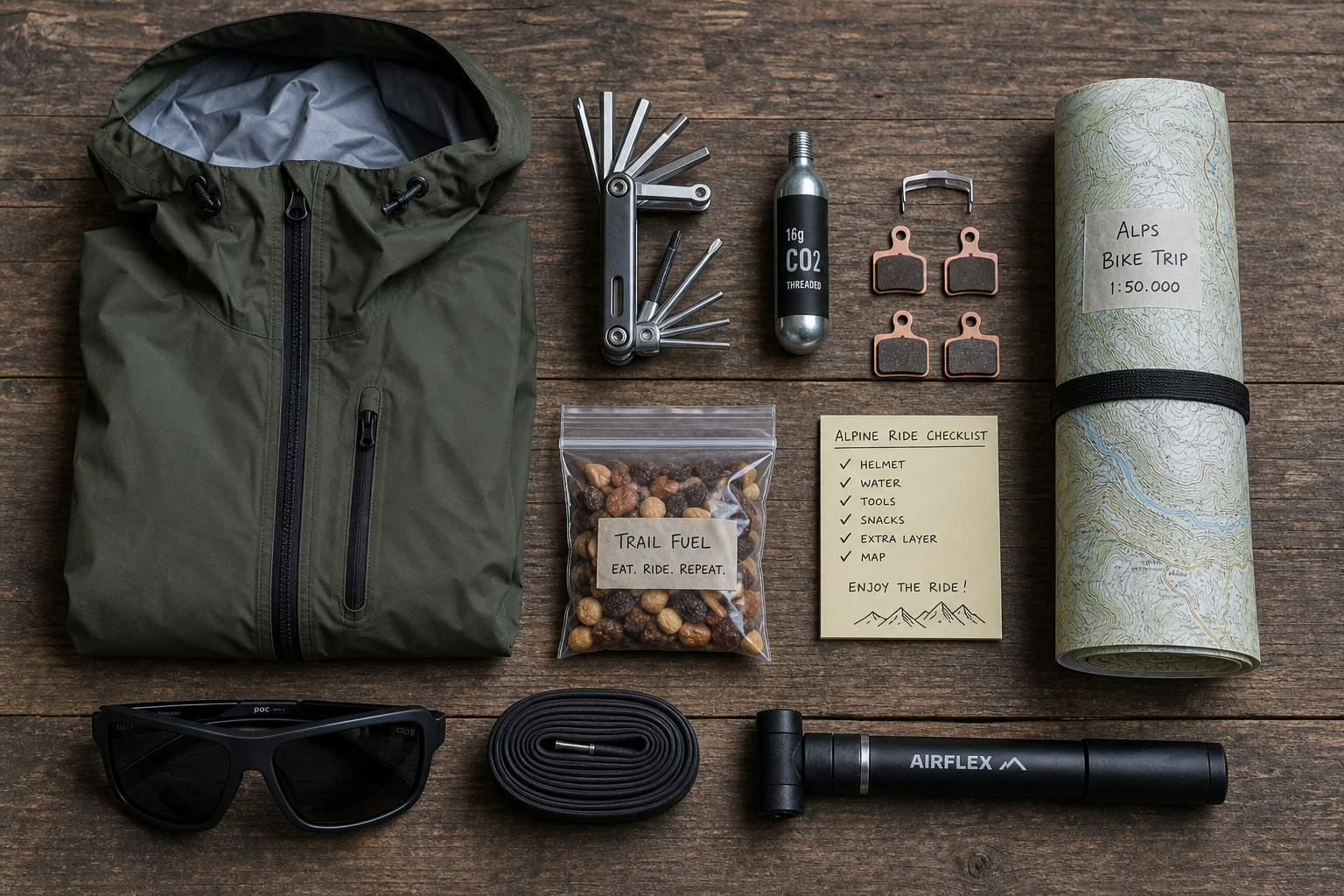
If you are packing your bags right now, cross-reference your luggage with our Swiss Alps Summer: A Simple 5-Step Packing Guide. Specifically for mountain biking, you must carry a highly curated kit.
The Alpine Pack Essentials
- Tires with Proper Casings: Do not bring lightweight XC tires to the Alps unless you enjoy fixing flat tires while the group waits. You need thick, robust casings (like Maxxis DoubleDown or Schwalbe SuperGravity) to survive the sharp, jagged alpine rocks.
- Brake Pads: Bring at least two sets of spare brake pads. The sustained, 1,000-meter descents will chew through organic brake pads in a matter of days. Sintered (metallic) pads are highly recommended for heat dissipation.
- The Layering System: A lightweight, packable waterproof shell is mandatory, even if the sky is blue at the trailhead. You should also carry a moisture-wicking merino wool baselayer to swap into at the summit so you don’t freeze on the descent.
- The On-Bike Toolkit: A high-quality multitool with a chain breaker, spare quick links (matched to your drivetrain speed), tire levers, a reliable pump, and a CO2 canister.
A Tale of Two Riders
Consider a mini-case study from a past season at the lodge. Two riders joined the Wednesday “Big Mountain Epic.”
Rider A brought a tiny hip pack with a single water bottle and no jacket, assuming the sunny 25°C (77°F) valley temperature would hold. Rider B brought a 12-liter hydration pack with a shell, snacks, and a first-aid kit.
At 2,400 meters, a localized storm rolled over the ridge. The temperature plummeted to 8°C (46°F). Rider A began shivering uncontrollably on the descent, losing the fine motor skills required to brake safely. Rider B had to lend out their spare mid-layer. The lesson? Your lack of preparation becomes the group’s burden. Pack for the mountain, not the trailhead.
The Etiquette of Joining International Group Rides
When you stay at a social lodge, your riding group will likely consist of people from four different countries, speaking three different languages, with varying levels of technical skill. Navigating this dynamic requires grace, patience, and excellent etiquette.
Communication on the Trail
Establish universal signals before the tires hit the dirt.
- Stopping: If you must stop on the trail, yell “Rider stopping!” and immediately pull your bike completely off the trail to avoid a rear-end collision.
- Passing: If you are slower, pull over when it is safe and explicitly tell the rider behind you, “Pass on my left.” If you are faster, do not ride on someone’s rear tire (tailgating). Politely ask, “Mind if I sneak by when you have a safe spot?”
- Feature Callouts: The lead rider should call out hazards like “Hiker up!”, “Deep rut!”, or “Slippery roots!” which should be echoed down the line by each subsequent rider.
Contributing to the Pack
You do not need to be the fastest rider or the best mechanic to be the most valued member of a group ride. You simply need to be a positive contributor.
Bring extra gummy bears or trail snacks to share at the summit. If someone gets a flat tire, don’t just stand there staring at your phone—offer to hold their bike, hand them the pump, or keep morale high with a good joke. Mountain biking is a team sport played on individual machines.
Beyond Biking: Multi-Sport Social Adventures
Even the most hardened mountain bikers eventually suffer from saddle sores or fatigue. The beauty of the Liddes and Val de Bagnes region is that when you need a rest day from the bike, the adventure doesn’t stop.
The social group you built on the trail seamlessly transitions to other activities. You might decide to rest the arms and challenge the legs by hiking.
If you want to stay local, you can explore the 5 Best Hiking Trails in Switzerland Near Mont Blanc. If you prefer to avoid the heavy tourist traps entirely, grab your new riding friends and check out our guide on Mountain Mont Blanc: 7 Ways to Visit Without the Crowd.
For those who want to mix a massive multi-day pedestrian mission into their bike trip, the region is famous for interconnected refuge systems. You can literally leave your bike box at the hostel, pack a 40-liter rucksack, and disappear into the clouds for a few days. Read How to Plan Hut to Hut Hiking in Switzerland (7 Tips) to see how this complements a biking holiday.
Frequently Asked Questions About Swiss Alps MTB Groups
Do I need to bring my own bike, or can I rent one?
While many serious riders prefer the comfort of their own dialed-in suspension, traveling with a bike box is expensive and stressful. Many guests choose to rent high-end enduro or E-bikes locally. Adventure lodges often have partnerships with local shops for discounted, high-quality rentals that are serviced daily.
Are E-bikes allowed on group rides?
Yes, but communication is key. Mixed groups (acoustic and E-bikes) work well on descents, but climbs can be frustrating if expectations aren’t managed. Often, lodges will organize specific E-bike exploration days to maximize the distance covered.
What if I am a beginner? Is the Swiss Alps too intense for me?
Absolutely not. While the region is famous for high-alpine extreme riding, the valley floors and lower forests are littered with smooth, flowing green and blue trails. The key is communicating your skill level accurately to your host so they can group you with similar riders and suggest the right trails.
How much does a guided group ride typically cost?
Private guiding in Switzerland can cost upwards of 300 to 500 CHF per day. However, by staying at a community-driven hostel, the “guiding” is often informal, built into the itinerary, or heavily subsidized by shared group costs, making it a fraction of the price of traditional tourism models.
Ready to Secure Your Spot in the Pack?
Typing “mountain bike group rides near me” into a search bar while sitting in an airport terminal is a gamble. You might find a great crew, but you are just as likely to find a disorganized, mismatched ride that leaves you frustrated.
When you travel to the Alps, you shouldn’t have to work hard to find your community. By choosing an adventure-focused basecamp like Ski Hostel in Liddes, you eliminate the logistical friction of mountain bike travel. The routes are planned, the vans are fueled, the dinners are cooking, and the group is already waiting for you in the lounge.
All you have to do is show up, build your bike, and pedal.