Best guided hiking tours in Switzerland for solo travelers
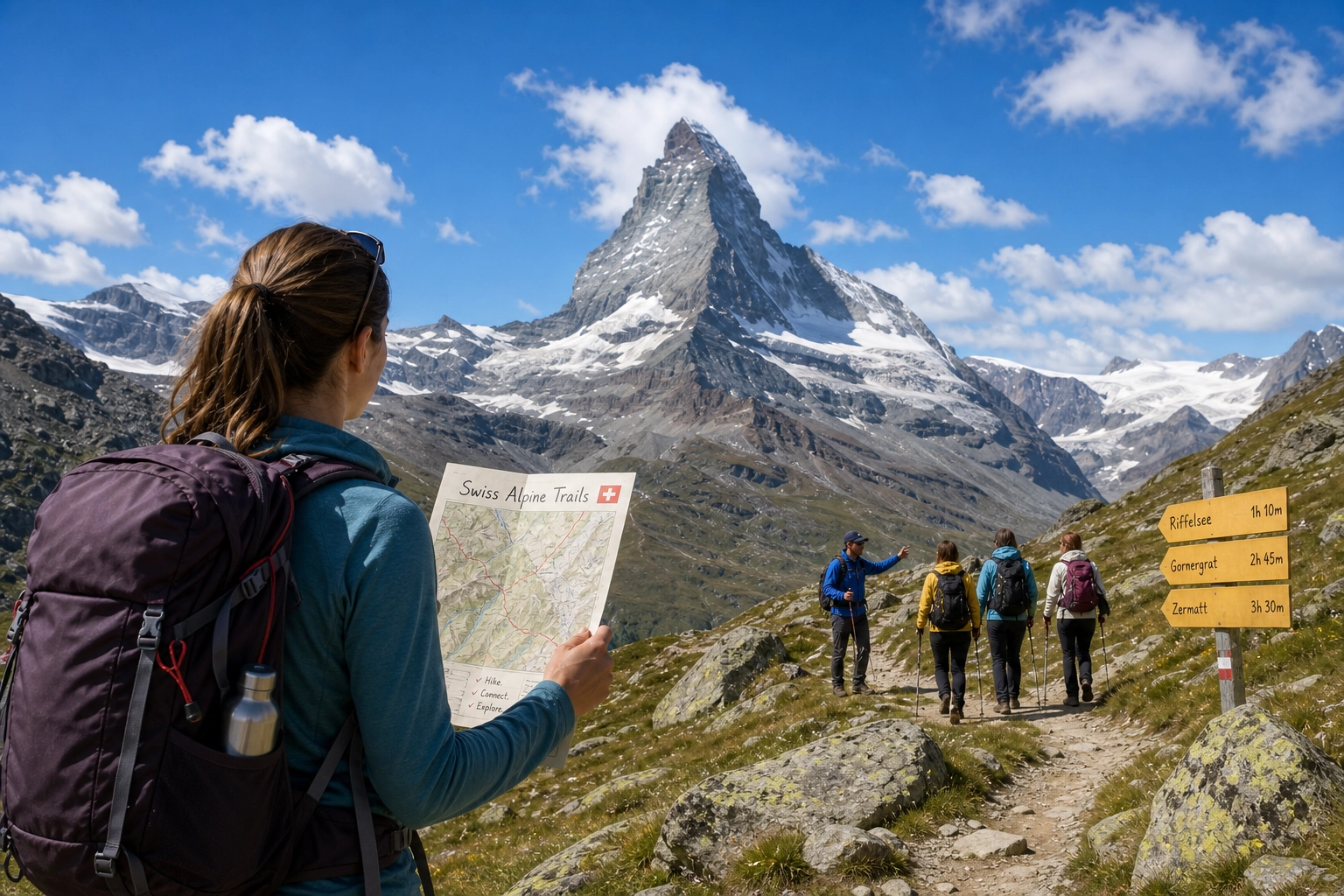
You are standing at a crossroads in the Swiss Alps. The air is impossibly crisp, the cowbells are echoing off a distant limestone face, and the trail marker points toward a spectacular, glacier-draped col. It is the exact moment you have been dreaming about since you first decided to hike in Switzerland.
But if you are a solo traveler, getting to that trail marker likely involved a massive logistical headache.
You probably spent hours deciphering the SBB train schedules, trying to figure out which postal bus connects to which funicular. You likely absorbed the shock of discovering that a basic single hotel room in a mountain village can cost upwards of CHF 200 per night. And when you finally got on the trail, you might have realized that while the solitude of solo hiking is beautiful, sipping a post-hike beer alone while everyone else is laughing in groups at the mountain hut can feel a bit isolating.
Switzerland is undeniably one of the most spectacular hiking destinations on earth. However, for solo travelers, backpackers, and digital nomads, it is also one of the most difficult places to navigate on a budget without feeling totally isolated.
This is exactly why guided hiking holidays for solo travelers have surged in popularity. Rather than piecing together a fragmented, expensive, and lonely itinerary, you can join a ready-made social group, hand off the logistical burden to local experts, and focus entirely on the trails.
In this comprehensive guide, we are going to break down the best guided hiking holidays in Switzerland for solo travelers. We will explore the traditional boutique tours, the highly immersive hut-to-hut treks, and the emerging, budget-friendly “social basecamp” models that are revolutionizing how solo adventurers experience the Alps.
The Reality of Solo Hiking in the Swiss Alps: Dream vs. Logistics
Before we dive into the specific tour options, it is important to understand why solo travelers so often pivot toward guided holidays in Switzerland. The romantic idea of stepping off a train with a backpack and wandering into the alpine wilderness often clashes with the rigid, expensive reality of Swiss infrastructure.
The Cost Trap and the Dreaded Single Supplement
Switzerland operates on a high-cost baseline. The infrastructure—from the impeccably timed trains to the marvels of alpine engineering like cliff-side cable cars—is world-class, but it comes at a premium.
For solo travelers, the biggest financial hurdle is accommodation. The vast majority of traditional Swiss mountain hotels operate on a per-room pricing model rather than a per-person model. If you want a bed for the night, you are paying for the whole room. This “single supplement” can instantly double your accommodation budget. While you can find shared dorms in some larger towns, boutique alpine villages often lack budget-friendly solo options. This dynamic is a primary reason Hotels in Swiss Mountains? Why Social Lodges Beat Luxury is a topic of heavy debate among modern backpackers.
The Logistical Web of Transport
To access the best trails in Switzerland, you rarely just drive to a parking lot. A typical day hike might involve taking a mainline train to a valley floor, switching to a narrow-gauge mountain railway, catching a yellow Postbus up a winding mountain road, and finally taking a gondola to the trailhead.
Managing these connections solo requires meticulous planning. Miss the last gondola down, and you are either facing a brutal three-hour descent in the dark or paying an exorbitant fee for an emergency taxi (if one can even reach you).
The Social Factor
The Swiss trails are busy in the summer, but they aren’t inherently social in the way backpacker hostels in Southeast Asia or surf camps in Central America are. Hikers tend to stick to their own groups. If you are hiking solo, you will likely remain solo for the duration of your trip. For many, finding a ready-made community is the greatest value of booking a guided trip. The desire to share the experience is a huge driver, which is why Guided Hiking in Switzerland: Finding Your Social Group is such a priority for modern digital nomads and solo adventurers.
The Three Main Types of Guided Hiking Tours in Switzerland
If you have decided that a guided holiday is the right path, your next step is choosing the style of tour. The Swiss hiking industry generally offers three distinct models for solo travelers.
1. Small-Group Alpine Hiking Tours (The Traditional Boutique Approach)
These are the classic, high-end guided tours. They usually feature groups of 6 to 14 people led by one or two certified mountain guides. The itinerary typically involves “inn-to-inn” hiking, where you hike from one picturesque village to the next while a logistics team transports your main luggage by van or taxi.
Several well-known operators dominate this space:
- Alpine Hikers: Highly regarded for their curated, village-based itineraries across the Bernese Oberland and Valais. They keep groups small and focus on boutique hotel accommodations. Because they cater heavily to international travelers, they offer a polished, seamless experience (Alpine Hikers).
- Alpine Adventure Trail Tours: Known for offering highly structured tours with robust support. On some of their departures, they provide up to three guides, allowing the group to split into easy, moderate, and strenuous hiking paces each day (Alpine Adventure Trail Tours).
- Alps Adventures: Another solid option for traditional multi-day trekking and guided experiences across the European Alps (Alps Adventures).
The Pros: You don’t have to carry a heavy backpack. The hotels are usually 3-star or 4-star, offering excellent regional food and private rooms.
The Cons: These tours are exceptionally expensive, often ranging from $3,000 to $5,000+ for a week. They also lean toward an older demographic. If you are a solo backpacker or a younger digital nomad, you might find yourself the outlier in a group of retired couples.
2. The Social Basecamp Model (The Backpacker & Nomad Choice)
The basecamp model flips the traditional inn-to-inn script. Instead of moving hotels every night, the group stays at a single, comfortable, socially driven location—like an alpine hostel or a large mountain lodge—for the entire week.
This is the model championed by Hiking Hostel. With core basecamps in strategic locations like Liddes (in the Valais region) and St. Stephan (in the Bernese Oberland), you unpack once. Every morning, private vans transport the group to different world-class trailheads.
The Pros:
- Budget-Friendly: By utilizing hostel-style accommodation and avoiding daily luggage transfer fees, the cost is a fraction of traditional boutique tours. This is one of the best strategies for 7 Tips for Hiking in Switzerland (Without the High Cost).
- Social Atmosphere: It is explicitly designed for solo travelers, backpackers, and small friend groups. Communal dinners, evening beers on the terrace, and shared spaces create a genuine community vibe.
- Flexibility: If you wake up with sore knees on day four, you don’t have to hike. Because you aren’t moving to a new village, you can just take a rest day at the hostel, read a book, or take a local bus to a nearby town.
The Cons: You won’t get the “journey” feeling of crossing an entire mountain range on foot, and you must return to the same bed each night.
3. Hut-to-Hut Guided Treks (The Immersive Alpine Experience)
For purists, hut-to-hut hiking is the holy grail. Guided hut-to-hut tours take small groups high into the alpine zone, sleeping in remote Swiss Alpine Club (SAC) huts that are inaccessible by road.
The Pros: Unbeatable sunrises, total immersion in nature, and the camaraderie of sleeping in high-altitude dormitories with other dedicated hikers.
The Cons: You must carry all your own gear (clothing, sleeping liner, toiletries) for the duration of the trip. The sleeping arrangements are usually large, mixed-gender dormitories with minimal privacy, and amenities like hot showers are rare. (If this appeals to you, check out How to Plan Hut to Hut Hiking in Switzerland (7 Tips)).
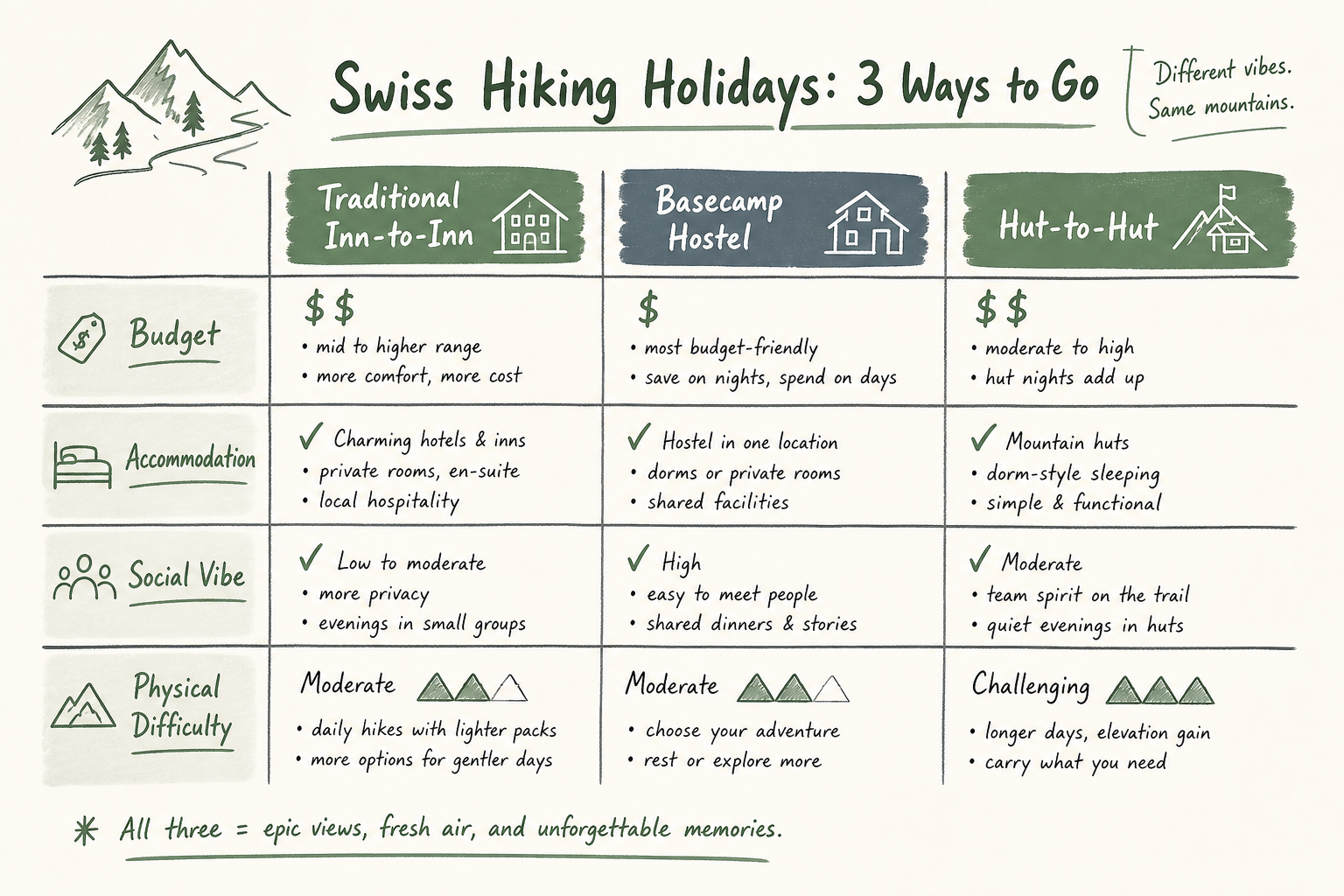
Comparing Solo Hiking Tour Styles: Which is Right for You?
To help you decide which format fits your travel style, budget, and physical capabilities, we have broken down the three primary models into a simple comparison framework.
When evaluating these options on platforms like TourRadar or Viator, look closely at the daily itineraries. An aggregate booking site will often mix all three of these styles under the generic banner of “Switzerland Hiking Tours.”
Deep Dive: The “Single Supplement” Problem and How to Beat It
We touched on this earlier, but it deserves its own section because it is the single most frustrating aspect of booking travel as a solo hiker.
Why do hotels charge a single supplement? In the Swiss Alps, the summer season is incredibly short—often just late June through September. Mountain hotels have a limited number of rooms and a very narrow window to make their yearly profit. If a solo traveler occupies a double room, the hotel loses out on the revenue of a second guest (including the money that second guest would likely spend on dinner, wine, and breakfast).
To compensate, hotels charge solo travelers a premium, often 80% to 100% of the full room rate.
When you book a traditional guided hiking tour, the operator passes this cost directly to you. They will offer two options: pay the hefty single supplement for a private room, or agree to be “paired” with a stranger of the same sex in a twin room.
The social basecamp model bypasses this entirely. By utilizing high-quality hostel infrastructure with small shared dorms (e.g., 4-bed or 6-bed rooms) or offering affordably priced single pods, the pricing is per-person by default. You are not penalized financially for traveling alone, and the shared spaces organically foster the connections that make solo travel rewarding.
Top Regions and Excursions for Your Solo Basecamp Holiday
Switzerland is geographically dense. You can travel from glacier-covered peaks to palm-tree-lined lakes in just a few hours. If you are joining a basecamp-style guided holiday, location is everything.
Here are the top regions and typical excursions that make a week-long Swiss hiking holiday spectacular.
The Valais Region (Base: Liddes)
The Valais (Wallis in German) is the sunniest and driest region in Switzerland, home to the highest peaks in the country, including the Matterhorn and the Dufourspitze. Liddes, situated on the historic route to the Great St. Bernard Pass, is a perfect basecamp.
From Liddes, guided groups can easily access the raw, dramatic trails of the Pennine Alps. The hiking here is characterized by steep, dramatic ascents, ancient irrigation channels (bisses) cut into cliffsides, and sweeping views of massive glaciers.
The Bernese Oberland (Base: St. Stephan)
If you close your eyes and picture Switzerland—lush green rolling hills, wooden chalets with red geraniums, and massive, sheer rock faces of the Eiger, Mönch, and Jungfrau—you are picturing the Bernese Oberland. St. Stephan, located in the picturesque Simmental valley, offers a quieter, more authentic basecamp than the bustling tourist hub of Interlaken, while still providing easy access to the region’s best trails.
Excursions from St. Stephan often include trips toward Glacier 3000 near Gstaad, offering hikers the chance to experience high-alpine suspension bridges and summer snow.
Cross-Border Day Trips and Excursions
One of the unique advantages of hiking in the Swiss Alps is the proximity to France and Italy. The best guided holidays incorporate cross-border excursions to add cultural and geographical variety to the week.
- Chamonix and Mont Blanc (France): Just across the border from the Valais lies Chamonix, the birthplace of modern alpinism. A guided day trip here offers views of Mont Blanc, the highest peak in Western Europe. For more on navigating this area, read Mountain Mont Blanc: 7 Ways to Visit Without the Crowd and discover the 5 Best Hiking Trails in Switzerland Near Mont Blanc.
- The Aosta Valley (Italy): Accessible via the Great St. Bernard Pass or the Mont Blanc tunnel, Aosta offers a distinct shift in culture. The espresso is cheaper, the architecture feels distinctly Roman, and the southern side of the Alps provides an entirely different geological perspective. While you might associate it with winter sports (as detailed in Skiing in the Italian Alps? Try This Aosta Day Trip), summer hiking in Aosta is spectacular and less crowded than the Swiss side.
A Day in the Life: The Social Basecamp Hiking Holiday Experience
If you have never been on a guided basecamp holiday, you might wonder how the daily rhythm flows. It is a carefully curated balance of physical exertion, logistical ease, and social downtime.
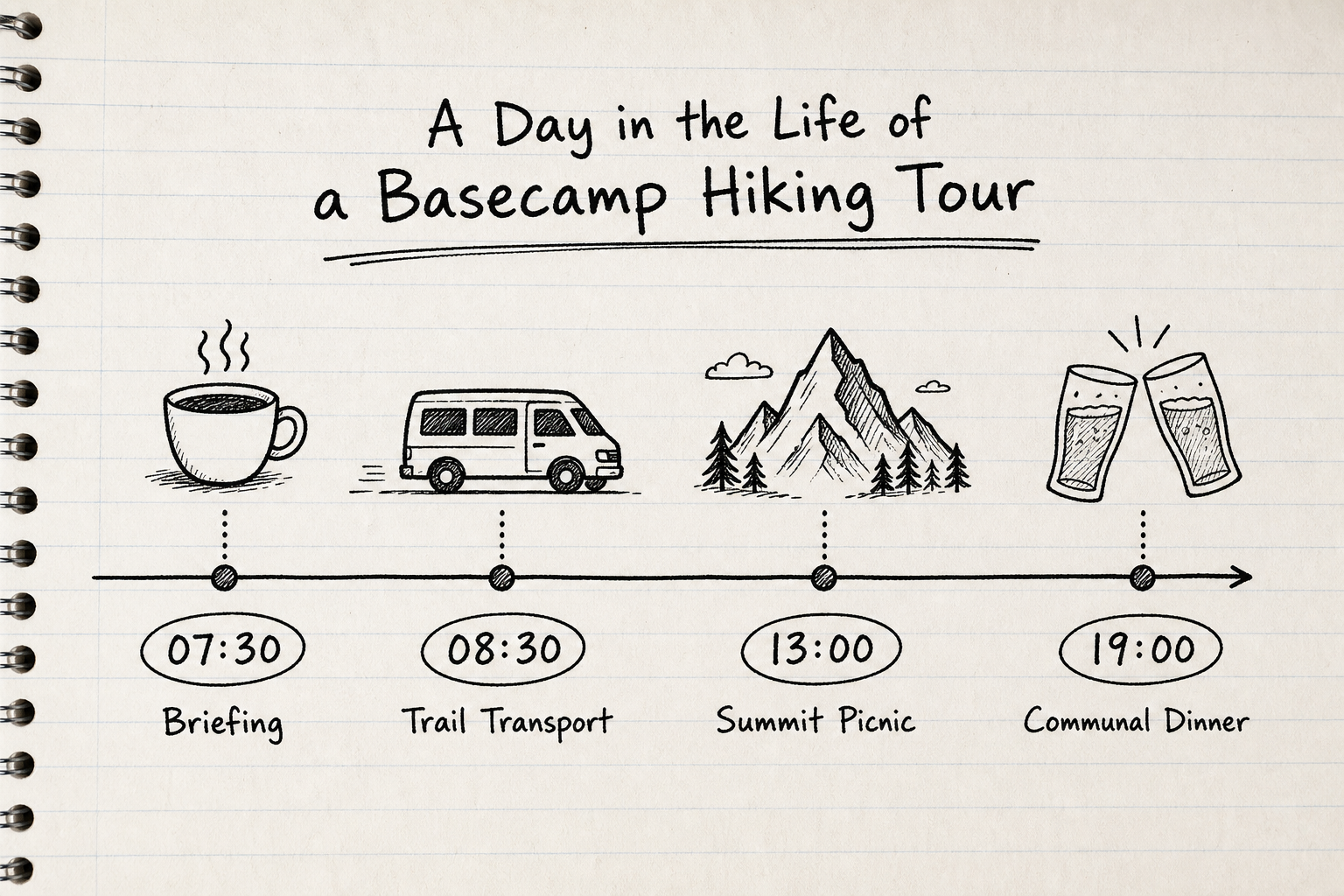
Here is what a typical day looks like on a Hiking Hostel summer trip:
07:30 - The Communal Breakfast
You wake up to the smell of fresh coffee and warm bread. The group gathers in the hostel dining room for a hearty Swiss breakfast—muesli, local cheeses, yogurt, and jams. The head guide gives a brief overview of the day’s trail, weather conditions, and what to pack in your daybag.
08:30 - The Stress-Free Departure
Instead of sprinting to a train station and deciphering a ticket machine, you simply step outside and load into the private transport vans. The logistics are entirely handled. You chat with your new friends as the van winds its way up a spectacular alpine valley toward the trailhead.
09:30 - Hitting the Trail
The hike begins. Depending on the group’s size and the chosen route, the guides might offer two pacing options: a faster group aiming for a higher col, and a moderate group taking a slightly lower, more relaxed path.
13:00 - The Summit Picnic
Around midday, the group converges at a scenic viewpoint—perhaps overlooking an azure glacial lake or a sweeping valley. You pull out the packed lunches provided by the hostel.
16:00 - The Apéro
After descending, the group makes a mandatory stop at a rustic mountain buvette (a small alpine tavern). You enjoy a cold local beer or an Rivella (a traditional Swiss soda) while taking your boots off and reflecting on the day’s elevation gain.
19:00 - Communal Dinner and Evening Social
Back at the basecamp, after a hot shower, the group gathers for a large, communal dinner. The atmosphere is loud, relaxed, and highly social. Stories are swapped, photos are air-dropped, and plans are made for the next day’s excursion.
The Anatomy of a Perfect Swiss Hiking Trail
Part of what makes guided hiking in Switzerland so enjoyable is the world-class trail infrastructure. However, for a solo hiker unfamiliar with the system, it can be intimidating. Guided tours remove the navigational anxiety, but it is still highly rewarding to understand the environment you are walking through.
Switzerland boasts over 65,000 kilometers of marked trails, known as the Wanderwege network. The Swiss Alpine Club (SAC) grades these trails meticulously to ensure hikers know exactly what they are getting into.
Understanding the Signage and SAC Scale
- Yellow Signs (T1): These are standard walking paths. They are generally flat, wide, and require no special footwear. You will often see local Swiss families pushing rugged strollers on these paths on Sundays.
- Red-White-Red Markers (T2/T3): These are mountain trails (Bergwanderwege). The terrain is uneven, steep in places, and requires proper hiking boots with good ankle support. This is where the vast majority of guided hiking holidays take place. You need a baseline of cardiovascular fitness and sure-footedness.
- Blue-White-Blue Markers (T4 to T6): These are alpine routes (Alpinwanderwege). They cross glaciers, snowfields, or exposed rock faces requiring the use of hands for scrambling. They often feature cables, chains, or ladders. Solo hikers should rarely attempt T4+ trails without extensive experience, making the presence of a certified guide invaluable if you want to push into higher altitudes.
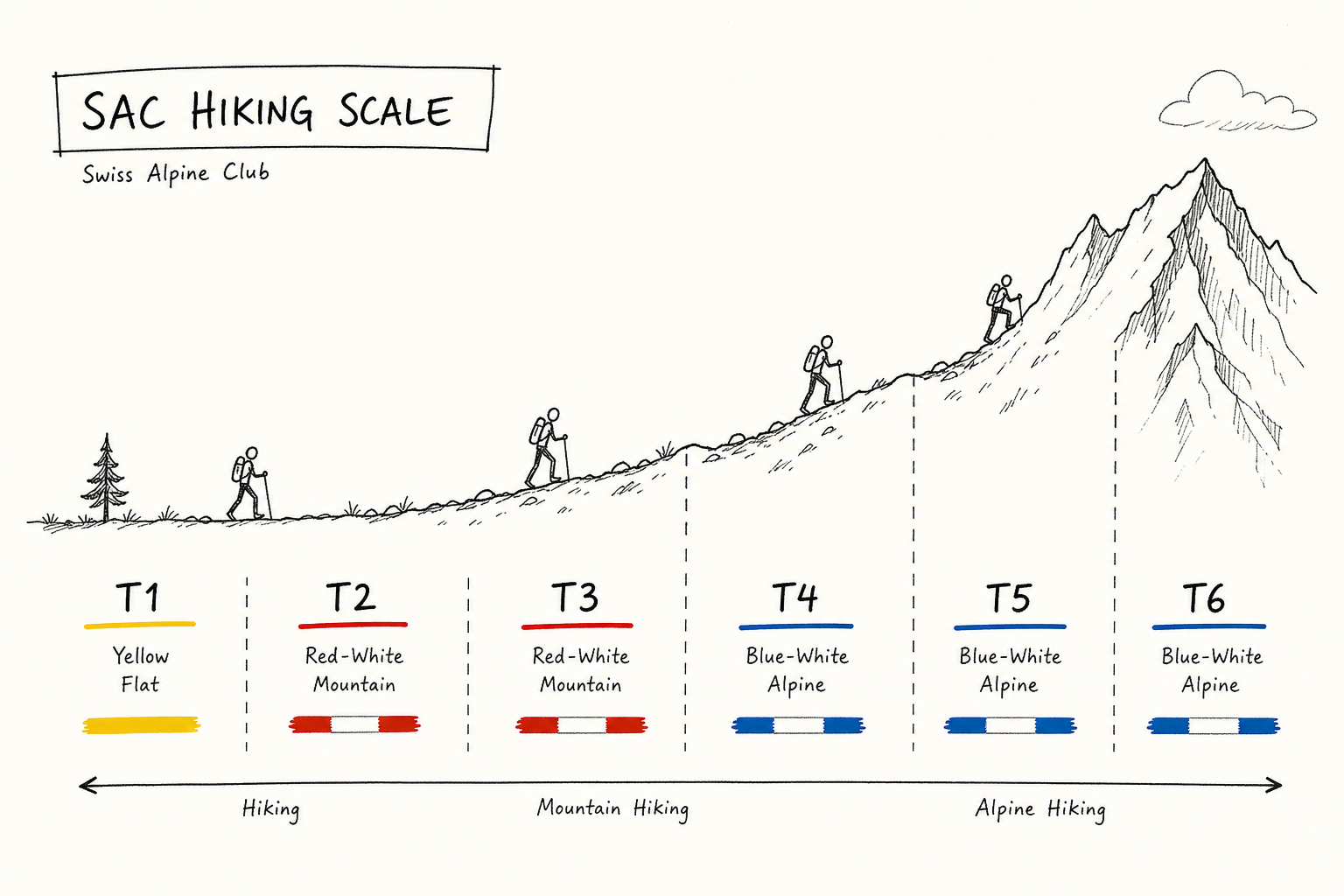
When you book a guided tour, the operators have already vetted the trails, monitored the seasonal rockfall risks, and checked the latest weather patterns. They know exactly which red-white-red trail will offer the best views without pushing the group into dangerous blue-white-blue territory.
Preparing for Your Swiss Hiking Holiday
Even though the logistics are handled, you still need to prepare physically and pack appropriately for a week in the Alps.
Physical Preparation
Do not underestimate the verticality of the Swiss Alps. Unlike hiking in the rolling hills of the UK or the older, rounded mountains of the Appalachians, Swiss trails go straight up. A typical moderate day hike might involve 800 to 1,200 meters (2,600 to 4,000 feet) of elevation gain.
To prepare, spend the months leading up to your trip focusing on stair climbing, lunges, and hiking local trails with a weighted backpack. Cardiovascular endurance is key, but eccentric leg strength (for the long, steep descents that famously burn out hikers’ knees) is equally critical. Just as you would prepare for a rigorous biking trip (see Find the Right Mountain Bike Group for Alpine Trails), finding your fitness baseline will make the holiday infinitely more enjoyable.
What to Pack: The Layering Principle
Alpine weather is notoriously fickle. You can start a hike in a t-shirt sweating under a blazing sun, and two hours later find yourself in a freezing, wind-whipped cloud at 2,500 meters.
The key to packing for the Alps is the layering system. You need a moisture-wicking base layer, an insulating mid-layer (like a fleece or lightweight down jacket), and a bombproof, waterproof hard shell to protect against sudden mountain squalls.
Do not overpack heavy, cotton clothing. For a comprehensive breakdown of exactly what to put in your duffel bag, review our Swiss Alps Summer: A Simple 5-Step Packing Guide.
Dietary Requirements and Alpine Food
Traditional Swiss alpine food is incredibly dense and designed to fuel manual laborers in cold weather. It relies heavily on potatoes, cheese, and cured meats. Think Rösti (a massive skillet of pan-fried grated potatoes, often topped with a fried egg and bacon), Fondue, and Älplermagronen (Swiss macaroni and cheese with applesauce).
While this is delicious after a long hike, navigating dietary restrictions (like veganism or severe gluten intolerance) in remote mountain huts can be a nightmare for a solo traveler who doesn’t speak French or German. A major benefit of joining a guided basecamp holiday is that the hostel staff and guides manage these dietary requirements in advance, ensuring you have proper, nutritious meals ready for you every day without the hassle of negotiating with a confused hut warden.