
Hiking Hostel vs Swiss Youth Hostels: a guide for solo hikers
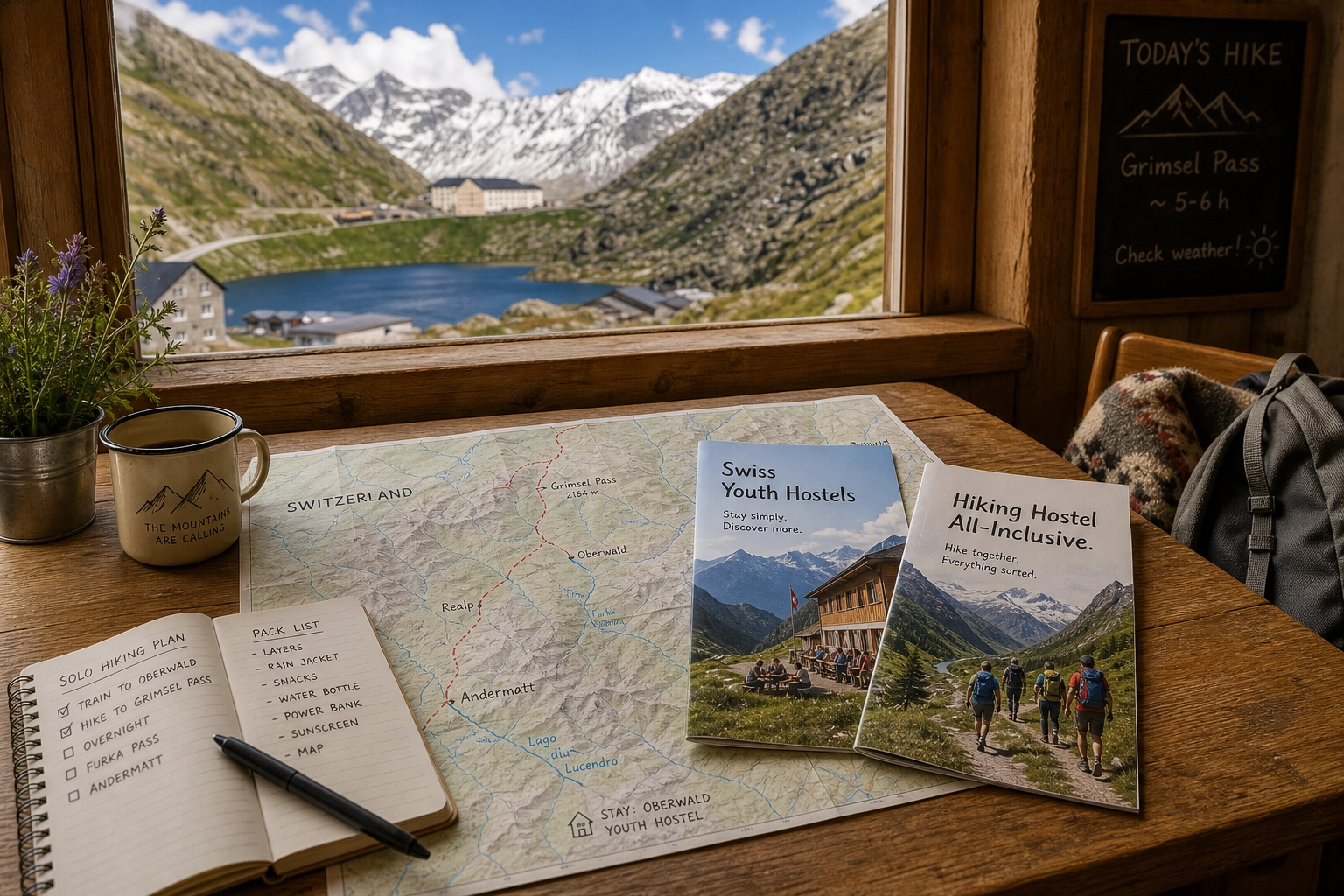
Landing at Geneva or Zurich airport, the sticker shock of the Swiss Alps hits almost immediately. A simple cappuccino costs $8, a standard train ticket to the mountains can rival a short-haul flight, and a basic hotel room easily clears $200 a night. For the budget-conscious solo traveler, backpacker, or digital nomad, the dream of a Swiss Alps hiking vacation often feels financially out of reach.
But hiking in Switzerland doesn’t require a luxury budget. The landscape is entirely accessible if you understand how to navigate the country’s accommodation and logistics systems. For solo hikers, the decision usually comes down to two distinct approaches: booking beds independently through the Swiss Youth Hostels network (a DIY approach) or joining a structured, all-inclusive basecamp experience like Hiking Hostel.
While both options serve the budget traveler, they offer wildly different experiences, hidden costs, and social dynamics. This guide breaks down the financial realities, logistical hurdles, and daily realities of choosing an independent hostel route versus an organized social hiking week.
The Solo Hiker’s Swiss Dilemma: DIY Logistics vs. Organized Basecamps
The traditional backpacker approach to Europe is highly independent: book a hostel, buy a train ticket, and figure out the daily itinerary on the fly. In countries with low costs of living, this flexibility is a massive asset. In Switzerland, improvisation is expensive.
When you buy last-minute train tickets in Switzerland, you pay a premium. When you decide to eat at a mountain hut because you forgot to pack a lunch, you pay a premium. When you realize the trailhead is a 45-minute bus ride from your hostel, you pay a premium.
This is the solo hiker’s dilemma. Do you trade time and mental energy for the perceived cheapness of independent travel, or do you lock in a fixed cost upfront for an organized package that eliminates logistical friction?
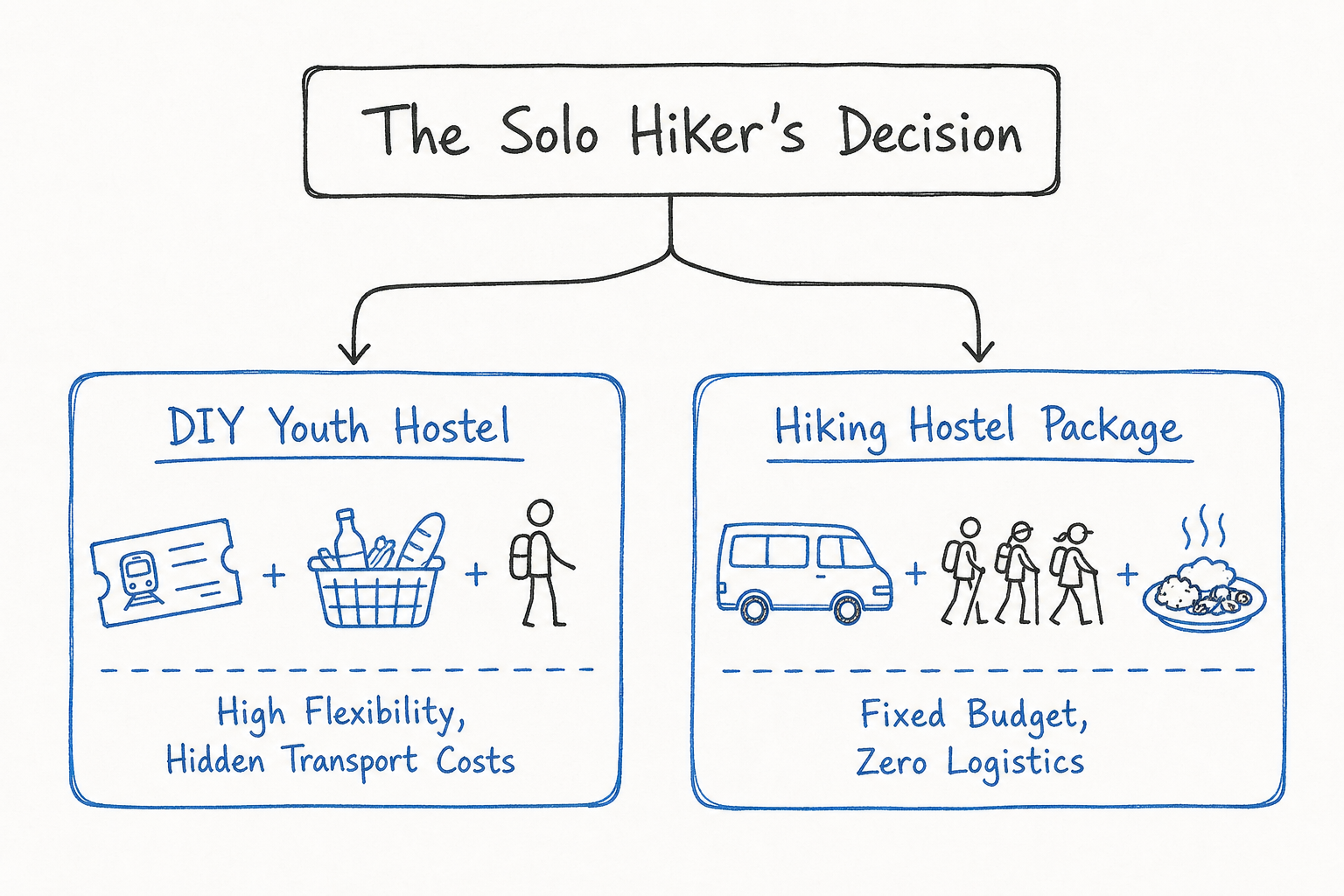
To make an informed decision, you have to look past the nightly bed rate and evaluate the total cost of the alpine experience: accommodation, food, trail transport, airport transfers, and the intrinsic value of community.
Swiss Youth Hostels: The Independent Backpacker’s Route
The Swiss Youth Hostels (Schweizer Jugendherbergen) network is famous worldwide for its high standards. Forget the grimy, party-centric hostels of Southeast Asia; Swiss hostels are clean, efficient, well-located, and often feature impressive modern architecture.
The Advantages of Independent Hosteling
- Ultimate Geographical Flexibility: With dozens of locations across the country, you can spend two days in Zermatt, three days in Grindelwald, and a weekend in St. Moritz. You are not tied to one region.
- Low Base Rate: A dorm bed in a Swiss Youth Hostel typically ranges from CHF 40 to CHF 70 per night, depending on the location and season. This is drastically cheaper than a traditional hotel.
- City and Mountain Access: The network includes major urban centers (Zurich, Bern, Geneva) and high-alpine resorts, allowing you to mix city tourism with mountain hiking.
The Hidden Frictions of the DIY Route
However, for a dedicated hiking trip, the Swiss Youth Hostel route introduces several challenges for solo travelers.
The Mixed Crowd: Youth hostels in Switzerland cater heavily to domestic school groups, families on budget holidays, and general tourists. You are just as likely to share a room with a family of four or a group of teenagers on a ski trip as you are with a fellow hiker. If you are a solo traveler looking to meet mountain partners for a difficult ridge hike, the youth hostel common room can be a difficult place to network.
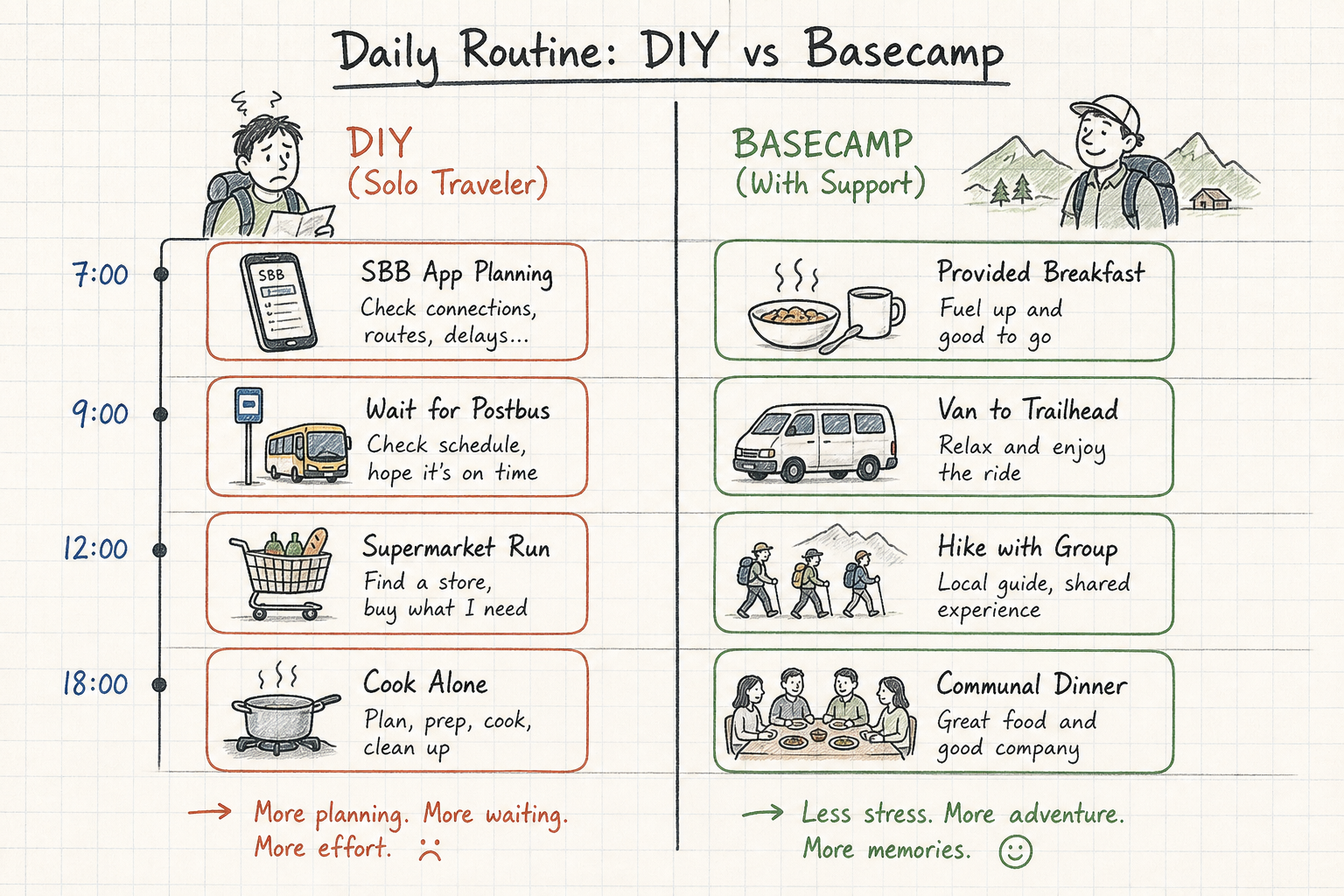
The Logistics Trap: Hostels provide a bed and a basic breakfast. Everything else is on you. You must research the trails, navigate the SBB (Swiss Federal Railways) app, walk or bus to the train station, take a train to the valley, and catch a Postbus to the trailhead. Each of these steps costs money and time.
The Food Cost: Self-catering is the only way to survive Switzerland on a budget. While hostels have kitchens, cooking for one person often leads to food waste, and you still have to navigate Swiss grocery store prices (Coop and Migros). After a 15-kilometer hike with 1,000 meters of elevation gain, fighting for stove space in a crowded hostel kitchen to boil pasta is rarely the highlight of the day.
Hiking Hostel: The All-Inclusive Social Basecamp
Hiking Hostel operates on a fundamentally different model. Rather than providing a transient bed for the night, it offers week-long summer hiking holidays built specifically for solo travelers, backpackers, digital nomads, and small groups. The core philosophy is the “social basecamp.”
Operating primarily out of hubs like Liddes (Valais) and St. Stephan, the model mirrors a ski chalet holiday, but tailored for summer hiking. Guests arrive on a set day, stay for a week, and experience the Alps as a cohesive group.
The Advantages of the Basecamp Model
- Fixed Budget Predictability: The upfront cost of a Hiking Hostel package includes hostel accommodation, all meals (breakfast, packed lunches for the trail, and dinners), airport transfers, daily transport to trailheads, and organized excursions. Once you pay for the week, your wallet stays in your backpack.
- Built-In Hiking Community: Every person staying at the lodge is there for the same reason: to hike the Alps. You don’t have to search for trail partners. The social friction is entirely removed. If you’re wondering how to connect with others, our guide on Guided Hiking in Switzerland: Finding Your Social Group explains why this shared-purpose environment is so effective for solo travelers.
- Zero Logistical Planning: You wake up, eat breakfast, grab your packed lunch, and jump in the provided transport. The routes are chosen based on the weather and the group’s ability. You bypass the complex Swiss public transport schedules entirely.
- Strategic Excursions: Basecamps allow for flexibility. If the weather in the Swiss Alps turns sour, the transport vans can pivot. Packages often include excursions to nearby regions, such as crossing the border for Italian culture. For example, if you want a change of pace, you might experience something similar to our Skiing in the Italian Alps? Try This Aosta Day Trip (adapted for summer hiking and culture).
The Trade-offs
The primary trade-off is geographical permanence. You are based in one region (like Valais or the Bernese Oberland) for the week. While these regions offer endless trails, you won’t be doing a whirlwind tour of five different Swiss cantons. For serious hikers, however, this hub-and-spoke model is actually an advantage, allowing for deep exploration of a specific mountain range rather than spending half the trip looking out of a train window.
Head-to-Head Cost Breakdown: A Week in the Alps
To truly understand the value proposition, we have to run the numbers. Let’s compare a 7-day DIY trip staying at a standard Swiss Youth Hostel versus a 7-day all-inclusive package with Hiking Hostel.
Note: Prices are estimates based on average summer high-season rates in Swiss Francs (CHF). 1 CHF is roughly equivalent to 1.15 USD or 1.05 EUR.
Scenario A: DIY Swiss Youth Hostel (7 Days)
- Accommodation (Dorm Bed): 7 nights @ CHF 55/night = CHF 385
- Food (Breakfast): Included at most youth hostels = CHF 0
- Food (Lunch on the trail): Supermarket sandwiches/snacks, 7 days @ CHF 15 = CHF 105
- Food (Dinner): Mix of hostel cooking and basic restaurants, 7 days @ CHF 30 = CHF 210
- Airport Transfer: Round-trip train from Geneva/Zurich to a mountain town = CHF 120 (assuming Half-Fare Card or Super Saver tickets)
- Daily Trail Transport: Postbuses and local trains to/from trailheads, 6 days @ CHF 20 = CHF 120
- Cable Cars/Gondolas: 2 rides for high-alpine access = CHF 60
- Swiss Half-Fare Card: Required to get the above transport prices = CHF 120
- Total Estimated Cost: CHF 1,120
Scenario B: Hiking Hostel Package (7 Days)
- Accommodation: Included
- Food (Breakfast, Packed Lunch, Dinner): Included
- Airport Transfer: Included
- Daily Trail Transport: Included via private vans
- Organized Excursions: Included
- Total Estimated Cost: Packages typically range from CHF 800 to CHF 1,050 depending on the specific week and room type (dorm vs private).
The Verdict on Cost
When budget-conscious travelers look only at the nightly rate, the DIY route seems cheaper. But when you factor in the “Swiss Premium” on food, trains, and mandatory transport passes, the all-inclusive package is not just competitive—it is often significantly cheaper. More importantly, it insulates you from budget blowouts. If you miss a bus on a DIY trip and have to take a taxi, you could lose CHF 80 in ten minutes. In a package model, your transport is guaranteed.
For more general advice on keeping costs down regardless of your choice, read our 7 Tips for Hiking in Switzerland (Without the High Cost).
Trail Access and Logistics: Getting to the Mountains
The Swiss public transport network is arguably the best in the world. Trains run with clockwork precision, and yellow Postbuses navigate terrifyingly narrow mountain roads to drop hikers at remote alpine passes. But utilizing this system requires constant active management.
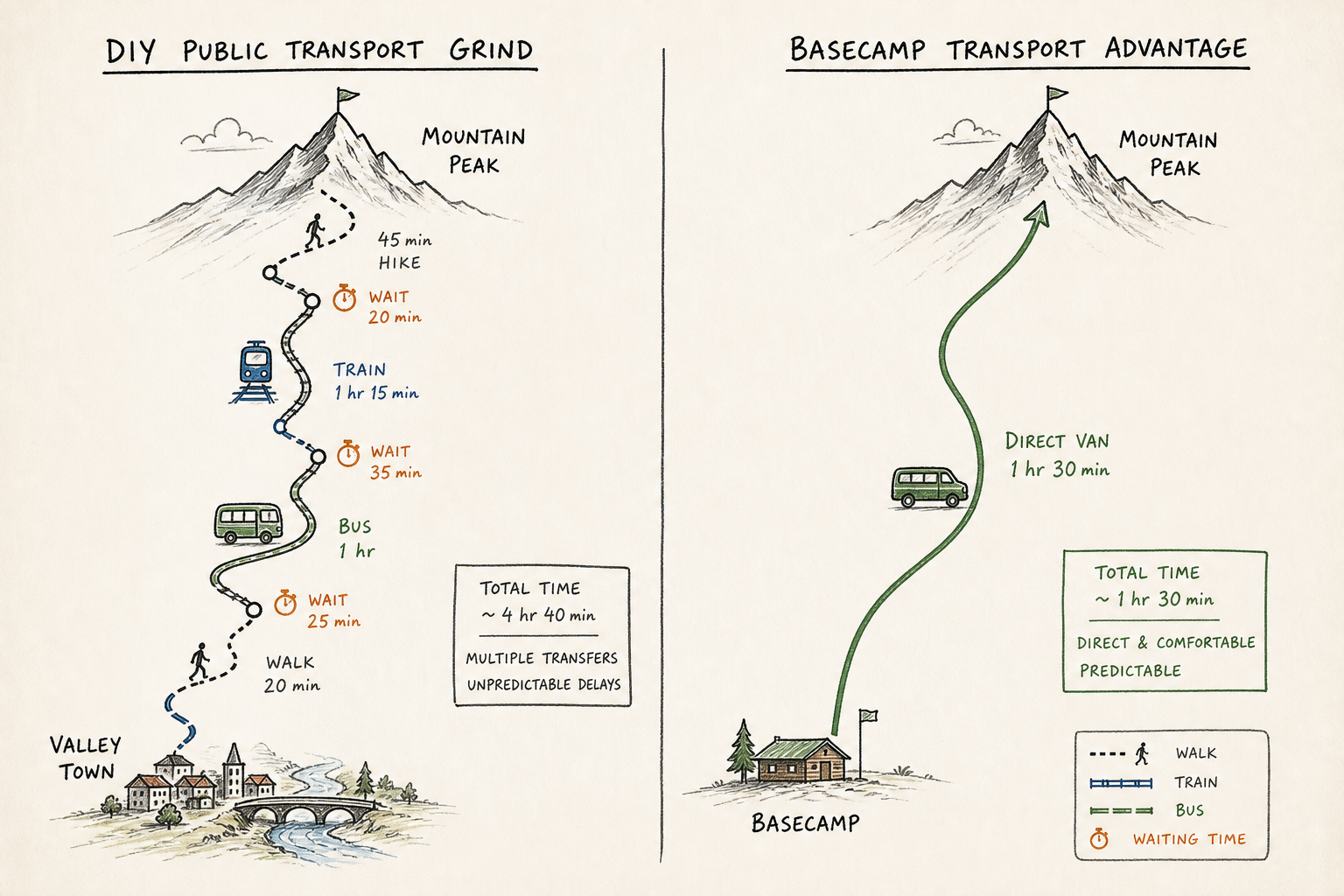
The DIY Public Transport Grind
If you are staying at an independent youth hostel in a valley town (like Interlaken or Sion), your morning looks like this:
- Wake up and check the SBB app.
- Walk 15 minutes to the main train station.
- Take a 30-minute train to a smaller village.
- Wait 15 minutes for a Postbus.
- Ride the bus for 40 minutes up a winding road to the trailhead.
This process is reliable, but it eats up 1.5 to 2 hours of your morning and requires precise timing. If you miss the 16:30 bus down from the mountain at the end of the day, the next one might not be until 18:30.
The Basecamp Transport Advantage
With a Hiking Hostel package based in hubs like Liddes or St. Stephan, the logistics are centralized. Because the staff knows the trails and the current conditions, they handle the routing.
You load into a private van after breakfast and are driven directly to the trailhead. This cuts transit time in half, allowing for longer hikes and more time resting. Furthermore, private transport allows access to trailheads that are poorly serviced by public buses. At the end of the day, the van is waiting for you. You can leave a change of shoes or an extra layer in the vehicle—a luxury independent backpackers don’t have.
Top Budget-Friendly Hiking Trails and Excursions
Whether you are navigating independently or exploring out of a Hiking Hostel basecamp, the Swiss Alps offer unparalleled trail infrastructure. Choosing regions like Valais or the areas around Mont Blanc allows you to experience massive glaciers and jagged peaks without the premium pricing of Zermatt or St. Moritz.
Here is a look at the caliber of trails accessible to budget-conscious hikers.
1. Evolène and the Valais Region
Valais is a hiker’s paradise, offering some of the highest peaks in the Alps, dry weather, and a vast network of trails. It is far less commercialized than the Jungfrau region, making it ideal for budget travelers.
A classic route in this region is the Alpine Passes Trail, Stage 25: Becs de Bosson Hut – Evolène. This spectacular descent takes you from the high-alpine environment of the Cabane des Becs de Bosson down into the traditional wooden village of Evolène. The trail offers sweeping views of the Pennine Alps. Doing this independently requires a steep cable car fee or a massive hike up just to start, whereas organized groups can often coordinate efficient drop-offs to maximize the high-altitude experience.
2. The Saas Valley (The Pearl of the Alps)
Adjacent to Zermatt is the Saas Valley (Saastal). It features 4,000-meter peaks and massive glaciers but operates at a slightly lower price point than its famous neighbor.
The hike from Längfluh to Saas-Fee is a remarkable descent trail. Starting at the foothills of the Fee Glacier, the path leads along leisurely terrain directly back into the car-free village of Saas-Fee. It allows you to get up close to glacial ice without requiring technical mountaineering equipment. Again, accessing Längfluh requires a cable car, which is where independent hikers need to budget carefully.
3. Aletsch Glacier Views (Bettmeralp)
The Great Aletsch Glacier is the largest in the Alps, a river of ice that must be seen to be believed. Accessing it from the Rhone Valley is straightforward via cable car.
The Bettmerhorn - Blausee - Riederalp route is a masterclass in Swiss hiking infrastructure. The trail winds past alpine lakes with constant views of the glacier. Note that Riederalp and Bettmeralp are car-free zones. You must take a cable car up from the valley floor. If you are staying at a youth hostel in the valley, factor this into your daily budget.
4. Engadin / St. Moritz Region
While St. Moritz is synonymous with luxury, the hiking trails surrounding it are free and spectacular. If you manage to find budget accommodation in the region, the high-altitude trails are unmatched.
The Corvatsch-Hahnensee classic route offers incredible visibility. On clear days, the panoramic views stretch for hundreds of kilometers, taking in the dramatic lakes of the Upper Engadin.
5. The Mont Blanc Massif
While Mont Blanc itself is in France, the massif spans the borders of France, Italy, and Switzerland. Many hikers base themselves in Switzerland and take excursions into the Chamonix valley or hike the Swiss stages of the Tour du Mont Blanc (TMB).
Hiking in this region provides dramatic, granite-spire scenery. For those looking to manage costs, utilizing budget shuttle buses between villages and trailheads is essential. If you are based in a hub like Liddes, excursions to the Mont Blanc region are incredibly easy.
For specific trail recommendations in this cross-border area, check out our guide to the 5 Best Hiking Trails in Switzerland Near Mont Blanc and Mountain Mont Blanc: 7 Ways to Visit Without the Crowd.
The Social Factor: Surviving the “Solo Slog”
One of the most overlooked aspects of a budget hiking trip is mental fatigue and loneliness. Hiking solo is an incredible, meditative experience, but coming back to a silent dorm room or eating dinner alone in a corner every night for a week can drain your enthusiasm.
The Youth Hostel Lottery
At a standard Swiss Youth Hostel, social interaction is a lottery. You might strike up a conversation with a fellow hiker in the kitchen, or you might be surrounded by a high school volleyball team on a retreat. Because everyone is on their own independent itinerary, coordinating a hike together for the next day is rare. People are heading in different directions, on different trains, at different times.
The Hiking Hostel Community
This is where the “social lodge” concept truly beats the DIY approach. When you book a week at a Hiking Hostel, you are opting into a community.
- Shared Meals: Dinner is the great equalizer. Sitting down at a long table with 15 other hikers to eat a hearty meal, drink a beer, and recount the day’s elevation gain builds immediate camaraderie.
- Trail Safety: Hiking in a group provides a massive safety net in alpine environments. If you twist an ankle on a rocky descent, you have immediate support.
- Skill Sharing: Groups naturally self-segregate by pace and ambition. Hardcore trail runners will group up for a 20km epic, while digital nomads looking for a relaxed scenic walk will form a slower group. You always have a hiking partner who matches your energy level.
For more on why this communal approach is superior to booking a lonely Airbnb or standard hotel, read Hotels in Swiss Mountains? Why Social Lodges Beat Luxury.
Food on the Mountain: Avoiding the “Swiss Premium”
Food will be your second highest expense after accommodation if you are not careful. A simple plate of Rösti or a bowl of soup at a mountain hut (Cabane/Hütte) can easily cost CHF 25.
The DIY Food Strategy
If you are hosteling independently, your primary resource is the local Coop or Migros supermarket.
- Breakfast: Eat heavily at the hostel buffet (bread, cheese, muesli, coffee).
- Lunch: Buy a fresh baguette, some local Gruyère cheese, salami, and an apple. Pack this in your daypack.
- Dinner: Buy pasta, canned tomatoes, and a cheap protein. Cook in the hostel kitchen.
This method works, but it takes time. You have to shop daily because hostel fridge space is notoriously tiny, and food theft (accidental or otherwise) is a universal hostel reality.
The Basecamp Food Strategy
In an all-inclusive setup, the mental load of food prep is gone.
- Breakfast: A robust buffet is laid out before the morning departure.
- Lunch: Ingredients for packed lunches are provided. You build your sandwich and pack your snacks before getting in the van.
- Dinner: A hot, communal meal is cooked for the group.
Not only does this save money, but it saves precious evening hours that are better spent resting, socializing, or reviewing the map for tomorrow’s hike.
Packing for a Hostel-Based Alps Trip
Whether you choose an independent hostel tour or a fixed basecamp, packing correctly is vital. Because you are returning to a base each night (rather than carrying all your gear over mountain passes like you would on a hut-to-hut trek), you can afford to bring a few more comforts, but you still need to be strategic.
The Daypack System:
You will need a sturdy 20-30L daypack. Since you aren’t carrying a sleeping bag or tent, this bag only needs to hold your waterproofs, extra insulating layers, packed lunch, 2 liters of water, and a first aid kit.
Layering:
The Swiss Alps in summer can be 25°C (77°F) in the valley and near freezing with high winds on a ridge just a few hours later.
For a comprehensive breakdown of exactly what to put in your suitcase and your daypack, consult our guide: Swiss Alps Summer: A Simple 5-Step Packing Guide.
Alternative Approaches: What About Hut-to-Hut Hiking?
Many budget travelers dream of hiking from mountain hut to mountain hut (like the Haute Route or the Tour du Mont Blanc). While this is a profound experience, it is surprisingly difficult to do on a strict budget.
Mountain huts (Cabanes/Hütten) charge for half-board (bed, dinner, breakfast). While Alpine Club members get a discount on the bed, the meals are expensive due to the cost of flying food in via helicopter. A night in a hut generally costs between CHF 75 and CHF 95. Over a week, this adds up fast, and there are no supermarkets in the high alpine to offset costs with self-catering.
If you are determined to try this, it requires meticulous planning months in advance. We break down the logistics and budgeting in our guide on How to Plan Hut to Hut Hiking in Switzerland (7 Tips).
For most budget-conscious solo travelers, a valley basecamp (youth hostel or Hiking Hostel) combined with aggressive day hikes into the high alpine offers 90% of the scenic reward for a fraction of the cost and stress.
Frequently Asked Questions (FAQ)
Is the Swiss Travel Pass worth it for a hiking trip?
If you are doing a DIY youth hostel trip where you move towns every two days, yes. The Swiss Travel Pass covers trains, buses, and boats across the country. However, if you are staying in one region for a week to hike, it is rarely worth the high upfront cost. A Half-Fare Card (which gives you 50% off all tickets) is almost always the mathematically superior choice for basecamp hikers. If you book a Hiking Hostel package, you may not need a pass at all, as daily trail transport is included.
Do I need to be an expert hiker to join a Hiking Hostel week?
No. Because it is a hub-and-spoke model with private transport, excursions can be tailored. While a baseline of cardiovascular fitness is required to enjoy the Alps, the presence of a group means you can opt for moderate valley trails while others tackle steep summits. (This dynamic is similar to finding a Mountain Bike Group for Alpine Trails, where different skill levels can coexist out of the same basecamp).
Can I drink the tap water in Swiss hostels?
Yes. Switzerland has some of the cleanest tap water in the world, often fed directly from alpine springs. Never buy bottled water. Bring a reusable Nalgene or hydration bladder and fill it at your hostel and at the ubiquitous village fountains (unless marked Kein Trinkwasser).
Verdict: Which Budget Option is Right for You?
The choice between a DIY Swiss Youth Hostel trip and an organized Hiking Hostel package comes down to what you value most: geographical wandering or frictionless alpine immersion.
Choose the independent Swiss Youth Hostel route if:
- Your primary goal is city-hopping (Zurich, Bern, Geneva) with only a few days of light hiking mixed in.
- You thrive on spontaneous itinerary changes and don’t mind spending 1-2 hours a day managing transport logistics.
- You prefer to be alone in the evenings and are comfortable navigating the complexities of Swiss supermarkets to save money.
Choose the Hiking Hostel basecamp package if:
- Your primary goal is aggressive, daily mountain hiking in the high Alps.
- You are a solo traveler, backpacker, or digital nomad who wants a built-in community of like-minded outdoor enthusiasts.
- You want absolute budget certainty. You want to pay one price and know that your bed, your meals, and your trail transport are completely covered.
- You want to spend your evenings drinking a beer and recounting the trail, rather than staring at a train schedule and boiling pasta in a crowded kitchen.
Switzerland will never be the cheapest country in Europe to explore, but it remains one of the most spectacularly rewarding. By understanding the true costs of logistics, food, and accommodation, you can build a budget-conscious hiking vacation that delivers all of the alpine majesty with none of the financial stress. Let the mountains take your breath away, not the price tags.