
5 Best Self-Guided Hut to Hut Alps Hiking Tours for 2026
Booking a fully guided alpine trek often means paying a premium for a strict itinerary, marching at the pace of the slowest group member, and missing the spontaneous moments that make the mountains so compelling. If the 2025 trekking season taught us anything, it’s that the heavy infrastructure of large tour groups is increasingly out of sync with what modern hikers actually want: flexibility, autonomy, and an authentic connection to the trail.
For 2026, self-guided hut-to-hut hiking is the definitive way to experience the Alps. You handle your own navigation and pace, but your evenings are still secured in high-altitude cabanes or rifugios offering hot meals and a warm bed. It is the perfect middle ground between carrying a 40-pound tent setup and paying thousands for a commercially guided walk.
But a self-guided tour requires meticulous planning. The mountain huts book up months in advance, navigating the varying terrain requires solid preparation, and finding the right route for your skill level is critical.
Whether you are using a community hub like Ski Hostel in Liddes as your basecamp or tackling a continuous two-week traverse, here are the five best self-guided hut-to-hut alps hiking tours for 2026, along with the operational details you need to pull them off.
The Self-Guided Mindset: Autonomy with a Safety Net
Before diving into the routes, it is important to define what “self-guided” actually means in the context of the Alps.
You are not surviving in the wilderness; you are walking through a highly developed alpine infrastructure. The trails are waymarked (usually with red-and-white or blue-and-white paint), the huts provide half-board (dinner and breakfast), and you pass through mountain villages every few days.
However, you are the project manager of your hike. You are responsible for:
- Micro-navigation: Knowing when to deviate from the main path if a high pass is snowed in.
- Pacing: Managing your daily vertical ascent so you arrive at the hut before dinner is served (usually precisely at 6:30 PM or 7:00 PM).
- Weather Management: Making the call to wait out an afternoon thunderstorm rather than pushing over an exposed col.
If you prefer having someone else make those decisions but still want a highly social experience, consider reviewing our thoughts on Guided Hiking in Switzerland: Finding Your Social Group. But if you are ready to take the reins, let’s look at the premier routes for the upcoming season.
1. Tour du Mont Blanc (TMB): The Essential Tri-Country Loop
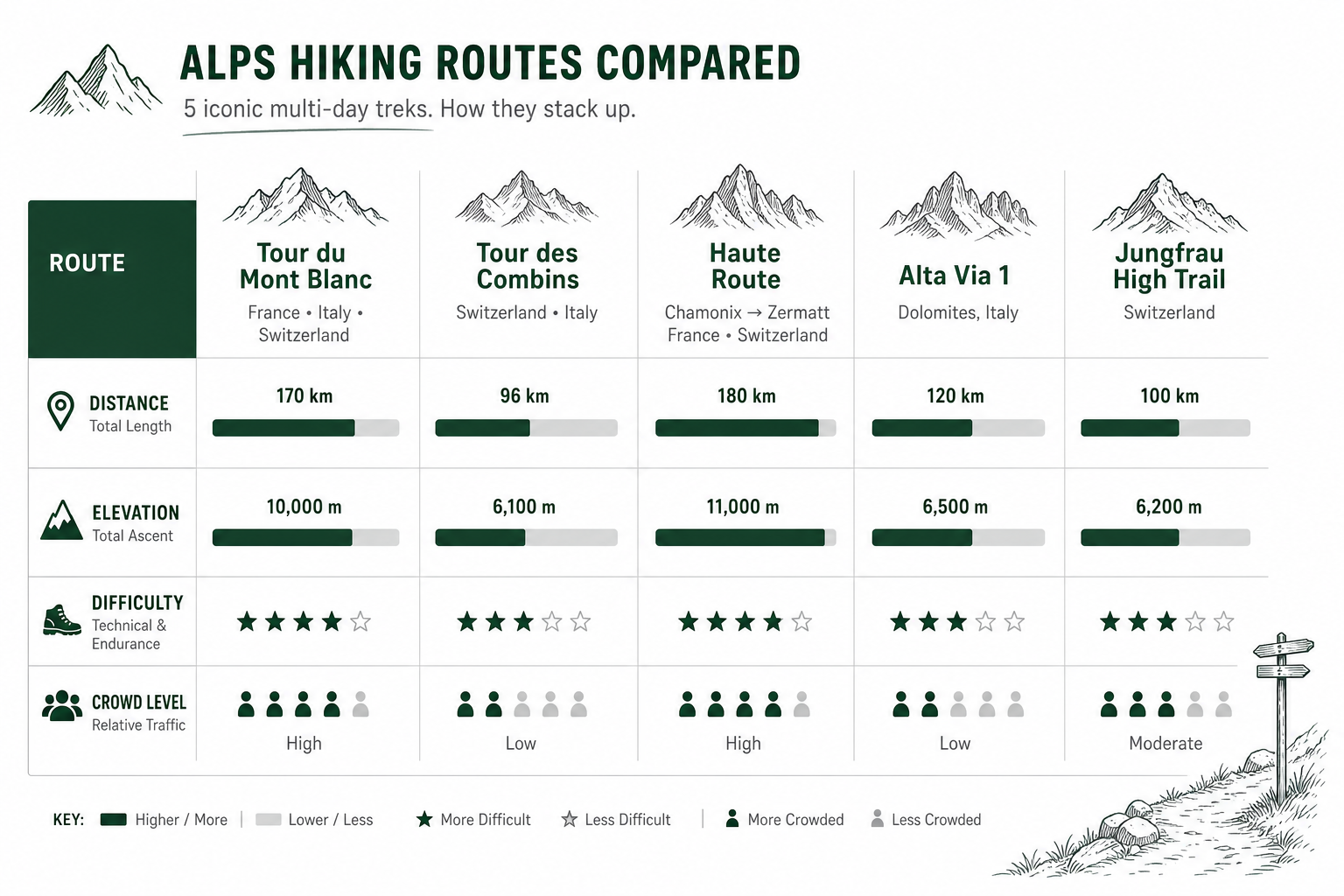
The Tour du Mont Blanc is the most famous long-distance trail in Europe for a reason. Circumnavigating the Mont Blanc massif, this 170-kilometer route takes you through France, Italy, and Switzerland.
Because of its popularity, the TMB is exceptionally well-suited for self-guided hikers. The trail is unmistakable, the infrastructure is world-class, and if you sprain an ankle, you are rarely more than a few hours from a valley floor with bus access.
- Distance: ~170 km (105 miles)
- Total Elevation Gain: ~10,000 meters (32,800 feet)
- Typical Duration: 9 to 11 days
- Difficulty: Moderate to Strenuous. The trail is technically straightforward but demands high cardiovascular endurance.
- Best Window: Late June to mid-September
Why it Makes the 2026 List
The TMB is timeless, but navigating the crowds has become an art form. Doing this route self-guided allows you to utilize off-cadence pacing. While the massive commercial groups leave the huts at 8:00 AM, you can leave at 6:30 AM or 9:30 AM to walk in solitude. For those wanting to dodge the main bottlenecks entirely, see our guide on the Mountain Mont Blanc: 7 Ways to Visit Without the Crowd.
Self-Guided Failure Mode: Booking Too Late
The single biggest mistake self-guided hikers make on the TMB is waiting until March to book huts for a July hike. For the 2026 season, you need to be finalizing your reservations by November or December of 2025. If you miss the window, consider basing yourself at a valley lodge and doing day-hits using public transit—we outline several nearby options in 5 Best Hiking Trails in Switzerland Near Mont Blanc.
2. Tour des Combins (TDC): The Quiet Swiss-Italian Alternative
If the Tour du Mont Blanc is a blockbuster movie, the Tour des Combins is the critically acclaimed indie film next door. Circling the Grand Combin massif (4,314m), this roughly 100-kilometer trek crosses between the Swiss Val de Bagnes and the Italian Aosta Valley.
Crucially for our community, this route passes right through the Liddes region, making it an incredible option for hikers staging out of Ski Hostel.
- Distance: ~103 km (64 miles)
- Total Elevation Gain: ~6,000 meters (19,600 feet)
- Typical Duration: 6 to 7 days
- Difficulty: Strenuous. The terrain is rougher and more remote than the TMB.
- Best Window: July to early September
Why it Makes the 2026 List
As the major trails become saturated, the TDC remains refreshingly raw. You will encounter suspension bridges (like the dramatic Corbassière bridge), cross high cols overlooking massive glaciers, and interact with authentic, family-run huts rather than the 100-bed dormitories common on the bigger routes. Because it borders Italy, you can easily experience the cultural contrast of a Swiss Rösti dinner one night and an Aosta Valley polenta the next (a dynamic we explore further in Skiing in the Italian Alps? Try This Aosta Day Trip for our winter guests).
Self-Guided Failure Mode: Underestimating the Terrain
The TDC has sections of steep, loose scree and narrow balcon paths. Self-guided hikers who assume it is just a “shorter TMB” often find themselves intimidated by the exposure. Bring trekking poles and ensure your footwear has an aggressive tread.
3. The Walker’s Haute Route: Chamonix to Zermatt
Connecting two of the most iconic mountain towns in the world—Mont Blanc in Chamonix and the Matterhorn in Zermatt—the Haute Route is the crown jewel of high-alpine trekking.
Unlike the TMB, the Haute Route does not circle a single massif; it is a linear journey cutting eastward across the grain of the Alps. This means you are constantly climbing out of deep valleys, crossing high passes, and descending into new linguistic and cultural zones.
- Distance: ~200 km (125 miles)
- Total Elevation Gain: ~12,000 meters (39,000 feet)
- Typical Duration: 12 to 14 days
- Difficulty: Very Strenuous. Significant daily elevation changes and several boulder-strewn pass crossings.
- Best Window: Mid-July to early September
Why it Makes the 2026 List
The Walker’s Haute Route is the ultimate test of a self-guided hiker’s fitness and logistics management. It requires stringing together French and Swiss transit, multiple accommodation styles, and demanding daily distances. The route passes directly through the Val de Bagnes, offering a perfect opportunity to build in a rest day. Taking a “zero day” midway through at a place like Ski Hostel allows you to do laundry, sleep in a real bed, and eat something other than hut food before tackling the grueling second half toward Zermatt.
Self-Guided Failure Mode: Ignoring Snowpack Reports
Early-season hikers (late June/early July) routinely get stopped by hard, icy snowpack on the higher passes (like the Fenêtre d’Arpette or Col de Prafleuri). As a self-guided hiker, you lack a guide to safely short-rope you across. You must monitor local SwissTopo reports and be willing to reroute via valley buses if a pass is unsafe.
4. Alta Via 1 (AV1): The Heart of the Dolomites
While our home base is the Swiss Alps, any definitive list of European hut-to-hut tours must include the Italian Dolomites. The Alta Via 1 is the most accessible and visually stunning of the Dolomite high routes, running roughly north to south from Lago di Braies to Belluno.
- Distance: ~120 km (75 miles)
- Total Elevation Gain: ~7,300 meters (24,000 feet)
- Typical Duration: 8 to 10 days
- Difficulty: Moderate. (The AV1 intentionally avoids the highly technical via ferrata cables that characterize other Alta Via routes, though there are a few cable-assisted walking sections).
- Best Window: Late June to late September
Why it Makes the 2026 List
The Dolomites offer a completely different geological experience compared to the glaciated peaks of Switzerland. The towering, sheer limestone spires turn bright pink and orange at sunset (the famous enrosadira). The Italian rifugios on the AV1 are also famous for their incredible culinary standards—expect three-course dinners featuring fresh pasta, local wines, and espresso that rival high-end valley restaurants.
Self-Guided Failure Mode: Water Management
Unlike the Swiss Alps, where glacial runoff provides abundant streams for filtering water, the porous limestone of the Dolomites means surface water is rare. Self-guided hikers frequently fail to carry enough water capacity, not realizing they must purchase or fill up all their daily water directly at the huts before departing.
5. Tour of the Jungfrau Region
For a deeply classic Swiss experience, the Tour of the Jungfrau Region provides an immersion into the postcard version of the Alps: deep green valleys, cowbells, wooden chalets, and the towering ice walls of the Eiger, Mönch, and Jungfrau.
- Distance: ~110 km (68 miles)
- Total Elevation Gain: ~9,000 meters (29,500 feet)
- Typical Duration: 9 to 10 days
- Difficulty: Moderate to Strenuous.
- Best Window: July to September
Why it Makes the 2026 List
The Jungfrau region boasts some of the most comprehensive public transport in the world. If you twist a knee or a storm rolls in, you are rarely far from a gondola, funicular, or yellow PostBus. This makes it a remarkably forgiving route for first-time self-guided hikers who want dramatic scenery but with multiple “bailout” options. It is also an area where careful planning can save you a fortune—a philosophy we heavily advocate in 7 Tips for Hiking in Switzerland (Without the High Cost).
Self-Guided Failure Mode: Over-Packing
Because the terrain feels close to civilization, hikers tend to over-pack for this route, bringing heavy town clothes and electronics. Every extra kilogram destroys your knees on the relentless 1,500-meter descents into Lauterbrunnen or Grindelwald. Keep your pack under 8kg (17 lbs) base weight.
The Basecamp Strategy: A Smart Alternative to Traditional Hut-to-Hut
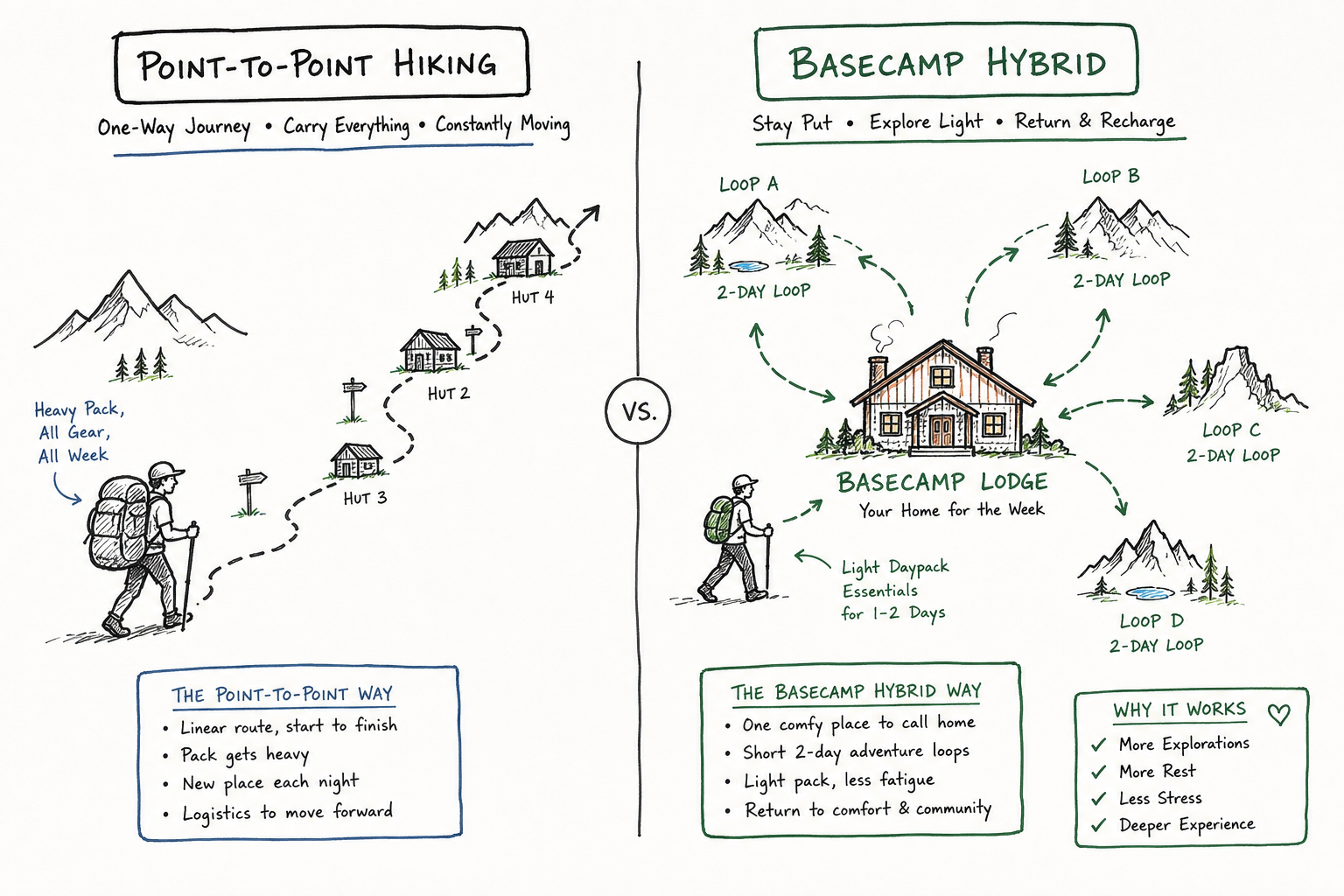
While point-to-point hut hiking is romantic, it has drawbacks. You carry everything for a week or more, you risk sleeping in hot, snoring dormitories every single night, and if it rains for three days straight, you are stuck walking in the mud with nowhere to dry your gear.
An increasingly popular model for 2026 is the Basecamp Hybrid.
Instead of a continuous 10-day point-to-point, you book 7-10 days at a community-focused lodge. From there, you launch into 2- or 3-day “mini hut-to-hut” excursions, returning to your basecamp in between.
Benefits of the Basecamp Model:
- Lighter Packs: You leave your laptop, travel clothes, and extra toiletries in a secure locker at the hostel. You hike to the high huts carrying only a 20L daypack with your sleep sack, toothbrush, and layers.
- Weather Flexibility: If a massive thunderstorm is predicted, you simply stay at the basecamp, work remotely on high-speed Wi-Fi, join a communal BBQ, and delay your hut trip by a day.
- Community: Long-distance hiking can actually be quite lonely if you aren’t with a group. Returning to a social hub allows you to swap stories, share meals, and find partners for the next leg.
This exact model is why many of our guests choose to stage their adventures with us. To see why this setup is often superior to traditional lodging, read Hotels in Swiss Mountains? Why Social Lodges Beat Luxury.
Tactical Planning Framework for 2026
If you are committed to the self-guided route, you must treat your logistics like a project manager. Use this timeline to ensure you aren’t left sleeping on a dining room floor (which huts will make you do if you arrive without a reservation).
Phase 1: November - January (The Booking Window)
- Lock in the Route: Decide on your exact dates and daily stages.
- Book the Huts: Use portals like Mon Refuge (France) or the Swiss Alpine Club (SAC) website to secure your beds. Popular huts on the TMB and Haute Route sell out weekend dates by January.
- Join an Alpine Club: Consider joining the Swiss, French, or Austrian Alpine Club. Membership often grants a 20-50% discount on hut nights, which pays for itself in just three days. For more on this, check out How to Plan Hut to Hut Hiking in Switzerland (7 Tips).
Phase 2: March - May (Training and Gear)
- Vertical Training: Stop focusing purely on distance. Hut-to-hut hiking is about elevation. You need to be comfortable climbing 1,000 meters (3,200 ft) in a single morning. Use stair climbers, stadium stairs, or local steep trails with a weighted pack.
- System Refinement: Dial in your gear. The alps are infamous for “four seasons in a day.” You need a lightweight, highly efficient kit. If you are unsure where to start, read our Swiss Alps Summer: A Simple 5-Step Packing Guide.
Phase 3: June (Final Logistics)
- Download Offline Maps: Download your GPS tracks on apps like SwissTopo (the gold standard for Switzerland), Fatmap, or Gaia GPS. Do not rely entirely on cell service, especially on the Tour des Combins or Haute Route.
- Transport Booking: Finalize your train tickets from the airport (Geneva or Zurich) to your trailhead using the SBB app.
Essential Gear for the Self-Guided Hiker
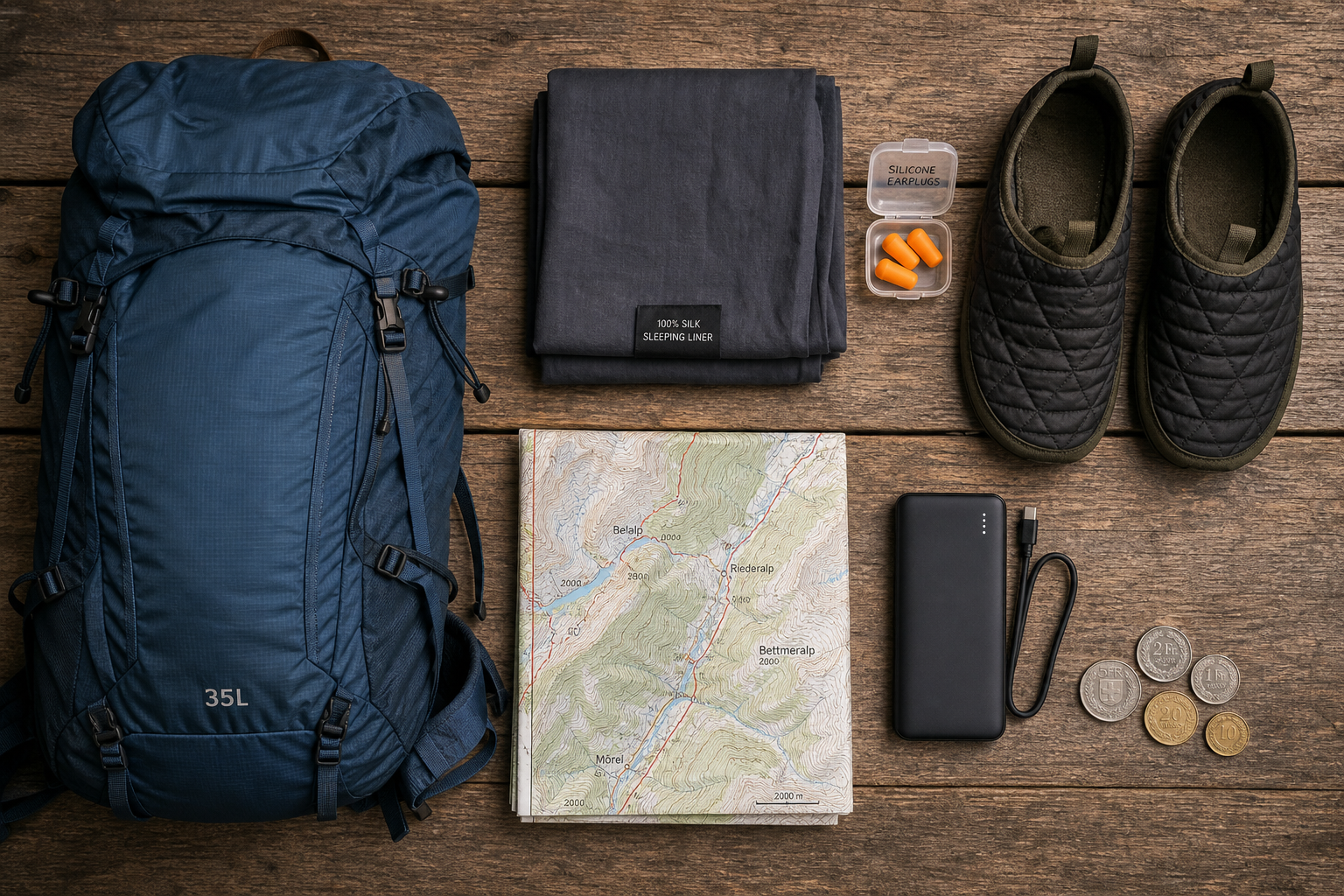
Hut-to-hut trekking requires a specific packing philosophy. Because you are provided with a mattress, blankets, dinner, and breakfast, you do not need a tent, sleeping bag, stove, or heavy food carry. Your backpack should ideally be between 30 and 40 liters and weigh no more than 7-9kg (15-20 lbs) without water.
The Mandatory Hut Kit
- Silk or Cotton Sleeping Liner: Huts provide heavy wool blankets or duvets, but they do not wash them daily. A personal sleeping liner is mandatory for hygiene.
- Earplugs: You will be sharing a room with up to 20 other people. Someone will snore. High-quality silicone earplugs are non-negotiable.
- Hut Slippers/Socks: Boots are strictly forbidden past the boot room in every alpine hut. Many huts provide communal Crocs or slippers, but bringing your own lightweight camp socks or sandals is much preferred.
- Cash (Francs and Euros): While many huts have upgraded to card readers via Starlink, a cloudy day can kill their connection. Always carry enough cash to cover your bed, board, and a few beers.
- Power Bank: Plugs are fiercely contested in hut dining rooms. Bring a 10,000mAh power bank to keep your navigation phone charged.
Integrating Other Activities
A major benefit of the self-guided approach is that you aren’t locked into just walking. Many of our guests at Ski Hostel mix their hiking itineraries with mountain biking. If you reach a valley town with a world-class trail network (like Verbier, just down the valley from us), you can take a rest day to rent a bike. If that appeals to you, see our guide on how to Find the Right Mountain Bike Group for Alpine Trails.
Cost Breakdown: Guided vs. Self-Guided
To understand why self-guided is surging in popularity, look at the math for a typical 10-day Alps tour in 2026.
| Expense Category | Fully Guided Tour (USD) | Self-Guided (USD) | Basecamp Hybrid (USD) |
|---|---|---|---|
| Accommodation & Food | Included in package | $85 - $110 / day | $60 - $90 / day (Hostel + Huts) |
| Guide Fees | $1,500 - $2,500 | $0 | $0 |
| Luggage Transfer | Included (Usually) | $0 (Carry your own) | $0 (Leave heavy bag at base) |
| Transit / Lifts | Included | $150 - $250 (Pay as you go) | $100 - $150 |
| Total Estimated Cost | $3,500 - $5,000+ | $1,000 - $1,400 | $700 - $1,100 |
By taking on the planning yourself, you effectively save a minimum of $2,000—money that can easily fund your flights, gear, and several rounds of high-altitude fondue.
Frequently Asked Questions
Do I need to speak French, German, or Italian to do a self-guided tour?
No. English is widely spoken by hut wardens across the major routes like the TMB, Haute Route, and AV1. However, knowing basic greetings and how to politely order a drink in the local language goes a long way in earning the respect of the hut staff. In the Swiss Valais (where the Haute Route and Tour des Combins cross), the primary language is French.
What happens if I get injured or stuck in a storm?
This is where self-guided hikers must be responsible. You should carry a basic first aid kit and understand the bailout routes for each stage of your hike. In Switzerland, downloading the REGA app allows you to instantly transmit your coordinates to alpine rescue. Always carry travel insurance that explicitly covers helicopter evacuation above 3,000 meters.
Can I hike hut-to-hut with dietary restrictions?
Vegetarianism is easily accommodated in almost all alpine huts—you will typically be served a cheese-heavy alternative, an omelet, or pasta. Vegan and gluten-free diets are much harder for high-altitude, helicopter-supplied kitchens to manage. If you have strict dietary needs, the Basecamp Hybrid model (where you can cook your own meals at a hostel like ours) is vastly superior to relying on hut kitchens.
Ready for the 2026 Season?
Tackling a self-guided hut-to-hut tour in the Alps is one of the most rewarding outdoor achievements you can undertake. The mix of intense physical effort during the day and deep comfort at night creates a rhythm that quickly strips away the stress of modern life.
Whether you plan to hike the iconic Tour du Mont Blanc, brave the Walker’s Haute Route, or explore the quiet ridges of the Tour des Combins, success comes down to early booking and smart logistics.
If you want the freedom of a self-guided hike but the warmth of an international community, consider making Ski Hostel your staging ground. Located in the heart of the Swiss Alps with direct access to hundreds of kilometers of trails, we provide the affordable accommodation, gear knowledge, and home-cooked meals you need to launch—and recover from—your alpine adventure.