
Best Place for Hiking in Switzerland: A Backpacker's Guide
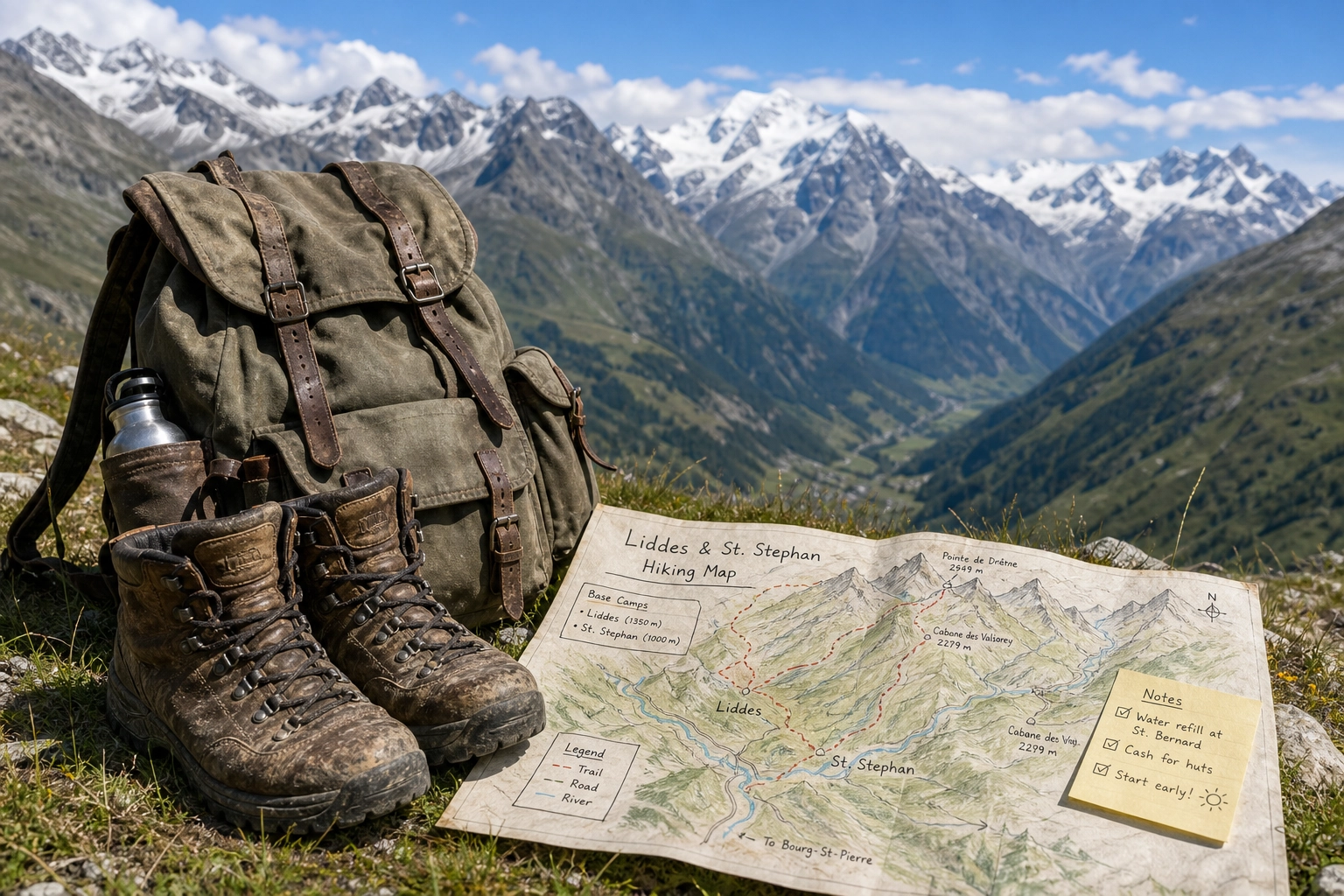
Most guides to the Swiss Alps assume you have an unlimited budget and a taste for five-star chalets. But if you’re a backpacker, digital nomad, or solo traveler heading into the 2026 hiking season, your priorities look different. You want dramatic ridgelines, glacier-fed lakes, and a vibrant community of fellow outdoor enthusiasts—without emptying your bank account.
Switzerland boasts over 65,000 kilometers of marked trails, making it one of the most densely networked hiking destinations on earth. The mistake most budget-conscious travelers make is bouncing from one famous town to another, bleeding cash on daily train fares, overpriced tourist hubs, and expensive restaurant meals.
The secret to hiking Switzerland on a backpacker’s budget is simple: anchor yourself in a strategic, community-driven base camp rather than a transient hotel.
The Strategy: Why Your Base Camp Dictates Your Budget
The traditional approach to a Swiss vacation involves booking a few nights in Zermatt, taking a scenic train to Interlaken, and finishing in Grindelwald. For a backpacker, this constant relocation is a financial death trap.
Instead of booking expensive hotels in the epicenter of tourist zones, savvy hikers base themselves in secondary valleys. These regions offer identical alpine grandeur, direct trail access, and a dramatically lower cost of living. Furthermore, staying in a communal adventure lodge provides built-in hiking partners, shared meals, and local trail beta that apps simply can’t match. If you want to know why this model works so well, read our take on Hotels in Swiss Mountains? Why Social Lodges Beat Luxury.
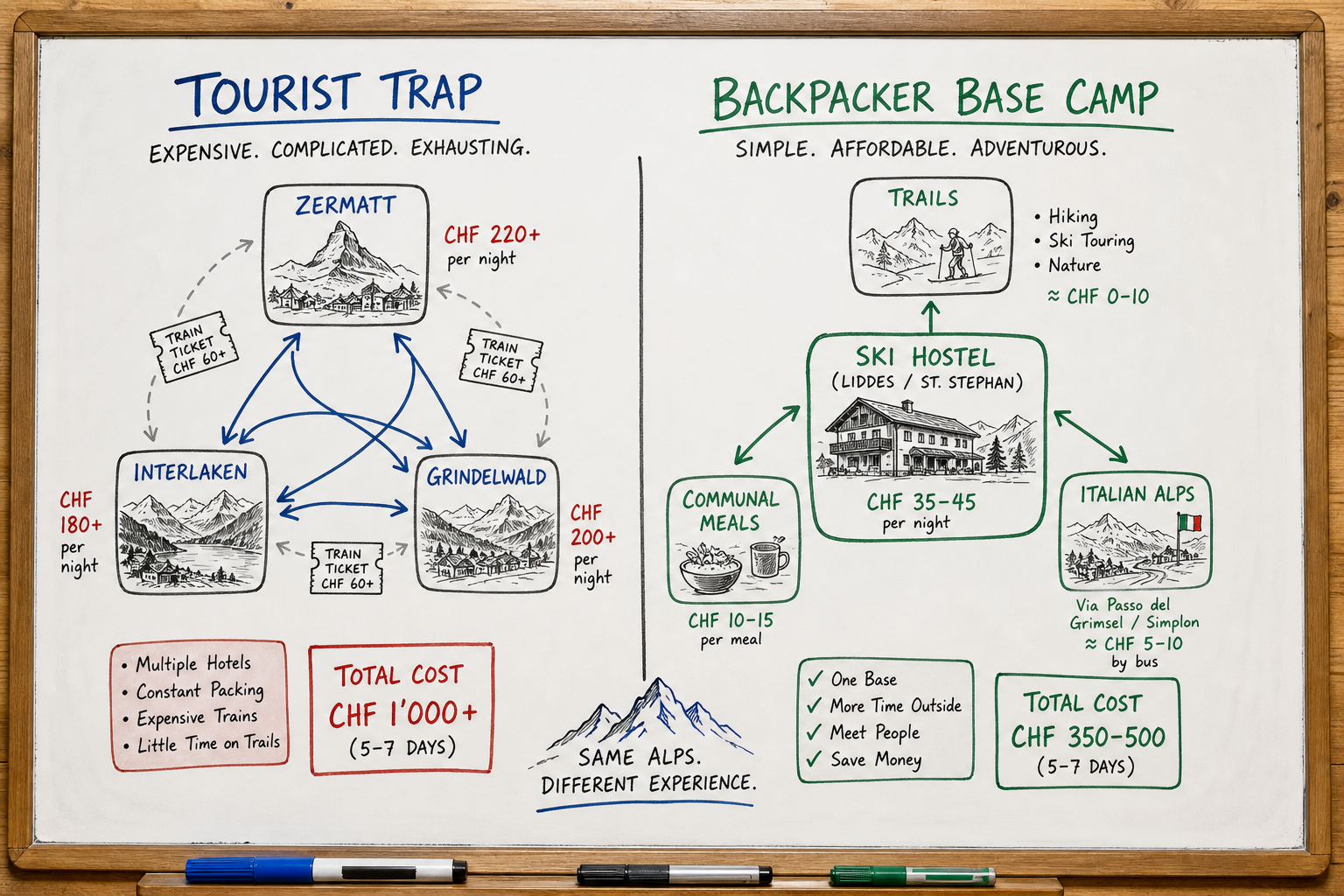
When you eliminate the logistical friction of constantly moving, you can focus your energy and budget on the actual hiking. You also integrate into an international community of like-minded travelers. For our community at Ski Hostel, this centralized strategy revolves around two prime locations: Liddes and St. Stephan.
Liddes & The Val de Bagnes: The Ultimate Hub for Mont Blanc
If you want to experience the majesty of the Mont Blanc massif without the chaotic crowds and inflated prices of Chamonix, the Val de Bagnes region—specifically the town of Liddes—is an unparalleled destination. This area serves as the heartland of Ski Hostel’s summer operations and an absolute playground for backpackers.
Why Liddes Works for Backpackers
- Direct Trail Access: Step out the door and connect to over 250 kilometers of trails. You can hike segments of the legendary Tour du Mont Blanc or explore the rugged Grand St. Bernard Pass right from the valley.
- Cross-Border Excursions: Weather looking grim in the Swiss valleys? Liddes is uniquely positioned for quick border-crossing excursions. You can easily chase the sun into Aosta, Italy, or nip over to France for a change of scenery.
- Community Infrastructure: You aren’t just booking a bed; you’re tapping into a lifestyle. Ski Hostel facilitates weekly adventure programs, communal dinners featuring Brazilian-influenced mountain food, spa nights, and BBQ gatherings.
- Remote Work Capabilities: For digital nomads, Liddes offers the rare combination of high-altitude isolation and high-speed Wi-Fi, allowing you to answer emails in the morning and summit a peak in the afternoon.
For specific route ideas in this region, check out our guide on the 5 Best Hiking Trails in Switzerland Near Mont Blanc and discover Mountain Mont Blanc: 7 Ways to Visit Without the Crowd.
St. Stephan: The Bernese Oberland’s Hidden Backdoor
If your hiking goals involve the classic, sweeping meadows, chiming cowbells, and dramatic limestone peaks of the Bernese Oberland, St. Stephan is the base camp to target. Located just a short train ride from the region’s famous peaks, it offers a tranquil, authentic retreat from the masses.
The St. Stephan Advantage
- Affordable Access to Icons: While Gstaad and Grindelwald drain your wallet, St. Stephan provides a budget-friendly launchpad into the exact same trail networks. You get the iconic views without the iconic price tag. Discover more on Which Swiss Ski Resort Fits a Backpacker’s Budget?
- Multi-Sport Potential: It’s not just about hiking. This region is a mecca for two-wheeled adventures. If you’re looking to mix up your itinerary, you can easily Find the Right Mountain Bike Group for Alpine Trails.
- Authentic Alpine Culture: St. Stephan remains deeply rooted in traditional Swiss agriculture. You are far more likely to share the trail with local farmers and their livestock than hordes of tourists wielding selfie sticks.
Decoding the Swiss Hiking Difficulty Scale
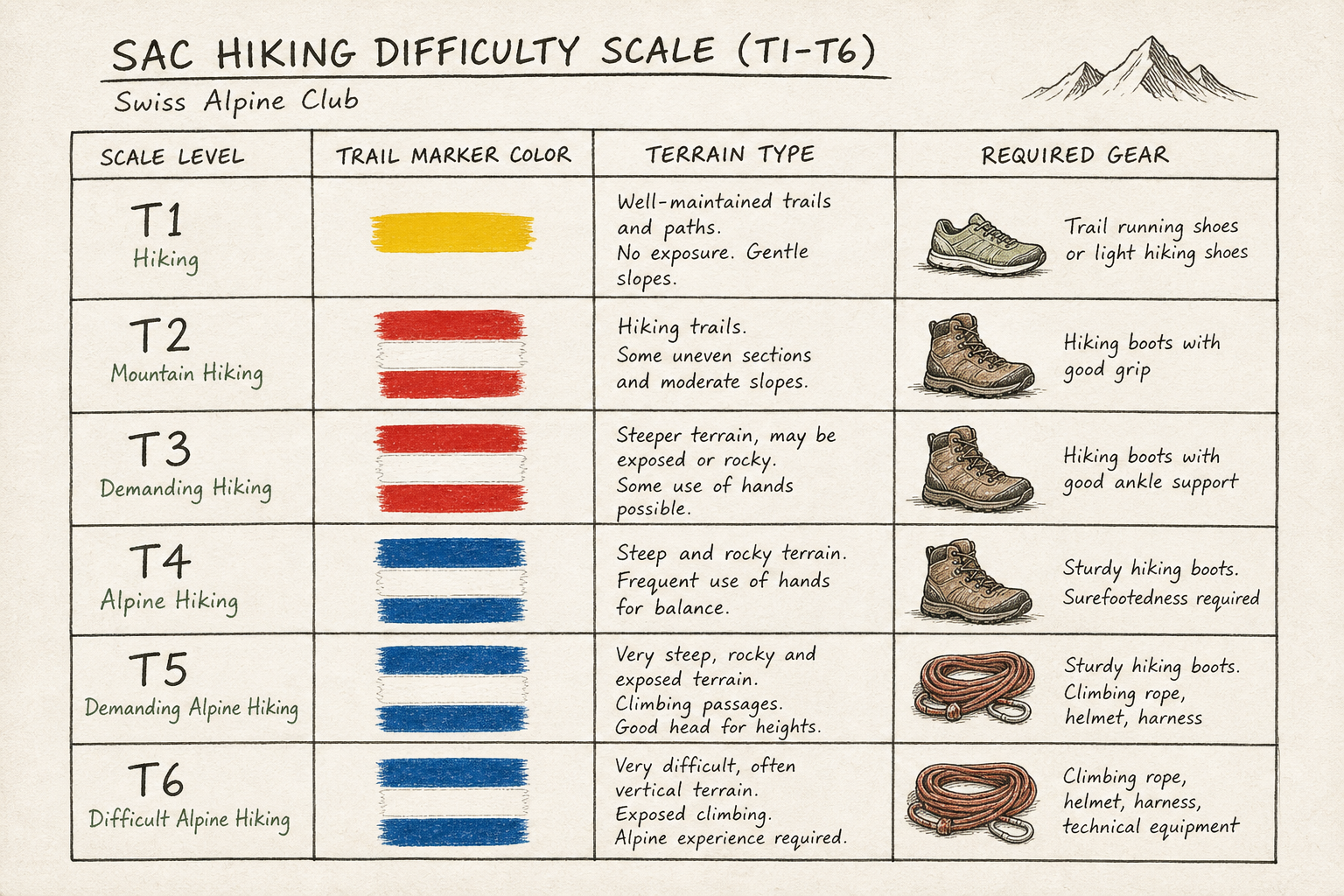
Switzerland doesn’t just categorize trails as “easy, medium, or hard.” They rely on the precise Swiss Alpine Club (SAC) hiking scale, which runs from T1 to T6. Knowing this scale is vital for your safety; it prevents you from accidentally ending up on a terrifying, exposed ridge when you only packed running shoes.
T1 to T6: What You Need to Know
- T1 (Yellow Markers): Well-cleared, wide trails. Flat or gently sloping. There is no risk of falling.
- Gear Check: Basic running shoes are fine.
- T2 (Red-White-Red Markers): Mountain trails with continuous paths. Some steep sections where you might need to watch your footing.
- Gear Check: Sturdy hiking boots are highly recommended.
- T3 (Red-White-Red Markers): Challenging mountain hikes. Exposed sections may have ropes or chains for assistance. You need sure-footedness, a head for heights, and good boots.
- Failure Mode: Attempting this in wet conditions without proper tread will lead to dangerous slips.
- T4 (Blue-White-Blue Markers): Alpine routes. There is often no distinct path. Involves scrambling and crossing steep snowfields or glaciers.
- Gear Check: Requires alpine experience, navigation skills, and potentially specialized gear.
- T5 & T6: Highly demanding alpine routes requiring specialized mountaineering gear, ropes, and expert climbing skills.
If you are new to navigating T3 or T4 terrain, going with locals, guides, or experienced friends is highly recommended. Learn more about Guided Hiking in Switzerland: Finding Your Social Group.
Essential Logistics for Backpacking Switzerland
To make a Swiss hiking trip work on a backpacker’s budget, you need a tight grip on logistics. The country operates like clockwork, but utilizing that infrastructure efficiently requires a bit of insider knowledge.
Transportation: Mastering the SBB App
The public transit system in Switzerland is a marvel of engineering. Trains and yellow PostBuses will deliver you to virtually any trailhead, but single tickets are expensive.
- The SBB Mobile App: Download this before you arrive. It is the undisputed bible for checking timetables for trains, buses, and cable cars.
- Discount Passes: Look into the Swiss Travel Pass (unlimited travel) or a Half Fare Card (50% off all tickets). If you plan on taking multiple cable cars or post buses to reach trailheads, the Half Fare Card usually pays for itself within three days.
Sustenance and Water Strategies
Dining out in Switzerland will obliterate a backpacker’s budget faster than anything else.
- Supermarket Lunches: Embrace the local supermarkets—Coop and Migros—for your trail lunches. Local cheeses, cured meats, fresh fruit, and bread are high-quality and surprisingly affordable.
- Sustainable Hydration: You rarely need to buy bottled water in Switzerland. Most village squares and mountain outposts have public fountains flowing with fresh, drinkable spring water. Bring a reusable flask and fill up as you go—it’s eco-friendly and free.
- Communal Dinners: Back at the lodge, take advantage of Ski Hostel’s home-cooked communal meals. It’s significantly cheaper than a restaurant and offers a chance to swap trail stories with fellow hikers.
For a complete cost-saving strategy, don’t miss our 7 Tips for Hiking in Switzerland (Without the High Cost).
Hut-to-Hut Hiking
For a multi-day adventure, staying in SAC (Swiss Alpine Club) huts is a rite of passage. These high-altitude cabins offer dormitory beds and hearty meals, saving you from carrying a heavy tent and sleeping bag up a 1,000-meter ascent.
- Book Early: Popular huts fill up months in advance during the peak summer season.
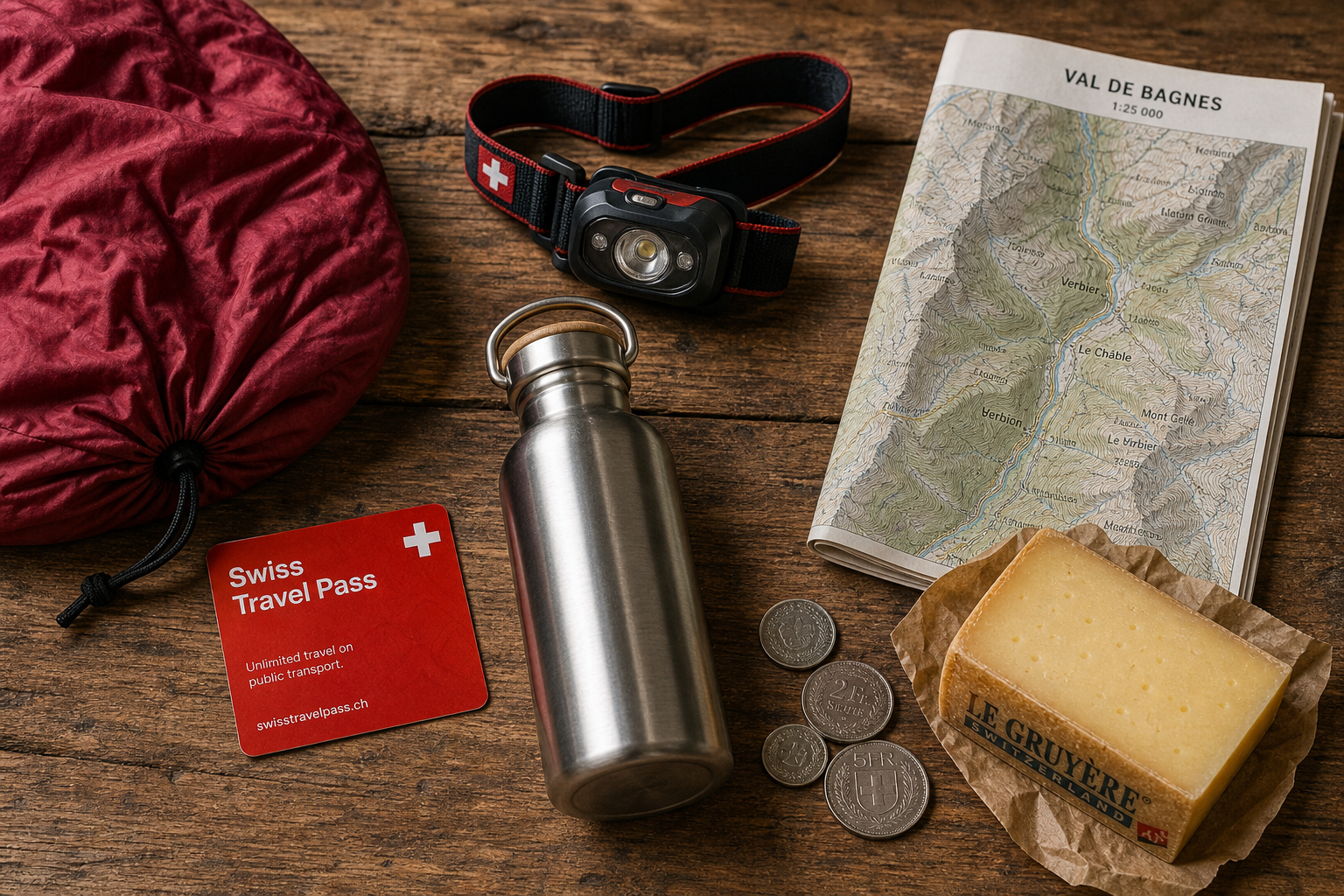
- The Rules: Bring a silk sleeping bag liner (it is mandatory for hygiene), a headlamp, and cash, as many remote huts do not accept cards.
- Get the Guide: Read our full breakdown: How to Plan Hut to Hut Hiking in Switzerland (7 Tips).
A Typical Day at a Social Adventure Lodge
If you’ve never stayed in a community-driven mountain lodge, you might wonder how it differs from a standard hostel or a luxury hotel. Here is what a typical day looks like at Ski Hostel in Liddes:
- 07:30 AM - The Communal Breakfast: Wake up and head to the shared kitchen. Over fresh coffee and Swiss bread, you review the weather forecast on the SBB app with the host and other guests.
- 08:30 AM - Gear & Go: Grab your rented trekking poles from the gear room. You join a group of four other digital nomads heading out for a T3-rated hike toward a local glacier.
- 12:30 PM - Summit Picnic: You reach a panoramic viewpoint overlooking the Val de Bagnes. The group unpacks lunch provisions bought yesterday at the local Migros.
- 04:00 PM - The Descent: Arrive back in the valley, catching the yellow PostBus directly back to the lodge.
- 06:00 PM - Recovery: Join the hostel’s spa night or simply relax in the lounge using the high-speed Wi-Fi to clear a few work emails.
- 08:00 PM - The Feast: Sit down for a massive, home-cooked communal dinner. The conversation flows from today’s trail conditions to plans for a border-crossing trip tomorrow.
If you need help organizing your daypack for this exact routine, review our Swiss Alps Summer: A Simple 5-Step Packing Guide.
When is the Best Time to Hike?
Timing is everything in the Alps. The “summer” season is shorter than you might expect, and high-altitude trails have a strictly defined window of accessibility.
- May to Early June: Stick to valley floors and lower elevations (T1/T2 trails). High alpine passes are still blocked by dangerous snowpack, and most SAC huts remain closed.
- Late June to September: This is the prime alpine season. High-altitude trails (T3/T4) clear up, cable cars run on full schedules, and all mountain huts are open for business.
- October: The crisp autumn air and golden larch trees make this a stunning, crowd-free month. However, you must keep an eye on early snowfalls. If winter arrives early, you can pivot your itinerary to early-season snow sports. Based in Liddes, you might even consider Skiing in the Italian Alps? Try This Aosta Day Trip.
The Verdict: Where Should You Go?
The “best” place to hike in Switzerland depends entirely on the experience you want. If you are a digital nomad, solo backpacker, or outdoor-loving family looking for affordable lodging, high-speed Wi-Fi, and a built-in community, setting up camp in Liddes or St. Stephan with Ski Hostel provides the ultimate return on investment.
You gain access to the world-class peaks of Mont Blanc and the Bernese Oberland, the convenience of fully managed gear and logistics, and the warm, social atmosphere that turns a standard hiking trip into a lifelong memory. Stop wandering aimlessly from expensive town to expensive town—pick a base camp, find your tribe, and hit the trails.