Best Places to Stay in Switzerland for Hiking: 2026 Guide
Most hikers planning a trip to the Swiss Alps make the exact same logistical error. They look at a map, pick five different iconic trails, and book five different hotels across the country.
By day three, they are exhausted. They have spent half their trip dragging luggage onto trains, checking in and out of expensive accommodations, and burning hundreds of francs on last-minute cable car tickets. When a sudden afternoon thunderstorm rolls in—a common occurrence in the Alps—their rigid point-to-point itinerary collapses.
If you want to hike Switzerland efficiently, socially, and without emptying your bank account, you need to rethink your approach. You do not need a road trip. You need a basecamp.
The most successful mountain trips rely on a “hub-and-spoke” strategy. By establishing yourself in one strategic alpine valley for four to seven days, you gain the flexibility to chase the best weather, connect with other outdoor enthusiasts, and drastically reduce your daily costs.
This guide breaks down the best places to stay in Switzerland for hiking, prioritizing strategic bases that offer authentic community, direct trail access, and smart logistics over overpriced luxury.
The Hub-and-Spoke Basecamp Strategy Explained
The Swiss public transit network—which integrates trains, PostBuses, funiculars, and gondolas—is designed to move people up and down mountains with astonishing efficiency. Because of this infrastructure, staying in one central valley gives you access to dozens of distinct micro-regions.
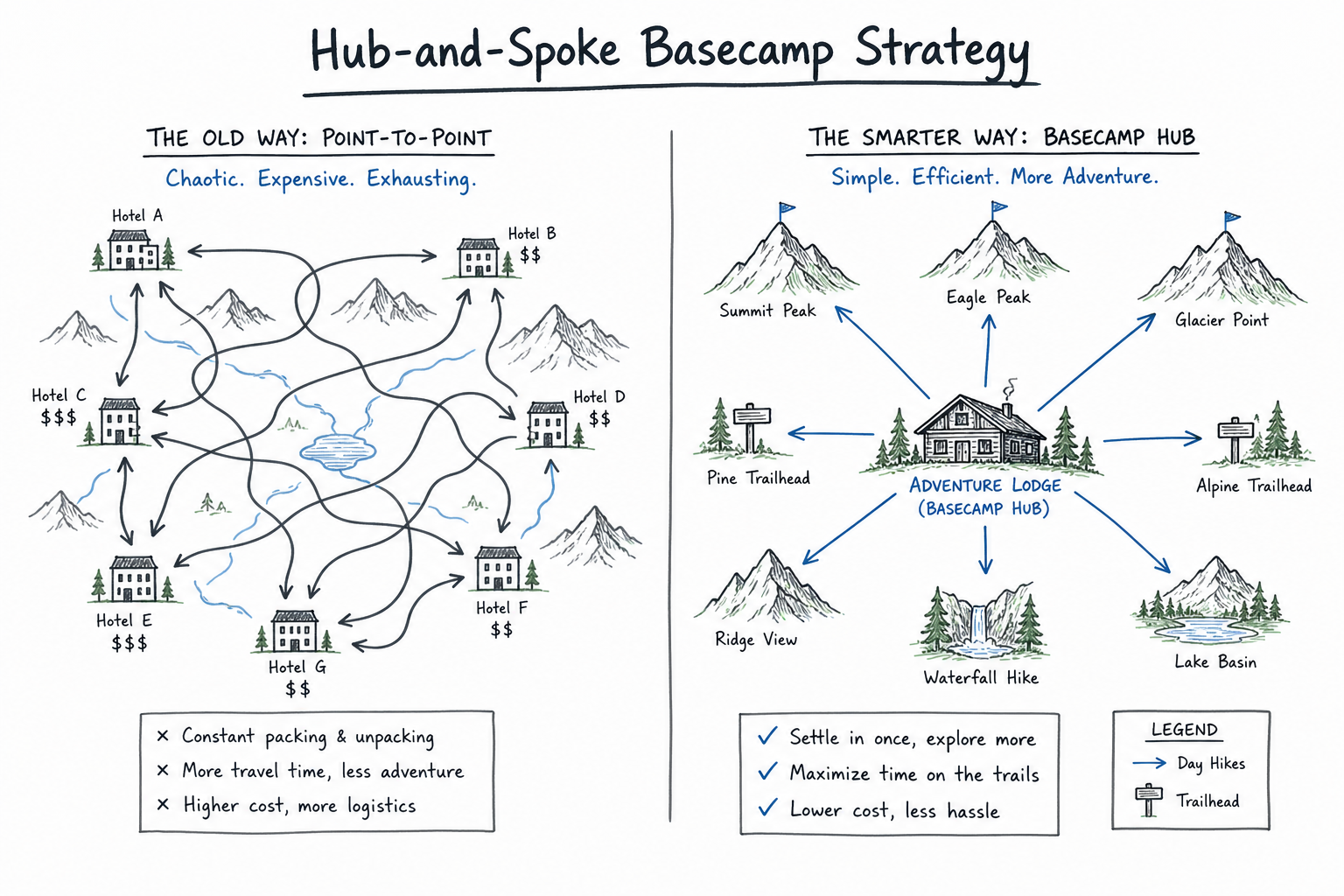
When you book a single basecamp, you unlock three distinct advantages:
- Weather Agility: Alpine weather is hyper-local. It might be pouring rain in the high peaks but perfectly sunny in the adjacent valley. A basecamp allows you to look at the morning radar and take a 30-minute bus ride to where the skies are clear.
- Cost Control: Weekly rates at adventure lodges are significantly cheaper than nightly rates at traditional hotels. Furthermore, having a home base means you can buy groceries, utilize communal kitchens, and avoid the staggering markup of mountain-top restaurants. If you want a deep dive into budget management, read our guide on hiking in Switzerland without the high cost.
- Community Building: Point-to-point hiking is inherently isolating. Staying in a dedicated hiker’s lodge for a week allows you to meet fellow solo travelers, share trail intelligence over evening BBQs, and organically form groups for more challenging routes.
The 5 Best Regions to Set Up Your Hiking Basecamp
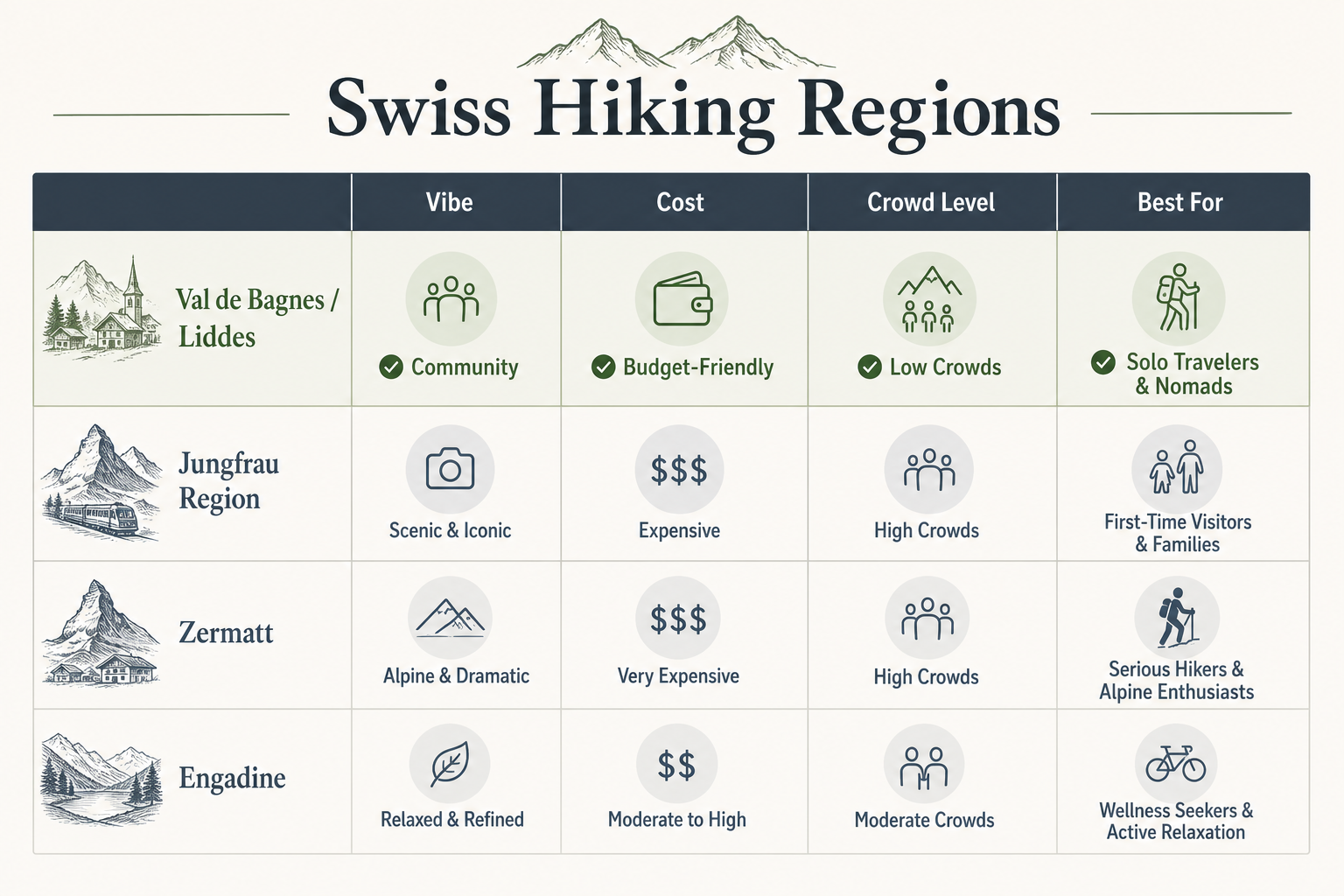
Not all Swiss valleys are created equal. Some are heavily marketed tourist traps; others are quiet mountaineering hubs. Your choice of region will dictate your budget, the crowds you face, and the types of trails you tackle.
1. Liddes & Val de Bagnes (Best for Community, Budget & Border-Hopping)
Located in the lower Valais region, the Val de Bagnes and neighboring Liddes area represent the ultimate sweet spot for digital nomads, international backpackers, and budget-conscious hikers. While the Instagram crowds flock to the Bernese Oberland, this region remains a genuine adventure hub with direct access to over 250 kilometers of world-class trails.
This area is particularly strategic because of its geography. From Liddes, you are uniquely positioned to explore the Swiss Alps while also hopping across borders. You can easily access the iconic mountain Mont Blanc region, or even cross the Great St. Bernard Pass for day excursions to Aosta, Italy. (This cross-border advantage isn’t just for summer; if you’re curious about winter applications, check out our guide to skiing in the Italian Alps).
Why it works as a basecamp:
- The Vibe: Authentic, community-focused, and highly social. It attracts travelers who prioritize actual mountain time over luxury boutiques.
- Trail Access: Ranging from gentle valley walks to high-altitude ridge traverses. You are also in prime position to tackle some of the best hiking trails in Switzerland near Mont Blanc.
- Cost: Significantly more affordable than Zermatt or Grindelwald. You can stretch your budget to stay a week or more.
- The Ski Hostel Advantage: Liddes and St. Stephan are home to our own community-driven adventure lodges, where we manage the logistics for you. With home-cooked communal dinners (including Brazilian-influenced cuisine), gear rental, high-speed Wi-Fi for remote workers, and organized transport to trailheads, it functions as the ultimate plug-and-play basecamp.
2. The Jungfrau Region / Bernese Oberland (Best for First-Timers & Postcard Views)
Towns like Grindelwald, Lauterbrunnen, Wengen, and Mürren make up the Bernese Oberland. This is the Switzerland you see on postcards: massive sheer cliffs, thundering waterfalls, and lush green meadows beneath the Eiger, Mönch, and Jungfrau peaks.
The Trade-offs:
While the hiking infrastructure is arguably the best in the world, you will pay a massive premium for it. The trails here are heavily trafficked, particularly from late June through August. If you choose this region, avoid staying in Interlaken—it requires too much daily transit time to reach the actual trails. Instead, base yourself higher up in a car-free village like Mürren, but be prepared for peak-season pricing.
3. Zermatt & The Matterhorn Valley (Best for High-Altitude Peak Baggers)
Zermatt sits at the end of the Mattertal valley, dominated by the iconic pyramid of the Matterhorn. Because of the high base elevation (1,620m), the hiking here is rugged, alpine, and often above the tree line.
The Trade-offs:
Zermatt is spectacular but logistically rigid. Because it sits at the dead-end of a valley, your day-trip options are limited to what is immediately accessible via the local (and very expensive) cable car network. It is less of a “hub” and more of a specific destination. It is ideal for expert hikers looking for high-altitude challenges, but less suited for families or budget backpackers wanting varied, low-level valley days.
4. Engadine Valley (Best for Solitude & Autumn Colors)
Located in the far east of Switzerland (Graubünden), the Engadine is a high alpine valley famous for its distinct Romansh culture and brilliant golden larch trees in October. Towns like Pontresina or Scuol make excellent bases.
The Trade-offs:
The Engadine is notoriously quiet and expansive. It lacks the dense, dramatic verticality of the Valais or Bernese Oberland, offering instead vast, sweeping landscapes. It is a brilliant choice for introverted hikers seeking solitude, but it lacks the vibrant international backpacker community found further west.
5. Appenzell (Best for Short Trips & Traditional Culture)
In northeastern Switzerland, the Alpstein massif offers some of the most dramatic, condensed hiking in the country, including the famous Aescher cliff restaurant.
The Trade-offs:
The hiking network here is relatively small. It is perfect for a three-day weekend, but you may run out of distinct trails if you try to use it as a basecamp for a full two-week trip.
Decoding Swiss Mountain Accommodation Options
Where you sleep dictates the rhythm of your trip. While typical tourists default to standard hotels, experienced hikers know there are better, more purpose-built options.
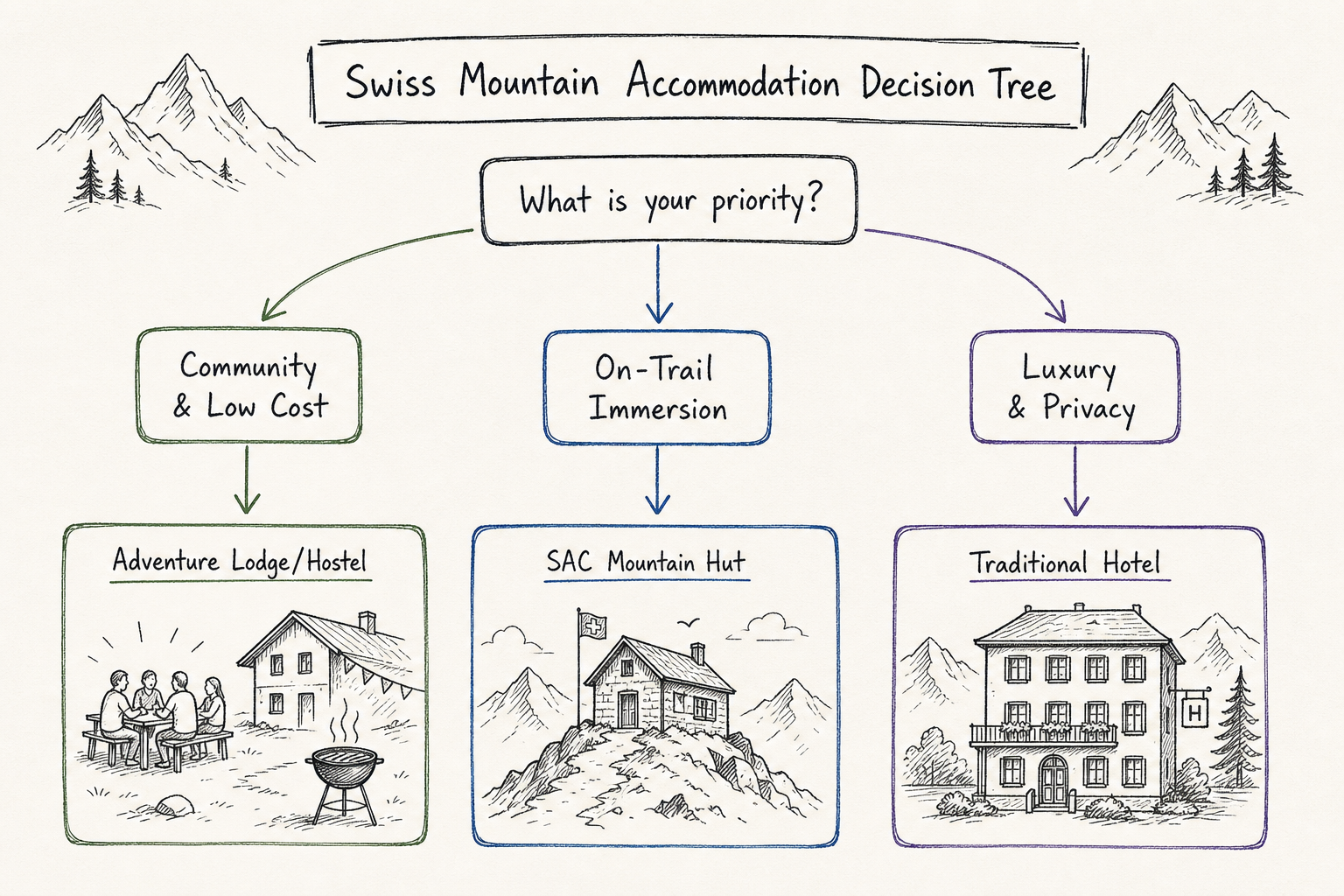
Social Adventure Lodges
The traditional hospitality model in Switzerland is broken for modern outdoor enthusiasts. Standard hotels in Swiss mountains charge premium rates for luxury amenities—like valet parking and daily room service—that hikers simply do not use.
Adventure lodges (like Ski Hostel) are disrupting this by offering all-inclusive, community-driven stays. Instead of a sterile hotel lobby, you get shared spaces designed to foster an international community. Instead of paying 40 CHF for a mediocre restaurant dinner, you get home-cooked communal meals.
Crucially, these lodges manage the logistics. Finding guided hiking in Switzerland or locating the right mountain bike group can be daunting for solo travelers. A good adventure lodge bakes these activities into the weekly itinerary, offering professional-led guidance, gear rental, and transport to the trailheads.
SAC Mountain Huts (Hut-to-Hut Trekking)
The Swiss Alpine Club (SAC) operates over 150 high-altitude huts. These are strictly for sleeping on the trail. They offer dorm beds, a hearty dinner, and a basic breakfast.
While incredibly atmospheric, huts are not basecamps. You cannot work remotely from them (Wi-Fi is non-existent), and you must carry all your gear on your back. They are best used as 1- or 2-night tactical strikes away from your main valley basecamp. If you want to integrate a hut stay into your trip, read our breakdown on how to plan hut to hut hiking in Switzerland.
Traditional Hostels
Standard city or valley hostels offer cheap beds, but they lack mountain infrastructure. You will still have to organize all your own transport, cook your own meals, and rent gear from expensive third-party sports shops. They are cheap, but they are not efficient.
Essential Basecamp Logistics for 2026
If you want to execute the basecamp strategy successfully, you need to master three logistical pillars: transit, timing, and packing.
Navigating Swiss Transit
Do not rent a car. Swiss mountain roads are narrow, parking at trailheads is highly restricted (or illegal), and many of the best mountain villages are entirely car-free.
Instead, download the SBB Mobile App (the Swiss railway app). It provides down-to-the-minute schedules for every train, bus, and gondola in the country.
If you are staying for more than a few days, you need a discount pass. The two main options are:
- The Swiss Travel Pass: Offers unlimited travel on trains, buses, and boats, plus 50% off most mountain cable cars. It is expensive upfront but offers ultimate flexibility.
- The Swiss Half Fare Card: Costs a flat fee upfront, then gives you 50% off all tickets for a month. If you are using the basecamp strategy (staying in one valley and taking shorter daily trips), the Half Fare Card is almost always the mathematical winner.
Weather Realities and Seasonality
Switzerland does not have a year-round hiking season. Altitude dictates accessibility.
- June: Lower valleys (like Liddes) are lush and clear, but high passes (above 2,200m) are often still blocked by snow. This is a quiet, beautiful time for valley hikes.
- July & August: The peak alpine season. All high-altitude trails and SAC huts are open. The weather is warmest, but afternoon thunderstorms are highly predictable. Start your hikes by 7:30 AM to be off the exposed peaks by 2:00 PM.
- September & October: Arguably the best time for serious hikers. The crowds vanish, the air is crisp, and the summer thunderstorms cease. Be aware that some high-altitude cable cars close for maintenance by mid-October.
For a detailed breakdown of what to bring across these changing seasons, review our Swiss Alps summer packing guide.
The Crossover Benefit: Winter Scouting
One overlooked advantage of booking a solid summer basecamp is scouting for winter. Regions that offer vast summer trail networks often convert into exceptional winter adventure hubs. By familiarizing yourself with the transit and terrain in July, you can easily determine which Swiss ski resort fits a backpacker’s budget for a return trip in January.
Summary: Making the Right Choice
The best place to stay in Switzerland for hiking isn’t a specific luxury hotel; it is a strategic, well-connected basecamp that matches your travel style.
If your goal is to check off the famous postcard views and you have a large budget, establishing a base in a car-free village in the Bernese Oberland is the traditional route.
However, if you are a digital nomad, a solo traveler, or a hiker who values community, authentic shared experiences, and smart logistics over high-priced amenities, you should look toward the Val de Bagnes and Liddes. By choosing a community-driven adventure lodge, you stop worrying about train schedules, dinner reservations, and gear rentals—and start focusing entirely on the mountains.