
Hiking Hostel vs Alpenwild
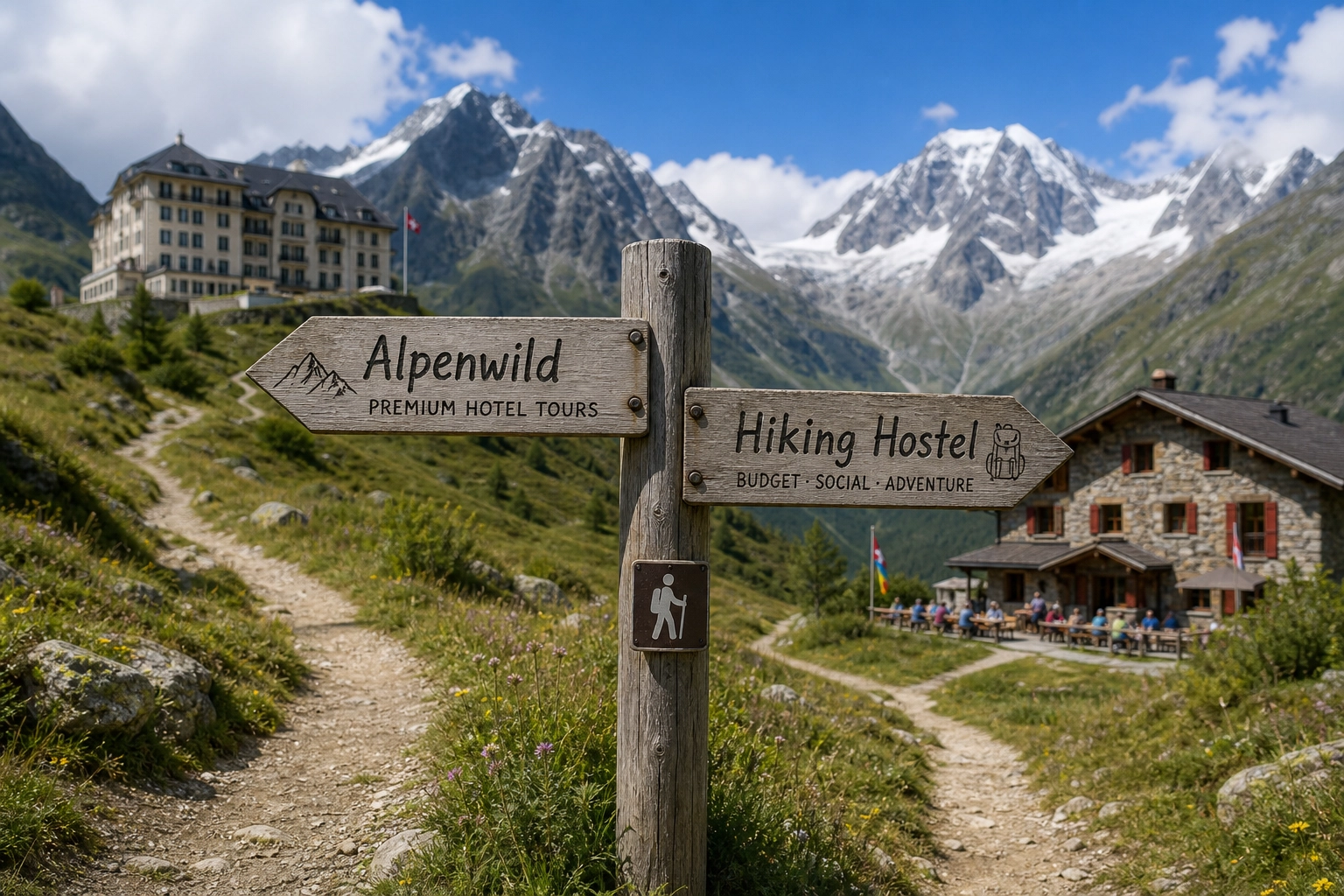
Booking a hiking trip to the Swiss Alps as a solo traveler usually forces a difficult choice: spend weeks painstakingly coordinating train schedules, mountain hut reservations, and trail maps by yourself, or pay a massive premium to join a fully catered luxury tour.
Switzerland’s trail network is arguably the best in the world, boasting perfectly timed public transit and iconic vistas. Yet, the logistical friction of stringing together a multi-day alpine route alone can easily turn a relaxing vacation into an exercise in project management.
For independent hikers who want the camaraderie of a group and the ease of a guided itinerary without the stress of DIY planning, two dominant models have emerged. On one end of the spectrum is Alpenwild, the gold standard for premium, hotel-based point-to-point trekking. On the other end is Hiking Hostel, which pioneered the week-long, single-basecamp model designed explicitly for budget-conscious solo travelers, digital nomads, and backpackers.
This guide breaks down the operational realities, social dynamics, logistical frameworks, and true costs of both approaches so you can choose the guided holiday that fits your travel style.
The Landscape of Solo Travel in the Swiss Alps
Solo travel is no longer a niche segment of the outdoor industry. According to Kiplinger, solo trips are projected to become a trillion-dollar industry by 2030, driven largely by travelers prioritizing flexibility, empowerment, and self-discovery over waiting for friends to coordinate vacation time.
However, the Swiss Alps present unique challenges for individuals traveling alone. The “single supplement”—a fee levied by hotels and tour operators to cover the cost of a single person occupying a double room—can increase the price of a Swiss holiday by 30% to 50%. Furthermore, managing dynamic weather conditions, interpreting trail signs in multiple languages (German, French, Italian, and Romansh), and handling emergency protocols at high altitudes carries a heavier mental load when you are alone.
Guided group tours neutralize these friction points. They provide immediate safety in numbers, pre-vetted trail routing, and built-in social interaction. The divergence between operators lies entirely in how they structure that group experience.
Alpenwild: The Premium Point-to-Point Standard
Alpenwild is one of the most recognized names in North American-operated Swiss Alps tours. They specialize in high-end, meticulously curated trekking experiences, primarily focusing on iconic point-to-point routes like the Jungfrau region, Zermatt, and the legendary Haute Route connecting Chamonix to Zermatt.
The Alpenwild Operating Model
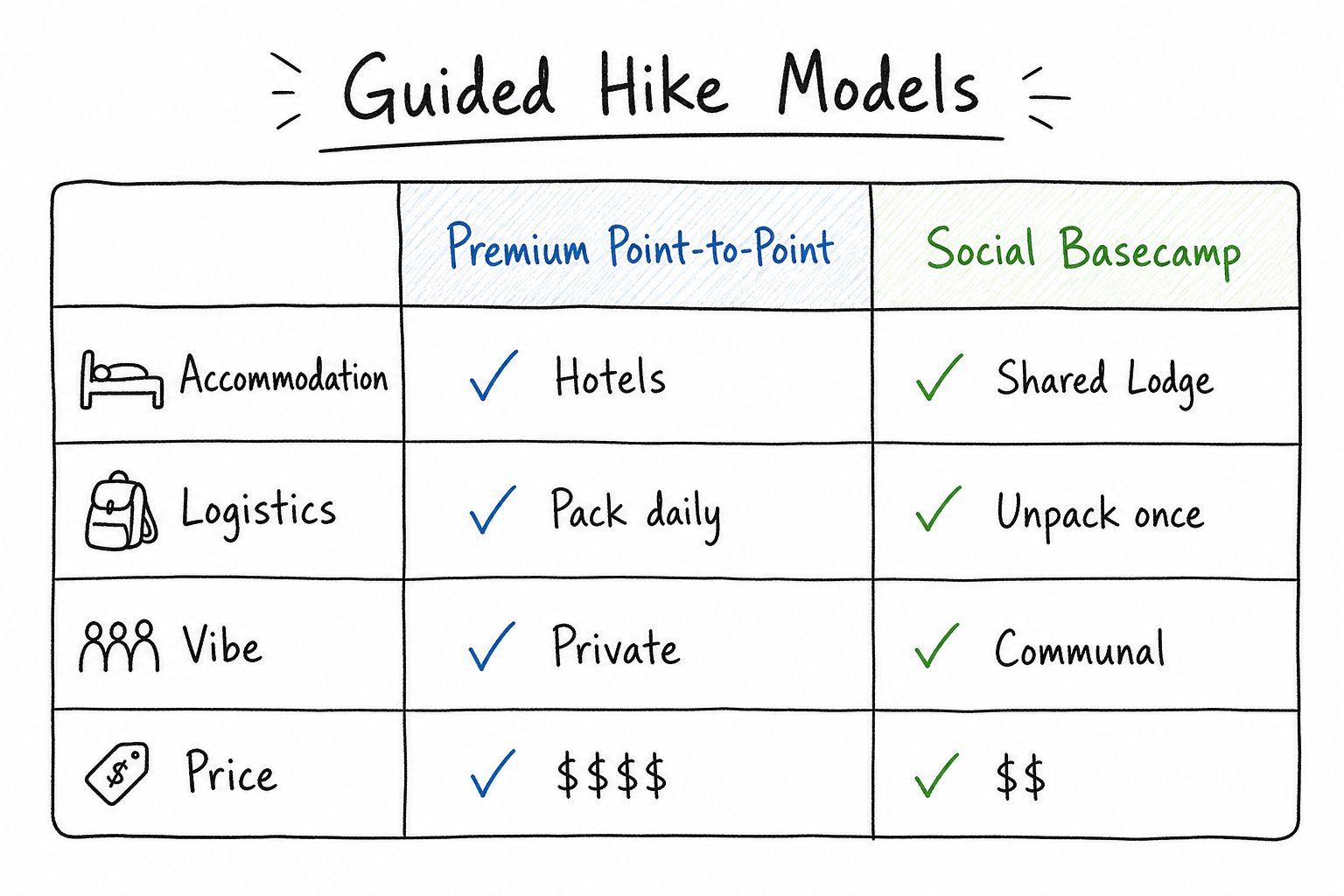
Alpenwild operates on a traditional premium touring model. Guests move from village to village each day, completing a linear journey across the Alps. Because carrying a 40-liter backpack for 10 days is physically grueling, Alpenwild employs a dedicated logistics network to transport your main luggage between hotels while you hike with only a lightweight daypack.
- Target Demographic: Affluent professionals, retirees, couples, and premium solo travelers who prioritize comfort, fine dining, and seamless service over budget.
- Accommodation: Primarily 3-star and 4-star alpine hotels, often featuring wellness facilities, private balconies, and high-end dining rooms.
- Dining: Multi-course dinners highlighting regional gastronomy, comprehensive hotel breakfasts, and organized trail lunches.
- Guiding: Certified mountain guides leading relatively large groups (often 10-14 people) along fixed daily itineraries.
The Solo Experience with Alpenwild
For a solo traveler, Alpenwild offers a deeply insulated, high-comfort environment. You do not have to think about train connections, luggage logistics, or trail navigation. You simply wake up, leave your bag at the reception desk, hike the day’s route, and arrive at a new hotel where your bag is waiting.
However, this level of service requires significant capital. A standard 10-day Haute Route trek with Alpenwild generally costs between $5,500 and $7,000, not including airfare. Solo travelers who want their own room will face a substantial single supplement. While you can bypass this fee by opting to share a room with another solo traveler of the same gender, the overall price point heavily filters the demographic, skewing toward an older, wealthier crowd rather than young backpackers or digital nomads.
Hiking Hostel: The Social Basecamp Approach
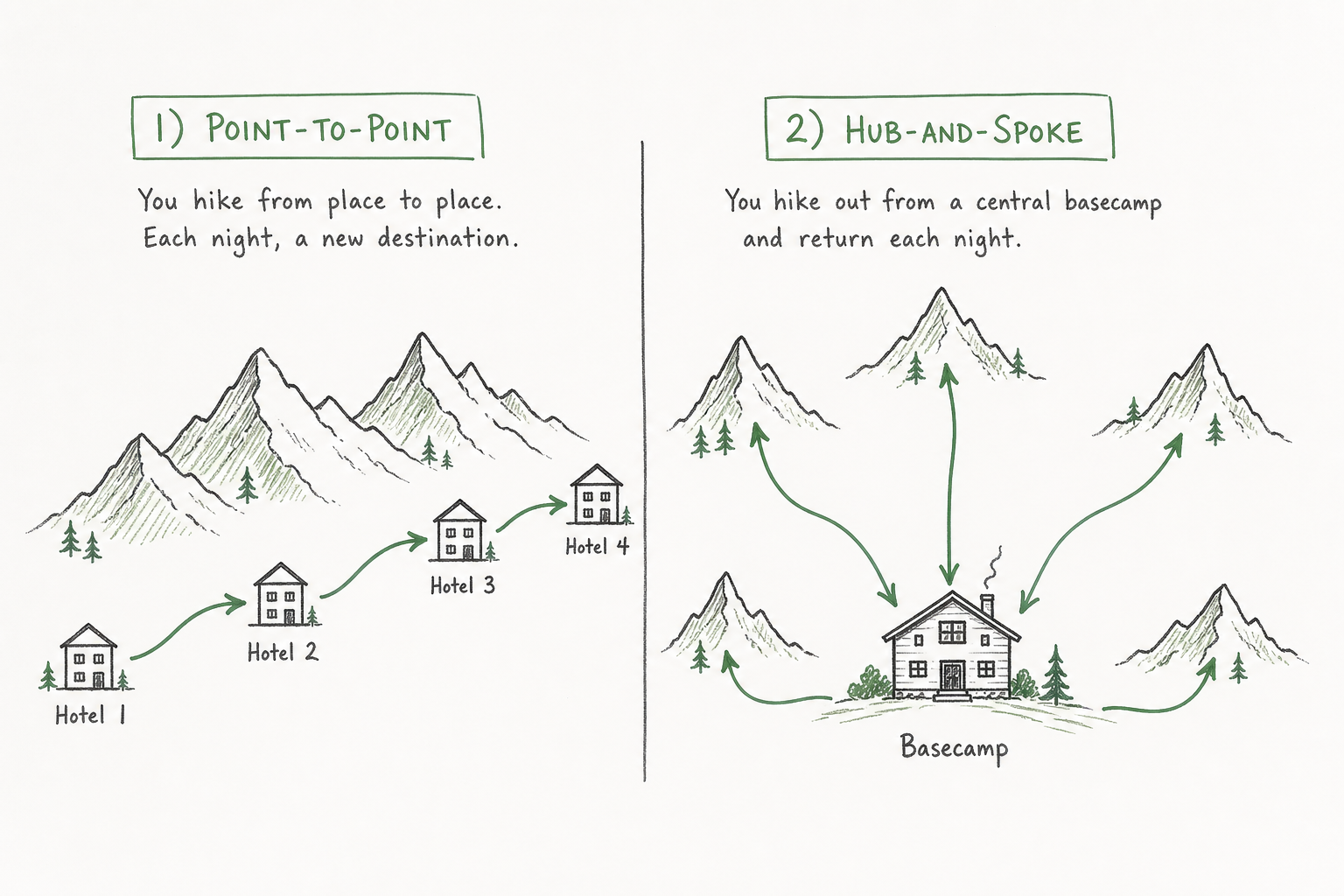
Operating with an entirely different philosophy, Hiking Hostel eliminates the transient nature of moving villages every day in favor of a centralized hub-and-spoke model. They offer week-long summer hiking holidays based out of dedicated alpine properties in Liddes and St. Stephan.
The Hiking Hostel Operating Model
Instead of paying a premium for luggage vans and varying hotel rates across different cantons, Hiking Hostel secures a single basecamp. From this hub, guides use daily trail transport to access different micro-regions, trails, and excursions, returning to the same bed each night. The package is aggressively all-inclusive on the logistical front: it covers hostel accommodation, meals, airport transfers, daily trail transport, and organized excursions.
- Target Demographic: Solo travelers, backpackers, digital nomads, and budget-conscious hikers looking for a highly social, communal atmosphere.
- Accommodation: Shared hostel-style rooms in a dedicated alpine lodge. The focus is on communal spaces rather than private luxury.
- Dining: Hearty, communal meals prepared at the hostel. Guests eat together family-style, fostering immediate social connections.
- Guiding: Structured daily hikes with options for organized excursions to nearby iconic regions like Aosta, Chamonix/Mont Blanc, Interlaken, and Glacier 3000/Gstaad.
The Solo Experience with Hiking Hostel
Hiking Hostel is engineered specifically to solve the isolation and expense of solo travel. By utilizing a shared-space model, they eliminate the concept of the single supplement entirely. You pay a flat rate for the week, which generally falls well under the cost of a standard Swiss hotel stay, let alone a fully catered tour.
For solo travelers seeking camaraderie, this model is highly effective. You aren’t retreating to a private 4-star room after a hike; you are sharing beers in the common room, swapping travel stories, and planning future trips with a cohort of like-minded peers. If you are trying to figure out how to find the right mountain bike group or hiking community, a week in a shared lodge accelerates those friendships faster than traditional tours.
Core Difference 1: Point-to-Point vs Hub-and-Spoke Logistics
The most fundamental difference between these two operators dictates how you will live day-to-day.
The Reality of Point-to-Point (Alpenwild)
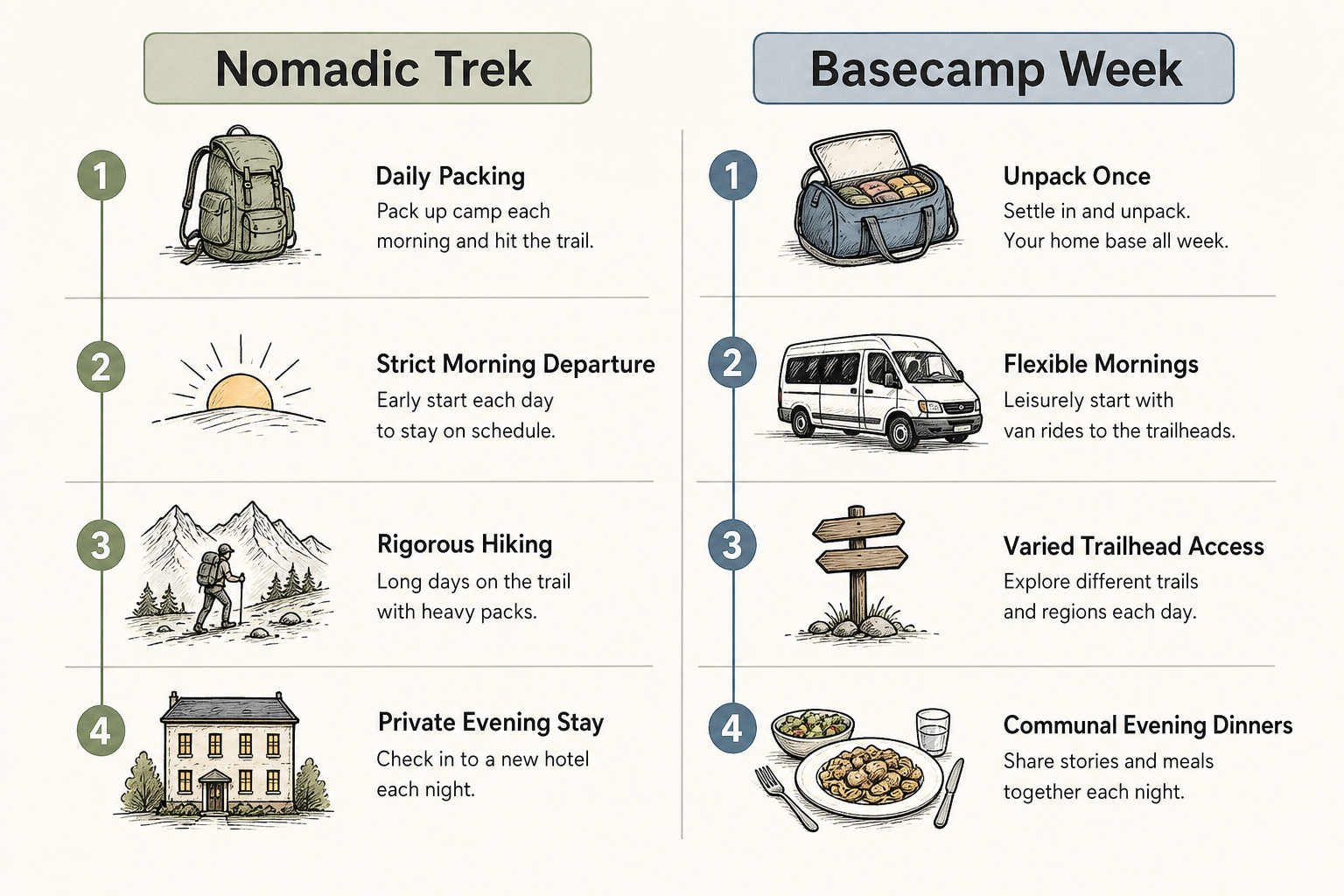
Hiking a linear route like the Haute Route means you are nomadic. Every single morning, you must pack your luggage, ensure your bags are downstairs by a strict deadline (often 8:00 AM) so the transport van can load them, and check out of your hotel.
Pros:
- You get the psychological satisfaction of crossing a country on foot.
- You experience the distinct culture of a new village every evening.
- The terrain constantly progresses, moving from lush valleys to glacial passes.
Cons:
- Living out of a suitcase for two weeks is tiring.
- If the weather turns violent on a high-pass day, the rigid itinerary often dictates that you must push through it or take a long, complicated train detour to the next hotel, as the entire logistical chain (and your luggage) is already moving forward. There is very little flexibility.
The Reality of Hub-and-Spoke (Hiking Hostel)
By basing their operations in Liddes (Valais) or St. Stephan, Hiking Hostel guests unpack exactly once. You claim your bunk, hang up your gear, and leave your heavy bags behind for the entire week. Each morning, you pack a day bag and use the included trail transport to access different trailheads.
Pros:
- Zero daily packing stress. You unpack once on Sunday and pack up the following Saturday.
- Ultimate weather flexibility. If it’s raining heavily in the north, the guide can simply pivot and drive the group south through a mountain tunnel to a sunnier valley.
- You don’t need a complex packing system. Bringing simple gear based on a standard Swiss Alps summer packing guide is entirely sufficient.
Cons:
- You don’t get the “journey” feeling of walking entirely across a mountain range.
- It requires daily driving (usually 30-60 minutes) to reach the trailheads, rather than stepping out of your hotel directly onto the path.
Core Difference 2: Accommodation and The Social Vibe
The type of bed you sleep in radically alters the social fabric of the trip.
Alpenwild utilizes traditional Swiss hotels. While these are universally clean, charming, and comfortable, hotel architecture inherently limits organic socialization. After dinner, guests naturally retreat to their private rooms to decompress, read, or sleep. The interactions are largely limited to the trail and the dining table. For independent hikers who value their solitude after a long day of exertion, this is an ideal setup.
Hiking Hostel takes the opposite approach. They operate on the belief that social lodges beat luxury hotels when it comes to group cohesion. Shared dormitories, communal bathrooms, and large, comfortable common rooms force interaction in the best way possible. You will likely spend your evenings playing cards, planning the next day’s excursion, or sharing photos from the trail. It feels less like a formal guided tour and more like a trip you organized with a dozen adventurous friends.
Core Difference 3: Route Flexibility and Excursions
When you book a classic point-to-point trek, the trail is the singular focus. You are there to walk from Point A to Point B.
Hiking Hostel’s week-long format treats the Swiss Alps as a playground rather than a strict marching route. Because they aren’t tied to a linear path, they integrate regional excursions into the hiking schedule.
Depending on your basecamp, a week with Hiking Hostel might include:
- Chamonix/Mont Blanc: Accessing the French side of the massif. Finding the best hiking trails near Mont Blanc and exploring ways to visit without the crowd.
- Aosta Valley (Italy): Crossing the border for a cultural shift. While some travelers associate this region with winter (perhaps looking for an Aosta day trip for skiing), the summer hiking and Italian alpine food scene are spectacular.
- Interlaken & Glacier 3000/Gstaad: Exploring the dramatic suspension bridges and glacial plateaus of the Bernese Oberland.
This variety is a massive draw for digital nomads and backpackers who want to “see the Alps” broadly rather than hyper-focusing on one specific valley.
A Day in the Life Comparison
To understand the visceral difference between the two holidays, look at how a typical Wednesday might unfold on both tours.
Wednesday with Alpenwild (The Haute Route)
- 06:30 AM: Wake up in a 3-star hotel in Zinal.
- 07:15 AM: Pack your main duffel bag and bring it to the lobby for the luggage transfer service.
- 07:30 AM: Sit down for a quiet, formal Swiss breakfast (croissants, cheese, cured meats, coffee).
- 08:30 AM: Step out of the hotel and immediately begin a steep 1,200-meter ascent toward the Forcletta pass. The pace is steady and determined.
- 01:00 PM: Eat a packed lunch at the top of the pass, enjoying sweeping views of the Weisshorn.
- 04:30 PM: Descend into the village of Gruben. Check into a new hotel. Your duffel bag is waiting in the lobby.
- 05:00 PM: Shower, then relax privately in your room.
- 07:00 PM: Rejoin the group for a three-course dinner featuring local Valais wine and raclette.
- 09:00 PM: Retire to your private room for the night.
Wednesday with Hiking Hostel (Liddes Basecamp)
- 07:30 AM: Wake up in your assigned bunk in Liddes. No need to pack your main bag; your gear is already laid out from yesterday.
- 08:00 AM: Head down to the communal kitchen area. Grab coffee, bread, and muesli while chatting with a digital nomad from Berlin and a solo backpacker from Toronto.
- 09:00 AM: Load into the transport van. Today, the guide has looked at the weather and decided to drive 45 minutes to the Italian border for a sunnier hike toward Aosta.
- 10:00 AM: Hit the trail. The pace is social, with plenty of stops for photos and water breaks.
- 01:30 PM: Stop at a high alpine refuge for a coffee or eat the communal lunch packed that morning.
- 04:00 PM: Finish the hike, load back into the van, and head back to Liddes.
- 05:00 PM: Arrive at the hostel. Kick off your boots in the drying room. Grab a beer from the communal fridge and join the group on the terrace.
- 07:00 PM: A large, family-style dinner is served in the main room.
- 08:30 PM: The group pulls out maps to discuss tomorrow’s excursion to Chamonix while someone hooks up a phone to the speakers to play music.
The True Cost of Solo Alpine Hiking
Switzerland is notoriously expensive. Managing a budget here requires strategy, often relying on specific tips for hiking in Switzerland without the high cost.
When evaluating guided tours, solo travelers must look beyond the sticker price and examine what is actually included.
The Alpenwild Ledger
If you book a 10-day Alpenwild trek, the base price hovers around $5,800.
- Single Supplement: Expect to add $800 to $1,200 if you want your own room.
- Airport Transfers: Often not included. A round-trip train ticket from Geneva or Zurich to the trailheads can cost $150–$250.
- Total Output: Easily $6,500 to $7,500 before flights.
The Hiking Hostel Ledger
Hiking Hostel operates on a highly consolidated pricing structure. A standard week-long holiday is priced sharply for the backpacking and budget-conscious market.
- Base Price: Generally under $1,500 for the week.
- Single Supplement: $0. (Shared accommodation is the default).
- Airport Transfers: Included. They handle the complex logistics of getting you from the airport to Liddes or St. Stephan.
- Excursions & Trail Transport: Included.
- Total Output: Aside from flights, a few beers, and souvenir money, the upfront cost is your final cost.
Other Contenders in the Market
While Alpenwild and Hiking Hostel represent the two distinct poles of the market, there are other reputable operators to consider:
- Ryder-Walker: For highly fit, expert-level trekkers. Ryder-Walker focuses heavily on the Matterhorn region and the Engadine. They lean toward smaller, intense hiking groups and are priced similarly to Alpenwild.
- Alpine Adventure: Operating since the 1970s, they offer smaller group sizes and cover regions like the Bernese Oberland and Valais. They are an excellent middle-ground option for older solo travelers who want guided support without the ultra-luxury price tag of Alpenwild.
If you are debating the merits of hut-to-hut hiking in Switzerland versus these guided options, remember that true hut-to-hut hiking (sleeping in SAC alpine club huts) is generally self-guided or run by technical mountaineering guides. It requires carrying all your own gear, sleeping in massive 20-person lofts, and navigating complex terrain. It is the most authentic way to see the high peaks, but it completely lacks the logistical support of a guided week.
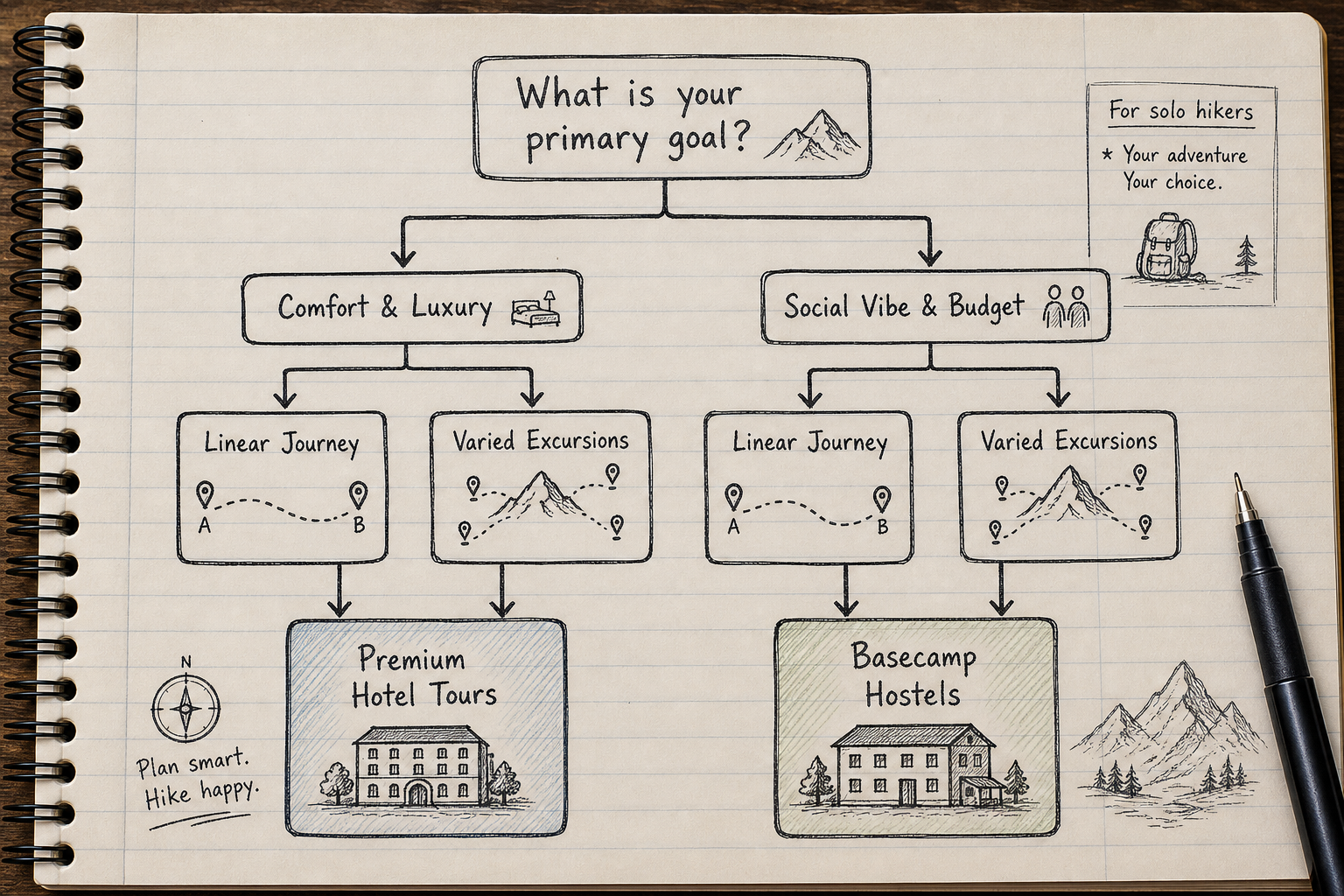
Decision Framework: Which Operator is Right for You?
Choosing between these options doesn’t require a spreadsheet; it requires an honest assessment of your personality, budget, and travel goals.
Choose Alpenwild if:
- Budget is not a primary concern. You are comfortable spending $6,000+ for a highly polished experience.
- You prefer privacy. You want to retreat to a quiet, private hotel room at the end of a physically demanding day.
- You want a linear journey. The idea of crossing the Alps from point A to point B on a historic route appeals to you.
- You hate vehicle transfers. You want to step out of your hotel and start walking, rather than driving to a trailhead.
Choose Hiking Hostel if:
- You are highly social. You are actively looking to meet other solo travelers, backpackers, and digital nomads. (Read more about finding your social group).
- You are budget-conscious. You want an all-inclusive week in Switzerland without draining your savings.
- You hate packing daily. Unpacking once and using a basecamp sounds significantly more relaxing than living out of a duffel bag.
- You want varied excursions. You prefer experiencing different micro-regions (Aosta, Mont Blanc, Glacier 3000) rather than staring at the same valley for a week.
Frequently Asked Questions (FAQ)
Is it weird to join a guided hiking tour as a solo traveler?
Absolutely not. On tours designed for younger demographics and budget travelers (like Hiking Hostel), solo travelers often make up the vast majority of the group. Even on premium tours like Alpenwild, solo travelers are common, though they may be outnumbered by couples.
How fit do I need to be for a Swiss Alps hiking week?
You need a baseline of cardiovascular fitness and comfort with uneven terrain. Switzerland’s trails are notoriously steep. However, the hub-and-spoke model (Hiking Hostel) offers more grace; if you are exhausted on a Thursday, you can simply stay back at the lodge. On a point-to-point trek (Alpenwild), you are essentially forced to hike to the next hotel unless you figure out complex public transit bail-outs.
What happens if the weather is bad?
In the high mountains, weather dictates everything. Premium point-to-point tours will hike through rain unless it is dangerous, simply because the logistics demand forward movement. Basecamp models will pivot. Guides will load the group into the van and drive to a different valley, or swap a high-elevation ridge hike for a lower-elevation forest trail or cultural excursion.
Should I stay in a ski resort instead?
During the summer, many ski resorts turn into ghost towns or massive construction sites as they prepare for the winter season. Unless you specifically research which Swiss ski resort fits your budget and summer operational schedule, you are generally better off staying in dedicated hiking villages or established alpine bases.
Choosing the right guided holiday fundamentally comes down to how you want to spend your evenings and how much you are willing to spend. Whether you choose the refined, hotel-based luxury of Alpenwild or the communal, basecamp energy of Hiking Hostel, the Swiss Alps will deliver the same spectacular trails. The only difference is who you’ll be sharing a drink with when the hiking boots come off.