Hiking Hostel vs Balmers comparison
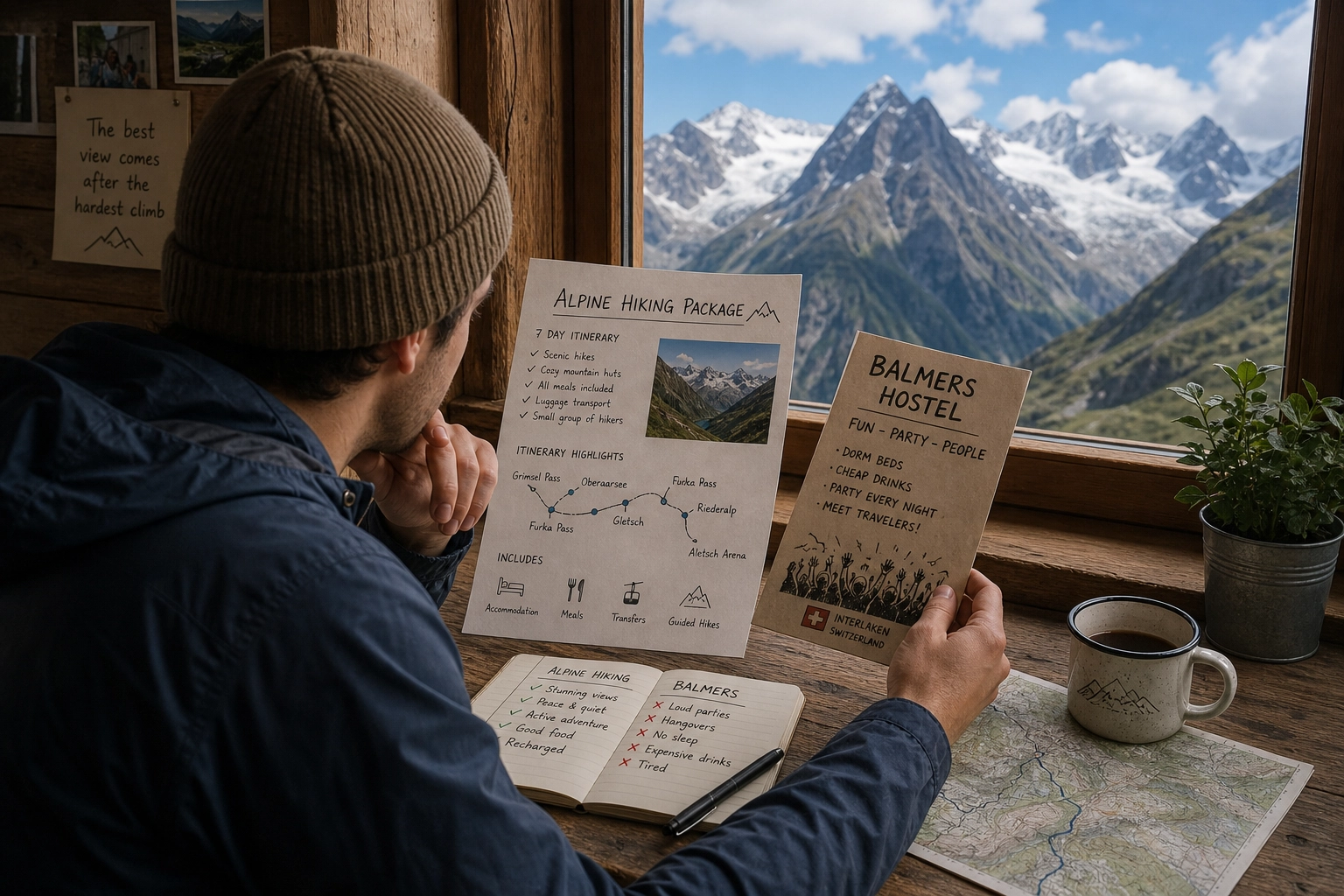
You step off the train at Interlaken Ost, heft your backpack, and walk toward your hostel. You’ve spent months dreaming of the Swiss Alps—early mornings on the trail, crisp mountain air, and sharing stories with fellow hikers over dinner.
But when you walk into a traditional mega-hostel like Balmers, the reality is often different. The common room is packed with 19-year-olds on a whirlwind European rail tour. The conversation isn’t about tomorrow’s elevation gain on the Hardergrat; it’s about which pub crawl has the cheapest Jägermeister. When your alarm goes off at 6:00 AM to catch the first postbus to the trailhead, you’re waking up a dorm full of people who just went to sleep two hours ago.
Switzerland is arguably the most spectacular hiking destination on earth. Yet, for solo backpackers, finding the right home base is a massive challenge. Traditional party hostels offer community but lack a mountain focus. Luxury alpine hotels are financially out of reach. Hut-to-hut hiking is incredible but requires brutal logistical planning and booking months in advance.
So, where does a solo, budget-conscious hiker stay?
In this guide, we are doing a deep dive into the Swiss hiking hostel ecosystem. We will compare the traditional Interlaken hostel experience—epitomized by the legendary Balmers Hostel and Backpackers Villa Sonnenhof—against the rising trend of dedicated, organized hiking packages like Hiking Hostel.
If you want to know how to hike the Alps without blowing your budget, planning complex train routes, or hiking alone, here is the definitive breakdown.
The Interlaken Solo Trap: Why “Basecamp” Hostels Fall Short for Hikers
Interlaken is widely considered the adventure capital of Switzerland. It sits perfectly between Lake Thun and Lake Brienz, acting as the gateway to the Jungfrau region. For a solo traveler, it seems like the obvious choice to base yourself here for a few days [1].
However, Interlaken itself is not in the mountains; it is in a valley. To actually hike the high alpine trails, you must take expensive and time-consuming trains or buses into the Lauterbrunnen or Grindelwald valleys.
Let’s look at the two titans of the Interlaken hostel scene to understand the traditional solo backpacker experience.
Balmers Hostel: The Party Legend
Balmers is the oldest private hostel in Switzerland and an institution on the European backpacking circuit. If you ask a forum about where to stay, you will inevitably hear that “Balmers rules” [2].
- The Vibe: High energy, extremely social, and geared toward nightlife. They have an underground club, hammocks, a hot tub, and a constant rotation of transient backpackers.
- The Crowd: Gap-year travelers, study-abroad students, and fast-paced backpackers spending 2-3 nights in Switzerland before moving on to Italy or France.
- The Problem for Hikers: Sleep quality is often poor due to the nightlife. Furthermore, the community is focused on high-adrenaline, low-effort tourist activities (skydiving, paragliding, or taking the train to the Jungfraujoch) rather than long, grueling days on the trail. If you are looking for a guided hiking group in Switzerland, you likely won’t find them at the hostel bar at 2 AM.
Backpackers Villa Sonnenhof: The Calm & Clean Alternative
If Balmers is the party house, Backpackers Villa Sonnenhof is the sensible older sibling. It frequently ranks as one of the best hostels in the country.
- The Vibe: Clean, highly organized, and peaceful. It caters to a slightly older backpacking crowd and families.
- The Amenities: Excellent kitchens, free breakfast, and strict quiet hours (check-out is firmly until 10:00 AM, with quiet hours enforced) [3].
- The Problem for Hikers: While Sonnenhof solves the sleep issue, it doesn’t solve the logistics issue. You are still in Interlaken. You are still paying daily transport fees to reach the trails. And because it is a traditional transient hostel, it lacks a unified group dynamic. You might meet a hiking partner in the kitchen, but they might be leaving the very next day.
The Evolution: Organized Hiking Holidays
The fundamental flaw with traditional hostels for serious hikers is a lack of shared purpose.
This is where the concept of an organized hiking hostel steps in. Instead of operating as a revolving door for tourists, a company like Hiking Hostel operates as a week-long summer hiking holiday designed specifically for solo travelers, digital nomads, and budget-conscious outdoor enthusiasts.
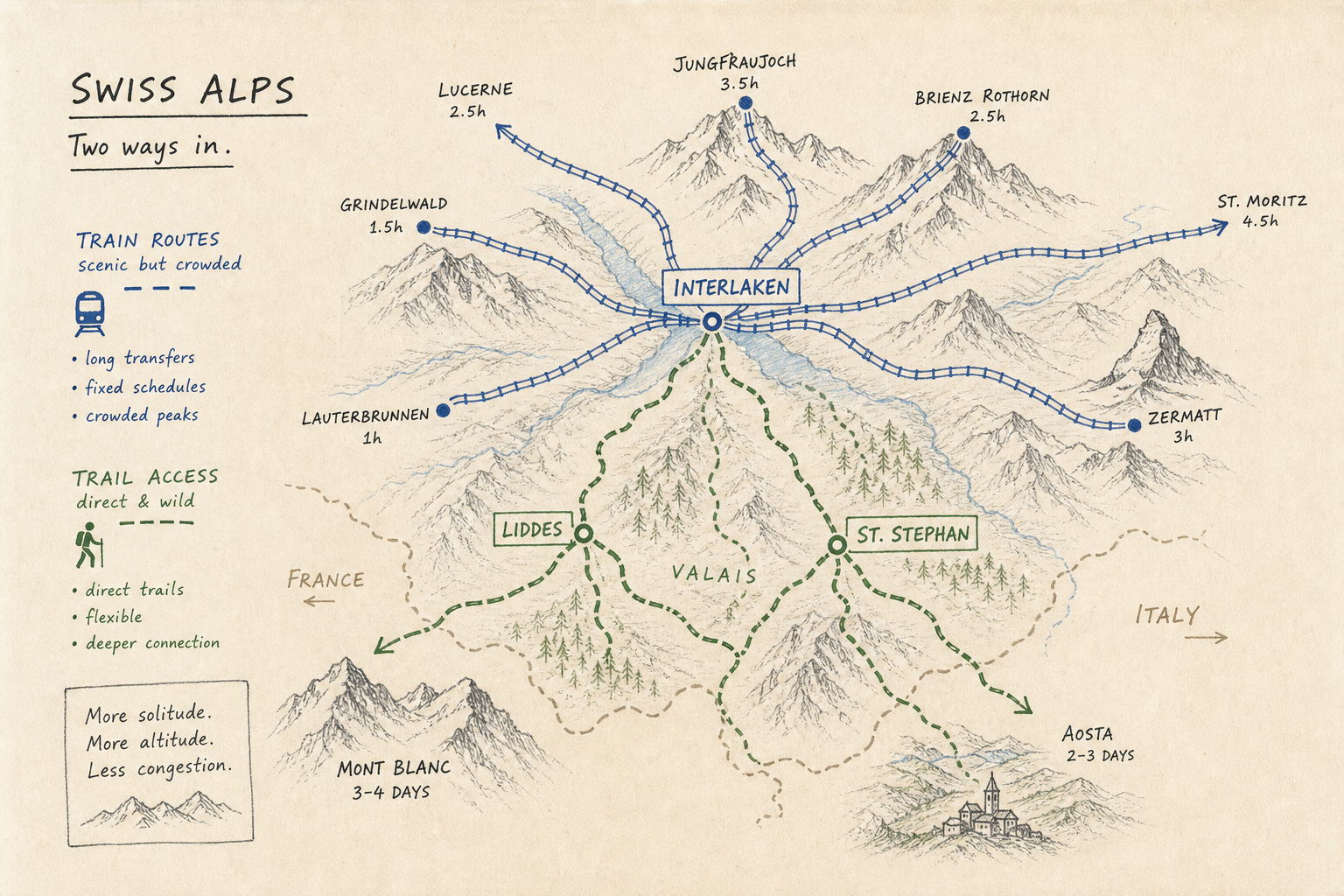
Instead of staying in the busy valley of Interlaken, these trips base you higher up in authentic alpine environments—specifically out of hubs like Liddes (in the Valais region near the St. Bernard Pass) or St. Stephan (in the Simmental valley near Lenk).
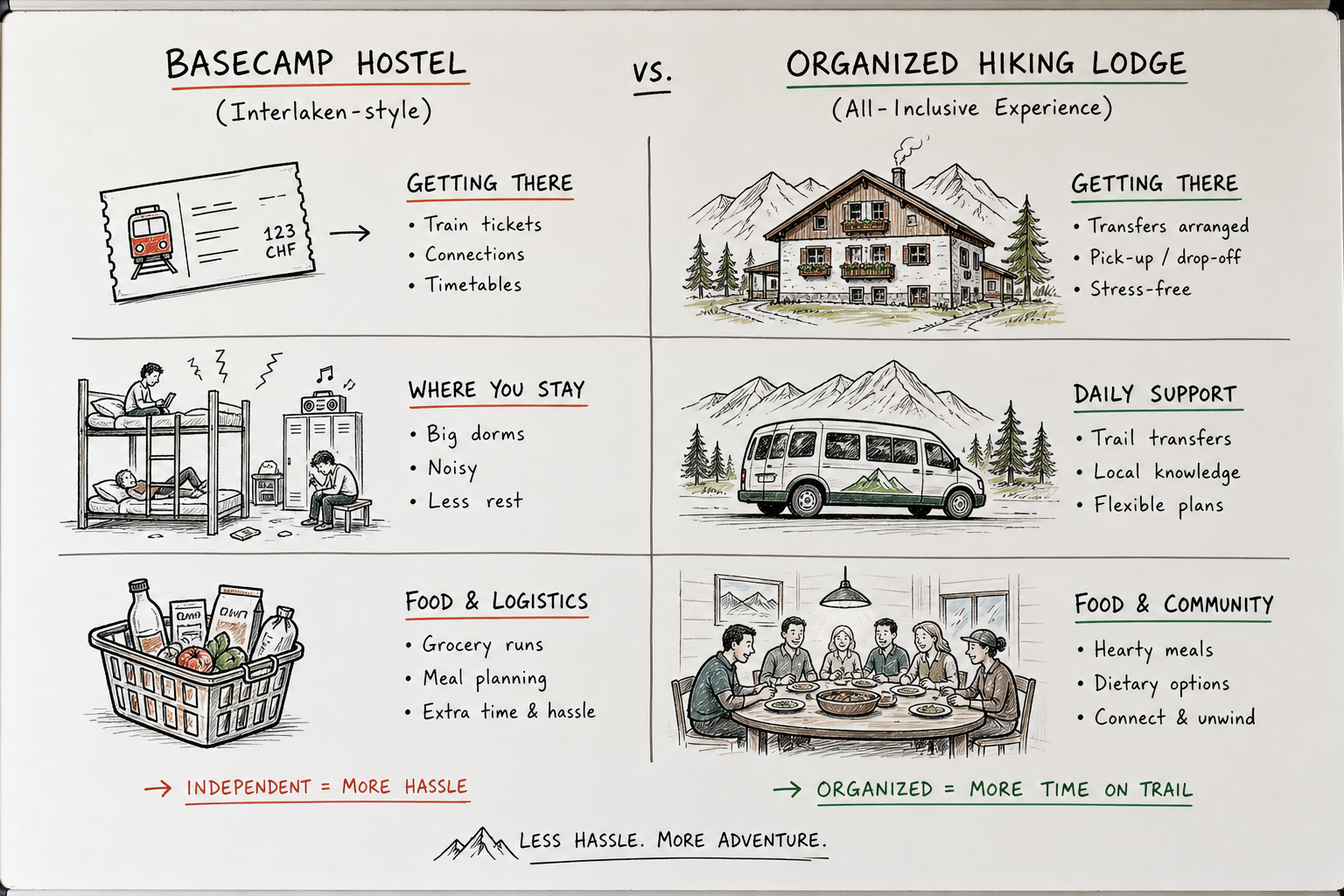
Let’s break down the head-to-head comparison between booking a week at a traditional hostel like Balmers versus booking a week with Hiking Hostel.
1. Cost Predictability and the Swiss Price Shock
Switzerland is notoriously expensive. Many solo backpackers book a cheap €40 bed at Balmers and think they have hacked the system. Then they arrive and realize the hidden costs.
The Traditional Hostel Cost Structure (Per Day Estimate):
- Dorm Bed: CHF 40 - 55
- Supermarket Breakfast: CHF 8
- Train/Bus from Interlaken to Trailhead (e.g., Lauterbrunnen or Grindelwald): CHF 20 - 40 (return)
- Gondola/Cable Car to skip the tree line (often necessary): CHF 30 - 60
- Supermarket Trail Lunch: CHF 15
- Hostel Dinner (Cooking pasta yourself): CHF 10
- Total Estimated Daily Cost: CHF 123 - 188 (Not including gear rental, beers, or guided excursions).
If you want tips for hiking in Switzerland without the high cost, the main advice is usually to avoid trains and cook all your meals. But managing grocery shopping and train timetables every day is exhausting.
The Hiking Hostel Cost Structure:
Hiking Hostel flips this model by offering a packaged week. The upfront cost includes your hostel accommodation, daily meals, airport transfers, daily transport directly to the trailheads, and organized excursions.
Because the logistics are bundled, you know exactly what your week in the Alps will cost before you even board your flight. You aren’t wasting two hours a day in a Swiss Coop grocery store calculating the exchange rate on a block of Gruyère cheese.
2. Trail Access and Excursion Variety
When you base yourself in Interlaken, you are geographically locked into the Bernese Oberland unless you want to spend hours on expensive intercity trains.
With a traditional hostel, your hikes will likely include the popular hits: Schynige Platte, Oeschinensee, or the Eiger Trail. These are stunning, but they are also incredibly crowded during the peak summer months.
An organized package like Hiking Hostel utilizes dedicated vans to drop you at different trailheads every day, unlocking regions that are nearly impossible to stitch together efficiently via public transit.
From their bases in Liddes and St. Stephan, the excursions are vastly more diverse:
- Valais Region: Deep, rugged, and less touristy trails.
- Chamonix / Mont Blanc: Crossing the border into France. It is difficult to figure out ways to visit Mont Blanc without the crowd on your own, but having a guided drop-off changes the game.
- Aosta Valley (Italy): The ability to jump across the Italian border for a day hike or ski excursion (if visiting in winter, read about skiing in the Italian Alps).
- Glacier 3000 & Gstaad: High alpine suspension bridges and glacier walks that are logistically annoying to reach by standard postbuses.
3. The Social Dynamic: Drinking Buddies vs. Trail Companions
Solo travel is about the people you meet.
At Balmers, you will absolutely make friends. But those friendships are forged over beer pong or a quick morning coffee before everyone scatters in different directions.
At Hiking Hostel, the week is structured around a cohort. You arrive together, you eat communal breakfasts, you ride the van to the trailhead together, you suffer up the elevation gains together, and you return to share a massive dinner together.
For a solo traveler or digital nomad, this is a profound difference. You get the community aspect of mountain lodges over luxury hotels without the transient, fleeting nature of a city hostel.
Reviewing Other Swiss Hostel Alternatives
If an organized, week-long package isn’t for you and you still want to travel independently, Switzerland does offer a few other hostels that bridge the gap better than the mega-hostels of Interlaken.
Mountain Hostel Gimmelwald
Located high above the Lauterbrunnen valley, Gimmelwald is a tiny, car-free village. The Mountain Hostel here is legendary among purist hikers.
- Pros: You step out the front door and you are immediately on the trail. The views of the Jungfrau massif are unmatched. It has a rustic, authentic, communal vibe with an excellent kitchen and wood-fired pizza nights.
- Cons: It is entirely isolated. Once the cable car stops running, you are stuck in the village. There is no grocery store in Gimmelwald, meaning you must bring all your food up from the valley. It is also highly competitive to book.
Backpackers Lucerne
If you prefer lakes and a slightly more urban environment to break up your mountain days, Lucerne is a great option. Backpackers Lucerne is highly recommended for solo travelers looking for a quieter vibe [4]. It is located right by the lake and is about an hour by train from Zurich [5].
- Pros: Excellent access to Mount Pilatus and Mount Rigi. Great for travelers who want to mix hiking with city culture, museums, and lake swimming.
- Cons: It is a city hostel, not an alpine lodge. The hikes nearby are beautiful but lack the raw, high-alpine drama of the Valais or the deep Bernese Oberland.
The Logistics of Solo Hiking in Switzerland (Failure Modes)
Why do solo backpackers end up stressed in Switzerland? It usually comes down to three “failure modes” that you must actively manage if you don’t book an all-inclusive package.
Failure Mode 1: The SBB Transit Trap
Swiss public transit (SBB) is the best in the world. It is perfectly punctual. It is also exceptionally expensive if you don’t have the right pass. Solo travelers often buy point-to-point tickets, which drains their budget in days. If you travel independently, you must calculate whether you need a Swiss Travel Pass, a Half-Fare Card, or a regional Berner Oberland Pass.
Failure Mode 2: The “Hut to Hut” Fantasy
Many backpackers arrive wanting to do a multi-day trek like the Walker’s Haute Route. But planning hut to hut hiking in Switzerland requires booking CAS (Swiss Alpine Club) huts 4 to 6 months in advance. You cannot simply show up with a tent, as wild camping above the tree line is strictly regulated and often illegal in nature reserves.
Failure Mode 3: Packing for Two Extremes
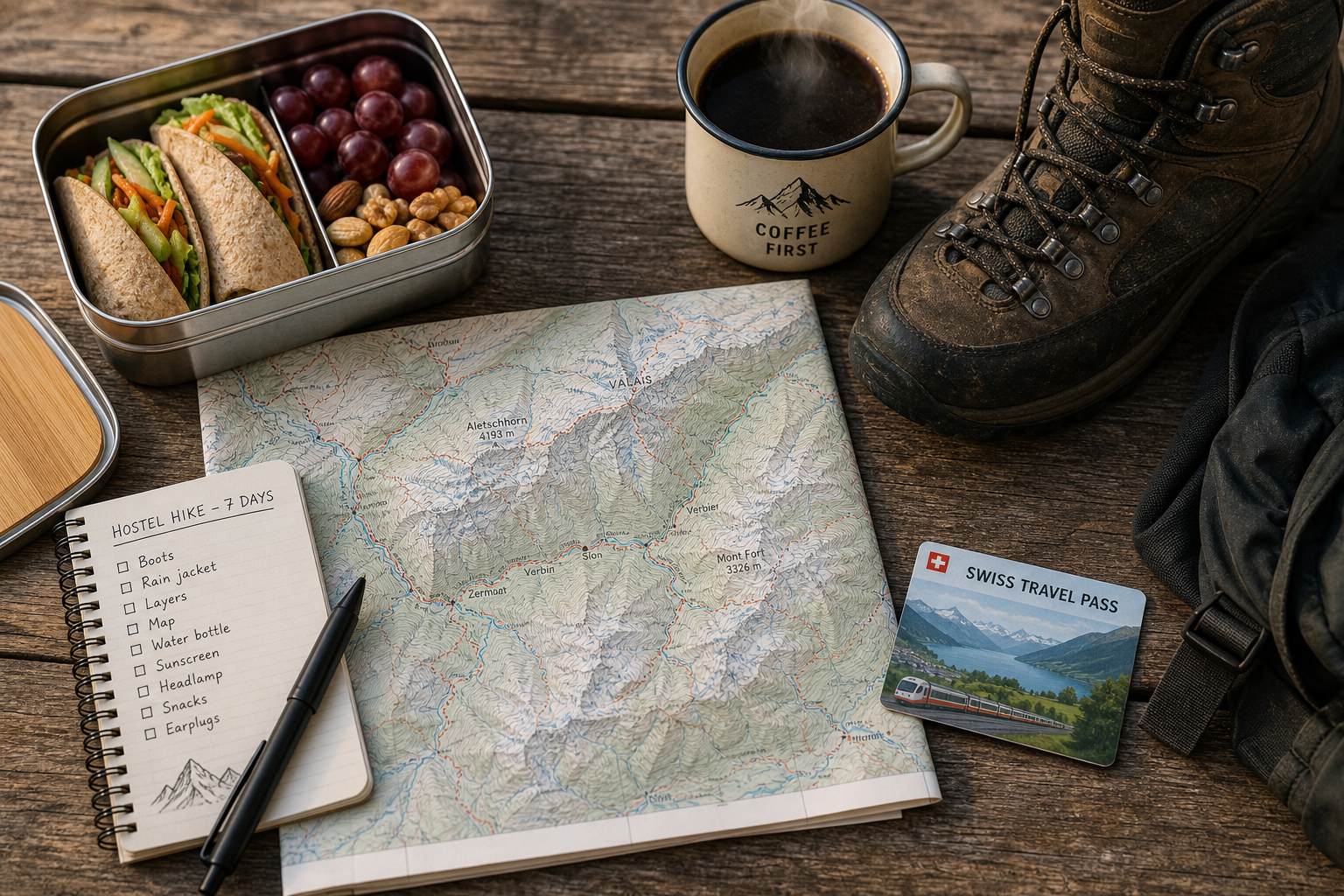
Swiss weather is notoriously fickle. You might start your day in a t-shirt in the valley and need a micro-puff jacket and waterproof shell at the summit. If you are bouncing between city hostels, you tend to overpack. Review our simple 5-step packing guide for a Swiss Alps summer to ensure your backpack remains manageable while still having essential safety gear.
A Week in the Life: The Organized Hiking Hostel Experience
To truly understand the contrast with a traditional hostel, let’s look at what a standard day looks like when you book a week with Hiking Hostel.
07:00 AM - Communal Breakfast:
Wake up in a traditional Swiss chalet in Liddes or St. Stephan. Instead of fighting for stove space with a hungover backpacker, a hearty alpine breakfast is prepared for the group. You pack your provided lunch provisions for the trail.
08:30 AM - Trail Drops:
The group loads into vans. Today, instead of paying 40 CHF for a train, the vans drive the group directly to a trailhead—perhaps crossing into France for one of the best hiking trails near Mont Blanc.
09:30 AM to 4:00 PM - The Hike:
You hike at your own pace. Some of the group pushes hard for a summit; others take a slower pace to photograph wild ibex and alpine lakes. You are solo, but never truly alone. If the weather turns, the logistics support is already tracking the group.
05:00 PM - The Return:
The vans pick you up. No waiting for a delayed postbus in the rain.
07:00 PM - Family Dinner:
The core of the Hiking Hostel experience. A massive, hot meal is prepared for the whole house. You sit around large wooden tables, trading stories with digital nomads, solo travelers, and outdoor enthusiasts from around the world.
Winter Considerations: Ski Hostels and Mountain Biking
While summer hiking is the peak draw, the Swiss hostel dynamic changes in the shoulder and winter seasons.
If you are traveling in the winter, finding a budget basecamp becomes even harder. Ski resorts are famously hostile to budget backpackers. If you are looking for winter options, investigate which Swiss ski resort fits a backpacker’s budget.
Similarly, if you are transitioning from hiking to downhill or enduro biking, the communal lodge model works perfectly. You can easily find the right mountain bike group for alpine trails when you are staying in a dedicated outdoor-focused lodge rather than a generic city hostel.
Decision Matrix: Balmers vs. Hiking Hostel
Still unsure which route to take? Use this framework to decide your Swiss accommodation strategy.
Choose Balmers or a Traditional Interlaken Hostel if:
- Your primary goal is partying and meeting a high volume of young, international backpackers.
- You only have 2 or 3 days in Switzerland and want to do “bucket list” tourist activities (Jungfraujoch, paragliding).
- You don’t mind navigating complex train schedules.
- You are okay with hiking busy, popular trails like Lauterbrunnen and Oeschinensee.
Choose Hiking Hostel (Organized Package) if:
- Your primary goal is actually hiking and experiencing the remote alpine wilderness.
- You are a solo traveler who wants a guaranteed social group of like-minded outdoor enthusiasts.
- You want a stress-free week where meals, trail transport, and airport transfers are handled for you.
- You want to explore diverse regions like Valais, Aosta, and Mont Blanc in a single week without going bankrupt on transit tickets.
- You are a digital nomad who wants a stable basecamp with good Wi-Fi to check emails before heading up the mountain.
Final Thoughts on Swiss Solo Backpacking
Switzerland does not have to be an isolating or stress-inducing destination for solo backpackers. The key is aligning your accommodation with your actual travel goals.
Traditional hostels like Balmers and Backpackers Villa Sonnenhof are fantastic at what they do: providing cheap beds and high energy for transient tourists in Interlaken. But for the dedicated hiker, they often add logistical friction and unexpected costs.
By opting for an organized hiking lodge experience—where your basecamp is in the mountains, your trail transport is handled, and your dinner table is full of fellow hikers—you unlock the Swiss Alps the way they were meant to be experienced. You get all the freedom of solo travel, with none of the logistical headaches.