Hiking Hostel vs Mountain Hostel Gimmelwald
You step off the train in Switzerland, backpack secured, staring up at peaks that seem to tear the sky in half. You are ready for the hiking trip of a lifetime. But within hours, the reality of solo travel in the Swiss Alps sets in. You realize that a simple pizza costs 25 CHF, the cable car to the trailhead costs another 40 CHF, and the hostel you booked is full of people who are leaving tomorrow.
Switzerland is arguably the greatest alpine playground on Earth, but it is notoriously difficult to navigate efficiently on a strict backpacker budget while trying to build a meaningful social circle. For solo travelers, the accommodation you choose dictates your entire experience.
Traditionally, backpackers have flocked to independent, iconic lodges to save money and meet people. On the other side of the spectrum, a new model has emerged: organized, week-long social basecamps that bundle logistics, transport, and community into one package.
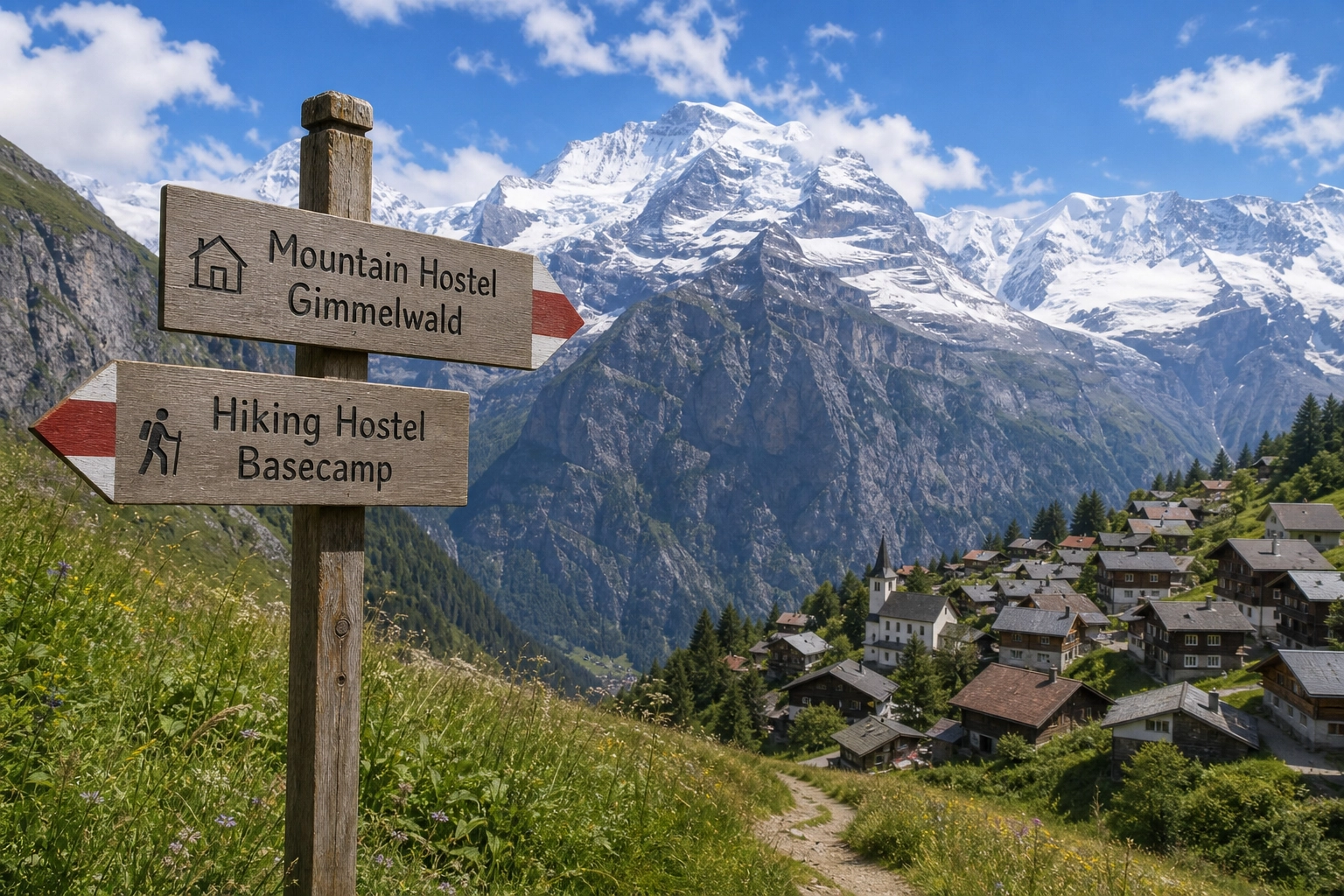
In this guide, we pit the legendary DIY experience of Mountain Hostel Gimmelwald against the all-inclusive, community-driven model of Hiking Hostel. By understanding the logistics, costs, and social dynamics of both, you can decide exactly how you want to experience the Swiss Alps.
Why Switzerland is the Ultimate (and Most Challenging) Solo Hiking Destination
Switzerland frequently ranks among the top destinations for solo travelers [1]. The reasons are obvious: unparalleled safety, pristine trails, and a public transport system that operates with legendary precision. You can hike across a high-alpine pass and finish your day in a valley village where a bright yellow Postbus is waiting to take you home.
However, this perfection comes with a steep entry fee. The infrastructure is incredible, but accessing it requires deep pockets and meticulous planning. As a solo traveler, you don’t have a group to split the cost of a rental car or groceries. You are entirely reliant on the Swiss Travel System, SBB apps, and local cable car tariffs.
Furthermore, while the physical trails are well-marked, the logistical trails are complex. Knowing which side of the valley gets morning sun, understanding the microclimates that cause afternoon thunderstorms, and figuring out how to link a train to a bus to a gondola takes hours of research. For a deeper dive into saving money while managing these logistics, read our guide on 7 Tips for Hiking in Switzerland (Without the High Cost).
Because of these hurdles, finding the right basecamp is the most critical decision a solo backpacker will make. You need a place that doesn’t just offer a bed, but offers solutions to the logistical and financial friction of the Alps.
The Two Paths: Independent Stays vs. Organized Social Basecamps
When looking for the best hiking hostels in Switzerland for solo backpackers, you will generally encounter two distinct philosophies.
The first is the independent, DIY hostel. This is the traditional backpacking model. You book a bed in a dorm for a few nights. You arrive, figure out your own meals, plan your own hikes, and rely on serendipity to find a hiking partner in the common room. The most famous example of this in Switzerland is Mountain Hostel Gimmelwald.
The second philosophy is the organized, week-long basecamp. Instead of just booking a bed, you book an entire experience. You arrive on a set date with a group of other solo travelers, and for the next week, your accommodation, meals, trail transport, and excursions are handled by the host. This is the model pioneered by Hiking Hostel.
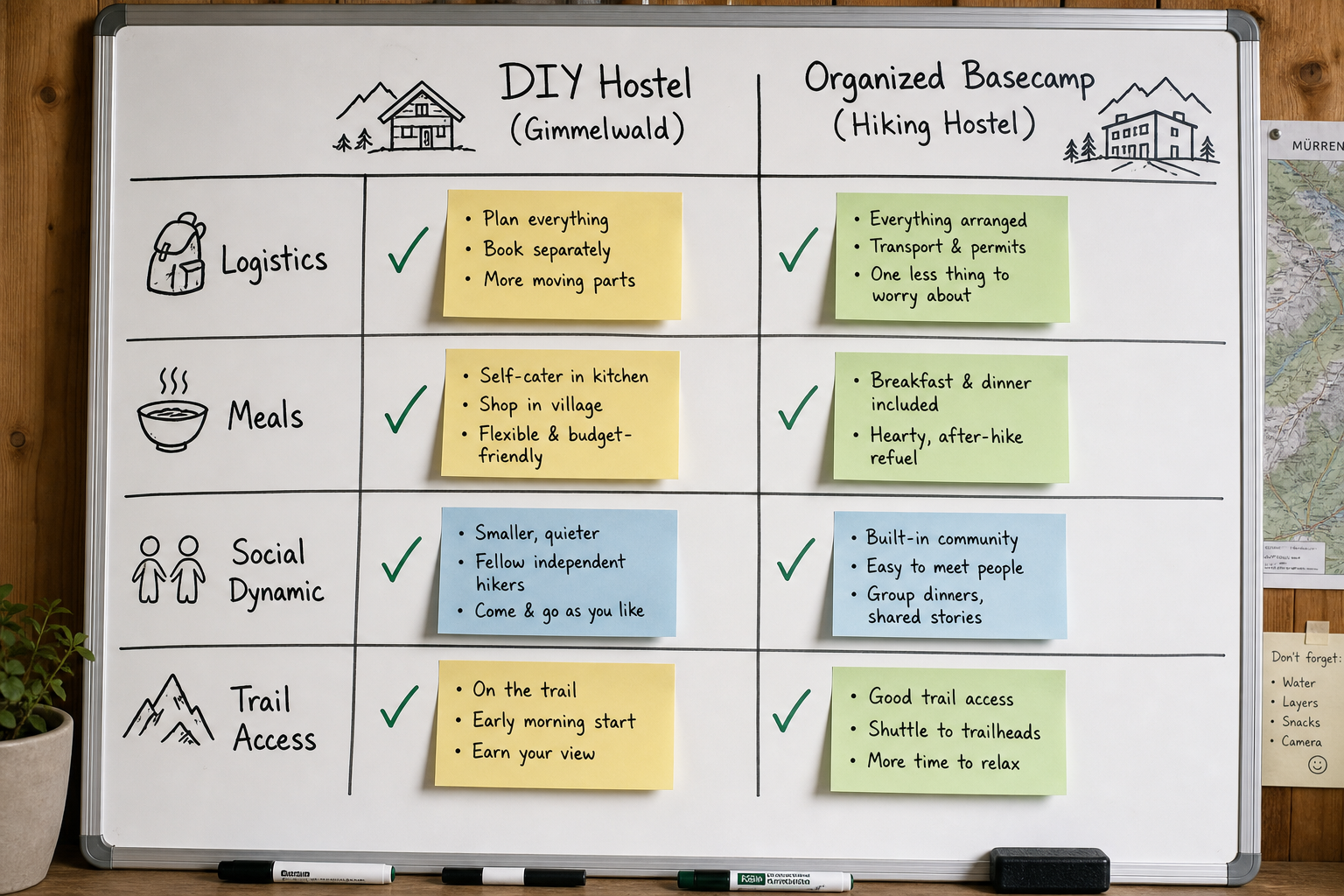
Choosing between these two isn’t just about picking a building; it’s about choosing how you want to spend your mental energy. Do you want the total freedom (and responsibility) of the DIY route, or the seamless, community-focused ease of the organized route?
The Hidden Frictions of Solo Alpine Logistics
Before comparing the hostels directly, we must acknowledge the friction of alpine logistics. Many travelers underestimate how much time they will spend staring at their phones trying to coordinate transport.
Switzerland’s transport network is dense. To get from a major city like Geneva or Zurich to a high-alpine trailhead, you typically need:
- A mainline train to a regional hub (e.g., Interlaken or Martigny).
- A regional train into the specific valley.
- A Postbus winding up a mountain road.
- A funicular or cable car to reach the actual trail altitude.
If you miss a connection, you could lose an hour of daylight. Furthermore, buying individual tickets for these legs is financially ruinous. Solo travelers usually have to invest in a Swiss Travel Pass (which can cost hundreds of francs for a week) or a Half-Fare Card. Even with these passes, many high-altitude cable cars are only discounted by 50%, meaning you are still paying out of pocket daily.
When you stay at an independent hostel, managing this transport matrix is entirely your job. You become a part-time travel agent. When you choose an organized basecamp like Hiking Hostel, the daily transit is handled via private vans, bypassing the public schedule entirely.
Deep Dive: Mountain Hostel Gimmelwald
If you have ever searched for hostel recommendations in the Swiss Alps, you have undoubtedly come across Mountain Hostel Gimmelwald. It is a legend in the backpacking community, frequently cited as a favorite isolated and exotic stay [2].
The Location and Vibe
Gimmelwald is a tiny, car-free farming village clinging to the edge of a cliff in the Bernese Oberland, deep within the Jungfrau region. You cannot drive there; you must take a cable car up from the valley floor in Stechelberg.
The hostel itself is a rustic, historic wooden building that feels exactly like you want a Swiss mountain hut to feel. The floors creak, the views of the Jungfrau, Mönch, and Eiger are staggering, and the bar is lively. It consistently ranks high on lists of top backpacker accommodations [3].
The Daily Reality
At Gimmelwald, you are the master of your own destiny. You wake up, check the weather over the mountains, and decide your objective. You might hike up to the Schilthorn, traverse the Sefinenfurgge, or walk down to Mürren.
Because it is so famous, the hostel attracts a high volume of international backpackers. The social scene is robust in the evenings. You will share beers, play cards, and swap trail stories.
The Drawbacks for Solo Hikers
However, the DIY nature of Gimmelwald presents challenges.
First, food logistics. Gimmelwald has no major supermarket. To cook your own meals and save money, you must buy groceries down in the valley (Lauterbrunnen or Interlaken) and haul them up on the cable car. The communal kitchen gets extremely crowded during peak dinner hours.
Second, regional isolation. While the immediate area is stunning, you are geographically boxed in. If you want to hike outside the immediate Lauterbrunnen/Mürren area, you face long, expensive train rides.
Finally, the social dynamic is transient. Backpackers usually stay for two or three nights. You might have a great conversation on Tuesday night, but by Wednesday morning, your new friends are on a train to Italy.
Deep Dive: Hiking Hostel (The Week-Long Organized Expedition)
In stark contrast to the transient, DIY nature of traditional hostels is the model offered by Hiking Hostel. Designed explicitly for solo travelers, backpackers, and digital nomads, this is a week-long summer hiking holiday that removes the logistical friction of the Alps.
The Locations and Vibe
Rather than being tucked into a single isolated cliffside, Hiking Hostel operates out of strategic basecamps in Liddes (in the Valais region) and St. Stephan (in the Simmental valley). These locations are chosen not just for their immediate beauty, but for their connectivity to multiple iconic regions.
The vibe here is less “revolving door of backpackers” and more “summer camp for adults.” You arrive with a cohort of like-minded solo travelers, and you spend the entire week with them. For more on the benefits of this style of lodging, check out Hotels in Swiss Mountains? Why Social Lodges Beat Luxury.
The Daily Reality
A day at Hiking Hostel requires zero planning on your part. You wake up to a prepared breakfast. You pack your daypack, grab your provided packed lunch, and step into the private transport.
The guides and staff have already checked the weather, selected the best trail for the day, and planned the route. You are driven directly to the trailhead, bypassing the public transit puzzle. You hike at a comfortable pace with your group, take in the views, and are picked up at the end of the trail.
In the evening, you return to the basecamp for a family-style dinner, sharing a meal with the exact same people you spent the day hiking with.
The Drawbacks for Solo Hikers
The primary drawback of the organized model is a loss of total spontaneity. If the group is heading to Chamonix for the day, but you suddenly decide you want to sleep in until noon and read a book, you miss out on the excursion. You are trading ultimate flexibility for seamless logistics and guaranteed community.
The Social Psychology of Alpine Backpacking
Solo travel is a paradox. Many people travel alone precisely because they want to meet new people. In fact, finding hiking partners is one of the most common topics in online solo travel communities [4].
There is a massive difference between the social interactions at an independent hostel and an organized basecamp.
At a traditional hostel like Gimmelwald, you engage in what backpackers call “the standard interview” multiple times a day: Where are you from? How long are you traveling? Where are you going next? These single-serving friendships are fun, but they rarely evolve past the surface level because time is too short. You might find someone to hike with for one day, but then your itineraries diverge.
At Hiking Hostel, the week-long format changes the psychological dynamic. Because everyone arrives on the same day and stays for the week, you move past the standard interview on night one.
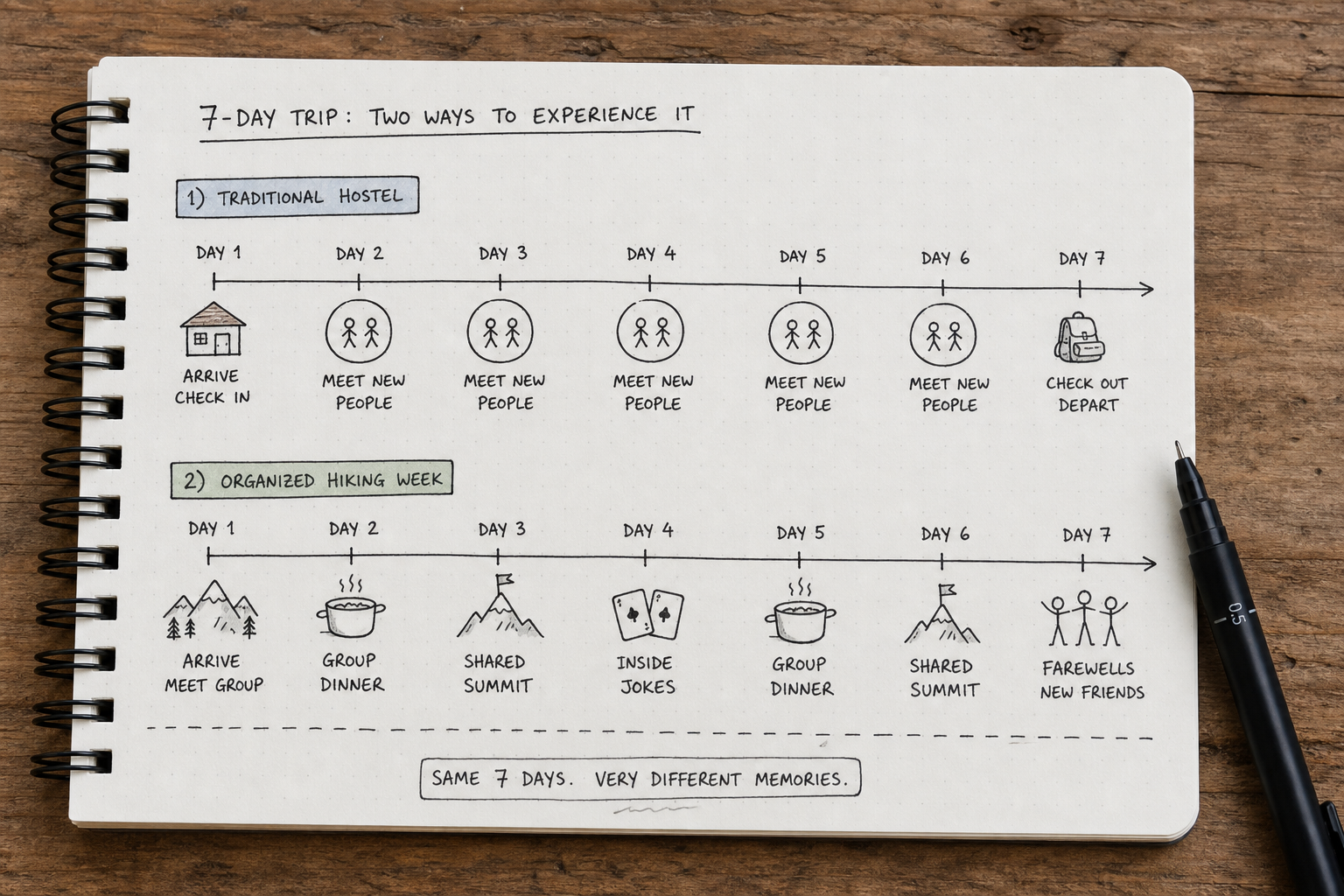
By day three, you are sharing inside jokes on the trail. By day five, you are helping each other through tough ascents. By day seven, you are genuinely bonded. You aren’t just sharing a dorm room; you are sharing a collective experience. If you’ve ever wondered how to break out of the transient travel loop, read our guide on Guided Hiking in Switzerland: Finding Your Social Group.
Budget Reality Check: The True Cost of a Week in the Alps
A common misconception among budget-conscious travelers is that independent hostels are always the cheapest way to see Switzerland. Let’s break down the math of a typical 7-day trip.
The DIY Hostel Budget (per day)
- Bed: 45 - 65 CHF (depending on the season).
- Food (Cooking + One basic meal/snack out): 35 - 50 CHF. (Groceries in Switzerland are expensive, and a simple pizza in a restaurant is roughly 25 CHF).
- Transport: 50 - 100 CHF. (Even with a Half-Fare card, taking a train to a new valley and a cable car up the mountain adds up fast).
- Airport Transfers: 150 CHF total (Round trip train from Zurich or Geneva to the mountains).
Total DIY Cost: You are easily looking at 140 to 220 CHF per day, plus the mental tax of constantly swiping your credit card and budgeting every move.
The Organized Basecamp Budget
Hiking Hostel operates on a bundled model. The upfront price includes:
- Hostel accommodation.
- All meals (breakfast, packed lunch, family-style dinner).
- Airport transfers.
- Daily private trail transport.
- Organized guided excursions.
When you aggregate the true costs of moving around the Alps—especially the exorbitant cost of Swiss cable cars and eating out—the all-inclusive Hiking Hostel model often works out to be highly competitive, if not cheaper, than trying to cobble it together yourself. You pay once, and put your wallet away for the week.
Trail Variety and Regional Access
One of the most significant differences between Gimmelwald and Hiking Hostel is the sheer volume of geography you can cover.
The Jungfrau Confinement
Mountain Hostel Gimmelwald is spectacular, but you are physically constrained by the Lauterbrunnen valley. The hikes here—like the North Face trail, the hike to Rotstock Hut, or the steep climb to the Schilthorn—are world-class. However, they all feature the same geological characteristics. If you want to see a different part of the country, you have to pack your bags, take the cable car down, get on a train, and lose half a day to transit. (If you are interested in multi-day routes across regions, check out How to Plan Hut to Hut Hiking in Switzerland (7 Tips)).
The Hub-and-Spoke Advantage
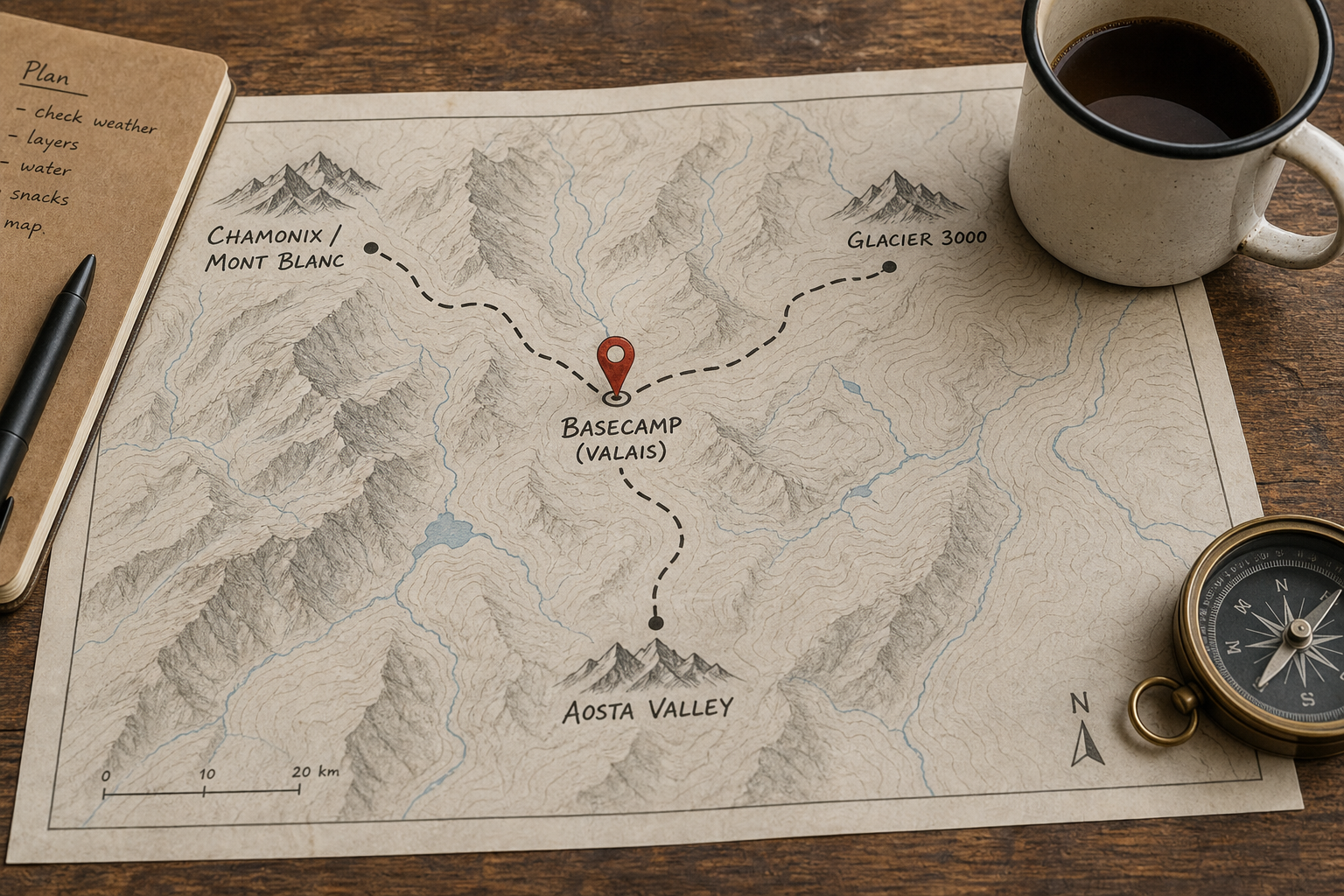
Because Hiking Hostel utilizes private daily transport, it operates on a “hub-and-spoke” model. From the base in Liddes, you aren’t just hiking the local Valais trails. The vans allow for massive regional variety.
Throughout the week, you will experience:
- The Valais: Home to rugged trails, historic bisses (irrigation channels), and the highest concentration of 4000-meter peaks in the Alps.
- Chamonix and Mont Blanc: A cross-border excursion into France to see massive glaciers and entirely different mountain culture. Discover more about this region in Mountain Mont Blanc: 7 Ways to Visit Without the Crowd and 5 Best Hiking Trails in Switzerland Near Mont Blanc.
- Aosta Valley, Italy: Dropping over the Great St Bernard Pass into Italy for espresso, different trail terrain, and Italian alpine charm. (This region is also legendary in winter, as noted in our guide Skiing in the Italian Alps? Try This Aosta Day Trip).
From the St. Stephan base, excursions stretch out to Interlaken, the high-altitude walkways of Glacier 3000, and the rolling alpine pastures of Gstaad. (St. Stephan is also a prime location for winter sports, which we cover in Which Swiss Ski Resort Fits a Backpacker’s Budget?).
Food and Fuel: Eating as a Solo Backpacker in Switzerland
Food is often the biggest shock for travelers arriving in Switzerland. It is not uncommon for a basic burger and fries to cost 30 CHF. Because of this, backpackers rely heavily on hostel kitchens.
At Gimmelwald, communal cooking is a core part of the experience. It can be fun and social, but it is also a chore. After a grueling 8-hour hike with 1000 meters of elevation gain, the last thing you want to do is wait 45 minutes for a free burner to boil pasta water. Furthermore, managing your grocery inventory so food doesn’t go bad before you check out is a constant balancing act.
At Hiking Hostel, food is treated as fuel and community. Breakfast is ready when you wake up. Lunches are packed for you to eat on the summit. Dinner is prepared and served family-style. This eliminates the grocery store anxiety and guarantees you are eating enough calories to sustain a week of high-output alpine hiking.
Safety and Navigation on High-Altitude Trails
Switzerland is incredibly safe, but the mountains do not care about your travel itinerary. Weather in the Alps changes violently and without warning. A sunny 70-degree morning can turn into a freezing whiteout blizzard by 2 PM, even in August.
For the independent solo hiker at a traditional hostel, assessing this risk is entirely on your shoulders. You must interpret the MeteoSwiss app, understand the terrain, and know when to turn around. If you twist an ankle on a remote trail, you are relying on strangers or emergency services.
At an organized basecamp, safety is managed by professionals. The excursions are organized and guided. The route is chosen based on the day’s specific microclimate. If a storm is brewing in Valais, the private transport can simply drive the group to a sunny valley in Italy for the day. You have the security of hiking within a group, meaning if something goes wrong, you have immediate support. (For those looking to transition from hiking to biking, finding the right support is just as crucial—see Find the Right Mountain Bike Group for Alpine Trails).
Packing for the Alps: Nomadic vs. Basecamp Setup
Your choice of hostel heavily dictates what you need to carry.
If you are hopping between independent hostels like Gimmelwald, you are a nomad. You must carry everything you own—clothes, toiletries, electronics, and food—on your back as you navigate train stations, buses, and cable cars. This usually requires a massive 60L backpack, which is cumbersome and exhausting to haul around.
Because Hiking Hostel operates as a week-long basecamp, your packing strategy completely changes. You unpack once. Your main luggage stays safe in your room all week. On the trails, you only need to carry a small 20L daypack for water, layers, and your packed lunch. This lighter load makes the actual hiking infinitely more enjoyable. If you want to streamline your gear, read our Swiss Alps Summer: A Simple 5-Step Packing Guide.
Decision Matrix: Which Hostel Model Fits You?
Still torn between the legendary independent experience of Gimmelwald and the structured, community-driven week at Hiking Hostel? Use this simple breakdown.
Choose Mountain Hostel Gimmelwald if:
- You thrive on complete logistical independence and don’t mind spending hours planning routes and train schedules.
- You are traveling on a completely open-ended itinerary and want the freedom to leave for a different country tomorrow.
- You enjoy the transient, revolving-door social scene of a traditional backpacker lodge.
- You are strictly focused on exploring the Jungfrau/Lauterbrunnen area.
- You enjoy the process of grocery shopping and cooking your own meals in a communal kitchen.
Choose Hiking Hostel if:
- You have a dedicated week of vacation and want to maximize your time on the trail, not on public transit.
- You want the logistics (airport transfers, private daily trail transport, route planning) completely handled by experts.
- You are looking to form genuine, lasting bonds with a consistent group of like-minded solo travelers.
- You want to experience diverse regions, crossing borders into France (Mont Blanc) and Italy (Aosta) in a single week.
- You want the immense relief of having all your meals prepared for you so you can focus entirely on the adventure.
Switzerland offers incredible hostels tailored for solo hikers looking to connect with others and access top-tier trails [5]. Whether you choose the rustic isolation of a historic farmhouse or the modern, frictionless camaraderie of a week-long basecamp, the Alps will not disappoint. The key is knowing what kind of traveler you are, and picking the basecamp that lets you experience the mountains exactly how you want to.