Mont Blanc Mountain Weather: How to Plan Your 2026 Hike
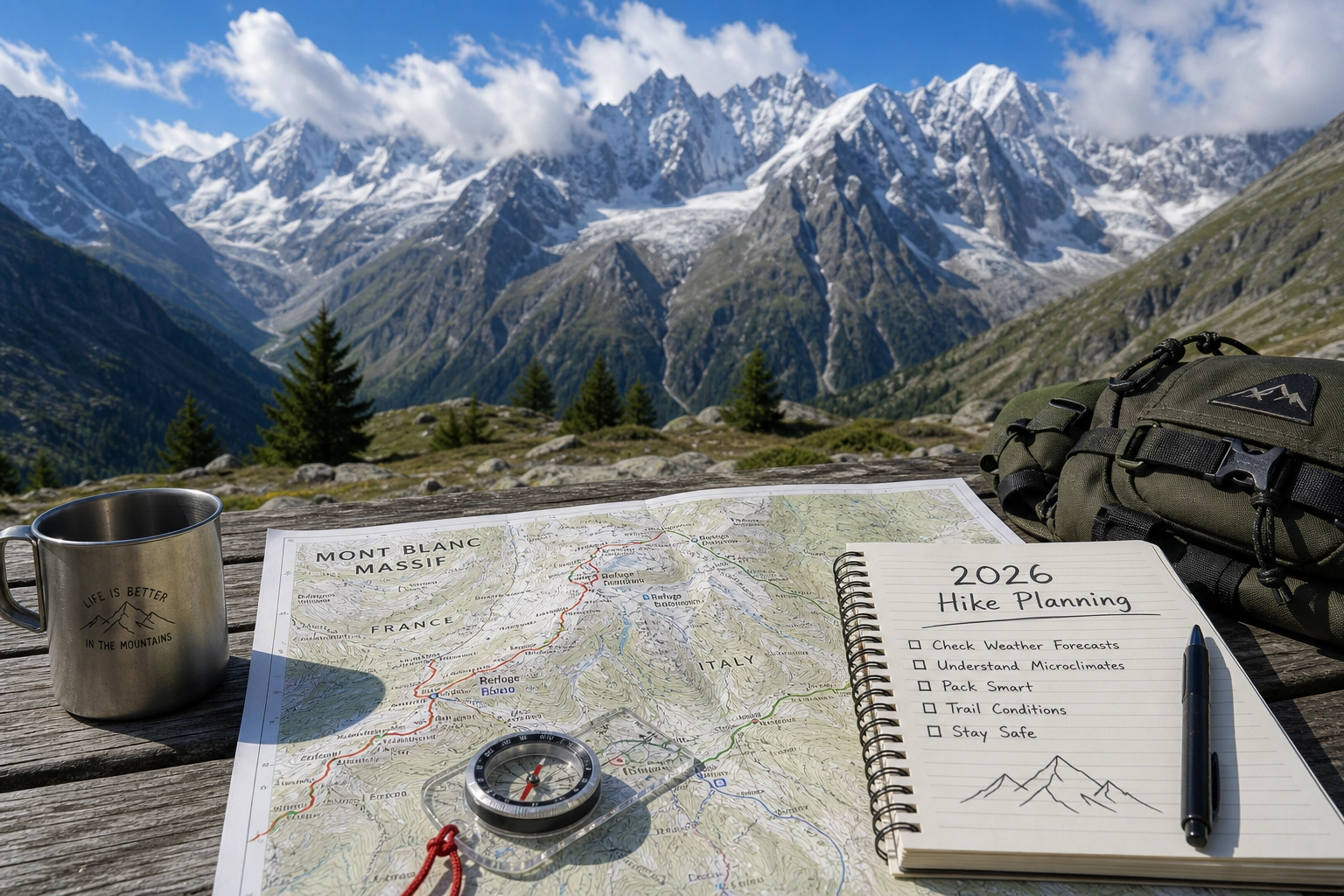
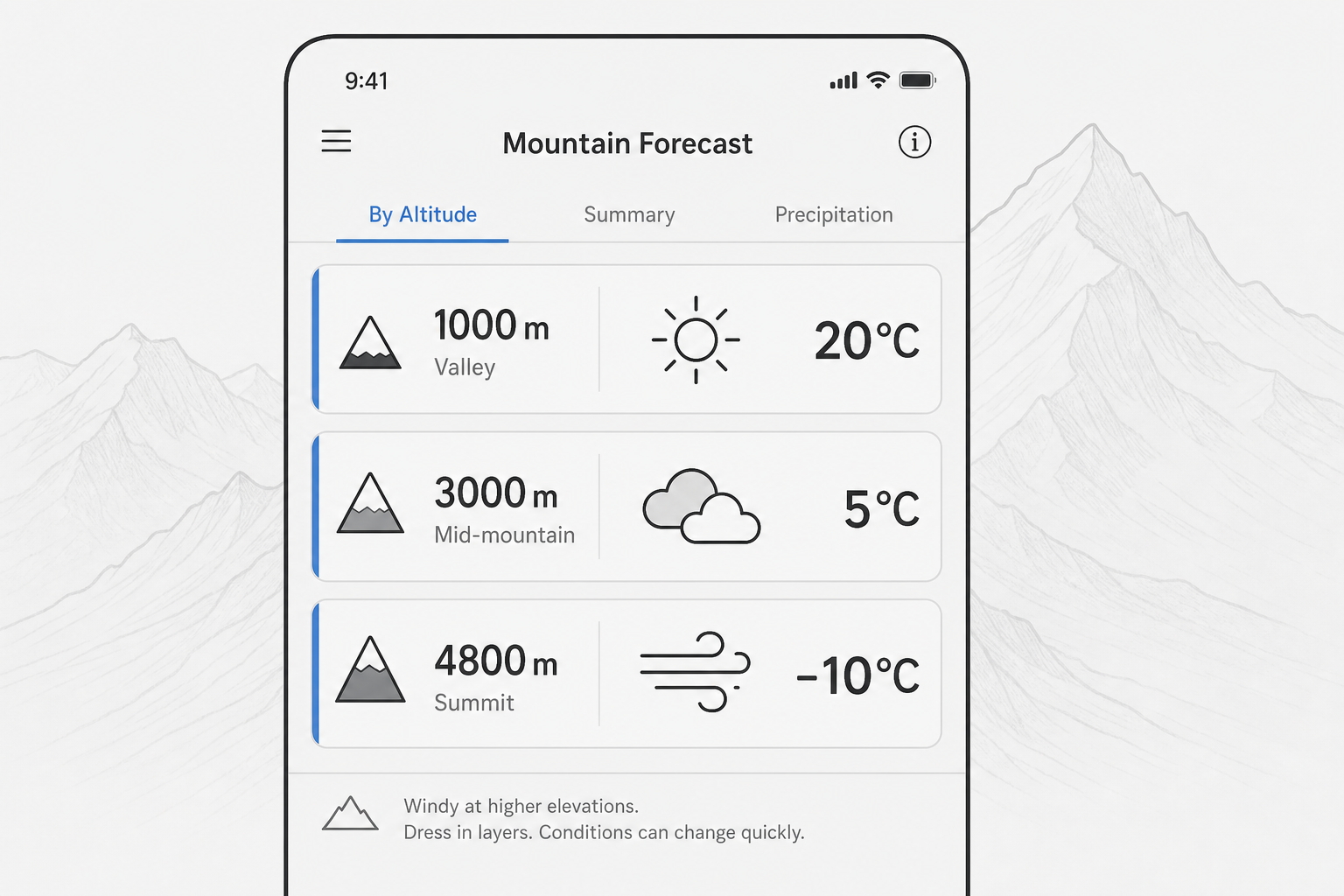
In the Alps, altitude is everything. Every year, eager hikers and climbers check their standard weather apps, see a sunny 22°C (71°F) predicted for the valley, and head out in a single base layer. By the time they reach 2,500 meters, the temperature has dropped by 10 degrees, the wind is howling at 50 kilometers per hour, and dark clouds are piling up over the ridges.
The Mont Blanc massif is massive enough to create its own weather. Spanning the borders of France, Italy, and Switzerland, it acts as a colossal wall that catches weather systems from the Atlantic and the Mediterranean. Understanding Mont Blanc mountain weather isn’t just about picking the right day for your photos; it is the single most important factor for a safe, successful hike in 2026.
Whether you are aiming for the summit, trekking the Tour du Mont Blanc (TMB), or exploring the surrounding Swiss valleys from a base camp like Ski Hostel, knowing how to interpret alpine forecasts will dictate your schedule, your gear, and your safety.
The Anatomy of Alpine Microclimates
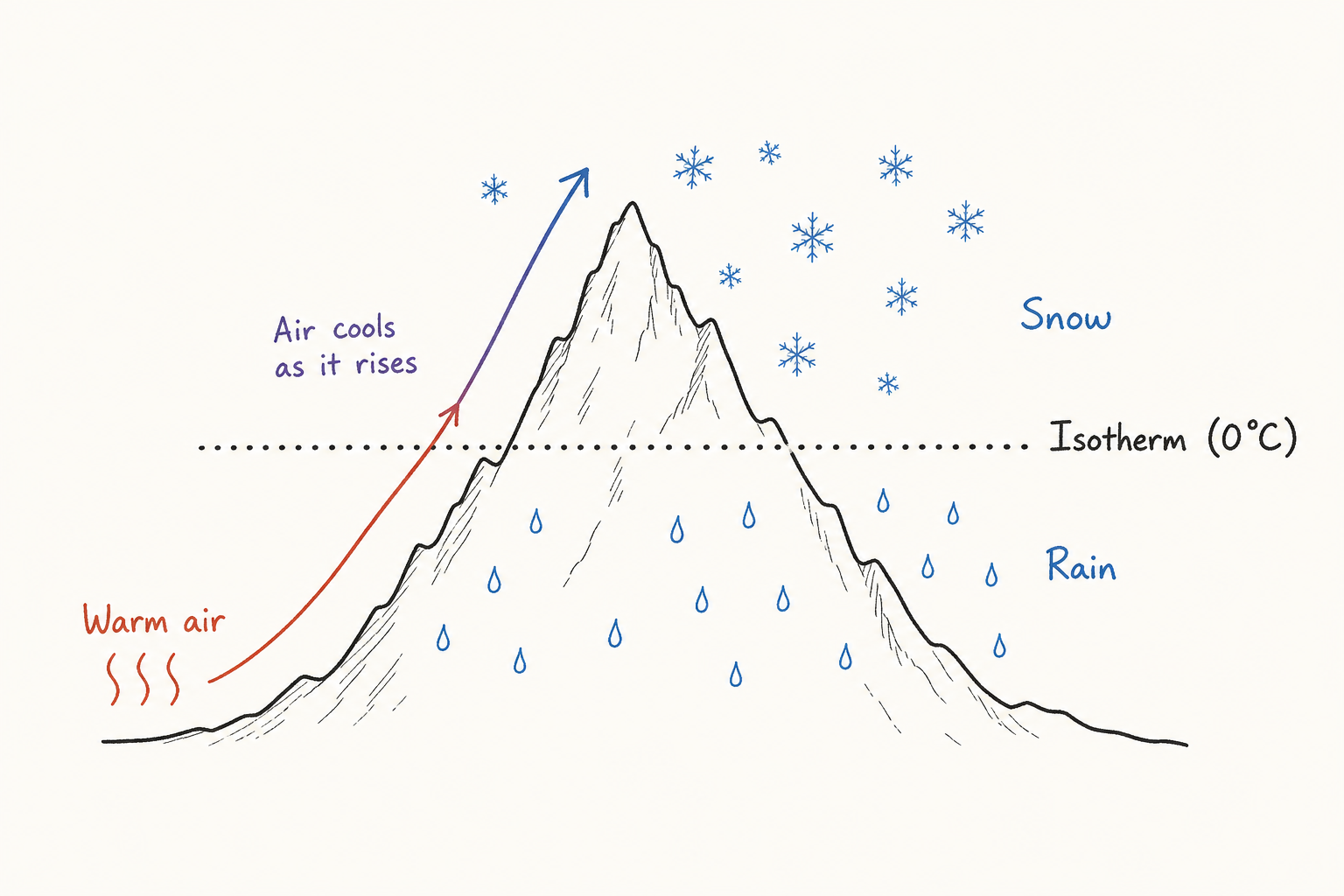
To understand why forecasts shift so dramatically, you have to look at the geography. The Mont Blanc massif sits at a crossroads. When moist air from the west hits the mountains, it is forced upward. As it rises, it cools rapidly, condensing into clouds, rain, or snow. This is known as orographic lift.
Because of this, the weather on the French side can be vastly different from the Italian side or the Swiss side in the Val de Bagnes region.
The Isotherm (Zero-Degree Level)
In mountain forecasting, the most informative metric isn’t the daily high or low—it is the isotherm, or the altitude at which the temperature drops to 0°C (32°F). If the isotherm is sitting at 3,000 meters, you know that precipitation above that line will fall as snow, and high-altitude glaciers will remain relatively stable. If a summer heatwave pushes the isotherm above 4,500 meters, snow bridges weaken, rockfall risk skyrockets, and afternoon thunderstorms become highly probable.
Monthly Weather Breakdown for the 2026 Season
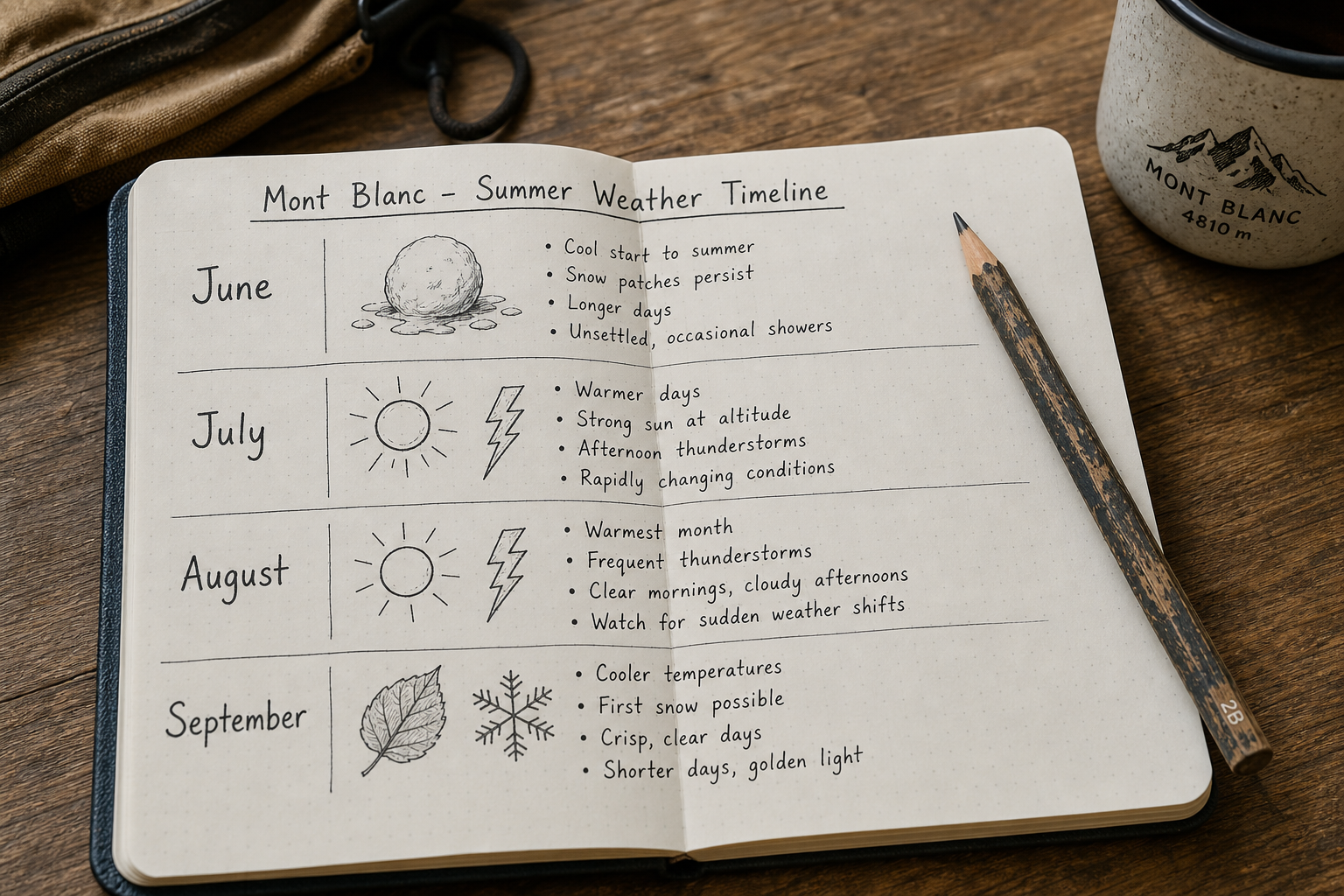
Choosing when to hike depends entirely on your tolerance for snow, crowds, and sudden storms. Here is how the weather generally behaves throughout the primary hiking season.
June: The Unpredictable Early Season
In June, the valleys are lush and green, but anything above 2,500 meters still holds significant winter snowpack.
- Valley Temps: 15°C to 23°C
- Altitude (3,000m) Temps: -2°C to 5°C
- What to Expect: Fast-moving fronts. You might start a hike in a t-shirt and need crampons to cross high passes. Afternoon rain showers are common as snowmelt creates high humidity.
July and August: Peak Summer (and Peak Storms)
This is the traditional hiking season. The snow has cleared from most of the standard routes, and days are long.
- Valley Temps: 20°C to 28°C
- Altitude (3,000m) Temps: 2°C to 12°C
- What to Expect: Consistent morning sunshine followed by convective cloud buildup. By 3:00 PM, these clouds frequently erupt into violent, localized thunderstorms. The golden rule for high-altitude hiking in August is to be off the ridges and passes by 2:00 PM.
September: The Hiker’s Sweet Spot
For many experienced backpackers, September is the best time to visit. The frantic energy of August fades, and the atmosphere stabilizes.
- Valley Temps: 12°C to 20°C
- Altitude (3,000m) Temps: -5°C to 6°C
- What to Expect: Crisp, clear days with incredible visibility. However, the days are shorter, and cold fronts can bring the first serious autumn snowstorms down to 2,000 meters. You must be prepared for winter-like conditions.
How to Read a Mont Blanc Weather Forecast
Standard smartphone weather apps are notoriously bad at predicting mountain conditions because they default to valley towns. If you type “Chamonix” into your phone, you are getting the weather for an elevation of 1,035 meters.
For accurate data, you need to use specialized mountain weather services that break down forecasts by elevation.
Reliable Tools for Your Trip:
- Météo France (Chamonix Valley): Provides highly accurate local radar and bulletin updates for the French side. Météo France’s 7-day forecast is a staple for daily planning.
- Mountain Forecast: This is highly practical for looking at specific peaks. You can check the Mont Blanc forecast at 4,807m to see temperature, wind chill, and freezing levels at the summit, the mid-mountain, and the base.
- Local Webcams: Forecasts are models; webcams are reality. Always check live webcams at high-altitude refuges before setting off.
Metrics That Matter:
- Wind Speed at Elevation: A 30 km/h wind in the valley is a breeze. A 30 km/h wind on a narrow 4,000m ridge can knock you off balance, and 50 km/h winds mean cable cars will shut down.
- Wind Chill: At altitude, the ambient temperature might be -5°C, but with a 40 km/h wind, the real-feel drops to -15°C, rapidly increasing the risk of frostbite on exposed skin.
- Cloud Base: Knowing whether the clouds will sit at 2,000m or 4,000m dictates whether you will be hiking in a miserable whiteout or enjoying an inversion (hiking above the cloud layer).
Weather Red Flags and Danger Zones
Mountain weather can turn a simple day hike into a survival situation. Watch out for these specific alpine phenomena.
The Föhn Wind
The Föhn is a warm, dry wind that sweeps down the leeward side of the Alps. It creates bizarrely warm temperatures and crystal-clear skies on one side of the massif, while the other side is battered by a massive storm. The Föhn can melt snow rapidly, increasing avalanche and rockfall risk, and it can reach hurricane-force speeds at high altitudes. If the forecast mentions strong Föhn winds, stick to the lower, sheltered forests.
The Whiteout
When thick clouds descend onto snow-covered glaciers or high-altitude snowfields, you lose all depth perception and spatial awareness. The ground and sky blend into a seamless white void. Navigation becomes nearly impossible without a GPS and compass. If a whiteout descends while you are above the snowline, the safest option is often to stop, dig in, and wait it out if you lack strict navigation tools.
Afternoon Thunderstorms
Alpine storms build fast. You might notice puffy white cumulus clouds at 10:00 AM. By noon, they are towering cumulonimbus clouds. By 2:00 PM, lightning is striking the peaks. If you hear static electricity buzzing in your ice axe or trekking poles, or if your hair stands on end, drop your metal gear immediately, retreat from the ridge, and find a low-lying area.
Packing for Unpredictable Alpine Conditions
Because you can experience four seasons in a single day, your packing strategy must be modular. The key is a robust layering system that you can add or remove without stopping for long periods.
- Base Layer: Moisture-wicking merino wool or synthetic. Avoid cotton entirely; if it gets wet from sweat, it will freeze you when the wind picks up.
- Mid Layer: A lightweight fleece or active insulation piece that breathes well on steep ascents.
- Insulating Layer: A packable down or synthetic puffer jacket for rest stops and high-altitude chill.
- Shell: A high-quality Gore-Tex (or equivalent) hardshell jacket and pants. These block both heavy rain and biting wind.
- Accessories: Always carry warm gloves, a beanie, and a buff, even in August.
For a complete breakdown of what to put in your backpack, check out our Swiss Alps Summer: A Simple 5-Step Packing Guide.
Adapting Your Itinerary Based on the Forecast
Flexibility is your greatest asset. Locking yourself into a rigid, non-refundable itinerary is a recipe for misery when a three-day storm rolls in. If the high-altitude forecast looks terrible, you do not have to waste the day indoors. The valleys surrounding Mont Blanc offer incredible alternatives.
Scenario A: High Winds at the Peaks, Clear in the Valleys
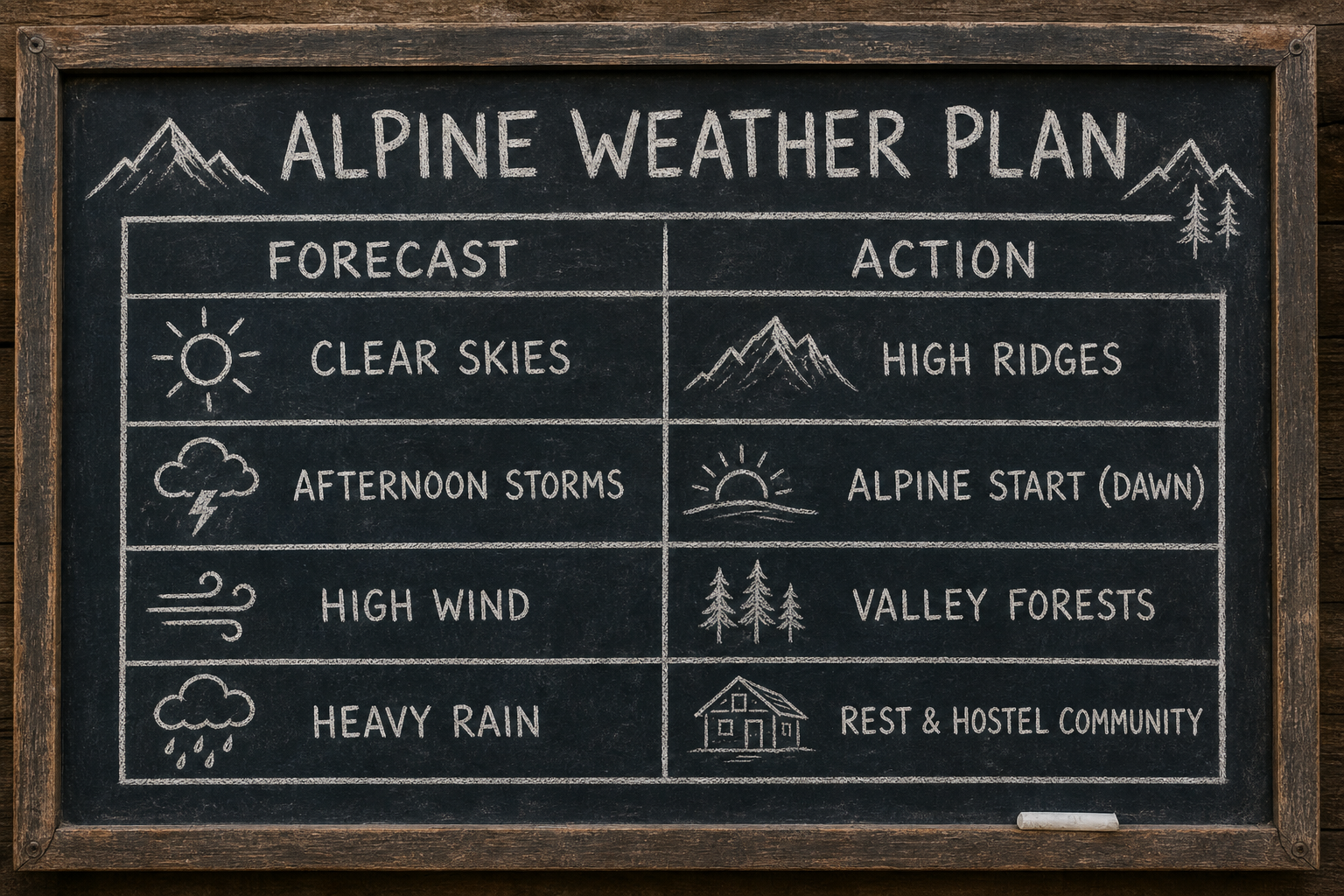
Skip the exposed ridges and summit attempts. Instead, focus on lower-elevation trails through the pine forests or along the valley floor. This is a great time to explore the 5 Best Hiking Trails in Switzerland Near Mont Blanc.
Scenario B: Heavy Rain and Thunderstorms
If the mountains are entirely socked in, retreat to culture and food. Consider taking the train or driving over the border for a day trip. You can find excellent food and history in nearby Italian towns. If you are visiting in winter and high-altitude winds shut down the backcountry, you might pivot to resort skiing—read our guide on Which Swiss Ski Resort Fits a Backpacker’s Budget? or see if Skiing in the Italian Alps? Try This Aosta Day Trip fits your schedule.
Scenario C: Unstable Afternoon Forecast
Start early. Alpine starts (waking up at 3:00 AM or 4:00 AM) are not just for mountaineers. Starting a hike at dawn ensures you are off the high passes before the heat of the day triggers convective thunderstorms.
The Social Side of Waiting Out a Storm
Sometimes, the weather simply says “no.” When a massive low-pressure system parks itself over the Mont Blanc massif, it can rain for days.
This is where your choice of accommodation makes or breaks your trip. If you are isolated in a sterile, expensive hotel room, bad weather feels like a ruined vacation. But if you are staying in a community-driven lodge, bad weather days turn into some of the best memories of the trip.
At Ski Hostel, we view storm days as an opportunity. When the trails are flooded, the hostel transforms into an active hub. Guests gather in the shared spaces, remote workers log hours on the high-speed Wi-Fi, and volunteers organize communal dinners featuring hearty Brazilian-influenced cuisine. A rainy afternoon is perfect for a spa night, trading trail stories with international backpackers, or finding partners for your next trek. If you are curious why this atmosphere is so appealing, read Hotels in Swiss Mountains? Why Social Lodges Beat Luxury.
Community also plays a huge role in safety. Having a network of experienced guides and fellow hikers to discuss the weather models with over coffee is infinitely better than staring at your phone in isolation. Whether you are finding the right mountain bike group for alpine trails or seeking partners for guided hiking in Switzerland, a social hub provides a built-in safety net.
Expert Tips for Budget-Conscious Hikers
If you are planning your 2026 trip on a budget, the weather can impact your wallet just as much as your itinerary.
- Book Flexible Huts: If you are planning a multi-day trek like the TMB or exploring the Val de Bagnes region, thoroughly understand the cancellation policies of the mountain refuges. See our tips on How to Plan Hut to Hut Hiking in Switzerland to manage logistics without losing your deposit.
- Avoid Cable Car Roulette: High-altitude cable cars like the Aiguille du Midi are expensive. If you buy a ticket on a cloudy day hoping it will clear up, you are gambling. Check the 10-day weather forecast for Chamonix-Mont-Blanc before making expensive reservations.
- Hike Smart, Hike Cheap: You do not need a luxury budget to enjoy the Alps safely. Focus on free trails, public transport, and social hostels. For more details, check out 7 Tips for Hiking in Switzerland (Without the High Cost) and learn about Mountain Mont Blanc: 7 Ways to Visit Without the Crowd.
Frequently Asked Questions
What’s the best time of day to check the mountain weather?
Check the forecast the night before your hike to plan your start time, but always check it again at 5:00 AM before you leave. Mountain weather models update frequently, and overnight data can shift the timing of a storm by several hours.
How accurate are 10-day forecasts in the Alps?
A 10-day forecast is useful for spotting major trends—like a massive high-pressure system or a prolonged rainy period. However, for pinpointing specific storm timings, wind speeds, and cloud cover, you should only trust a 48-hour window. Look at the AccuWeather Chamonix forecast for general trends, but rely on specialized local bulletins for immediate planning.
Does it snow on Mont Blanc in the summer?
Yes. Above 3,500 meters, precipitation falls as snow year-round. Even at 2,500 meters, a summer cold front can easily dump 15 centimeters of snow overnight.
Is the weather different on the Italian side of Mont Blanc?
Yes, drastically. The massif blocks weather systems. It can be raining heavily in Chamonix (France) while Courmayeur (Italy) enjoys bright sunshine, or vice versa. Always check the forecast for the specific valley you intend to hike in.
Taking the time to respect the environment and understand the forces at play will ensure that your 2026 mountain adventure is memorable for all the right reasons. Prepare for the worst, pack smart, and stay flexible, and the Alps will reward you with some of the best hiking in the world.