Mont Blanc: Is It the Tallest Mountain in Europe?
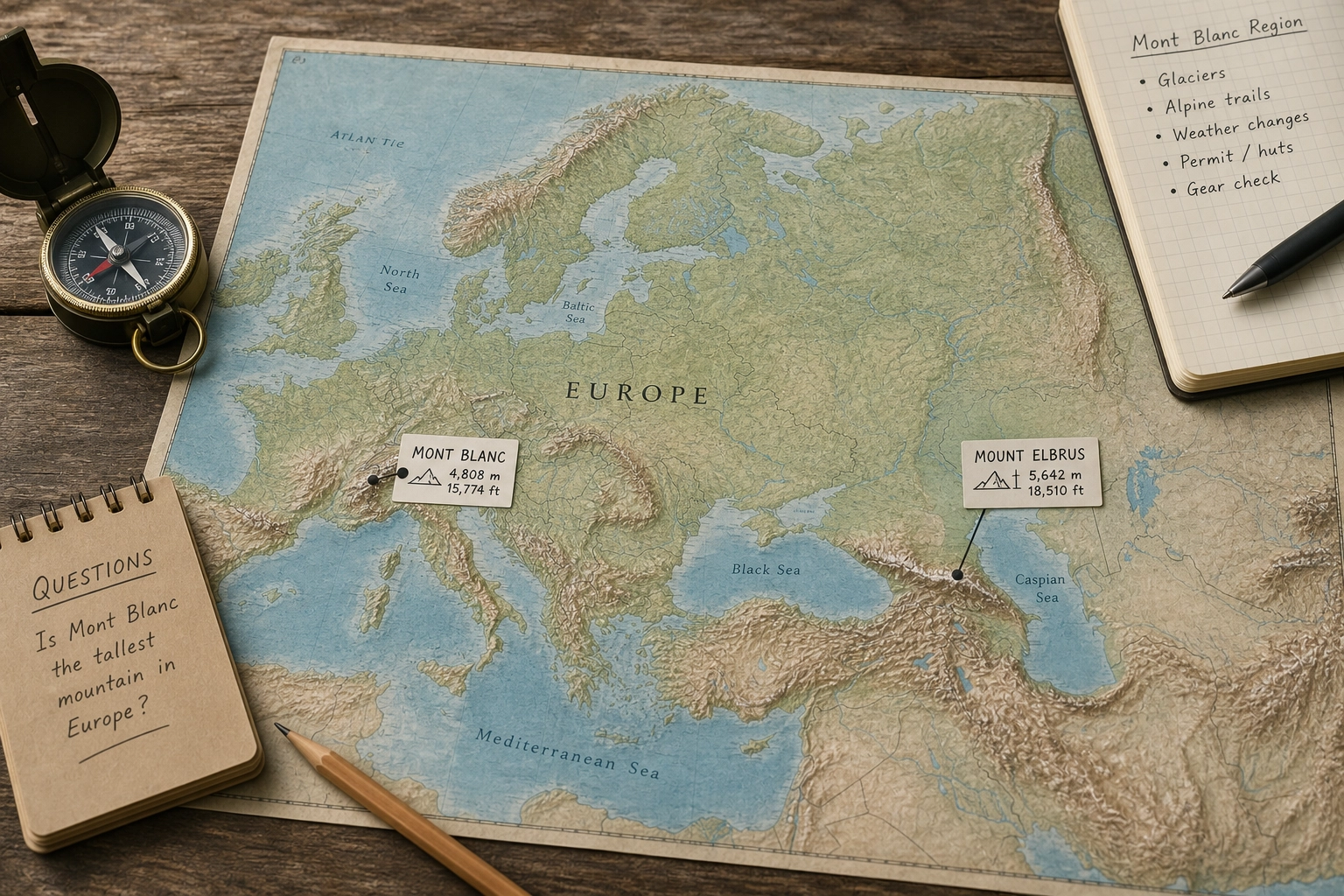
Stand in the streets of Chamonix, crane your neck upward, and you will see a massive dome of glacial ice towering over the valley. Mont Blanc commands the skyline with an authority that leaves little room for argument. It feels like the top of the world. But is it the top of Europe?
For decades, geography textbooks, mountaineers, and cartographers have engaged in a surprisingly fierce debate over this exact question. If you ask a French alpinist, the answer might be an unequivocal yes. If you ask an international peak-bagger aiming to complete the Seven Summits, the answer is usually no—that title belongs to Mount Elbrus in Russia.
Understanding why Mont Blanc is simultaneously recognized as the highest peak in Western Europe while losing the continental crown requires untangling centuries of shifting cartography, geopolitical borders, and the physical science of how mountains are actually measured.
For outdoor enthusiasts, digital nomads, and budget-conscious backpackers basing themselves in the Swiss Alps, the debate is largely academic. Whether it ranks first or second on a technicality, the Mont Blanc massif remains the most accessible, culturally rich, and infrastructurally supported alpine playground in the world.
Here is the definitive look at the Mont Blanc versus Mount Elbrus debate, how the “White Mountain” continues to change its height, and how you can experience this iconic region without breaking the bank or hiring a high-altitude expedition team.
The Great Geographical Debate: Mont Blanc vs. Mount Elbrus
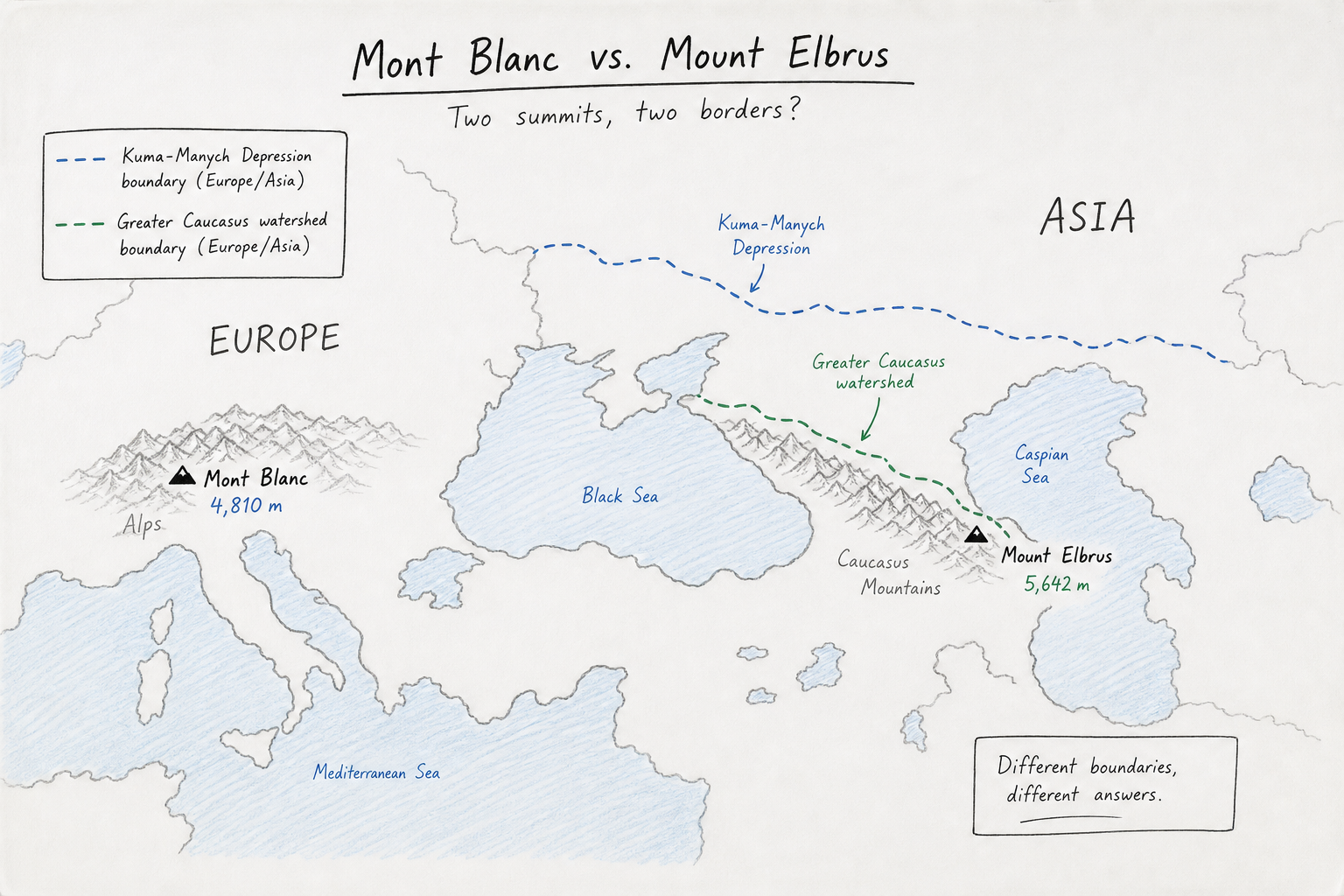
The confusion over Europe’s tallest mountain does not stem from a lack of accurate altimeters. We know exactly how tall both mountains are. The debate hinges entirely on an imaginary line: the continental boundary between Europe and Asia.
Unlike the clear oceanic borders that define continents like Australia or North America, Europe and Asia share a massive contiguous landmass known as Eurasia. Because there is no ocean dividing them, geographers have historically had to agree on arbitrary topographical features to draw the line.
The Two Competitors
| Feature | Mont Blanc | Mount Elbrus |
|---|---|---|
| Elevation | 4,805 meters (15,777 ft) | 5,642 meters (18,510 ft) |
| Mountain Range | The Alps | The Caucasus Mountains |
| Location | France / Italy border | Russia (near the Georgian border) |
| Geological Type | Crystalline rock uplift | Dormant double-coned volcano |
| First Ascent | 1786 | 1874 (West Peak) |
Where Does Europe Actually End?
The Ural Mountains in Russia universally serve as the eastern boundary between Europe and Asia. However, the southern boundary is where the controversy lies.
There are two primary ways geographers draw this southern border:
1. The Kuma-Manych Depression (The Historical Standard)
For centuries, many European cartographers used the Kuma-Manych Depression—a long, shallow basin located north of the Caucasus Mountains—as the official dividing line. If you accept this boundary, the entire Caucasus mountain range (including Mount Elbrus) sits firmly in Asia. Under this geographical model, Mont Blanc is the undisputed tallest mountain in Europe.
2. The Greater Caucasus Watershed (The Modern Standard)
In modern times, especially within the mountaineering community, the boundary is drawn along the watershed line of the Greater Caucasus mountain range. Because Mount Elbrus sits just north of this main watershed divide, it falls on the European side of the line. Consequently, Elbrus takes the title of Europe’s highest peak by a margin of over 800 meters.
Why Mount Elbrus Wins the “Seven Summits” Title
The argument was largely settled in the 1980s by the mountaineering community. The “Seven Summits” is a famous challenge that involves climbing the highest peak on every continent.
When Richard Bass first proposed the list, he included Mount Elbrus as the European representative. Later, legendary alpinist Reinhold Messner created a revised, more challenging list (swapping Australia’s Mount Kosciuszko for Indonesia’s Puncak Jaya), but Messner also kept Mount Elbrus as the highest peak in Europe.
Because the global climbing community universally adheres to the Messner or Bass lists, Mount Elbrus is recognized as the European champion. However, Mont Blanc securely retains its title as the highest mountain in the Alps, the highest in Western Europe, and the highest peak within the European Union.
Mont Blanc’s Changing Elevation: A Summit That Breathes
If you learned that Mont Blanc is 4,810 meters tall, your geography teacher was not wrong—they are just out of date.
Mont Blanc is a dynamic geological structure. Unlike mountains that end in a jagged spike of exposed rock (like the Matterhorn), the summit of Mont Blanc is covered by a permanent, highly exposed ice cap. This means the official height of the mountain fluctuates based on weather patterns, wind speeds, and snowfall.
The Rock vs. The Ice
Beneath the snowpack, the actual rocky summit of Mont Blanc is highly stable, sitting at precisely 4,792 meters. But the ice dome on top of that rock shifts and transforms.
Every two years, a specialized team of expert surveyors from the French department of Haute-Savoie embarks on an expedition to the summit. Armed with high-precision GNSS (Global Navigation Satellite System) antennas and climbing gear, they take exact measurements of the ice cap.
- In 2007: The mountain measured 4,810.90 meters.
- In 2017: It dropped to 4,808.72 meters.
- In 2021: It was recorded at 4,807.81 meters.
- In 2023: The official height was announced as 4,805.59 meters.
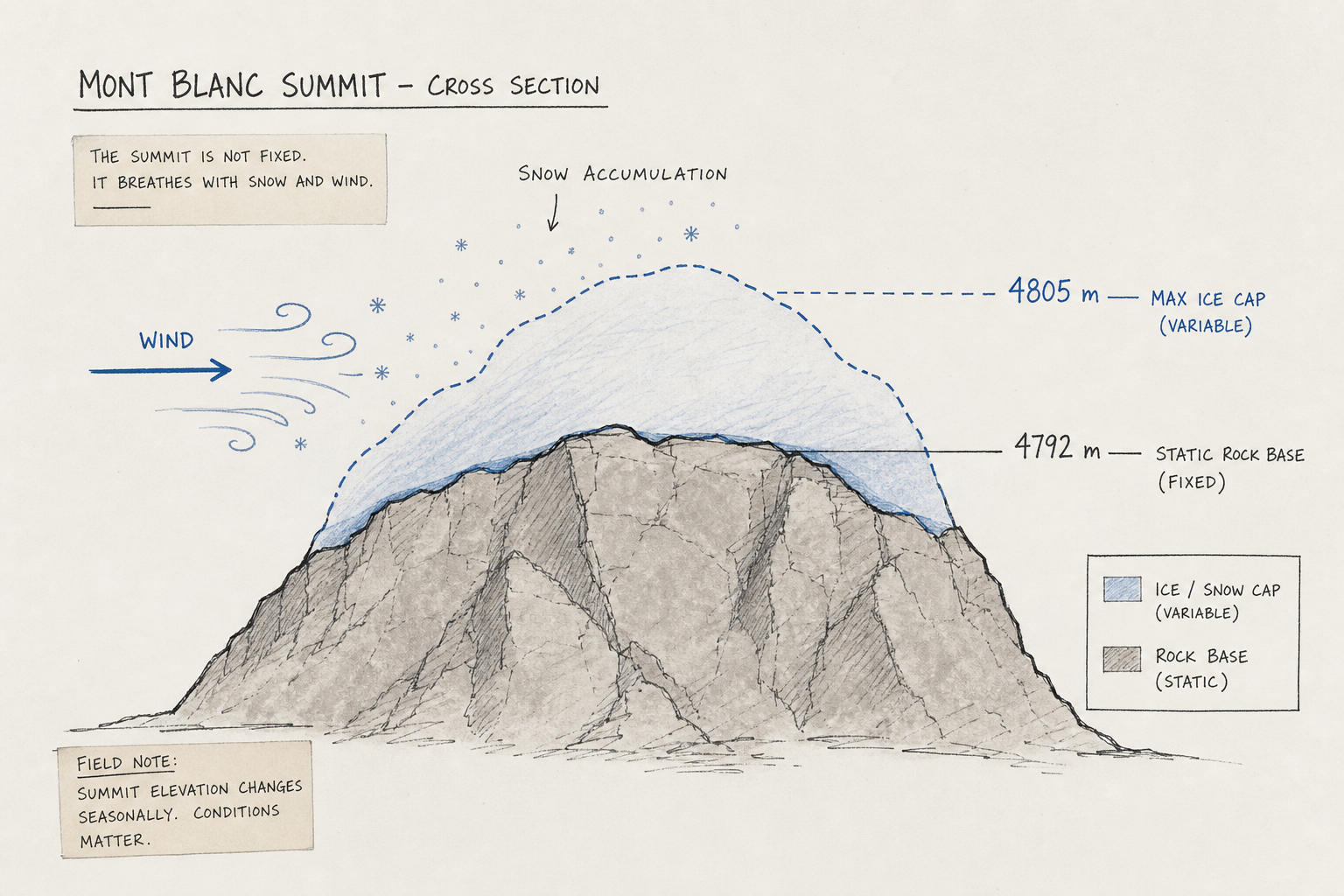
These variations are largely driven by summer winds and precipitation rather than global warming melting the summit directly. The temperature at 4,800 meters remains consistently below freezing year-round, so the ice dome acts more like a massive snowdrift that is reshaped by the violent alpine jet stream.
The Geopolitical Quirks: Who Actually Owns the Summit?
As if the continental boundary debate was not enough, Mont Blanc is the subject of an ongoing border dispute between France and Italy.
If you look at an official map printed by the French government, the border line between the two nations loops southward just before the summit, placing the highest point of Mont Blanc entirely within French territory. The nearby, slightly lower peak of Mont Blanc de Courmayeur is relegated to Italy.
If you look at an official map printed in Italy, the border follows the natural watershed ridge line directly over the main summit, meaning the highest point is shared equally by both countries.
This dispute traces back to the Treaty of Turin in 1860, when the Duchy of Savoy was annexed to France. The original map attached to the treaty supposedly showed a shared border, but subsequent French military maps altered the line. To this day, the dispute remains largely a matter of national pride rather than a source of actual conflict. Both French and Italian municipalities cooperate heavily on rescue operations, environmental preservation, and tourism.
Why the Alps Beat the Caucasus for Adventure Travelers
While Mount Elbrus might hold the geographical title, Mont Blanc is universally preferred by international backpackers, digital nomads, and outdoor enthusiasts.
Attempting to visit or climb Mount Elbrus requires securing a Russian visa, navigating complex logistics, and dealing with relatively sparse tourist infrastructure. The Mont Blanc massif, by contrast, sits at the heart of the most well-developed alpine network in the world.
You do not need to be a technical alpinist to experience the shadow of the White Mountain. The region is flanked by three distinct cultures (French, Italian, and Swiss) and offers an unmatched density of hiking trails, cable cars, mountain huts, and social adventure lodges.
For a deeper look at the logistical advantages of the region, read our guide on Mountain Mont Blanc: 7 Ways to Visit Without the Crowd.
The Basecamp Strategy: Rethinking Your Accommodation
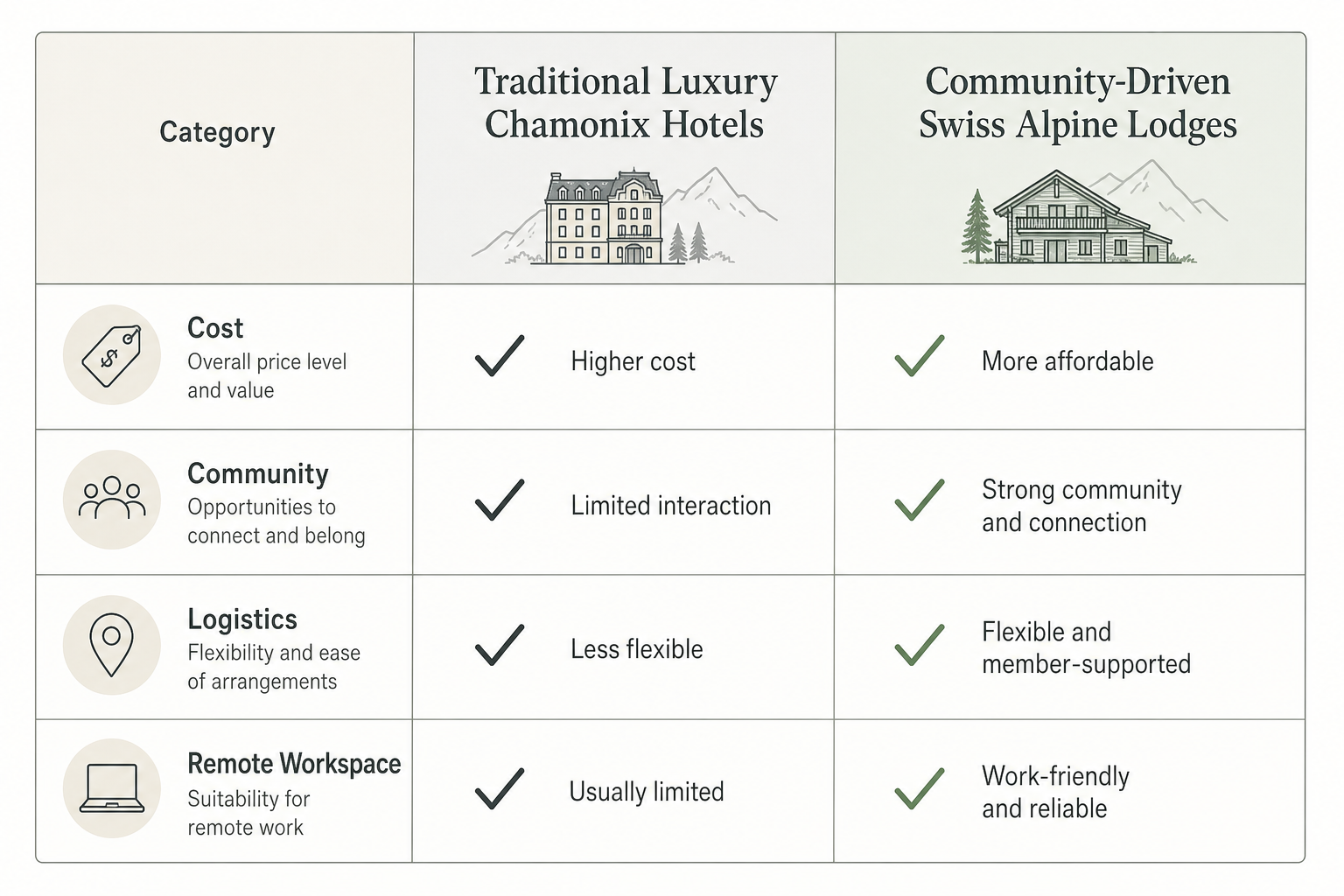
Chamonix, France, is the traditional gateway to Mont Blanc. However, its international fame comes with luxury-tier pricing, crowded streets, and an environment that caters heavily to high-end resort tourists.
For solo travelers, digital nomads, and budget-conscious hikers, a smarter approach is the “basecamp strategy.” Instead of paying a premium to sleep directly under the peak, you base yourself just across the border in the Swiss Alps—specifically in regions like Val de Bagnes (Liddes) or St. Stephan.
This is the core philosophy behind community-driven adventure lodges like Ski Hostel. By staying in a social lodge in the Swiss Alps, you gain:
- Affordable Access: Lower nightly rates compared to central Chamonix or Courmayeur.
- Built-In Community: Communal dinners, shared itineraries, and instant access to hiking partners—crucial for solo backpackers.
- Managed Logistics: Hosts arrange transport and unique border-crossing excursions, taking the headache out of navigating multiple countries’ train networks.
- Remote Work Infrastructure: Fast Wi-Fi and designated workspaces that traditional mountain refuges lack.
From a Swiss basecamp, you can take advantage of organized excursions. For example, Ski Hostel regularly coordinates day trips across the border. You can hike in Switzerland on Tuesday, take a Skiing in the Italian Alps? Try This Aosta Day Trip excursion on Thursday, and visit the Chamonix valley for a close-up of Mont Blanc on Saturday.
For more on why this model works for modern travelers, check out Hotels in Swiss Mountains? Why Social Lodges Beat Luxury and 7 Tips for Hiking in Switzerland (Without the High Cost).
Experiencing the Massif: Hiking, Biking, and Viewing
Summiting Mont Blanc requires crampons, ice axes, crevasse rescue training, and a willingness to brave the notorious “Grand Couloir” where rockfall is a constant threat. It is a serious mountaineering objective, not a hike.
However, the best views of a mountain are rarely from its own summit. The surrounding valleys offer world-class ways to experience the scale of the Alps without roping up.
The Tour du Mont Blanc (TMB)
The Tour du Mont Blanc is arguably the most famous long-distance trek in Europe. Circumnavigating the entire massif, the trail covers roughly 170 kilometers (105 miles) and passes through France, Italy, and Switzerland.
The trek typically takes 9 to 11 days and involves around 10,000 meters of cumulative elevation gain. Hikers sleep in mountain refuges (huts) along the way, eating communal meals of polenta, cheese, and stew.
If you don’t have 11 days to spare, you can hike individual stages of the TMB as day trips from your basecamp. The Swiss sections—particularly around Champex-Lac and La Fouly—are notoriously beautiful and slightly less crowded than the French stages.
For advice on navigating alpine hut systems, see How to Plan Hut to Hut Hiking in Switzerland (7 Tips).
Accessible Viewpoints and Cable Cars
If your goal is to get as close to the summit as possible without breaking a sweat, the region boasts incredible alpine engineering:
- Aiguille du Midi (France): A two-stage cable car from Chamonix lifts you to an astonishing 3,842 meters. From the viewing platforms, Mont Blanc feels close enough to touch. The altitude up here is severe, and visitors routinely feel lightheaded simply walking up the stairs.
- Skyway Monte Bianco (Italy): Departing from Courmayeur, this rotating cable car takes you to Pointe Helbronner (3,466 meters) on the Italian side of the massif. It offers a spectacular, wilder view of the mountain’s southern face.
Day Hikes in the Swiss Valleys
For those wanting active outdoor days without the crowds of the TMB, the Swiss valleys surrounding the Mont Blanc region offer endless terrain. From your base in Val de Bagnes, you can access over 250 kilometers of marked trails.
Whether you are looking for a steep ascent to an alpine lake or a gentle traverse through cow pastures, the trail infrastructure is impeccable. Discover some of our favorites in 5 Best Hiking Trails in Switzerland Near Mont Blanc.
Mountain biking is equally dominant here. The steep topography demands respect, but the proliferation of e-bikes has opened up high-altitude trails to intermediate riders. Joining a group makes navigating the expansive trail networks much safer and more enjoyable. Learn how to Find the Right Mountain Bike Group for Alpine Trails.
Preparing for High-Altitude Alpine Environments
The Alps demand respect, even in the middle of July. When you are hiking near Mont Blanc, you are routinely moving at elevations between 2,000 and 3,000 meters.
The Reality of Alpine Weather
The Mont Blanc massif creates its own microclimate. It acts as a massive barrier to weather fronts moving across Europe. A morning that starts with cloudless blue skies can violently pivot into a dangerous afternoon thunderstorm with plunging temperatures and hail.
Hikers who only check the valley weather forecast frequently find themselves underprepared when they reach a high mountain pass.
Essential Gear for Alpine Basecamps
Packing for an alpine summer requires a strict adherence to the layering system. You need to be prepared for 25°C (77°F) heat in the valley and near-freezing windchill at the high passes.
Your daily pack should always include:
- A hard-shell jacket: Fully waterproof and windproof, not just water-resistant.
- An insulating mid-layer: A lightweight down jacket or fleece.
- Proper footwear: Stiff-soled trail runners or light hiking boots with deep lugs for mud and scree.
- Trekking poles: Essential for saving your knees on 1,000-meter descents.
- Hydration and calories: At least 2 liters of water and high-energy snacks. The dry mountain air masks how much you are sweating.
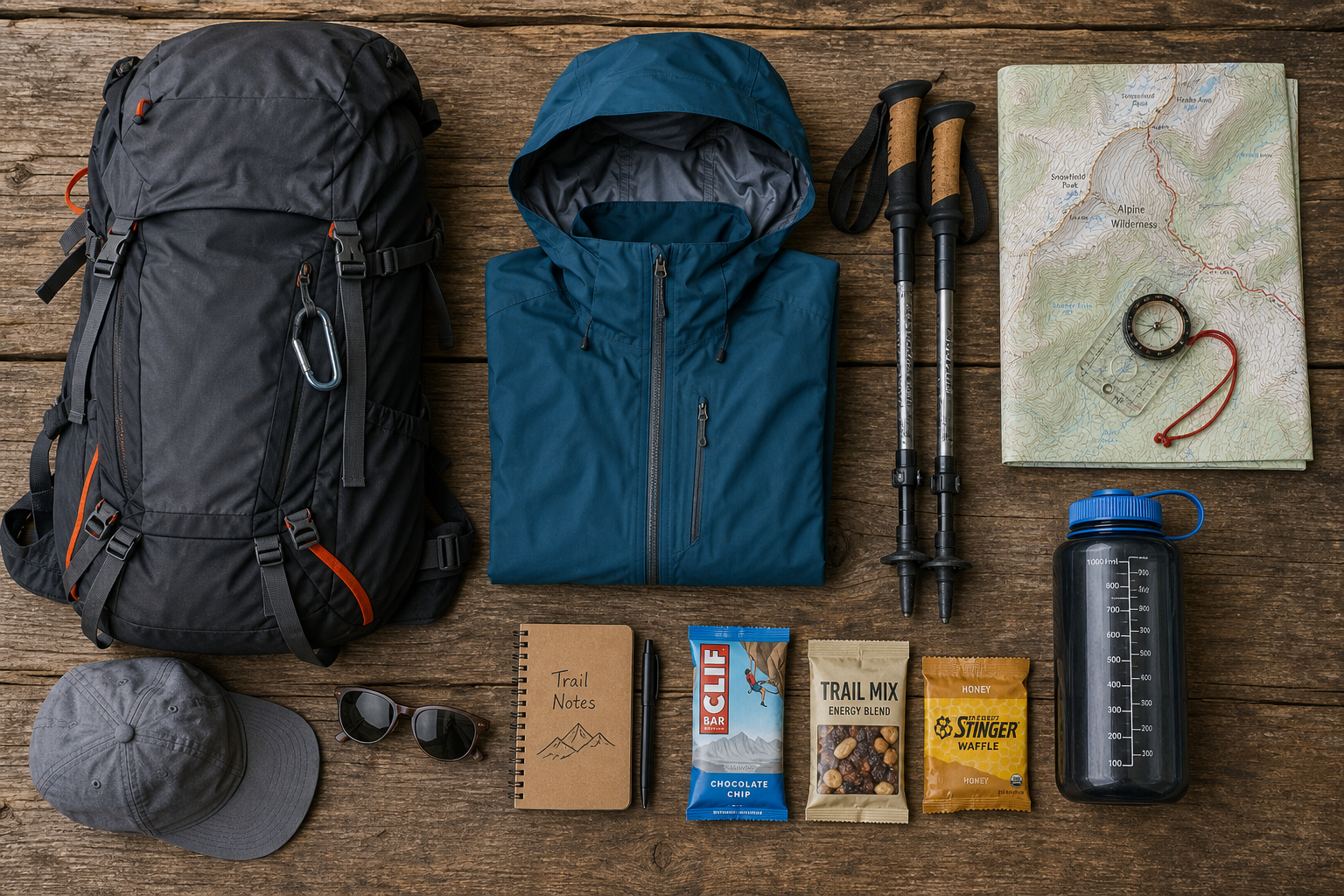
For a comprehensive breakdown of what to put in your bag before flying to Geneva or Zurich, read Swiss Alps Summer: A Simple 5-Step Packing Guide.
Managing Altitude
Altitude sickness is rarely life-threatening on standard hiking trails, but it can easily ruin your day. Above 2,500 meters, the air is noticeably thinner.
- Hydrate aggressively: Drink water before you feel thirsty.
- Pace yourself: A pace that feels slow at the trailhead will feel appropriate once you hit the steep switchbacks.
- Climb high, sleep low: The basecamp model inherently protects you. By hiking up to a high pass during the day and returning to a lower elevation lodge at night, your body acclimatizes efficiently while allowing you to recover properly.
Finding partners who match your pace is crucial for a safe experience. If you are traveling solo, staying at a community-focused lodge allows you to pair up with hikers of similar fitness levels. Read more about Guided Hiking in Switzerland: Finding Your Social Group.
Winter in the Shadow of the White Mountain
While summer brings hikers, winter completely transforms the Mont Blanc ecosystem. The snowpack buries the high hiking trails, and the region shifts into a freeride skiing mecca.
Skiing the famous Vallée Blanche in Chamonix—a 20-kilometer unmarked, unmaintained off-piste descent down a glacier—is a bucket-list objective for expert skiers. However, navigating the crevasses requires a certified high-mountain guide and specialized avalanche equipment.
For backpackers and budget travelers, standard resort skiing in the shadow of the massif is equally rewarding and far more accessible. By basing yourself at a social ski hostel in Switzerland, you bypass the exorbitant lift ticket prices of the mega-resorts while still accessing world-class alpine powder.
Our hosts handle gear rentals, coordinate group ski days, and arrange transport to the best snow conditions in the region. If you are planning a winter trip, evaluate your options with our guide: Which Swiss Ski Resort Fits a Backpacker’s Budget?.
Frequently Asked Questions About Mont Blanc
Can you see Mont Blanc from Switzerland?
Yes. While the summit itself sits on the France/Italy border, the massif is clearly visible from numerous high-altitude vantage points in the Swiss canton of Valais, particularly from peaks surrounding the Val de Bagnes region.
Is Mont Blanc a volcano like Mount Elbrus?
No. Mount Elbrus is a dormant double-coned volcano. Mont Blanc was formed by the collision of the African and Eurasian tectonic plates, which violently pushed deep crystalline granite upward to create the Alps. It is a solid rock uplift covered by glaciation.
How cold is it at the summit of Mont Blanc?
Even in the height of summer (July and August), temperatures at the 4,805-meter summit frequently range between -10°C and -20°C (14°F to -4°F), not factoring in windchill. The violent alpine jet stream can make the perceived temperature significantly colder, which is why proper mountaineering gear is mandatory.
Do I need a guide to hike near Mont Blanc?
To summit Mont Blanc, yes—a guide is strongly recommended unless you are a highly experienced alpinist. To hike the trails around Mont Blanc, such as the TMB or local Swiss trails, a guide is not strictly necessary if you have solid map-reading skills and mountain sense. However, joining a guided group from a social hostel greatly enhances safety and provides immediate camaraderie.
The Final Verdict
If you want to win a trivia night in a room full of cartographers and mountaineers, you must concede that Mount Elbrus is the tallest mountain in Europe. The arbitrary line dividing Europe and Asia dictates the final scoreboard.
But if your goal is not pedantry—if your goal is to experience the most dramatic, accessible, and culturally vibrant mountain environment on the continent—Mont Blanc holds the true crown.
The “Roof of the Alps” does not demand that you fly to a remote Russian territory or secure complex expedition permits. It simply invites you to lace up your boots, join a community of international travelers, and step onto the trail. Whether you are viewing it from a high-altitude cable car, navigating a mountain bike through a Swiss valley, or sharing a communal dinner after a long day of alpine hiking, the presence of Mont Blanc is an experience that Elbrus simply cannot replicate.