Where to Stay in Switzerland for Hiking (Near 250km Trails)
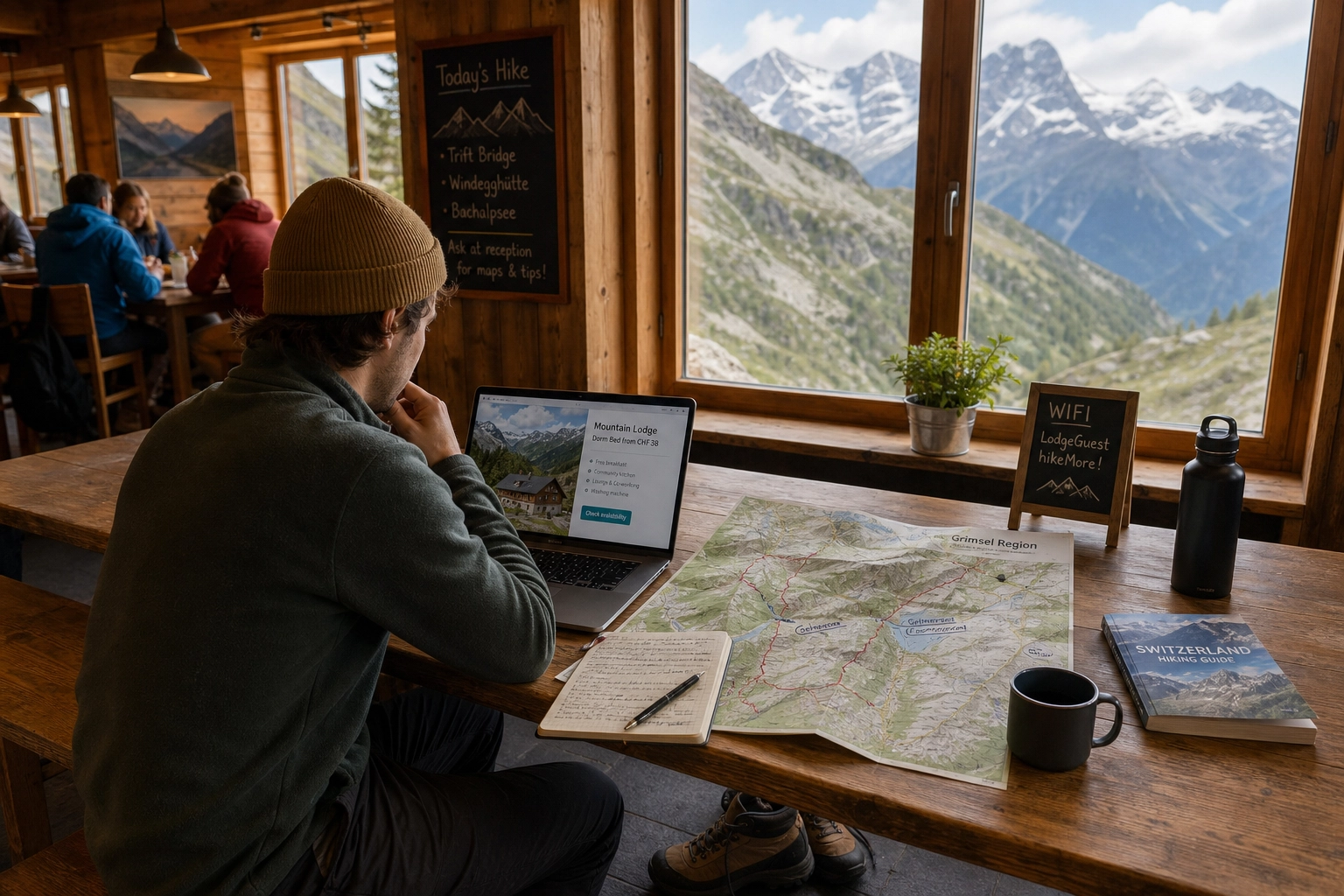
Most hikers planning a trip to the Swiss Alps make the exact same mistake: they book a luxury hotel in an ultra-famous, crowded resort town, spend half their travel budget on cable cars and expensive dinners, and end up hiking in a literal conga line of tourists.
Switzerland is arguably the greatest hiking destination on the planet, boasting over 65,000 kilometers of marked trails. But navigating where to set up your basecamp can be overwhelming. If you get it wrong, you’ll spend more time looking at train schedules than mountain peaks.
For solo travelers, digital nomads, and budget-conscious adventurers, the traditional Swiss hotel model often falls short. It lacks community, charges premium rates for basic amenities, and rarely offers logistical support for actual trail running or peak bagging.
Instead, a new wave of hikers is turning toward social, community-driven adventure lodges in strategic, slightly off-the-radar valleys—like Liddes, St. Stephan, and the Val de Bagnes region. These hubs offer direct access to massive 250-kilometer trail networks, home-cooked meals, and a built-in crew of international backpackers ready to hit the mountains.
In this comprehensive guide, we will break down exactly where to stay in Switzerland for hiking, how to choose between the famous regions and the hidden gems, and why your choice of basecamp matters more than your daily itinerary.
Why Your Basecamp Strategy Makes or Breaks Your Trip
When people visit Switzerland mostly to hike, they quickly realize that alpine logistics are complex. According to discussions in communities like this Reddit thread on hiking in Switzerland, travelers consistently underestimate the time and cost required to travel between valleys.
Switzerland’s geography means that moving from one famous peak to another often requires descending all the way to a valley floor, taking a train around a massive mountain range, and ascending the other side.
The Hub-and-Spoke Method vs. Constant Relocation
There are generally three ways to structure a Swiss hiking trip:
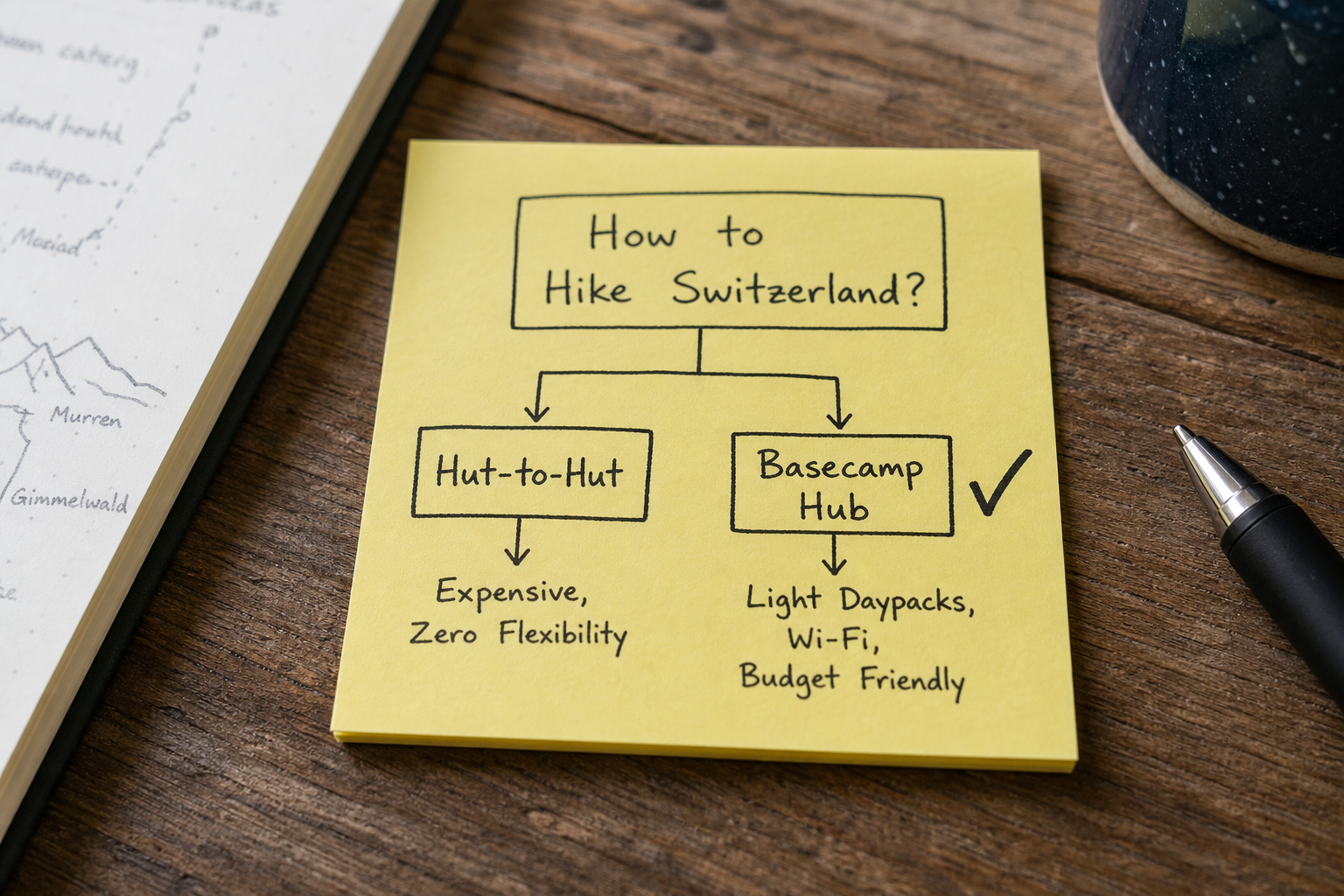
- The Nomadic Approach (Moving Every Night): You book a different hotel or hostel in a new town every day. The Reality: You lose 3-4 hours daily packing, checking out, navigating transit, and checking in. It is exhausting and highly inefficient.
- The Hut-to-Hut Approach: You hike between high-altitude Swiss Alpine Club (SAC) huts. The Reality: Incredible experience, but requires booking months in advance, carrying all your gear on your back, and offers zero flexibility for bad weather.
- The Hub-and-Spoke Approach (The Basecamp): You stay in one highly connected, strategic location for 5 to 14 days and take day trips to different trailheads. The Reality: You hike with a light daypack, have a warm bed every night, save money on weekly accommodation rates, and can pivot your plans if a storm rolls in.
For the vast majority of hikers—especially remote workers who need reliable Wi-Fi or solo travelers looking to make friends—the Hub-and-Spoke method is superior. If you want to learn more about keeping your budget intact while using this method, read our guide on 7 Tips for Hiking in Switzerland (Without the High Cost).
Decoding the 4 Major Swiss Hiking Regions
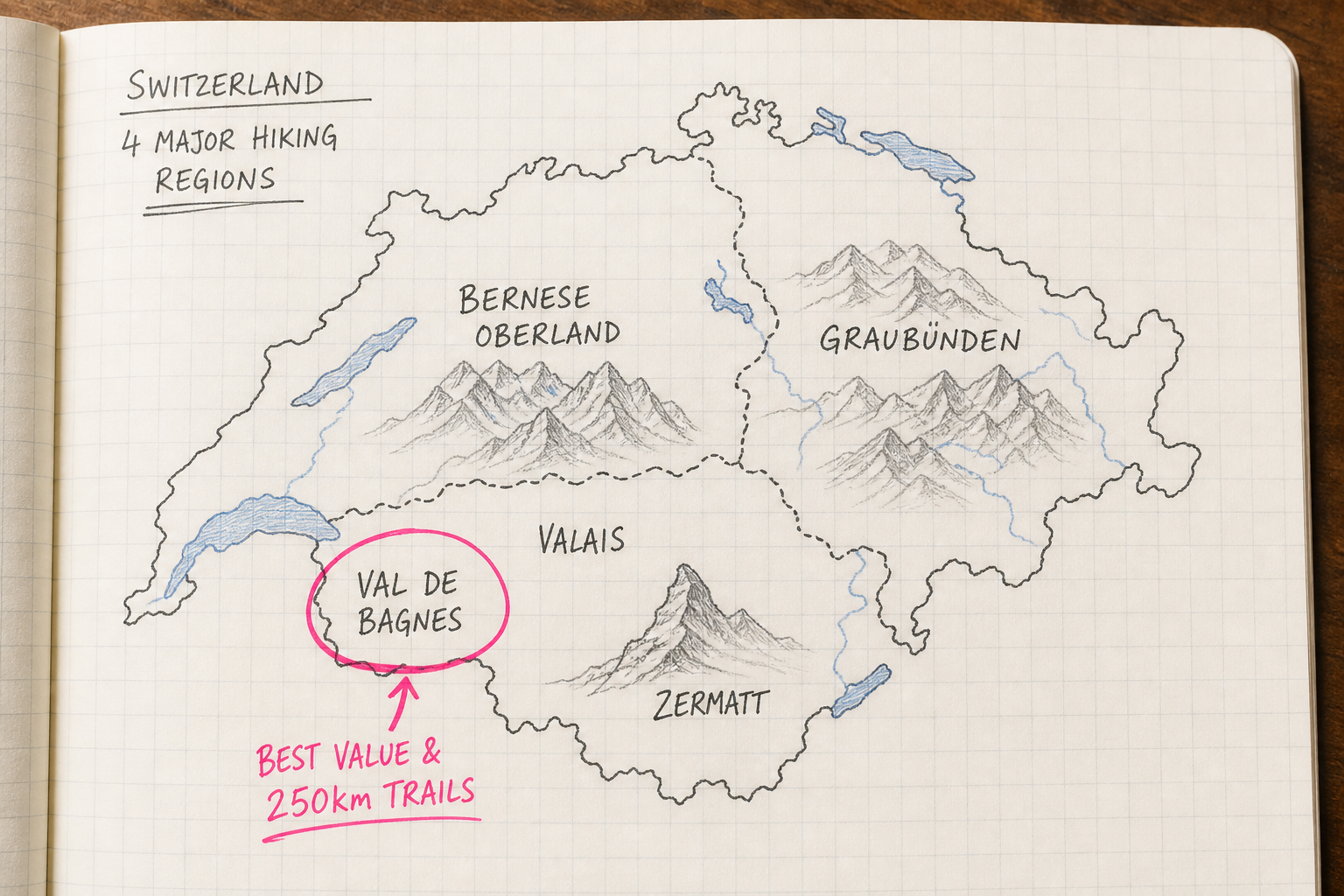
When researching where to stay, you will quickly notice that Switzerland’s mountains are divided into distinct regions, each with its own micro-culture, price point, and trail style. Understanding these is the first step to picking your base.
1. The Bernese Oberland (Jungfrau Region)
- The Vibe: Postcard-perfect, extremely famous, highly touristed.
- Famous Sights: Grindelwald, Lauterbrunnen, the Eiger, Mönch, and Jungfrau peaks.
- The Reality for Hikers: It is undeniably beautiful, but it comes at a steep premium. Trail traffic is heavy, and accommodation leans heavily toward luxury. If you are looking for a Relais & Châteaux itinerary for hiking the Swiss Alps, this is where you go. If you are a backpacker, you might find yourself priced out of a simple dinner.
2. Graubünden (The East)
- The Vibe: Remote, expansive, culturally distinct (Romansh speaking).
- Famous Sights: Swiss National Park, St. Moritz, Davos.
- The Reality for Hikers: Excellent for experienced hikers wanting serious isolation. However, transit connections back to major hubs like Geneva or Chamonix are long, making it tougher for a shorter trip.
3. Zermatt and the Matterhorn
- The Vibe: Iconic, dramatic, high-altitude luxury.
- Famous Sights: The Matterhorn, Gornergrat.
- The Reality for Hikers: You must see the Matterhorn once in your life, but basing yourself in Zermatt for two weeks will drain your bank account rapidly. It’s better suited for a 2-day excursion than a long-term basecamp.
4. Valais / Val de Bagnes (The Smart Basecamp)
- The Vibe: Authentic, sprawling, adventurer-focused, borders Italy and France.
- Famous Sights: Mont Blanc Massif, Grand Combin, Verbier.
- The Reality for Hikers: This is the sweet spot. Regions like Liddes, St. Stephan, and the Val de Bagnes offer the same dramatic 4,000-meter peaks as Zermatt and Jungfrau, but maintain a rugged, accessible charm. This region is home to sprawling 250-kilometer trail networks and is the epicenter of mountain sports.
When seasoned outdoor enthusiasts ask about a budget-friendly home base in Switzerland for scenic hikes, the Valais region consistently ranks at the top due to its lower cost of living, massive trail accessibility, and sunny microclimate.
Traditional Hotels vs. Social Mountain Lodges
If you search for the best regions for a hiking base, you’ll find plenty of traditional accommodation options. But where you stay dictates how you experience the mountains.
Most traditional Swiss hotels are designed for privacy and luxury. You check in, you keep to yourself, you eat at your private table, and you hike alone.
For the modern traveler—especially solo backpackers, digital nomads, and younger families—this model feels isolated and overpriced. If you look at standard Switzerland Hiking Hotels on Tripadvisor, you’ll routinely see prices exceeding 250 CHF per night for a basic room, with zero logistical support for your actual hike.
The Rise of the Adventure Lodge (The Ski Hostel Model)
Adventure hospitality is shifting the paradigm. Lodges like Ski Hostel, located in Liddes and St. Stephan, operate entirely differently. They function as community-driven hubs designed specifically for outdoor enthusiasts.
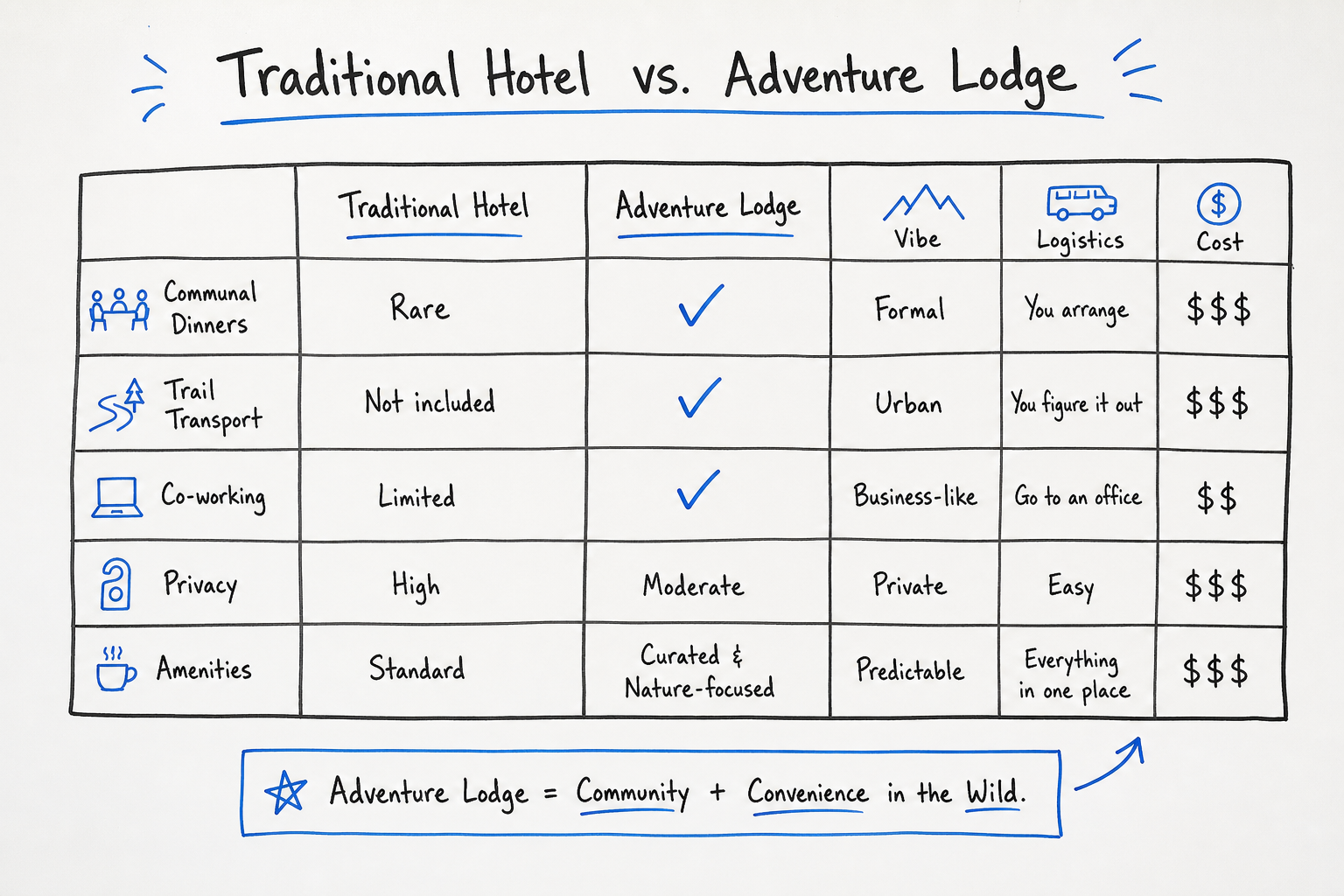
Here is how a social mountain lodge compares to a traditional hotel:
| Feature | Traditional Swiss Hotel | Social Adventure Lodge (Ski Hostel) |
|---|---|---|
| Atmosphere | Formal, private, quiet. | Communal, "home away from home", social. |
| Demographic | Older couples, luxury tourists. | Solo travelers, digital nomads, outdoor enthusiasts. |
| Dining | Expensive, formal restaurant dining. | Communal home-cooked dinners (e.g., Brazilian-influenced cuisine), BBQ gatherings. |
| Logistics | Concierge hands you a paper map. | Host and volunteers manage gear rental, group itineraries, and trail transport. |
| Pricing | High nightly rate, everything is an extra fee. | Budget-friendly, often offering all-inclusive summer/winter packages. |
| Remote Work | Spotty room Wi-Fi, no working culture. | High-speed Wi-Fi, shared co-working spaces designed for digital nomads. |
If you are tired of sterile luxury and want to meet people who actually want to hit the trails at 7:00 AM, read our breakdown on Hotels in Swiss Mountains? Why Social Lodges Beat Luxury.
Spotlight on Liddes and St. Stephan: The Ultimate 250km Trail Hubs
If you want to maximize your time on the trail and minimize your time on a train, Liddes and St. Stephan are two of the most strategic locations you can choose.
Nestled in the heart of the Swiss Alps, these areas serve as gateways to some of the most dramatic landscapes in Europe, offering direct access to over 250 kilometers of interconnected hiking and mountain biking trails.
1. The Val de Bagnes and Liddes Connectivity
Liddes is situated perfectly on the route up to the Great St. Bernard Pass. It is quiet enough to feel like a true alpine retreat, yet connected enough to allow you to explore a massive variety of terrain.
From here, you aren’t just limited to one valley. You can access deep gorge walks, high-altitude ridgelines, and glacial moraines all within a short distance. This is why Liddes functions so well as a hub for both guided hiking in Switzerland and finding your social group. You have options for every skill level, from casual meadow walkers to hardcore alpinists.
2. Proximity to the Mont Blanc Massif
One of the greatest advantages of staying in this specific region is the proximity to Mont Blanc. While staying directly in Chamonix (France) can be wildly expensive and overcrowded during the summer months, basing yourself on the Swiss side gives you the best of both worlds.
From your basecamp, you can easily access the trails that look back at the Mont Blanc massif. For a deeper dive into accessing this iconic peak without the massive tourist buses, check out Mountain Mont Blanc: 7 Ways to Visit Without the Crowd.
3. A Multi-Sport Environment
While you might be coming primarily for the hiking, staying near a 250km trail network means you are also in the heart of mountain biking territory.
Social lodges often cater to multi-sport days. If your legs are shot from three days of steep ascents, you can switch gears, rent a mountain bike, and take advantage of the rolling valley trails. Interested in switching it up? Read our guide to finding the right mountain bike group for alpine trails.
Hut-to-Hut Trekking vs. The All-Inclusive Basecamp
Many hikers dream of doing a classic Swiss hut-to-hut trek. And it is a spectacular experience. As outlined by resources like Wander We Go’s guide to Hut Hiking, staying high in the alpine environment is magical.
However, it comes with severe logistical constraints:
- Availability: Popular huts book out 6-8 months in advance for the summer season.
- Weather Dependency: If a massive thunderstorm rolls in on day three of your trek, you are stuck. You cannot easily reroute or skip a day.
- Work Constraints: If you are a digital nomad, hut-to-hut is nearly impossible. Huts rarely have Wi-Fi, and charging devices is often restricted or costs extra.
The Basecamp Alternative
A lodge like Ski Hostel offers a hybrid solution that is far more forgiving.
You can leave your heavy laptop, extra clothes, and travel gear locked safely in your room. You can hike all day with a 15-liter daypack containing only water, snacks, and a rain shell. If the weather is terrible, you stay at the lodge, enjoy the spa night, catch up on work, or join a communal BBQ.
If you do want to experience a hut night, you can use the lodge as your launchpad, hike to a hut for one night, and return to your primary base the next day. For tips on managing this hybrid approach, read How to Plan Hut to Hut Hiking in Switzerland (7 Tips).
Understanding the Swiss Trail Signage System
When you base yourself near a massive 250km network, you need to know how to read the landscape. Switzerland uses a highly standardized, incredibly reliable trail marking system. Knowing this will help you plan your daily itineraries from the lodge.
The Yellow Signs (Wanderweg)
- What they are: Standard walking paths.
- Terrain: Paved roads, wide gravel paths, or smooth forest tracks.
- Footwear: Running shoes or light trail shoes are fine.
- Danger Level: Zero to none. Perfect for a casual rest-day stroll.
The Red-White-Red Signs (Bergwanderweg)
- What they are: Mountain trails.
- Terrain: Uneven, rocky, steep, and potentially exposed. These make up the vast majority of the 250km network around Liddes and Val de Bagnes.
- Footwear: Proper hiking boots or aggressive trail running shoes with good grip.
- Danger Level: Moderate. Requires sure-footedness and a head for heights in certain sections.
The Blue-White-Blue Signs (Alpinwanderweg)
- What they are: Alpine routes.
- Terrain: Crossing glaciers, scrambling over rock faces, snowfields. Often requires using hands or holding onto installed chains/cables.
- Footwear: Stiff alpine boots.
- Danger Level: High. Only for experienced, well-equipped hikers.
When you stay at a community-driven lodge, the hosts and volunteers will actively help you map out routes that match your specific skill level, ensuring you don’t accidentally wander onto a blue-white alpine route in your sneakers.
5 Standout Trail Experiences Near Your Basecamp
Having a massive trail network at your doorstep means variety. From a base in Liddes or St. Stephan, you can string together an itinerary that feels completely different every single day.
If you are building your hit list, here are the types of trails you can expect. For specific route names and GPS data, check our deep dive on the 5 Best Hiking Trails in Switzerland Near Mont Blanc.
1. The Glacial Moraine Ascent
Hike right up to the edge of the shrinking, yet still massive, Swiss glaciers. These trails usually start in lush green alpine meadows and slowly transition into stark, lunar-like rock landscapes. The contrast is unbelievable.
2. The Balcony Trails
Instead of hiking straight up a mountain and straight down, balcony trails involve taking a cable car or a shuttle to a high elevation, and then hiking horizontally along the side of the valley. This gives you 360-degree panoramic views of the Val de Bagnes with minimal elevation gain.
3. The Gorge and River Walks
Perfect for hotter days or days when the high peaks are shrouded in clouds. These trails weave through deep, shaded ravines, following roaring glacial meltwater rivers.
4. The Historic Pass Crossings
Walking the same routes used by Roman legions and medieval traders. The Great St. Bernard Pass is one of the most famous, featuring the historic hospice and, of course, the legendary St. Bernard dogs.
5. The Peak Bagger’s Summit
For the fit and acclimated, the region boasts numerous non-technical peaks ranging from 2,500 to 3,200 meters. These require a grueling early morning start but reward you with views that stretch all the way into France and Italy.
Border-Crossing Excursions: Italy and France
One of the most unique aspects of basing yourself in the Val de Bagnes or Liddes region is that you aren’t just confined to Switzerland.
The geography of this area means you are practically sitting on the border of three countries. A major differentiator of staying at an adventure lodge like Ski Hostel is that they organize and facilitate unique border-crossing excursions.
Aosta Valley, Italy
Just over the Great St. Bernard Pass lies the Aosta Valley in Italy. The transition is startling. You go from Swiss precision and architecture to rugged Italian charm, incredible espresso, and a completely different culinary scene.
While famous as a winter destination—as we highlight in Skiing in the Italian Alps? Try This Aosta Day Trip—Aosta is equally spectacular in the summer. Leaving the Swiss basecamp in the morning, hiking on the Italian side, eating a massive bowl of authentic pasta for lunch, and returning to Switzerland for an evening spa session is the ultimate alpine flex.
Chamonix, France
A short drive away lies Chamonix, the undeniable capital of world alpinism. It is a bustling, intense town sitting directly under the highest peak in Western Europe. Visiting Chamonix as a day trip from your quieter Swiss basecamp allows you to experience the awe-inspiring Aiguille du Midi cable car and the vibrant town energy without paying Chamonix’s exorbitant nightly accommodation rates.
Packing for a Swiss Alps Basecamp
When you utilize a central lodge rather than moving every day, your packing strategy changes significantly. You don’t need to stress about ultra-lightweight everything because you aren’t carrying your entire backpack every single day.
Instead, you can pack for comfort at the lodge and efficiency on the trail.
The Basecamp Packing Strategy
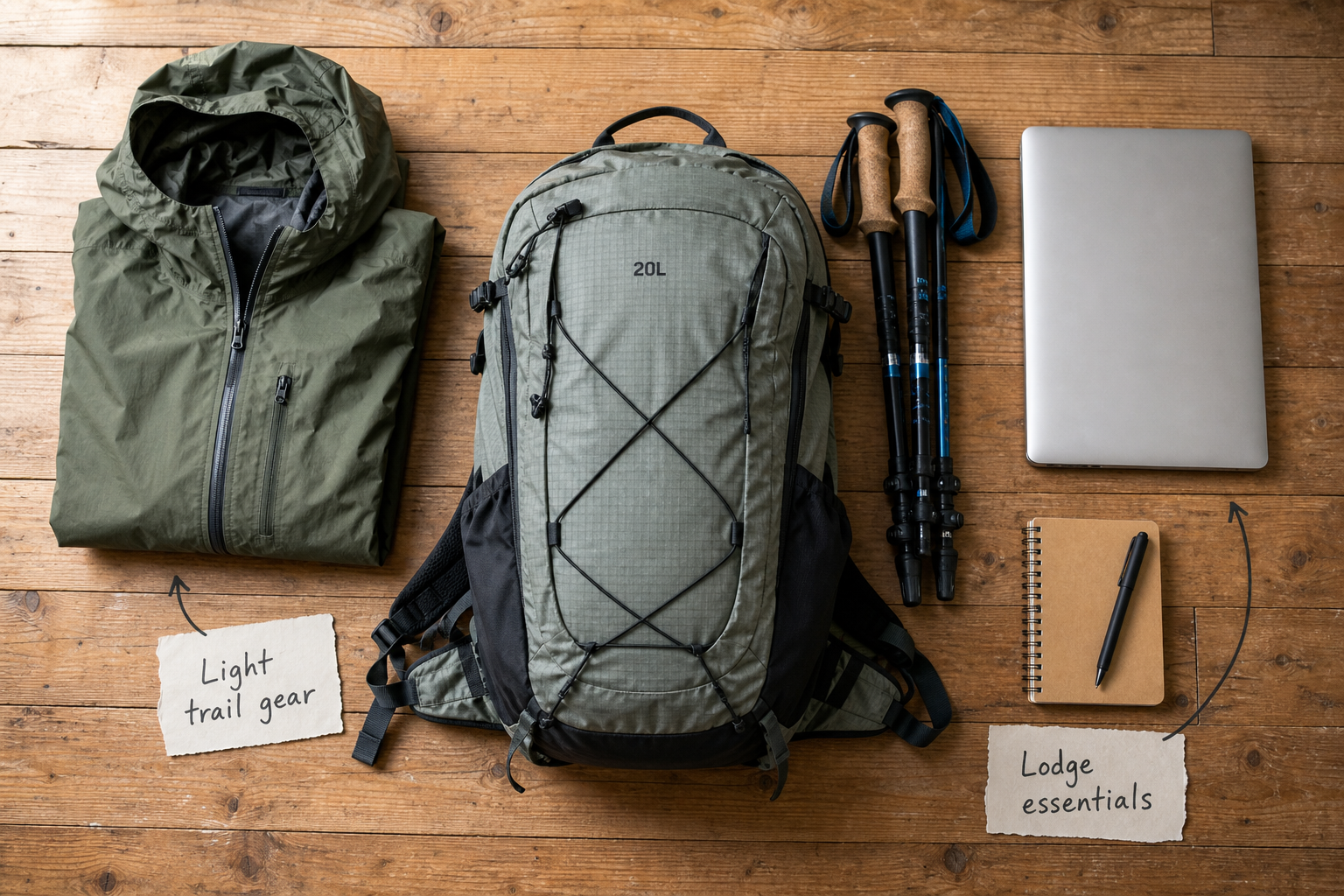
- For the Trail: A 15-25L daypack, a reliable Gore-Tex rain shell, a lightweight puffy jacket (even in July, peaks are cold), trekking poles, and sturdy trail runners or boots.
- For the Lodge: Comfortable clothes for communal dinners, a swimsuit for the spa/sauna, a laptop for the co-working space, and a good book.
- Gear Rental: One of the perks of an adventure lodge is gear rental. If you don’t want to fly with your bulky trekking poles or need specialized gear for a specific day, you can often rent it directly from the host.
For a complete breakdown of exactly what to put in your suitcase, review our Swiss Alps Summer: A Simple 5-Step Packing Guide.
Year-Round Potential: When Summer Ends
It is worth noting that the best summer hiking bases often double as the best winter bases. The infrastructure that supports a 250km hiking network in July is exactly what supports massive freeride ski terrain in February.
If you fall in love with the community vibe of your summer lodge, you’ll likely want to return when the snow falls. Because these lodges cater to backpackers and budget-conscious travelers year-round, you won’t have to suffer the sticker shock of standard winter rates.
If you are already curious about how this translates to winter, read Which Swiss Ski Resort Fits a Backpacker’s Budget?
FAQs: Staying in Switzerland for Hiking
Is it better to stay in one place or travel around Switzerland?
For hikers, staying in one highly-connected basecamp (the Hub-and-Spoke method) is almost always better. It saves you money, eliminates the daily stress of checking in and out of hotels, and allows you to hike without carrying a massive backpack.
How much does a hiking basecamp in Switzerland cost?
It varies wildly. A luxury hotel in Zermatt can easily cost 300-500 CHF per night. A bed in an adventure lodge or specialized ski/hiking hostel in a strategic region like Liddes will be a fraction of that cost, often including home-cooked communal meals and logistical support, making it incredibly budget-friendly.
Do I need a car to hike in Switzerland?
No. Switzerland has the most efficient public transportation network in the world. Trains, post buses, and cable cars connect almost every trailhead. Furthermore, adventure lodges often provide transport to various alpine resorts and trailheads as part of their community-driven model.
What makes an “Adventure Lodge” different from a normal hostel?
Traditional hostels are just cheap beds in a city. An adventure lodge is a curated experience. They are located directly in the mountains, cater specifically to outdoor enthusiasts, organize group itineraries, offer high-speed Wi-Fi for remote workers, and foster a tight-knit community through shared dinners and social events.
Conclusion: Finding Your Mountain Community
The mountains of Switzerland are majestic, but they can also be intimidating and expensive to navigate alone.
Choosing where to stay is about more than just finding a bed near a mountain; it’s about choosing the type of experience you want to have. If you prefer the quiet isolation of a luxury resort, the Bernese Oberland has plenty of options.
But if you want to swap stories over a communal BBQ, find a hiking partner for a tough ascent, knock out a few hours of remote work on high-speed Wi-Fi, and explore a pristine 250km trail network without draining your life savings, the choice is clear.
Regions like Liddes, St. Stephan, and the Val de Bagnes provide the ultimate playground. By choosing a community-driven adventure lodge, you aren’t just booking a room—you are securing a home away from home in the heart of the Swiss Alps.